
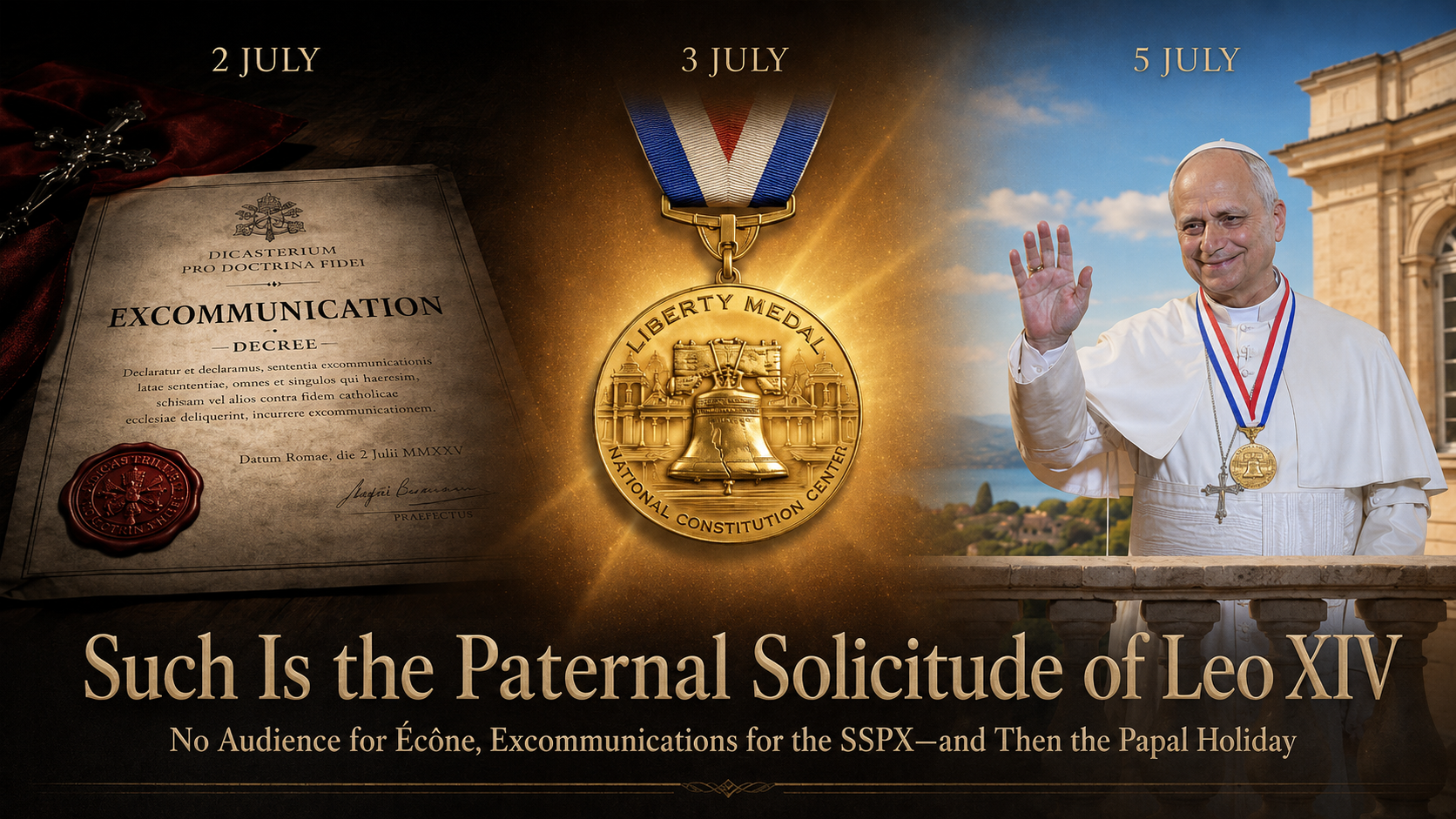
Such Is the Paternal Solicitude of Leo XIV:
No Audience for Écône, Excommunications for the SSPX—and Then the Papal Holiday
For five months, while the SSPX crisis advanced openly towards episcopal consecrations and excommunication, Leo XIV received politicians, footballers, brewers, Muslim representatives, Anglican and Orthodox delegations, bankers and assorted organisations. He did not receive Father Davide Pagliarani. During the same period, cardinals and bishops publicly questioned definitive teaching, announced programmes contrary to existing discipline, promoted practices rejected by Rome and blurred Catholic sacramental boundaries without comparable penalty. On 2 July, Rome issued its decree against the SSPX. On 3 July, Leo accepted a medal honouring his defence of conscience and religious liberty. On 5 July, he departed for more than three weeks at Castel Gandolfo.

On the evening of Sunday, 5 July, Pope Leo XIV arrived at Castel Gandolfo. Appearing briefly upon the balcony of the Apostolic Palace, he thanked the faithful gathered in the Piazza della Libertà and spoke of enjoying “a little rest, a little prayer, a little reading” and, he hoped, “a little sport”. He also emphasised the importance of coming together and thanked those assembled for being “brothers and sisters”. Leo will remain there until 27 July. During this period, general, private and special audiences are suspended.¹
There is nothing inherently objectionable in a Pope taking a holiday. The Roman summer is oppressive; the burdens of the papal office are immense; prayer, recreation and physical rest are legitimate human necessities. No serious criticism can rest merely upon the fact that Leo has gone to Castel Gandolfo.
The scandal is the chronology.
On 2 July, the Dicastery for the Doctrine of the Faith declared six bishops associated with the Society of Saint Pius X excommunicated following the episcopal consecrations at Écône on the previous day. Its accompanying explanatory note went considerably further, characterising the Society’s sacred ministers as schismatics, directing Catholics away from its celebrations and activities, and extending grave canonical claims to its priests and to faithful judged formally to adhere to it.²
Three days later, the Pope left Rome.
The sequence would be less disturbing had Leo spent the preceding months exhausting every personal means of averting the rupture. He did not. The Society announced on 2 February that episcopal consecrations would take place on 1 July. Its communiqué stated that Father Davide Pagliarani had already requested an audience with the Pope in August 2025 and had subsequently written again concerning the need to ensure the continuation of the Society’s episcopal ministry. On 12 February, the Superior General met Cardinal Víctor Manuel Fernández at the Dicastery for the Doctrine of the Faith, but not Leo. On 14 May, he addressed a formal Declaration of Catholic Faith to the Pope, presenting the Society’s position explicitly as a matter of conscience and professing its desire to live and be confirmed in the Roman Catholic Faith.³
Appeals for a pastoral settlement followed. The Holy See knew the date, the participants, the arguments and the likely consequences. Nothing arrived unexpectedly. Nothing was concealed. No sudden emergency overtook an unsuspecting pontificate. The crisis advanced for five months in full public view.
Leo allowed it to advance without granting the one audience that might have mattered.
Throughout those months, however, the Pope was not generally inaccessible. His official calendar records a steady procession of visitors. The doors of the Apostolic Palace were open—just not to Father Pagliarani.
On 27 April, Leo formally received Sarah Mullally as Archbishop of Canterbury. He welcomed her delegation, spoke warmly of friendship and ecumenical dialogue, and prayed with her in the Urban VIII Chapel. He urged Catholics and Anglicans to persevere in overcoming their divisions, however difficult those divisions might appear.⁴
The contrast is extraordinary. Leo found time to receive and pray with the female head of a communion separated from Rome for nearly five centuries and whose orders the Catholic Church judges invalid. He spoke of patience, friendship and perseverance in overcoming entrenched division. Yet the Superior General of a priestly society whose clergy profess the Catholic Creed, offer the traditional Roman Mass, recognise the Roman Pontiff and insist that they desire no separation from the Church could not obtain a personal hearing.
Centuries of separation merited encounter. Five months of an impending Catholic rupture did not.
The elasticity of the papal diary was demonstrated even more strikingly on 9 May. On that single day, Leo received the management and players of FC Internazionale Milano, representatives of the Edith-Wagner-Haberland Foundation and Augustiner Brewery, the Prime Minister of Haiti, representatives of the Muslim community in Senegal, members of the Italian Amyotrophic Lateral Sclerosis Association and the John Paul II Foundation for the Sahel.⁵
The point is not to disparage any of those visitors. It is to demonstrate how much the papal household could accommodate in one day when the Pope wished to receive people. Footballers, brewers, a head of government, Muslim representatives and charitable organisations could all be fitted into one crowded schedule. Yet across five months, no space could be found for Father Pagliarani.
The diary was not merely open. It was elastic. It could expand to receive half a dozen unrelated delegations in one day, but not to accommodate the audience that might have prevented the gravest rupture of Leo’s pontificate.
Leo was not inaccessible. He was selectively accessible.
The contradiction reached its climax on 30 June, the eve of the consecrations. That morning, Leo personally received a delegation from the Ecumenical Patriarchate of Constantinople. He spoke of fraternity, Christian witness, friendship and the common journey towards full unity. On the same day, the Holy See published his final letter to Father Pagliarani, pleading with him not to proceed and insisting that the Church remained open to dialogue.⁶
Open, apparently, provided that the dialogue remained correspondence.
The Orthodox delegation received the Pope’s person. Father Pagliarani received his letter.
The symbolism could scarcely be more damning. Leo spoke face to face with representatives of a body separated from Rome for almost a millennium while declining a face-to-face meeting with the man he believed was about to precipitate the gravest internal rupture of his own pontificate.
In his reply, Father Pagliarani thanked Leo for his “paternal solicitude”, but immediately identified what that solicitude had lacked: “For a long time, I had hoped to have the opportunity of meeting You in person.” That opportunity, he wrote, had not presented itself. He asked Leo to consider the sincerity of the Society’s intentions and insisted that it was not yet too late.⁷
It was not too late for the Pope to summon him, postpone another engagement, convene an emergency meeting, appoint mediators trusted by both parties, negotiate the number or identity of the bishops, explore a temporary mandate, or delay penal action while the claimed necessity was examined. None of these measures guaranteed agreement. The possibility of failure did not excuse the refusal to try.
Leo alone possessed the authority capable of converting a sterile exchange of warnings into direct negotiation. He alone could have placed the full moral and juridical weight of the Petrine office behind a final effort at reconciliation.
He did not do so.
The defence that Father Pagliarani had already determined to proceed merely compounds the problem. That claim cannot be demonstrated precisely because the decisive audience was never granted. Rome cannot refuse the conversation and then cite the imagined futility of that conversation as justification for refusing it.
Nor was a last-minute letter an adequate pastoral substitute. The Good Shepherd is not merely a correspondent. He does not observe the flock approaching a precipice, send a note on the eve of disaster and then declare his responsibility discharged when the sheep continue forward.
If Leo genuinely believed that bishops, hundreds of priests and a worldwide body of faithful were approaching formal separation from the Church, his duty to intervene personally was overwhelming. The more catastrophic Rome believed the consequences to be, the more indefensible the Pope’s distance becomes.
Either the danger was grave enough to justify the sweeping decree that followed, in which case the failure to grant an audience was pastoral negligence of the first order; or it was not grave enough to require the Pope’s personal intervention, in which case the severity of the decree becomes still harder to defend. Rome cannot have it both ways.
The disparity becomes more conspicuous when the SSPX affair is placed beside the public conduct of senior churchmen during the same five months. The cases are not canonically identical, and no serious argument should pretend otherwise. Episcopal consecration without pontifical mandate, doctrinal dissent, moral scandal, disciplinary resistance and sacramental confusion engage different canons and different questions of culpability.
The comparison concerns something broader: Roman priorities, pastoral urgency and the contemporary hierarchy’s radically unequal appetite for discipline.
In March, Cardinal Jean-Claude Hollerich publicly called for women’s access to ordained ministry. He said that he could not imagine how the Church could survive in the long term while half the People of God lacked such access. His remarks entered directly into the sacramental order, notwithstanding the definitive judgement of Ordinatio sacerdotalis that the Church possesses no authority to confer priestly ordination upon women and that this judgement must be held definitively by all the faithful.⁸
No ultimatum followed. No public demand for retraction was issued. No decree warned that the cardinal had placed himself in doctrinal rupture. Hollerich remained in full standing, free to present definitive Catholic teaching as an obstacle to the Church’s survival.
Also in March, Bishop Johan Bonny of Antwerp declared that the question of ordaining married men was “no longer whether” but when and by whom. He promised to make every effort to ordain married men for his diocese by 2028, to identify prospective candidates and to prepare them. He described the issue, significantly, as a matter of conscience.⁹
Bonny did not explicitly say that he would act without Rome. He proposed to communicate with the Belgian bishops and the Holy See during the intervening period. Nevertheless, he publicly announced a defined episcopal programme to alter the existing Latin discipline and invoked conscience in its support.
Rome did not denounce him as preparing a rupture. His appeal to conscience was permitted to enter a process of consultation and dialogue.
Conscience for Antwerp. Condemnation for Écône.
The contrast became sharper still in Vienna. Archbishop Josef Grünwidl, newly installed in one of Europe’s most prominent sees, told the Austrian bishops in March that “what comes from the Holy Spirit, canon law cannot stop”. He applied his appeal for renewal and change particularly to the role of women in the Church.¹⁰
The structure of the argument is strikingly similar to the Society’s own appeal. Grünwidl identified a higher spiritual imperative which, in his judgement, could not be restrained by positive ecclesiastical law. The SSPX invoked the preservation of the Faith, the priesthood and the salvation of souls against a canonical prohibition. Grünwidl’s appeal to the Holy Ghost against canonical restraint was treated as progressive pastoral reflection. The Society’s appeal to necessity was treated as rebellion.
When a progressive archbishop places what he discerns as the movement of the Spirit beyond the restraining power of canon law, Rome hears a contribution to synodality. When traditional Catholics appeal to the supreme law of the salvation of souls, Rome hears only disobedience.
On 18 April, Bishop Joseph Brennan of Fresno attended the Anglican consecration of Gregory Kimura. Public footage appeared to show the Catholic bishop standing among Anglican ministers during the laying-on of hands, prompting serious questions about whether his participation had exceeded that of a passive ecumenical observer. Brennan was not listed among the consecrating bishops, and that distinction must be acknowledged. His visible participation nevertheless risked obscuring the Catholic judgement concerning Anglican orders and the sacramental distinction a Catholic bishop is obliged to preserve.¹¹
No public disciplinary response followed. No explanatory note warned Catholics that the ceremony had blurred the doctrine of Holy Orders. No decree accused Brennan of compromising ecclesial communion.
A Catholic bishop could appear to participate in a rite purporting to confer an episcopal order Rome does not recognise, and the response was silence. The SSPX conferred episcopal orders whose sacramental validity Rome did not dispute, and the response was excommunication.
The legal categories differ. The contrast in urgency remains.
In Germany, bishops continued to promote formalised blessings for same-sex and other non-sacramental couples despite the Holy See’s stated opposition to ritualised forms capable of legitimising unions contrary to Catholic teaching. When Cardinal Pietro Parolin was asked whether sanctions might follow, he said it was premature even to discuss them and expressed the hope that they would never be necessary. Negotiation, he said, should seek a peaceful solution.¹²
Peaceful resolution for German bishops proceeding along a path Rome itself had rejected. Immediate penalties for traditional Catholics who pleaded that the Faith and priesthood were in danger.
Nor did comparable urgency follow when Cardinal Timothy Radcliffe preached at a Mass in London on 13 June marking fifty years of the friendship, partnership and shared public work of two men. Two retired Catholic bishops concelebrated. A prepared prayer was subsequently offered over the pair. Radcliffe later clarified that he had not known a blessing would occur and had not himself blessed anyone; that clarification must be recorded. It does not erase the public scandal of a cardinal and two bishops lending the solemnity of the Catholic altar to an event promoted as the anniversary celebration of a same-sex partnership.¹³
No decree followed. No public canonical investigation was announced. No warning was issued that clergy or faithful attending such celebrations might imperil their ecclesiastical communion.
These were not private remarks by obscure theologians. They involved cardinals, diocesan bishops and the Archbishop of Vienna. Their statements and actions touched Holy Orders, priestly discipline, marriage, sexual morality, sacramental theology, canon law and the authority of definitive teaching.
Yet Rome found no comparable urgency, no sweeping decree and no need to warn the faithful that association with these churchmen might endanger their communion with the Church.
For them, there was clarification, patience, negotiation—or silence.
For the SSPX, there was the machinery of punishment.
The contemporary hierarchy can tolerate almost any challenge to the Faith. What it cannot tolerate is a challenge to its power.
That is the hypocrisy exposed by the Écône affair. Doctrine may be questioned, morality obscured, sacramental boundaries blurred and canon law relativised, and the response will be dialogue. But let traditional Catholics act without permission in order to preserve what the Church herself possessed for centuries, and Rome suddenly rediscovers the virtues of authority, precision and immediate penalty.
The offence punished most swiftly was not public confusion concerning Holy Orders, marriage, sexual morality or definitive teaching. It was disobedience to the contemporary ecclesiastical establishment.
This reveals the contradiction beneath that establishment’s preferred self-presentation. It is intensely anxious to appear progressive: attentive to conscience, hostile to exclusion, suspicious of rigid authority and committed to listening, accompaniment, participation and decentralisation. It contrasts its supposedly pastoral methods with the juridicism and authoritarianism it attributes to the Church of former generations.
It speaks endlessly of dialogue. It reserves the right to decide who deserves it.
Those who challenge inherited Catholic teaching in the name of modernity are invited into consultation and discernment. Those who challenge modern ecclesiastical policy in the name of Tradition receive prohibitions, deadlines and penalties. Dissent against the Faith becomes a contribution to conversation. Resistance in defence of the Faith becomes contumacy.
Conscience is honoured when it supports progressive departure. It becomes suspect when it appeals to Tradition against the prevailing programme. Diversity is celebrated until it includes an uncompromising attachment to the doctrine, worship and discipline handed down by the Roman Church. “Rigidity” is condemned by men who display remarkable rigidity when enforcing their own revolution against it.
The pastoral language is soft. The administrative hand is iron.
This is managerial authoritarianism clothed in therapeutic language. It denounces clericalism while invoking the most maximalist conception of clerical power whenever traditional Catholics refuse to acquiesce. It praises decentralisation until a traditional community acts upon a judgement not approved at the centre. It offers accompaniment—but only towards a destination already chosen.
The faithful may discuss almost anything except whether the hierarchy’s own programme has produced the crisis they are experiencing.
The SSPX dispute reveals this contradiction because Rome did not principally answer the Society’s concerns about doctrine, liturgy, priesthood and the preservation of the Faith. It declared that the claimed necessity did not exist, demanded submission to that judgement and punished those who acted upon the contrary conclusion.
The hierarchy acted as interested party, prosecutor and judge. It determined that the crisis was insufficient, pronounced the Society’s conscience erroneous, refused its Superior General a personal hearing and then imposed the consequences of disobedience.
This was not discernment. It was predetermined judgement dressed in pastoral vocabulary.
Conscience, of course, does not create truth. It does not render every decision objectively right or absolve every violation of law. The Society’s judgement remained open to theological challenge and canonical adjudication.
But respect for conscience requires more than praising it in ceremonial speeches. It requires hearing those who invoke it, examining the grounds of their judgement, distinguishing sincerity from contempt and establishing personal culpability through procedures proportionate to the penalty contemplated.
A mistaken conscience may require correction. It does not merit dismissal. Nor may the hierarchy praise conscience as sacred when addressing the world and treat it as irrelevant when traditional Catholics appeal to it against the hierarchy itself.
The irony became almost grotesque on 3 July, the day after the decree was issued. Appearing virtually before the National Constitution Center in Philadelphia, Leo accepted its Liberty Medal. The award honoured his work promoting religious liberty and freedom of conscience and expression.¹⁴
In his acceptance address, Leo said that authentic freedom safeguards the interior sphere in which convictions are formed and conscience guides human decisions. He praised the religious liberty necessary to follow conscience without fear or coercion and defended the right of individuals, communities and associations to express their faith publicly.¹⁵
One could scarcely invent a more devastating contrast.
On 2 July, Rome asserted the gravest ecclesiastical consequences against bishops, priests and faithful whose actions were expressly defended as arising from a crisis of conscience concerning the preservation of the Catholic Faith and priesthood.
On 3 July, Leo accepted an international award for defending conscience.
On 5 July, he went on holiday.
The medal honoured the principle. The chronology exposed the hypocrisy.
A hierarchy sincerely committed to conscience need not have accepted the Society’s conclusions. It would, however, have heard its Superior General personally before imposing penalties of such magnitude. It would have distinguished formal schism from disobedience, examined subjective culpability and afforded the accused the procedural justice necessary to determine guilt.
Instead, Leo praised the sanctuary of conscience before an American audience after declining to enter that sanctuary pastorally when it belonged to traditional Catholics.
Conscience was sacred in Philadelphia. At Écône, it was obstinacy.
Bonny could invoke conscience in support of his programme and be offered years of consultation. Grünwidl could invoke the Holy Ghost against canonical restraint and be heard as a voice for renewal. German bishops could proceed against Rome’s stated judgement and be promised dialogue in the hope that sanctions would never become necessary. The SSPX could invoke conscience concerning the preservation of Tradition and receive an ultimatum.
The scene at Castel Gandolfo is therefore damaging not because the Pope smiled, desired recreation or sought legitimate rest. It is damaging because Leo spoke of gathering as brothers and sisters immediately after his government had treated a substantial body of his own spiritual children as schismatics without his having personally received their Superior General.
“Brothers and sisters” cannot be merely balcony rhetoric. Christian fraternity imposes duties. Paternal solicitude cannot consist in refusing a son an audience, warning him through intermediaries, waiting until the final hour, punishing him when he proceeds, accepting a medal for defending conscience and then suspending audiences for the summer.
The chronology has acquired the quality of satire, except that the consequences are tragically real.
Leo found room for footballers, brewers, politicians, Muslim representatives and charitable organisations in a single day. He found time for Anglican and Orthodox delegations across the following months. Rome found patience for Hollerich, Bonny, Grünwidl, Brennan, the German bishops and Radcliffe. Yet no publicly recorded audience was granted to the man whose reception might have prevented the gravest internal rupture of Leo’s pontificate.
This was not lack of opportunity. It was a choice.
Responsibility does not rest upon Rome alone. The SSPX must answer for its decisions and for whatever canonical consequences may legitimately follow. But the Roman Pontiff bears a unique responsibility for the unity of the Church. He possesses an authority—and therefore an obligation—that no priestly society possesses.
The greater his power to prevent rupture, the greater his accountability for failing to exhaust it.
Leo’s holiday does not prove personal indifference. He may be distressed. He may pray sincerely for reconciliation. But government is judged by acts, not by invisible sentiments. The visible record is one of repeated appeals for a meeting, months of audiences granted to others, doctrinal and sacramental scandals met with patience, a final letter sent at the eleventh hour, a sweeping decree, an award for defending conscience and then more than three weeks during which audiences are suspended.
Castel Gandolfo may provide Leo XIV with necessary rest. It should also provide him with an occasion for examination of conscience.
He should ask why ecumenical dialogue was available to Canterbury and Constantinople but not to Écône; why conscience was respected in Antwerp and praised in Philadelphia but condemned in Switzerland; why the Holy Ghost could be invoked against canon law in Vienna without rebuke while the salvation of souls could not be invoked by the SSPX without punishment; why progressive churchmen could question doctrine and blur sacramental order without penalty; and why papal authority was exercised more decisively to punish the rupture than to prevent it.
When Leo returns to Rome, the wound will remain. The decree will remain. The priests and faithful affected by it will remain. So too will the question that no rhetoric about synodality, inclusion or conscience can obscure:
Why did the Pope find time and tolerance for so many others, but neither time nor tolerance for the audience that might have changed everything?
Five months without a personal meeting; a last-minute letter; the consecrations; the excommunications; the medal for freedom of conscience; and then the holiday.
Dialogue for outsiders. Indulgence for progressives. Discipline for traditional Catholics. Conscience in speeches. Coercion in government.
Such, apparently, is the paternal solicitude of Leo XIV.
¹ Vatican News, “Pope Leo XIV Greets Crowds upon Arrival at Castel Gandolfo”, 5 July 2026. The report records Leo’s remarks concerning rest, prayer, reading, sport and fraternity; his stay until 27 July; and the suspension of general, private and special audiences.
² Dicastery for the Doctrine of the Faith, decree and explanatory note concerning the episcopal consecrations of 1 July 2026, published 2 July 2026; Vatican News, “Excommunication Decreed for Lefebvrite Episcopal Ordinations”, 2 July 2026.
³ General House of the Society of Saint Pius X, communiqué of 2 February 2026; Vatican News, “Holy See Proposes Theological Dialogue with Society of St Pius X”, 12 February 2026; Davide Pagliarani, “Declaration of Catholic Faith Addressed to Pope Leo XIV”, 14 May 2026.
⁴ Holy See Press Office, “Audience with Her Grace Sarah Mullally, Archbishop of Canterbury”, 27 April 2026. The audience included prayer in the Urban VIII Chapel and an address on continued Anglican–Catholic engagement.
⁵ Holy See Press Office, “Audiences”, 9 May 2026. The bulletin lists the Prime Minister of Haiti, FC Internazionale Milano, Senegalese Muslim representatives, the John Paul II Foundation for the Sahel, the Edith-Wagner-Haberland Foundation and Augustiner Brewery, with the Italian Amyotrophic Lateral Sclerosis Association also received that day.
⁶ Holy See Press Office, “Audience with the Members of the Delegation of the Ecumenical Patriarchate”, and “Letter of the Holy Father to the Reverend Fr Davide Pagliarani”, 30 June 2026.
⁷ Davide Pagliarani, “Letter from the Superior General in Response to His Holiness Pope Leo XIV”, 30 June 2026.
⁸ Alexander Folz, “Luxembourg’s Cardinal Hollerich Says Women’s Ordination Essential to Church’s Future”, EWTN News/Catholic World Report, 24 March 2026; John Paul II, Ordinatio sacerdotalis, 22 May 1994.
⁹ Inti Landauro and Joshua McElwee, “Belgian Bishop Challenges Pope Leo to Allow Married Priests by 2028”, Reuters, 20 March 2026.
¹⁰ CNA Deutsch, “Vienna’s Archbishop: ‘What Comes from the Holy Spirit, Canon Law Cannot Stop’”, Catholic World Report, 18 March 2026.
¹¹ Thomas Colsy, “Catholic Bishop’s Role at Anglican Consecration Prompts Questions”, Catholic Herald, 27 April 2026.
¹² CNA Deutsch, “Cardinal Parolin Says Talks with German Bishops Continue, Calls Sanctions Talk Premature”, Catholic World Report, 6 May 2026; Junno Arocho Esteves, “Vatican Continues Dialogue with German Bishops Regarding Blessing for Same-Sex Couples”, OSV News, 11 May 2026.
¹³ Catholic World News, “Cardinal Preaches at 50th Anniversary Mass of Same-Sex Couple; Bishops Concelebrate”, 2 July 2026; Niwa Limbu, “Cardinal Radcliffe Clarifies Role in London Mass Featuring Blessing for Same-Sex Couple”, Ad Vaticanum, 4 July 2026.
¹⁴ National Constitution Center, presentation of the 2026 Liberty Medal to Pope Leo XIV, 3 July 2026.
¹⁵ Leo XIV, address accepting the Liberty Medal of the National Constitution Center, 3 July 2026.
RELATED ARTiCLES


LATEST ARTICLES
- Today’s Mass: October 17 St Gall, Confessor;Saint Gall, born in Ireland in the sixth century, became a notable confessor after accompanying Saint Columban to France and later Switzerland, where he preached and converted idolaters. Despite his significant contributions, he humbly declined the position of bishop of Constance. He died in 646, leaving a lasting legacy.
- 18.10.26 Nuntiatoria CXXVIII: NON POTEST VERITAS SUBDI POTESTATIThis editorial asserts that truth should not be subjugated to authority, emphasising that legitimate power derives from truth rather than mandates it. It critiques contemporary tendencies in both ecclesiastical and societal contexts where authority prioritises institutional credibility over accountability. Ultimately, it calls for a return to truth as the foundation of authority, urging faithful adherence to moral principles.
- ORDO w/c 18.10.26The liturgical calendar from 18 to 25 October 2026 includes the feast of St Luke the Evangelist, commemorating essential themes of forgiveness and evangelisation. Subsequent days honour St Peter of Alcantara, St John Cantius, St Ursula and St Raphael, culminating in the celebration of Christ the King, affirming His universal sovereignty over all creation.
- THE DEBTOR AT HIS BROTHER’S THROAT: The Twenty-First Sunday after PentecostThe Twenty-First Sunday after Pentecost highlights the danger of receiving divine mercy and failing to extend the same to others, exemplified by the parable of the unforgiving servant. The Church emphasises the need for genuine charity, justice without vengeance, and the importance of faith in guiding interpersonal conduct amidst spiritual struggle.
- The Roman Provenance of MonsignorThe title “Monsignor” is often misunderstood as an ecclesiastical rank or honour, whereas it is merely a style of address linked to specific ecclesiastical offices. The distinction between substantive dignity and its verbal expression is crucial. Various regulations historically defined these roles, ensuring accurate representation of ecclesiastical authority and honour.
CURRENT EDITION


Today’s Mass Propers
- Today’s Mass: October 17 St Gall, Confessor;
 Saint Gall, born in Ireland in the sixth century, became a notable confessor after accompanying Saint Columban to France and later Switzerland, where he preached and converted idolaters. Despite his significant contributions, he humbly declined the position of bishop of Constance. He died in 646, leaving a lasting legacy.

Leave a Reply