
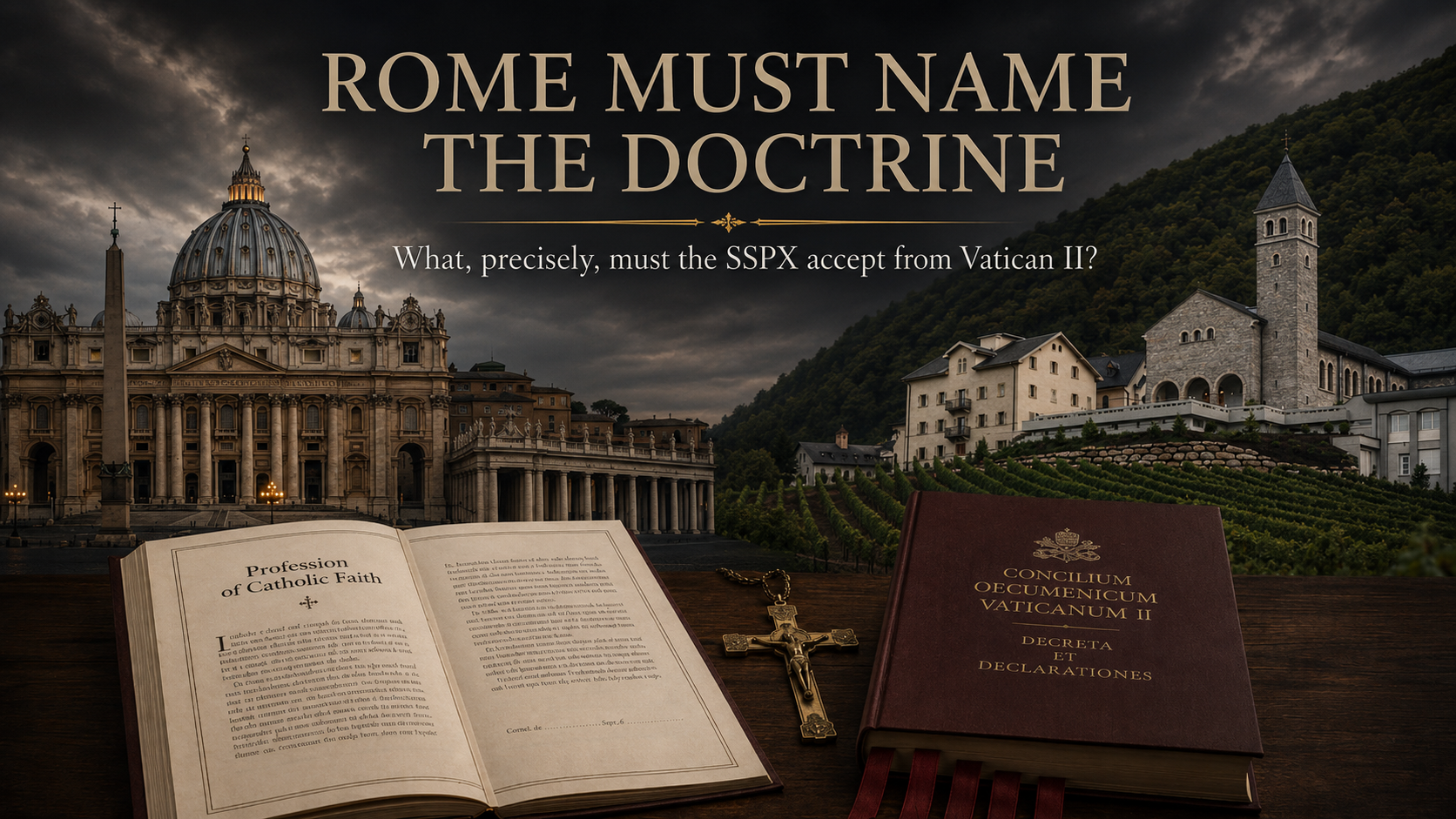
ROME MUST NAME THE DOCTRINE
Pope Leo XIV says that the Society of Saint Pius X refuses fundamental elements of the Church, beginning with Vatican II. The Society has answered with 154 articles of Catholic doctrine. Rome must now identify the precise proposition at issue, the assent it requires, and its continuity with the Faith already received.

Eight days after Pope Leo XIV accused the Society of Saint Pius X of refusing “certain fundamental elements of the Church”, the Society placed a comprehensive profession of Catholic faith before him and every cardinal.
The Pope had been speaking informally to journalists outside Villa Barberini on 16 June. Asked about the four episcopal consecrations planned for Écône on 1 July, he appealed to the Society not to proceed. Division among Christians was painful, he said, but the Society refused to accept “certain fundamental elements of the Church, starting with various points of the Second Vatican Council”.¹
On 24 June, the Society replied.
Its Profession of Catholic Faith runs to twenty-eight pages, 154 numbered propositions and 127 notes. It was accompanied by a letter addressed to Pope Leo and the College of Cardinals, presenting the text as a full profession of the Faith and expressing the hope that it might one day provide the basis for an “honest discussion” with the Holy See.²
The profession confesses the Trinity, Creation, original sin, the Incarnation, the objective character of Revelation, the necessity of grace, the redemptive Sacrifice of Calvary, the divine maternity and privileges of Our Lady, the seven sacraments, transubstantiation, the sacrificial nature of the Mass, the necessity of the Church, the moral law, the Social Kingship of Christ, judgement, purgatory, hell and the Beatific Vision.
It confesses papal primacy in terms which cannot honestly be mistaken for sedevacantism or ecclesial independence. The Roman Pontiff is the successor of Saint Peter, the Vicar of Christ, the visible head and supreme pastor of the whole Church. His jurisdiction is proper, supreme, full, immediate and universal. His authority comes directly from Christ. The profession affirms his infallibility when he defines a doctrine of faith or morals to be held by the universal Church, and it acknowledges the respect and filial obedience owed to him in the legitimate exercise of his office.³
Rome says that the Society refuses fundamental elements of the Church. The Society has set out, article by article, what it believes those elements to be.
Rome must now name what is missing.
The answer cannot simply be “Vatican II”. An ecumenical council is not itself a single article of faith. Vatican II promulgated sixteen documents containing doctrines, theological explanations, disciplinary directions, pastoral judgements and applications to the circumstances of the modern world. Those propositions do not all possess the same object, form or theological note. They do not all demand the same kind of assent merely because they appeared in documents promulgated by the same council.
The Dicastery for the Doctrine of the Faith appeared to recognise as much in February. It proposed a theological dialogue with the Society to establish the “minimum requirements” for full communion. The suggested subjects included the distinction between the act of faith and the religious submission of intellect and will, the different degrees of assent owed to conciliar texts, and their proper interpretation.⁴
That was the right question. The difficulty lay in the proposed answer.
The Society declined the offer because, as its Superior General understood the terms, the disputed conciliar texts could not be corrected, the legitimacy of the liturgical reform could not be questioned, and sixty years of official post-conciliar interpretation already supplied the fixed framework within which the discussion must proceed.⁵
Such a dialogue might permit explanation. It would not permit judgement. Continuity would be the premise rather than the matter to be proved.
The new profession is therefore not an unsolicited manifesto dropped into a settled doctrinal peace. It is an answer to Rome’s repeated demand that acceptance of Vatican II should serve as a condition of full communion.
The answer takes the form of a question: what precisely must be accepted?
Vatican II defined no new dogma through an extraordinary act of the conciliar Magisterium. It promulgated no new dogmatic canons and attached no anathemas to its disputed propositions. No teaching peculiar to the Council was solemnly imposed upon the universal Church as newly revealed by God.
This is not a traditionalist evasion devised after the event. It follows from the explanation given by the Pope who promulgated the Council.
On 7 December 1965, Paul VI said that the Council’s teaching authority had not wished to issue “extraordinary dogmatic pronouncements”. He nevertheless insisted that it had delivered authoritative teaching in the pastoral form it had deliberately chosen.⁶
On 12 January 1966, he answered the question of theological qualification more precisely. Because of its pastoral character, the Council had avoided solemn definitions engaging the infallibility of the extraordinary Magisterium. Its teaching was nevertheless invested with the authority of the supreme ordinary Magisterium and was to be received according to the Council’s intention concerning “the nature and purposes of the individual documents”.⁷
Both halves of that explanation matter.
Vatican II cannot be dismissed as a theological conference without authority. It was an exercise of the authentic Magisterium. Catholics cannot treat its teaching with contempt merely because it chose not to define new dogmas.
Nor can every sentence of every document be treated as though it were itself a solemnly defined article of divine and Catholic faith. Paul VI expressly directed Catholics to consider the nature and purpose of the individual texts. That requires distinctions.
The Council contains many truths which are de fide. The Trinity is de fide. The Incarnation is de fide. The Real Presence is de fide. The divine constitution and indefectibility of the Church belong to the Catholic Faith. Those doctrines possess their authority because they were revealed and had already been infallibly taught, not because Vatican II first defined them.
No disputed conciliar novelty became de fide by virtue of a new definition at Vatican II. There was no such definition.
The titles “Dogmatic Constitution” attached to Lumen gentium and Dei Verbum do not alter this. They indicate the subject and authority of the documents. They do not make every sentence within them a solemn definition. The Council’s own theological commission stated that the Synod would bind the Church definitively only where it expressly declared that intention. It made no such new declaration concerning the teachings now disputed.
This does not make those passages optional. Authentic non-definitive teaching ordinarily demands religious submission of intellect and will. But religious submission is not the same thing as the act of divine and Catholic faith owed to revealed dogma. Nor does non-definitive teaching become irreformable merely because submission is ordinarily owed to it.
That is why “acceptance of Vatican II” is too imprecise to bear the weight Rome places upon it.
Does Rome require the Society to accept the dogmas which Vatican II repeated from the prior infallible Magisterium? The profession accepts them.
Does it require religious submission to particular non-definitive teachings? Rome must identify those propositions, state the degree of assent owed to them and demonstrate how they preserve the same doctrine previously taught.
Does it require acceptance of the whole post-conciliar settlement—the Council’s texts, later papal interpretations, ecumenical practice, interreligious initiatives, synodal structures and the liturgical reform—as a single package which may be explained but never corrected? That is a much larger demand. It cannot be converted into an article of faith merely by calling it acceptance of a council.
The disputed propositions are not difficult to identify.
Dignitatis humanae teaches a civil right to religious freedom grounded in the dignity of the human person. The Society argues that this is at least apparently irreconcilable with Quanta cura, the Syllabus, Immortale Dei and Libertas, which distinguish between tolerating religious error for the common good and acknowledging that error possesses a natural right to public propagation.
The profession accepts toleration where necessary to avoid greater evil or preserve civil peace. It denies that falsehood possesses rights equal to truth or that an erroneous conscience creates an absolute right to public religious action.⁸
Rome may answer that Dignitatis humanae concerns immunity from coercion rather than the moral rights of error, and that it deliberately preserves the traditional duty of men and societies towards the true religion. That is the argument which must be made. The controversy cannot be settled by saying that the Council defined religious liberty as a new dogma. It did not.
Unitatis redintegratio says that separated Churches and ecclesial communities may be used by the Spirit of Christ as “means of salvation”. The profession replies that whatever truth and grace exist beyond the visible boundaries of the Church belong by right to the Catholic Church and draw souls towards her. It denies that separated communities possess a salvific efficacy precisely as separated religious bodies.⁹
Again, the dispute is real. Rome must explain how the conciliar formulation preserves the earlier doctrine that salvation comes through Christ and His Catholic Church, and that religious separation as such is not a saving instrument.
Nostra aetate says that non-Christian religions often reflect “a ray of that Truth which enlightens all men”. The profession accepts that fragments of natural truth and vestiges of revelation may survive among their adherents. It denies that false religions themselves are paths positively used by God for salvation.¹⁰
That distinction ought not to be controversial. God may save a man despite the errors which surround him. It does not follow that those errors become means of salvation. The concern of the Society is that conciliar language and post-conciliar practice have repeatedly blurred the difference.
The profession also rejects interpretations of episcopal collegiality which would create a permanent second subject of supreme authority beside the Pope. Here the Society risks overstating its own case. The relationship between papal primacy, episcopal jurisdiction and the college of bishops was disputed among orthodox theologians before Vatican II. The profession presents one Roman theological school with something approaching the force of dogma.
That is part of a wider weakness. The text often uses the same emphatic register for revealed dogma, settled doctrine, theological conclusion and historical judgement. Transubstantiation does not possess the same theological note as the title “Co-redemptrix”. The seven sacraments are not of the same order as the claim that the liturgical reform caused the collapse in vocations. The Social Kingship of Christ is Catholic doctrine; every political application proposed in its name is not thereby an article of faith.
A profession which demands precision from Rome concerning the authority of conciliar propositions should be equally precise about the authority of its own.
This is a defect, but not an answer to the document.
A serious doctrinal exchange would ask Rome to identify which propositions it accepts, which it regards as incomplete, which it considers legitimate theological opinions and which it judges incompatible with Catholic teaching. It would require the Society to state the theological note claimed for each disputed article and to distinguish the Faith itself from its favoured theological synthesis.
That would be an actual discussion. Another demand for undifferentiated acceptance would not.
The profession’s treatment of the liturgy makes the distinction especially important. It argues that the post-conciliar reform weakened the expression of sacrifice, propitiation, priesthood and the Real Presence; brought Catholic worship closer to Protestant forms; and contributed to the loss of sacred consciousness and Catholic practice.¹¹
These are severe historical judgements, not newly revealed doctrines. They can be tested against texts, intentions and results. They cannot be answered by pointing only to the lawful promulgation of the reformed rite. Juridical legitimacy does not establish pastoral wisdom, theological clarity or historical success.
The Society must also be precise. Criticism of the reform cannot become a general denial that the Church possesses authority over her rites. An appeal to the deficiencies of the new books cannot by itself establish that Catholics may refuse every command associated with them.
The same standard must govern the approaching consecrations.
The profession of papal primacy does not automatically justify disobedience to a direct papal prohibition. The Society must explain how its claimed state of necessity permits episcopal consecrations without becoming a jurisdiction conferred upon itself. It must show how practical resistance remains compatible with the supreme and immediate authority it explicitly confesses.
Canon law may judge that act.
It cannot answer the profession.
A declaration of excommunication would not establish the continuity of Dignitatis humanae with Quanta cura. It would not explain how separated communities function as means of salvation without attributing salvific value to separation. It would not determine the authority owed to the disputed formulations or prove that the liturgical reform is beyond doctrinal and pastoral correction.
Penalties address conduct. They do not prove propositions.
John Paul II recognised the unresolved obligation even while condemning Archbishop Lefebvre’s consecrations in 1988. He called for further study capable of revealing clearly the continuity of Vatican II with Tradition, especially where its teachings appeared new or had not been well understood.¹²
Benedict XVI put the balance plainly in 2009. The Church’s teaching authority could not be frozen in 1962. Yet anyone wishing to be obedient to Vatican II must accept the Faith professed through the centuries and cannot sever the tree from the roots from which it draws life.¹³
The Magisterium did not end in 1962.
It did not begin there either.
Tradition is not the preservation of one favoured period. It is the transmission of the same revealed Faith through time. Authentic development may make doctrine more explicit or apply it to new circumstances. It cannot reverse the meaning of what the Church has already taught and still remain a development of that teaching.
The Society believes that this continuity has not been established in religious liberty, ecumenism, interreligious dialogue, collegiality and the reformed liturgy. Rome maintains that these represent legitimate developments.
The profession has now forced the question into the open.
Rome may find errors and exaggerations in its 154 articles. It should identify them. It may judge that the Society has presented theological opinion as doctrine. It should distinguish them. It may believe that the Society has misconstrued the Council. It should prove the continuity from the texts and the prior Magisterium.
What it cannot reasonably do is make “acceptance of Vatican II” the decisive test of communion while leaving the content of that acceptance undefined.
Pope Leo says that the Society refuses fundamental elements of the Church. The Society has answered with a profession of the elements it believes fundamental.
Rome must now identify the disputed proposition, state the assent it demands, and prove its continuity with the Faith already received.
- Leo XIV, remarks to journalists outside Villa Barberini, Castel Gandolfo, 16 June 2026, reported by Vatican News, “Pope: May US-Iran Memorandum Be ‘Truly a Solution to the War’.”
- Davide Pagliarani, Alfonso de Galarreta, Christian Bouchacourt, Bernard Fellay and Franz Schmidberger, “Open Letter to His Holiness Pope Leo XIV and to the Cardinals of the Holy Church,” Menzingen, 24 June 2026; Society of Saint Pius X, Profession of Catholic Faith of the Society of Saint Pius X to Enlighten Souls in the Face of Modern Errors (Menzingen, 24 June 2026).
- SSPX, Profession of Catholic Faith, paras. 73–84; First Vatican Council, Dogmatic Constitution Pastor aeternus, chaps. 3–4.
- Dicastery for the Doctrine of the Faith, statement following the meeting between Víctor Manuel Cardinal Fernández and Father Davide Pagliarani, 12 February 2026; Vatican News, “Holy See Proposes Theological Dialogue with Society of St. Pius X,” 12 February 2026.
- Davide Pagliarani et al., letter to Víctor Manuel Cardinal Fernández, 18 February 2026, quoted in Vatican News, “Society of St. Pius X Rejects Dialogue Proposed by the Holy See,” 20 February 2026.
- Paul VI, Address during the Last General Meeting of the Second Vatican Council, 7 December 1965.
- Paul VI, General Audience, 12 January 1966; Second Vatican Council, Notification concerning the theological qualification of the teaching contained in Lumen gentium, 6 March and 16 November 1964.
- Second Vatican Council, Declaration Dignitatis humanae, nos. 1–3 and 7; Pius IX, Encyclical Quanta cura, 8 December 1864; Leo XIII, Encyclicals Immortale Dei, 1 November 1885, and Libertas praestantissimum, 20 June 1888; SSPX, Profession of Catholic Faith, paras. 96–105.
- Second Vatican Council, Decree Unitatis redintegratio, no. 3; Pius XI, Encyclical Mortalium animos, 6 January 1928; Pius XII, Encyclical Mystici Corporis Christi, 29 June 1943; SSPX, Profession of Catholic Faith, paras. 54–65.
- Second Vatican Council, Declaration Nostra aetate, no. 2; SSPX, Profession of Catholic Faith, paras. 62–64.
- SSPX, Profession of Catholic Faith, paras. 119–126; Alfredo Cardinal Ottaviani and Antonio Cardinal Bacci, letter presenting the Short Critical Study of the New Order of Mass to Paul VI, 25 September 1969.
- John Paul II, Apostolic Letter Ecclesia Dei, 2 July 1988, no. 5(b).
- Benedict XVI, Letter to the Bishops of the Catholic Church concerning the remission of the excommunication of the four bishops consecrated by Archbishop Lefebvre, 10 March 2009.
RELATED ARTiCLES


LATEST ARTICLES
- Today’s Mass: September 29 Dedication of Saint Michael the ArchangelThe Feast of the Dedication of Saint Michael the Archangel highlights St. Michael’s role as the leader of heavenly armies and protector of the Church. He is revered for defeating evil spirits and is traditionally invoked for defence against sin. The liturgy honours his significant role alongside other angels in spiritual warfare and the protection of believers.
- THE SALERA DOSSIERBishop Daniele Salera’s tenure in the Diocese of Ivrea is marked by significant controversies that challenge the effectiveness of Francis-era synodality. These conflicts question whether a Church focused on listening can embrace unsolicited participation, acknowledge differing viewpoints, and accept potential corrections to authority rather than merely seeking compliance from parishioners.
- WHEN THE SHEPHERD TELLS THE FLOCK WHOM TO REPLACECardinal Robert McElroy urged Catholics to oppose the Trump administration’s immigration policies, advocating for the replacement of political representatives who tolerate these policies. While emphasizing migrant dignity, he also recognised the necessity of borders and political order. His message raises concerns about the balance between moral teaching and electoral guidance.
- THE SWORD IN COTTON WOOLBishop ✠Marian Eleganti sharply critiques the synodal process initiated by Pope Leo XIV regarding Amoris Laetitia. He argues that while doctrine appears upheld, pastoral language and practices risk undermining sacramental judgement. His metaphor of truth as a sword “wrapped in cotton” highlights the tension between maintaining doctrine and adapting to contemporary pastoral approaches.
- LOURDES: LEO LISTENS AGAIN — BUT THE UNANSWERED QUESTIONS REMAINPope Leo XIV’s meeting with seven clerical abuse victims at Lourdes highlighted the importance of listening. While their positive experiences are commendable, Nuntiatoria stresses the need for action and accountability in the Church. The ongoing challenges of the Rupnik case and Chiclayo raise doubts about translating compassion into credible processes and effective reforms.
CURRENT EDITION


Today’s Mass Propers
- Today’s Mass: September 29 Dedication of Saint Michael the Archangel
 The Feast of the Dedication of Saint Michael the Archangel highlights St. Michael’s role as the leader of heavenly armies and protector of the Church. He is revered for defeating evil spirits and is traditionally invoked for defence against sin. The liturgy honours his significant role alongside other angels in spiritual warfare and the protection of believers.



Leave a Reply