
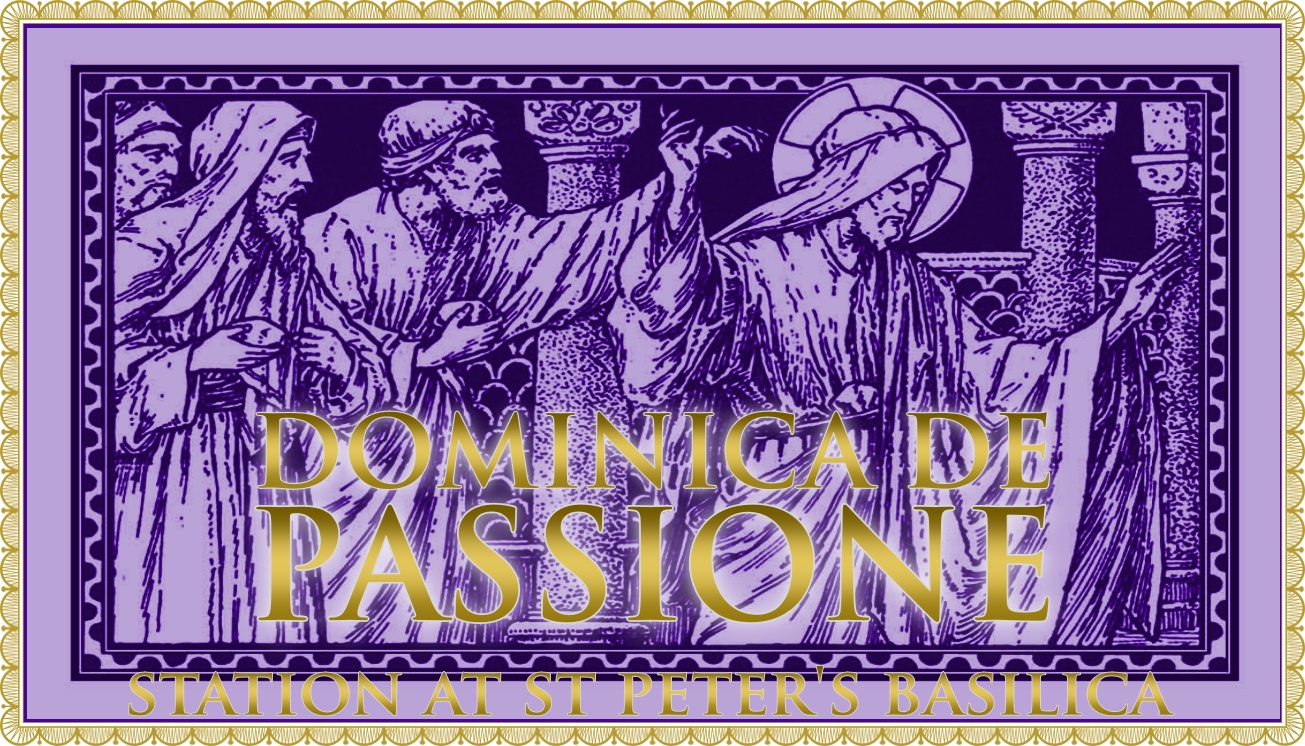
PASSION SUNDAY: The Veiling of Glory and the Hidden Descent into the Passion
The Threshold of the Passion
With Passion Sunday, the Church crosses a threshold. The long discipline of Lent, already marked by fasting, penance, and moral exhortation, now gives way to something more severe and more interior. The Roman tradition names this period Tempus Passionis—Passiontide—and it is not merely a continuation of Lent but its intensification, its concentration, its final descent toward the Cross.¹
In the pre-1955 Tridentine Rite, this transition is neither subtle nor accidental. The liturgy itself alters in tone, structure, and expression. What had been preparation becomes participation. What had been exhortation becomes contemplation. The Church no longer speaks primarily of sin and repentance, but of Christ Himself—of His suffering, His rejection, His sacrifice. As Dom Prosper Guéranger writes, the faithful are now called to follow Christ “step by step in the last scenes of His mortal life.”² The liturgy does not merely recall these events; it sacramentally re-presents them, drawing the Church into their reality.³
The Veiling of Glory
The most immediate and arresting sign of this transition is the veiling of images. From First Vespers of Passion Sunday, crosses, statues, and sacred images throughout the church are covered in violet.⁴ The sanctuary is altered at once. What had been visible is now concealed. What had drawn the eye is now withdrawn from it.
This practice is explicitly prescribed in the traditional rubrics. The Caeremoniale Episcoporum directs that crosses and images be veiled from Passion Sunday onward, except for those required for liturgical function.⁵ The Roman Missal likewise assumes the veiling as part of the seasonal discipline.⁶
This is not an aesthetic gesture, nor merely an intensification of Lenten austerity. It is a liturgical enactment of the Gospel itself. On this day, the Church proclaims the climactic moment in St John’s Gospel when Christ, having declared His divine identity—“Before Abraham was made, I AM”—is met with violence, and “Jesus hid Himself, and went out of the temple” (John 8:58–59).⁷ The veiling corresponds to this withdrawal. Christ, who has revealed Himself, now conceals Himself. The visible signs of His presence are obscured, and the Church enters into a mystery not of manifestation but of hiddenness.
The Fathers perceive in this withdrawal not defeat, but sovereignty. St Augustine insists that Christ “hid Himself not because He was afraid, but because He would not yet suffer.”⁸ The Passion is not imposed upon Him; it is entered into freely, at the appointed hour. The veiling, therefore, does not signify absence, but restraint—divine majesty withholding itself in preparation for sacrifice.
For the faithful, the effect is immediate and pedagogical. The senses are deprived. The eye, accustomed to sacred form and beauty, is denied its object. One must now proceed by faith alone. Pius Parsch describes this as a “fast of the eyes,” corresponding to the bodily fast of Lent, a discipline by which the soul is trained to seek God beyond sensible consolation.⁹
The Silence of Praise
Alongside the veiling, the liturgy itself becomes more restrained. The Gloria Patri, the doxology that habitually crowns the psalms with explicit praise of the Trinity, is omitted in key places: at the Introit, in the Lavabo, and in other contexts governed by Passiontide rubrics.¹⁰
The Ritus servandus in celebratione Missae prescribes that in Passiontide the psalm at the foot of the altar is omitted entirely, and with it the customary doxological conclusion.¹¹ This omission is deliberate and expressive. The Church does not cease to glorify God, but she refrains from doing so overtly. Praise yields to contemplation. Expression yields to silence.
This restraint reflects the condition of Christ Himself as He enters His Passion. He who is the eternal Word will soon stand silent before His accusers (cf. Matthew 26:63). He who is the glory of the Father will be stripped, mocked, and condemned (cf. Philippians 2:6–8). The liturgy begins to mirror this abasement. The language of triumph is muted; the tone becomes grave, even austere. The Church prepares her children not for consolation, but for endurance.
The Cry of the Just Man Reassigned
Yet if the liturgy is restrained, it is not silent. It speaks with a particular intensity through the texts it selects, and nowhere more strikingly than in the Introit: Judica me, Deus, et discerne causam meam de gente non sancta—“Judge me, O God, and distinguish my cause from the nation that is not holy” (Psalm 42/43:1).¹² This is the voice of the just man under persecution, the cry of one falsely accused and surrounded by deceit.
At first glance, there appears to be a contradiction in the Church’s handling of this psalm. Throughout the year, Judica me forms part of the priest’s private preparation at the foot of the altar.¹³ Yet precisely at the moment when the liturgy turns most grave, this psalm is removed from that preparatory place—only to be placed more prominently at the very opening of the Mass.
This is not inconsistency, but deliberate reorientation. The Church does not suppress the psalm; she reassigns its voice and elevates its function. As Josef Jungmann notes, the preparatory prayers at the foot of the altar developed as a later addition, distinct from the more ancient structure of the Mass itself.¹⁴ Passiontide, by removing this element, restores a certain primacy to the public proclamation of the Introit.
No longer is the psalm the quiet, personal disposition of the priest preparing to ascend the altar. In Passiontide, it becomes the public cry of Christ Himself—the Just One standing before His accusers, appealing to the Father as He enters into judgment. What had been ascetical becomes Christological. What had been private becomes ecclesial.
This shift reflects a deeper transformation in the liturgical movement itself. Earlier in Lent, the emphasis lies upon ascent—upon purification, readiness, and the soul’s approach to God. But with Passion Sunday, the movement changes direction. The liturgy no longer emphasises ascent to the altar, but descent into the Passion. The priest no longer speaks primarily in his own person; the Church speaks in the person of Christ.
Thus, the psalm is not removed because it is unsuitable, but because its former placement would now be insufficient. It is freed from the narrow confines of private preparation and given its full weight as the voice of the suffering Christ, proclaimed at the threshold of the sacred action.
The Sacrifice Revealed in the Epistle
The Epistle from the Letter to the Hebrews (9:11–15) provides the theological key to Passiontide. Christ is presented not merely as a sufferer, but as the High Priest of the New Covenant, who enters not into an earthly sanctuary but into the heavenly holy of holies, offering not the blood of animals but His own Blood.¹⁵
This interpretation is rooted in apostolic teaching and developed consistently in patristic theology. St John Chrysostom emphasises that Christ “offered not another’s blood, but His own,” thereby accomplishing a redemption that is both eternal and efficacious.¹⁶ The Passion is thus understood as sacrifice, not merely suffering.
The liturgy insists upon this perspective, lest the faithful mistake the external humiliation for an internal defeat. Christ is both Priest and Victim, the one who offers and the one who is offered—a theme later articulated dogmatically in the teaching of the Council of Trent on the Sacrifice of the Mass.¹⁷
The Gospel and the Crisis of Revelation
The Gospel of Passion Sunday (John 8:46–59) marks a decisive escalation. Christ does not merely teach; He declares. “Before Abraham was made, I AM.”¹⁸ The claim is unmistakable. It is a direct invocation of the divine Name revealed to Moses (Exodus 3:14).¹⁹ There can be no ambiguity. Christ identifies Himself with the God of Israel.
The response is immediate and violent. The Jews take up stones to kill Him. The conflict, long developing, now reaches its breaking point. Yet, in a final gesture of sovereignty, Christ withdraws: “Jesus hid Himself.” The hour has not yet come (cf. John 7:30).²⁰ The sacrifice will be offered according to divine timing, not human initiative.
This Gospel sets the tone for all that follows. The Passion is not merely the suffering of a righteous man. It is the rejection of God Himself. The Cross will be the place where divine revelation is both most fully manifested and most violently denied.
The Liturgical Atmosphere of Passiontide
Taken together—the veiling, the omissions, the reassigned voice of the psalm, and the intensified readings—the liturgy of Passion Sunday produces a distinct atmosphere. It is marked by silence, severity, and interiorisation. The Church deliberately withdraws external supports in order to deepen interior participation.
This corresponds to the broader ascetical tradition of the Church. As St Thomas Aquinas teaches, external signs and sensible aids are ordered toward interior realities, but must sometimes be withdrawn so that the soul may adhere more firmly to God Himself.²¹ Passiontide embodies this principle liturgically.
The Mystical Theology of Hiddenness
At its deepest level, Passion Sunday teaches a theology of hiddenness. Christ, who is the Light of the World (John 8:12), begins to withdraw that light from sight. He is no less present, no less active, no less divine—but He is hidden.
This anticipates not only the Cross, but the entire paradox of the Christian mystery: that God reveals Himself most fully precisely where He appears most obscured. As St Leo the Great teaches, the Passion manifests both the weakness of human nature and the power of divine love.²²
For the faithful, this becomes a pattern. The life of grace is often marked by obscurity. God is present, but not perceived. Passiontide trains the soul to endure this condition, to believe without seeing (cf. John 20:29), to hope in darkness.
The Veil Before the Victory
Passion Sunday does not conclude the liturgical journey; it intensifies it. The veils will remain. The liturgy will grow more severe. The Church will follow Christ to Calvary. Yet even now, the end is implicit. The Cross that is hidden will be unveiled. The Christ who withdraws will return in glory.
The logic is consistent and inescapable. Glory is veiled before it is revealed. Victory is hidden before it is manifest. As St Paul writes, “If we suffer with Him, we shall also be glorified with Him” (Romans 8:17).²³
Thus Passion Sunday stands as both threshold and summons. The faithful are called not merely to observe the Passion, but to enter it—to walk with Christ into the hidden depths where suffering and redemption meet, and where the Cross, once veiled, will become the sign of eternal life.
- Missale Romanum (1962; reflecting pre-1955 structure), Rubricae generales, XVIII–XIX.
- Dom Prosper Guéranger, The Liturgical Year: Passiontide and Holy Week (Dublin: James Duffy, 1870), p. 3.
- Pius XII, Encyclical Mediator Dei (1947), §§68–70.
- Caeremoniale Episcoporum (1886 ed.), II, c. 22, n. 1.
- Ibid.
- Missale Romanum, Rubricae generales, XIX.
- John 8:58–59 (Vulgate: “Abscondit se Iesus…”).
- St Augustine, In Ioannis Evangelium Tractatus, 43 (PL 35:1710).
- Pius Parsch, The Church’s Year of Grace, Vol. II (Collegeville: Liturgical Press, 1953), pp. 87–89.
- Missale Romanum, Rubricae generales, XIX.
- Ritus servandus in celebratione Missae, X, 2.
- Psalm 42:1 (Vulgate numbering).
- Missale Romanum, Ordo Missae, “Psalmus Judica me.”
- Josef A. Jungmann, Missarum Sollemnia, Vol. I (Vienna: Herder, 1948), pp. 310–315.
- Hebrews 9:11–15.
- St John Chrysostom, Homilies on Hebrews, Homily 17 (PG 63:131).
- Council of Trent, Session XXII, Doctrine on the Sacrifice of the Mass, ch. 2.
- John 8:58.
- Exodus 3:14.
- John 7:30.
- St Thomas Aquinas, Summa Theologiae, II–II, q. 81, a. 7.
- St Leo the Great, Sermon 54 on the Passion (PL 54:309).
- Romans 8:17.
related articles


Latest articles
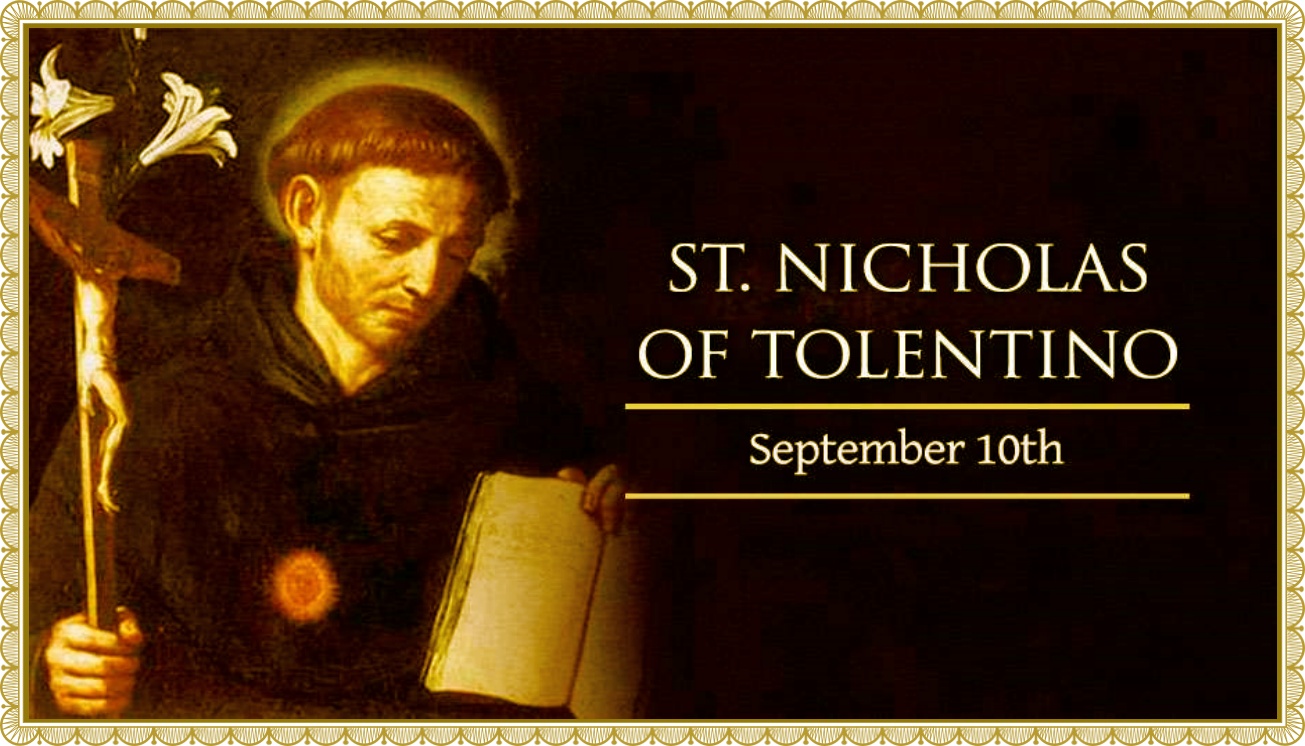
- Today’s homily: St Nicholas TolentinoThe reflection celebrates Saint Nicholas of Tolentino, emphasising that holiness is achieved not through personal efforts but through grace. It highlights his life of service, prayer, and self-discipline, suggesting that his true sanctity stems from dependence on God. The message reinforces the importance of a single-hearted focus on God in one’s spiritual journey.
- Today’s Mass: September 10 St Nicholas of TolentinoSaint Nicholas of Tolentino, born around 1246 in Italy, became a devout Augustinian hermit known for his piety and dedication to preaching. He spent his later years in Tolentino, promoting virtue, and maintaining his chastity until his death in 1306. Canonised in 1446, his tomb is revered by the faithful.
- Today’s Mass: September 09 Day II in the Octave of The Nativity of the Blessed Virgin MaryThe feast of Our Lady’s Nativity, of ancient Eastern origin and established at Rome by the time of Pope St Sergius I, celebrates Mary as the immaculate New Eve and the dawn of salvation, the chosen tabernacle from whom the Redeemer would take His flesh. Today the Church also commemorates St Gorgonius, an officer of the imperial household at Nicomedia who, with his companion Dorotheus, embraced the Faith and suffered martyrdom under Diocletian in A.D. 303; his relics were later translated to Rome.
- NOMEN MANET, RES DEEST ~ The Name Remains; the Reality Is Lacking: Spiritual Conference for Nuntiatoria CXXIIThe content emphasises the disconnect between the names associated with Catholicism and the actual practices of faith. It highlights the importance of embodying belief through genuine actions, urging self-examination rather than mere external observance. Ultimately, it advocates for a restoration of sincerity in faith, calling individuals to authentically reflect their beliefs through their lives and worship.
- Mary Is Co-Redemptrix: Cardinal Burke Reopens Rome’s Marian ControversyCardinal Raymond Leo Burke has declared the Virgin Mary as “Co-Redemptrix” amidst controversy over the Vatican’s restriction on this title. The debate revolves around the appropriateness of certain theological language and whether terminology historically used can still accurately express Marian cooperation in Redemption without compromising Christ’s unique role.




Leave a Reply