
Saint Anne: The Mother Who Prepared the Mother of God
The traditional Roman liturgy honours Saint Anne on 26 July through the scriptural figure of the valiant woman and the Gospel’s parables of hidden growth. Little can be stated with historical certainty about her life beyond the ancient tradition that she was the mother of the Blessed Virgin. Yet that single dignity places her within the immediate human preparation for the Incarnation: in her womb the Immaculate Virgin was conceived, and in her household the future Mother of God received the natural formation upon which grace brought forth its perfect fruit.

The Church approaches Saint Anne on 26 July with the words Gaudeamus omnes in Domino: “Let us all rejoice in the Lord, celebrating a festival day in honour of blessed Anne, on whose solemnity the Angels rejoice and praise the Son of God.” The last words govern everything that follows. The angels rejoice over Anne because they praise Christ. Her feast belongs to the mystery of the Incarnation, for God chose her to be the mother of the woman from whom the Eternal Word would take His human nature.
The canonical Scriptures tell us nothing directly of the parents of the Blessed Virgin. The names Joachim and Anne are preserved in the Protoevangelium of James, a second-century apocryphal work whose narratives possess neither the inspiration nor the historical authority of the Gospels. The Church has never asked the faithful to accept all its particulars. Yet the names of Mary’s parents were received remarkably early and consistently in both East and West. They appear in the preaching of such Fathers as Saint Gregory of Nyssa, Saint Germanus of Constantinople and Saint John Damascene, and became established in the Church’s liturgical memory.¹
This distinction matters. Piety does not require us to convert every ancient legend into history. Nor does historical reserve oblige us to treat the Church’s inherited memory with suspicion. We know Saint Anne principally through her daughter. The Roman liturgy is content to proceed from that certainty, placing on Anne’s lips the inspired words of Proverbs and setting beside them the parables of the mustard seed and the leaven. It does not attempt a biography. It reveals the theological meaning of a motherhood.
The mother of the Mother of God
The Collect gives the feast its exact measure:
O God, Who didst vouchsafe to confer upon blessed Anne the grace that she should merit to become the mother of the Mother of Thine only-begotten Son: mercifully grant that we who celebrate her solemnity may be assisted by her intercession with Thee.
Anne is not praised apart from Mary, and Mary is never considered apart from Christ. Her dignity is expressed through a succession of relationships established by God: Anne became the mother of Mary; Mary became the Mother of the only-begotten Son; the Son is the source of every grace bestowed upon both.
The Collect says that God “vouchsafed to confer” this grace upon Anne. Her motherhood was first a gift and an election. She could not acquire a claim upon the Incarnation or make herself, by natural virtue, worthy to enter so closely into its preparation. God chose her, disposed her and enabled her to answer His purpose. When the prayer adds that she “merited” to become Mary’s mother, it speaks according to the Catholic doctrine of merit under grace. Anne’s holiness was truly her free and virtuous response, but the grace by which she responded had already come from God.
Saint Augustine supplies the necessary rule: when God crowns the merits of His saints, He crowns His own gifts.² Grace does not make human action unreal. It raises the creature and enables a cooperation which God truly accepts and rewards. Saint Anne’s maternal vocation was therefore neither an impersonal use made of her by Providence nor an achievement independently gained. It was a divine election fulfilled through a woman’s faithful consent to the duties God placed before her.
Saint John Damascene understood the grandeur of this election. In his homily for the Nativity of the Blessed Virgin, he addresses Joachim and Anne as the blessed couple through whom creation offered to its Creator the woman who would become His Mother.³ The language is daring because the Incarnation itself is daring. God did not manufacture a human body independently of the human race. The Word became the son of Mary, receiving from her the flesh by which He was descended from Adam, born under the Law, crucified under Pontius Pilate and raised bodily from the dead.
Mary’s humanity came from her parents. The flesh which the Word assumed from Mary was formed within the same real genealogy. Anne was not the direct source of Christ’s humanity, but she belongs to its immediate maternal ancestry. God chose to enter His creation through the ordinary continuities of conception, gestation, birth and family descent, while accomplishing within them the wholly extraordinary works of the Immaculate Conception and the virginal conception of Christ.
The liturgy therefore honours Anne without loosening its gaze from her divine Grandson. Even the Introit speaks of the angels praising “the Son of God”. Devotion to Saint Anne is sound when it follows this order. It leads through the mother to the daughter and through the daughter to Christ.
The valiant woman
For the Epistle, the Church chooses the concluding verses of Proverbs: Mulierem fortem quis inveniet? — “Who shall find a valiant woman? Far and from the uttermost coasts is the price of her.”
The passage praises the woman who can be trusted by her husband, governs her household wisely, works with willing hands, rises before daylight, gives food to those under her care and opens her hand to the poor. “Strength and beauty are her clothing”; wisdom is upon her tongue; her children rise and call her blessed. “Favour is deceitful, and beauty is vain: the woman that feareth the Lord, she shall be praised.”⁴
Proverbs presents no fragile or merely decorative ideal of womanhood. Its valiant woman possesses judgement, foresight, practical competence, generosity and endurance. The household is not a confinement imposed upon an otherwise idle life. It is the sphere within which her intelligence, sacrifice and authority bear fruit.
The liturgy applies this portrait to Anne without claiming documentary knowledge of her daily routine. It tells us what the Church recognises in the mother entrusted with Mary: strength disciplined by the fear of God, domestic government ordered towards holiness, and a maternal fruitfulness whose full consequence remained hidden from the world.
The last point deserves attention. Anne’s motherhood belongs to the unrecorded years of the history of salvation. No imperial decree noticed the birth of her daughter. No chronicler understood that the child in her arms had been preserved from original sin and predestined to give the Redeemer His flesh. The important work was being done far from the places where importance was ordinarily measured.
The Church’s choice of Proverbs is therefore more than a tribute to maternal respectability. It declares that the household may become an instrument of Providence. Within it a child first encounters authority, mercy, sacrifice, language, prayer and the distinction between sacred and profane. A mother’s repeated acts may seem too small for history, yet they enter the moral and spiritual formation of a person who will live beyond her sight.
In Anne’s case, that child was the Blessed Virgin. Mary’s sanctity came from God. Her Immaculate Conception was a unique privilege granted in view of the merits of Christ, not the natural consequence of parental virtue. Yet supernatural grace did not make maternal care unnecessary. The Immaculate child was still carried, fed, protected, taught and loved. Perfect grace did not abolish the created order; it made that order perfectly receptive to God.
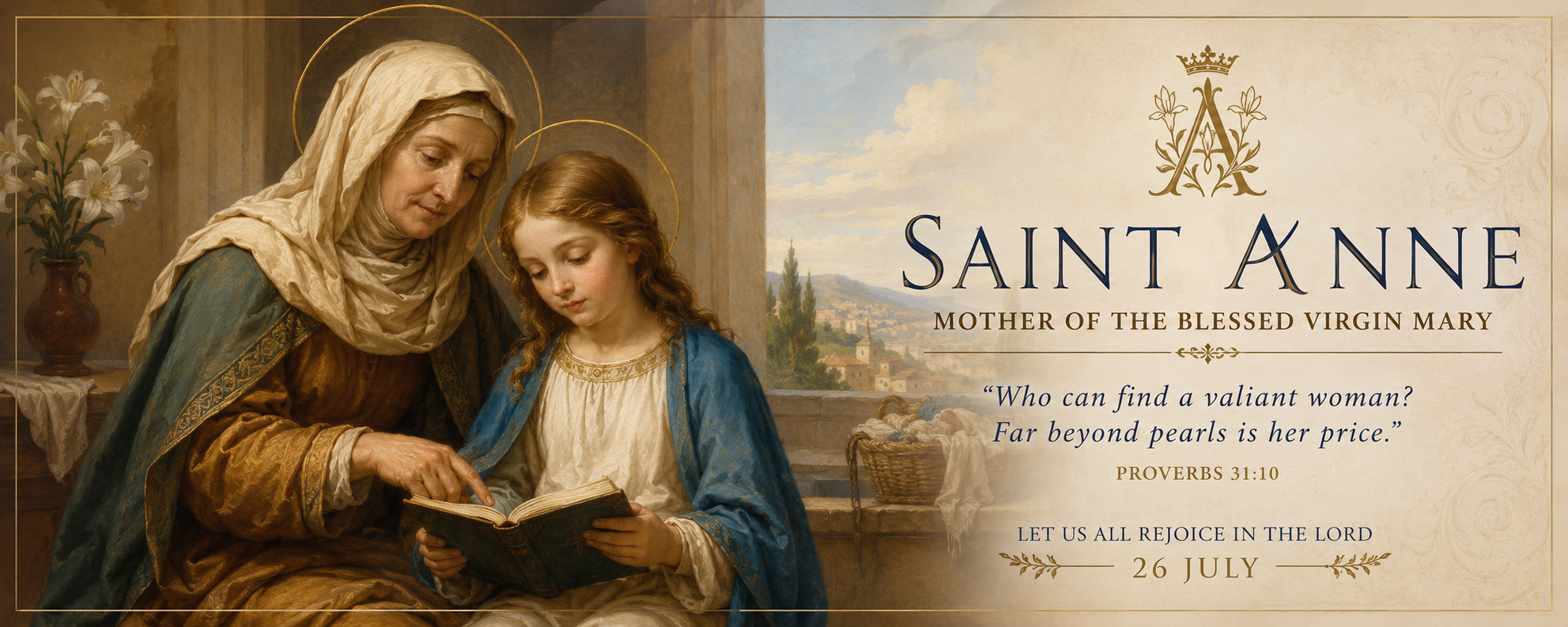
The popular artistic representation of Saint Anne teaching Mary to read rests upon no certain historical record. It nevertheless expresses a theological truth. The Magnificat shows a mind steeped in the language of Scripture. Its praise recalls the canticle of Anna, mother of Samuel, and gathers up phrases and themes from the Psalms and Prophets. The Gospels allow us to hear in Mary not an untutored religious impulse but the fruit of Israel’s prayer brought to extraordinary perfection.
We cannot identify each human instrument by which that formation was given. It is, however, reasonable to see in Anne the mother who first brought Mary into the rhythms of domestic prayer and Israel’s worship. Before Mary taught the child Jesus the words of human speech, another mother had spoken to Mary of the God of Abraham, Isaac and Jacob.
The Immaculate Conception in Anne’s womb
Saint Anne’s closest relation to a defined dogma lies in the fact that the Immaculate Conception occurred within her womb. The privilege belonged entirely to Mary. Anne was not herself conceived without original sin, nor did she communicate sanctifying grace to her daughter through natural generation. At the first instant of Mary’s conception, Almighty God preserved her from every stain of original sin by a singular grace and privilege, in view of the merits of Jesus Christ.⁵
That distinction protects both the supernatural character of Mary’s privilege and the true dignity of Anne’s motherhood. Anne supplied what every human mother supplies according to the order of nature. God intervened in that conception by preserving the person conceived from the inherited stain which otherwise touches every child of Adam. The Immaculate Conception was neither Christ’s virginal conception nor an immaculate conception of Christ by Mary. It was Mary’s own conception by Joachim and Anne, sanctified from its first instant through the anticipated merits of her Son.
The scholastic tradition treated Mary’s prenatal holiness in connection with her divine maternity. Saint Thomas Aquinas argued that the Church’s celebration of her Nativity showed that she had been sanctified before her birth, since the Church celebrates as holy the earthly birth of those who came forth sanctified from the womb.⁶ His account did not arrive at the precise formulation later defined by Blessed Pius IX; on the question of the first instant of conception, the theological schools continued to dispute the manner in which Mary’s universal need of redemption could be reconciled with complete preservation from original sin.
The decisive insight, developed with particular force in the Franciscan school associated with Blessed John Duns Scotus, was that preservation is the most perfect form of redemption. Mary did not stand outside Christ’s redeeming work. She was redeemed more sublimely by being prevented, through His foreseen merits, from contracting the stain from which others are cleansed. Pius IX’s definition settled the doctrinal question while preserving the fundamental Catholic truth that every grace in Mary came through her Son.
Saint Anne stands immediately beside this mystery, though she is not its subject. Her womb was the created chamber in which God prepared the living tabernacle of the Incarnate Word. There the daughter of Adam who was to become the new Eve began her life untouched by the serpent’s inheritance.
Catholic devotion should not hurry past the physical reality. Christianity is not a religion in which salvation takes place by escape from matter. The body of Mary was formed within Anne; the body of Christ was formed from Mary. The Church honours conception and maternity because the Word truly became flesh. Against every ancient or modern tendency to reduce the body to an accidental instrument of the self, Anne’s feast recalls that God’s redemptive purpose entered human history through the bodies of mothers.
Prayer answered after barrenness
The ancient tradition speaks of Joachim and Anne as childless for many years before Mary’s conception. This detail comes principally through apocryphal narratives and cannot be treated as though it were recorded in the canonical Gospels. Yet the Fathers found it consonant with a recognisable biblical pattern.
Saint John Damascene compares Anne with Anna, the mother of Samuel.⁷ Sara bore Isaac after natural hope had failed; Rachel’s reproach was taken away in the birth of Joseph; the prayers of Anna were answered by Samuel; Elizabeth conceived the Precursor in old age. In each instance, God makes human weakness the setting of His action. The child is recognised not as a possession extracted from nature but as a gift received from Providence.
The analogy must not be pressed beyond its purpose. Mary’s conception was natural in its manner, though singularly privileged by grace. Christ alone was conceived virginally. The barrenness tradition surrounding Anne serves rather to place her within the scriptural history of women who waited in sorrow and discovered that delay had not meant abandonment.
Dom Prosper Guéranger reads Anne’s trial as a preparation for the greatness of the gift. The promised child was received after humiliation and prayer, when no ordinary expectation could obscure the hand of God.⁸ His meditation follows the Church’s instinct: the saints are often prepared for their appointed work through a poverty which prevents them from imagining that the work belongs to them.
The spiritual application is plain without being facile. Prayer does not purchase a particular outcome, and no Christian has been promised that every natural deprivation will be removed in this life. Saint Anne’s example cannot be used to explain another person’s childlessness or to guarantee the fulfilment of a cherished desire. It teaches instead that apparent sterility does not place a life beyond Providence. God may act after long delay; He may answer in a manner not recognised at once; He may also ask that suffering itself be offered in union with Christ.
Anne’s traditional patronage of women longing for children has endured because she is not approached as a pagan power controlling fertility. She is invoked as a mother who knew supplication, waiting and the reception of life as grace.
The mustard seed and the leaven
The Gospel contains two brief parables. The kingdom of heaven is like a grain of mustard seed which, though small, grows until the birds dwell in its branches. It is also like leaven which a woman hides in three measures of meal until the whole is leavened.⁹
The Fathers found several related meanings in these images. Saint Jerome saw the mustard seed as the Gospel: outwardly slight at its first preaching, but growing into the great body of the Church. Saint John Chrysostom related its littleness to the Apostles, few and unimpressive by worldly judgement, through whom the preaching of Christ spread across the nations. Saint Augustine could see in the seed Christ Himself, humbled in the Passion and rising in the glory of His kingdom.¹⁰
The liturgy does not erase these primary interpretations when it appoints the Gospel for Saint Anne. It places her life within them. The kingdom advances through beginnings which escape notice. God’s greatest preparations are not always accompanied by visible power. A child is conceived in an obscure Jewish household; another child will later be conceived at Nazareth after an angel’s salutation; the Saviour will be born where there is no room for His Mother at the inn.
The mustard seed supplies the pattern of growth from hidden littleness. The leaven suggests an influence that works inwardly. Both belong naturally to Anne’s maternal vocation. She did not preach to nations, govern a kingdom or witness the public ministry of Christ. Her influence entered history through a daughter.
The comparison with leaven must be made with theological care, since Scripture can use leaven in both favourable and unfavourable senses. Here Our Lord explicitly makes it an image of the kingdom. Hidden in the meal, it does not remain isolated but works through the whole. The domestic image is especially apt for the quiet transmission of faith. A Catholic home forms its members not only by occasional instruction but through habits: the crucifix before which one prays, grace at table, the observance of fast and feast, the ready mention of the saints, forgiveness after fault, reverence in speech and the expectation that God’s commandments govern ordinary decisions.
This influence is easily weakened when parents outsource the formation of their children while retaining only the language of responsibility. Schools and clergy may assist; neither can replace the household as the first school of Christian life. Anne’s feast honours a maternity in which natural care and religious formation belonged together.
The point should not be romanticised. No home is preserved from fatigue, anxiety, misunderstanding or sin merely because it calls itself Catholic. The Holy Family knew poverty, flight and the sword foretold by Simeon. Holiness does not remove the cost of family life. It directs that cost towards charity and teaches each member to ask forgiveness.
The wisdom of the liturgy
The Roman feast of Saint Anne developed later in the West than in the Christian East, where devotion to Joachim and Anne and the liturgical celebration of events connected with Our Lady’s infancy appeared much earlier. Evidence of Anne’s veneration reached Rome under Byzantine influence, but her feast on 26 July became established gradually in the medieval Latin Church. It was extended more widely under Gregory XIII in 1584 and received increased liturgical rank under Leo XIII in 1879.¹¹
The history advises against a simplistic claim that every universally cherished devotion must have possessed its final Roman form from apostolic times. The Church’s liturgical recognition can mature as the implications of revealed truth are contemplated and as legitimate traditions take root. The feast developed; the theological reason for it was already contained in the Church’s confession that Jesus Christ was born of the Virgin Mary.
Cardinal Ildefonso Schuster noted that the Roman liturgy often speaks of saints with greater sobriety than later legend.¹² That sobriety serves Saint Anne particularly well. Her dignity requires no elaborate reconstruction of her life. Had the Church possessed a detailed and certain biography, it could hardly add to the essential fact expressed by the Collect: she was granted the grace to become the mother of the Mother of God.
The proper texts maintain a disciplined reserve. Proverbs supplies the virtues of the God-fearing mother. The Gospel reveals the divine economy of hidden beginnings. The prayers locate Anne within the preparation for Christ and ask for her intercession. The Church says what she knows, contemplates what the fact means and leaves uncertain details outside the substance of the feast.
Mystical literature has often attempted to fill the silence. The revelations attributed to Saint Bridget of Sweden and the more extensive narratives of the Venerable Mary of Agreda contain meditations upon Joachim, Anne and the childhood of Our Lady. Such writings may be read with ecclesiastical prudence, but private revelation does not enlarge the deposit of faith and cannot establish historical facts merely by devotional appeal. Their soundest contribution is contemplative rather than documentary: they help the reader dwell upon the hidden preparation by which God disposed persons, families and circumstances for the Incarnation.
The surest mysticism of Saint Anne’s feast remains the mysticism of the liturgy itself. It takes an almost unknown woman and shows the eternal consequence of a life placed at God’s disposal.
Her children rose up and called her blessed
The words of Proverbs attain an unusual fulfilment in Saint Anne: “Her children rose up, and called her blessed.” Her child is the woman who prophesied that all generations would call her blessed. Mary’s own blessedness does not eclipse Anne. It is the supreme fruit of the maternal vocation entrusted to her.
Yet Anne could not claim that fruit as her own achievement. The closer a creature stands to the great works of God, the more clearly the primacy of grace appears. She did not make Mary immaculate. She did not confer the divine maternity. She did not live to direct the public mission of Christ. She received a daughter, fulfilled the obligations of a mother and surrendered the future to Providence.
That is why the feast speaks with particular force to parents and grandparents. They rarely know the full effect of their fidelity. A prayer taught in childhood may return after decades of neglect. A sacrifice unnoticed at the time may make possible another person’s vocation. A grandmother may preserve what a more confident generation has discarded. Much of the transmission of Catholic life has depended upon women whose names never entered ecclesiastical histories but who knew the prayers, kept the feasts, guarded modesty, prepared children for the sacraments and refused to let the faith disappear from the household.
Saint Anne did all this under circumstances more exalted than any other mother, but the form of her service remained recognisably human. She bore a child, cared for her and prepared her for a vocation whose measure she could not fully see.
The Communion returns to Proverbs: “Favour is deceitful, and beauty is vain: the woman that feareth the Lord, she shall be praised. Give her of the fruit of her hands, and let her works praise her in the gates.” The Roman liturgy does not praise Anne for visibility, originality or self-assertion. It praises the fear of the Lord and the fruit of her hands.
Her greatest fruit was Mary. Mary’s fruit was Christ.
On 26 July the Church follows that line of grace to its source in God. She honours the mother who carried the Immaculate Conception without possessing it, who formed the Mother of God without living to see Bethlehem, and whose quiet fidelity became part of the human preparation for the salvation of the world.
- Protoevangelium of James, chapters 1–7; Friedrich G. Holweck, “St Anne”, The Catholic Encyclopedia, vol. I, New York, 1907; Saint Gregory of Nyssa, On the Nativity of Christ; Saint John Damascene, Oration on the Nativity of the Holy Theotokos.
- Saint Augustine, Epistle 194, chapter 5, no. 19; cf. Enchiridion, chapter 107.
- Saint John Damascene, Oration on the Nativity of the Holy Theotokos, §§2–6.
- Proverbs 31:10–31, Douay-Rheims; Roman Missal, Proper of the Saints, 26 July, Epistle for the Feast of Saint Anne.
- Blessed Pius IX, Apostolic Constitution Ineffabilis Deus, 8 December 1854.
- Saint Thomas Aquinas, Summa Theologiae, III, q. 27, a. 1.
- Saint John Damascene, De fide orthodoxa, IV, 14; Oration on the Nativity of the Holy Theotokos.
- Dom Prosper Guéranger, The Liturgical Year, Time after Pentecost, “Saint Anne, Mother of the Blessed Virgin Mary”, 26 July.
- Matthew 13:31–35, Douay-Rheims; Roman Missal, Proper of the Saints, 26 July, Gospel for the Feast of Saint Anne.
- Saint Jerome, Commentary on Matthew, II, on Matthew 13:31–32; Saint John Chrysostom, Homilies on Matthew, XLVI; Saint Augustine, Questions on the Gospels, I, 12.
- Holweck, “St Anne”, The Catholic Encyclopedia; Congregation of Sacred Rites, historical notices concerning the Roman calendar; Leo XIII, decree raising the feasts of Saints Joachim and Anne, 1879.
- Blessed Ildefonso Schuster, The Sacramentary: Historical and Liturgical Notes on the Roman Missal, vol. IV, section for 26 July.
related articles


Latest articles
- Today’s Mass: September 10 St Nicholas of TolentinoSaint Nicholas of Tolentino, born around 1246 in Italy, became a devout Augustinian hermit known for his piety and dedication to preaching. He spent his later years in Tolentino, promoting virtue, and maintaining his chastity until his death in 1306. Canonised in 1446, his tomb is revered by the faithful.
- Today’s Mass: September 09 Day II in the Octave of The Nativity of the Blessed Virgin MaryThe feast of Our Lady’s Nativity, of ancient Eastern origin and established at Rome by the time of Pope St Sergius I, celebrates Mary as the immaculate New Eve and the dawn of salvation, the chosen tabernacle from whom the Redeemer would take His flesh. Today the Church also commemorates St Gorgonius, an officer of the imperial household at Nicomedia who, with his companion Dorotheus, embraced the Faith and suffered martyrdom under Diocletian in A.D. 303; his relics were later translated to Rome.
- NOMEN MANET, RES DEEST ~ The Name Remains; the Reality Is Lacking: Spiritual Conference for Nuntiatoria CXXIIThe content emphasises the disconnect between the names associated with Catholicism and the actual practices of faith. It highlights the importance of embodying belief through genuine actions, urging self-examination rather than mere external observance. Ultimately, it advocates for a restoration of sincerity in faith, calling individuals to authentically reflect their beliefs through their lives and worship.
- Mary Is Co-Redemptrix: Cardinal Burke Reopens Rome’s Marian ControversyCardinal Raymond Leo Burke has declared the Virgin Mary as “Co-Redemptrix” amidst controversy over the Vatican’s restriction on this title. The debate revolves around the appropriateness of certain theological language and whether terminology historically used can still accurately express Marian cooperation in Redemption without compromising Christ’s unique role.
- When Politics Defines Doctrine: Edmund Waldstein, Integralism and the New Boundary at HeiligenkreuzThe ongoing exclusion of Father Edmund Waldstein from teaching at Heiligenkreuz has sparked debate on the limits of acceptable Catholic thought, particularly regarding integralism and its relationship to Church doctrine. Critics argue that Waldstein and similar positions challenge both Catholic teachings and democratic values, raising questions about the intersection of faith and politics.




Leave a Reply