
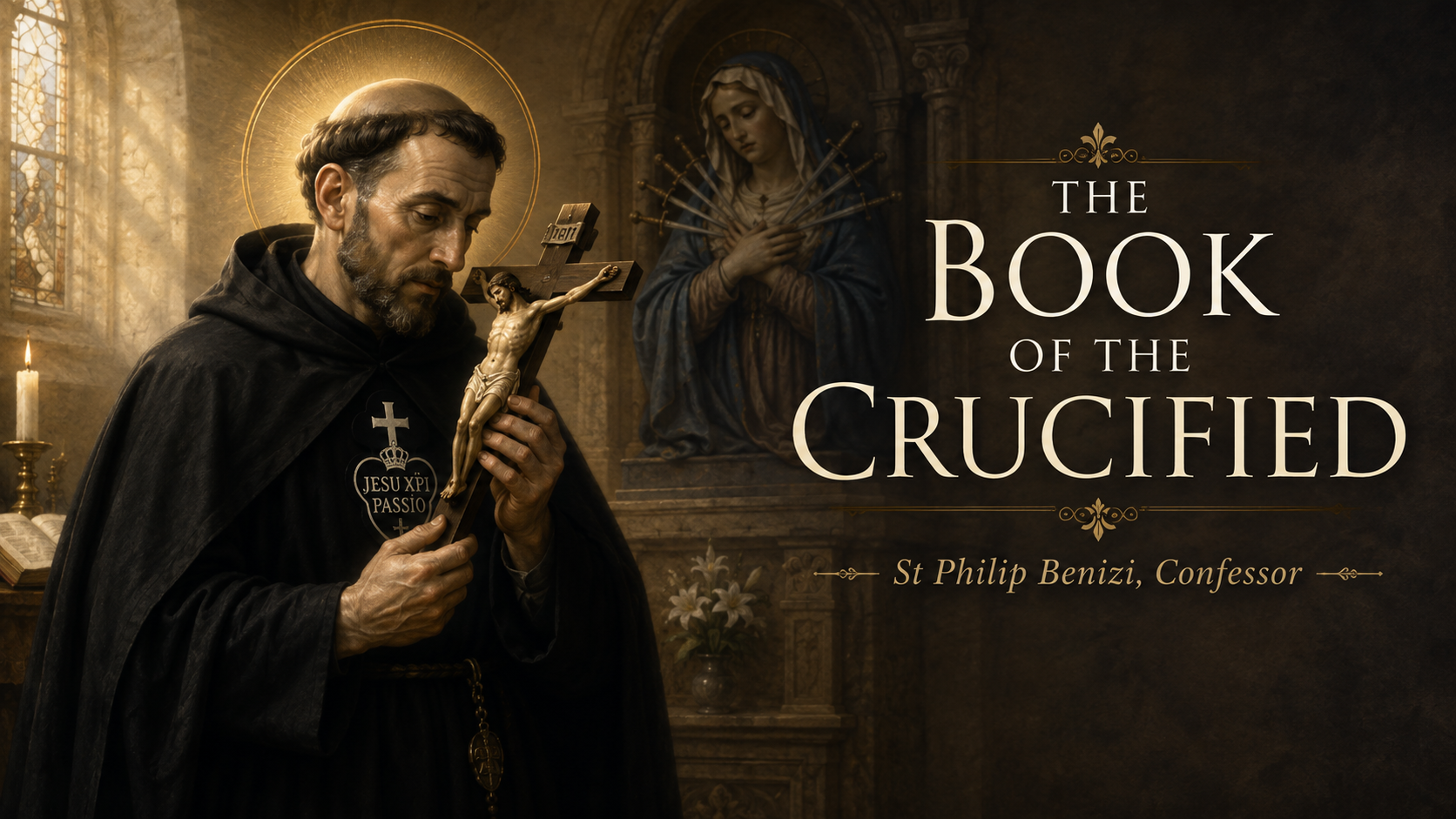
The Book of the Crucified: St Philip Benizi, Confessor, August 23
The Roman liturgy chooses one virtue above all others by which to interpret St Philip Benizi: humility. Not timidity, self-deprecation or incapacity, but that profound Christian freedom which comes when a man no longer needs to possess himself because he belongs to God. Physician, priest, preacher, peacemaker and Prior General of the Servites, Philip possessed gifts which could have carried him to the highest dignity in Christendom; instead, when cardinals considered him for the papacy, he fled. At his death he asked only for “his book”: the Crucifix. The Mass of his feast explains why. The just man flourishes because he is planted in God; the Apostle becomes a spectacle because he has ceased living for human applause; the “little flock” possesses the Kingdom because it no longer depends upon the securities of the world. In St Philip, the Church shows us humility not as littleness of soul, but as liberation for greatness.

The feast of St Philip Benizi, Confessor, is kept on 23 August. In the older Roman calendar familiar from the pre-1955 books it is a Double feast in white, with commemoration of the Vigil of St Bartholomew and, according to the rubrics, the Vigil as the Last Gospel. In the 1962 arrangement it survives as a feast of the third class. Its Mass, Justus ut palma, is substantially that of a Confessor not a Bishop, but its proper Collect supplies the unmistakable interpretative key. God, the Church prays, has given Philip as an eximium humilitatis exemplum—an outstanding example of humility—and we ask that, following his example, we may prospera mundi despicere, et caelestia semper inquirere: despise the prosperity of the world and seek always the things of heaven.¹ The older Roman liturgy therefore places, on the threshold of an Apostle’s feast, a saint whose greatness consisted in refusing to make greatness his possession.
That Collect deserves to govern everything we say about him. The Church could have emphasised Philip’s learning, his preaching, his missionary activity, his government of the Servite Order, his peacemaking amid the savage political divisions of thirteenth-century Italy, his charity towards the poor, or the miracles attributed to his intercession. Instead she selects humility. This is characteristic of the Roman liturgy at its most penetrating. A saint’s biography may contain a hundred memorable incidents; the liturgy identifies the supernatural principle which made those incidents holy. Philip’s greatness was not that he lacked gifts, ambition or responsibility, but that he learned to hold all these beneath the sovereignty of God.
The Introit immediately prevents us from misunderstanding what humility means: Justus ut palma florebit: sicut cedrus Libani multiplicabitur: plantatus in domo Domini—“The just man shall flourish like the palm tree; he shall grow up like the cedar of Lebanon: planted in the house of the Lord.” The image is not of diminishment but of magnificent growth. Palm and cedar rise. They are vigorous, fecund and enduring. Yet their greatness is received rather than manufactured: they flourish because they are planted. The first lesson of St Philip’s Mass is therefore already a rebuke to false humility. Grace does not require a man to become less than God created him to be. It requires him to cease imagining that he is the source of what he is.
This is precisely the distinction made by St Thomas Aquinas. Humility, for the Angelic Doctor, is governed by truth. It restrains the appetite from reaching after greatness in a manner contrary to right reason, while magnanimity moves the soul towards genuinely great things according to right reason. The two virtues therefore do not contradict one another. Humility is rooted fundamentally in reverence for God: man recognises himself as creature, recognises whatever good he possesses as received from God, and refuses to appropriate divine gifts as though they originated in himself. St Thomas can consequently teach that humility and magnanimity concern the same field from different directions. The humble man need not become small-minded. He may attempt very great things precisely because he has stopped pretending that their success depends upon himself.²
Few saints illustrate that distinction more clearly than Philip Benizi. Born at Florence in 1233 and highly educated, he entered the still-young Order of the Servants of Mary and initially sought the obscurity of the lay state within the community. His learning and ability could not remain concealed, however; he was ordained priest and on 5 June 1267 was elected Prior General. The Servite Order was then passing through a dangerous stage in its early history, when the consequences of the Second Council of Lyons and wider restrictions upon newer religious communities threatened its continued existence. Philip did not invoke humility as a reason to withdraw from responsibility. He governed, preached, travelled, defended the community entrusted to him, and helped guide the Order through the crisis. The history of the Servites rightly regards his generalate as decisive.³
This is important because counterfeit humility is often merely another form of self-occupation. St Francis de Sales is wonderfully severe about it. He rejects the idea that we honour God by denying the graces He has actually bestowed. True humility knows the gifts, acknowledges their Giver, and uses them when charity and duty require. False humility says, “I cannot,” when what it frequently means is, “I do not wish to risk myself.” De Sales observes memorably that honour, rank and dignity are like saffron, which flourishes better when trodden underfoot; yet he is equally emphatic that refusing God-given talents under a pretence of lowliness may itself conceal pride.⁴ Philip’s humility had precisely this quality. He did not make himself useless in order to prove that he was humble. He allowed God to make use of him without beginning to believe that he belonged to the offices he occupied.
To understand Philip fully, however, we must understand what it meant for him to be a Servite. The spirituality of the Order is centred upon the Passion of Christ contemplated with the sorrowful Mother who stands beneath the Cross. Traditional Servite spirituality interprets the black habit as a memorial of the Sorrows of Mary, and the Order’s characteristic apostolate became the propagation of devotion to her Dolours. Its spiritual instinct is therefore profoundly Christocentric and Marian at once: to stand with Mary is to look where Mary looks, and she looks towards the Crucified. Philip became so important in the Order’s preservation and expansion that Servite memory came to regard him almost as an eighth founder, the great consolidator of the work begun by the Seven Holy Founders.⁵
Dom Prosper Guéranger perceives something particularly beautiful in Philip’s place in the liturgical year. In the ancient arrangement of the Roman calendar, the Octave of the Assumption has only just closed. The Church has spent eight days contemplating the triumph of the Mother of God; then appears Philip, whom Guéranger presents as an apostle of her sorrows, recalling us to the road by which heavenly glory is attained. Mary’s Assumption does not abolish Calvary. Her glorification reveals where the road ends; Philip reminds us what the road costs.⁶ The juxtaposition is profoundly Catholic. The Mother who is crowned is the Mother who stood at the Cross. The Servite who longs for heaven learns from her that glory is not seized but received, and that the road to exaltation passes through obedience, surrender and fidelity.
There is a profound theology here. The Blessed Virgin is the most exalted of creatures precisely because she is the creature who most perfectly receives. Her fundamental answer to God is not self-assertion but Fiat. At Nazareth she receives a vocation she did not invent; at Bethlehem poverty; in Egypt exile; during the public ministry of Christ, obscurity and progressive relinquishment; at Calvary, the sword foretold by Simeon. Yet none of this makes Mary passive. Her humility is the highest created receptivity to grace. She does not design holiness for herself; she consents to God’s design. Philip learned humility in that Marian school. The Servant of Mary becomes great by learning from Mary that sanctity is not self-construction but supernatural availability.
The Epistle, 1 Corinthians 4:9–14, gives the feast a harder edge. St Paul describes the Apostles as men made a spectacle to the world, angels and men: fools for Christ, weak, dishonoured, hungry, persecuted, reviled and treated as the refuse of the world. Yet when reviled they bless; when persecuted they endure; when slandered they entreat. The Church deliberately places this apostolic abasement before us on the feast of a man whose talents and responsibilities had made him conspicuous. The lesson is not that authority is intrinsically corrupting, nor that public service is incompatible with sanctity. It is that apostolic authority becomes spiritually dangerous when the man exercising it begins to require the honour attached to it.
St John Chrysostom, commenting upon this passage, notices the deliberate irony with which Paul contrasts the self-satisfied Corinthians with the suffering Apostles. The Corinthians imagine themselves already rich, already strong, already reigning. Paul confronts them with the authentic apostolic condition: the ministers of Christ appear condemned and contemptible according to the world’s judgement. Yet Chrysostom sees the paradox. Their humiliation itself manifests their greatness, because their combat is worthy of angelic contemplation. What appears as abasement before the world becomes supernatural magnificence before God.⁷
The great Catholic exegete Cornelius a Lapide develops the same image. The Apostles stand, as it were, in the theatre of the universe. To worldly eyes they are exposed as failures; before the angels and the faithful their constancy becomes a spectacle of fortitude, faith, innocence, patience and meekness.⁸ The Christian life is therefore lived beneath a different gaze. The decisive question ceases to be, “What will men think of me?” and becomes, “What is true before God?” That is the interior revolution humility accomplishes.
Philip lived in a world saturated with public honour, political rivalry and faction. Thirteenth-century Italy was repeatedly convulsed by the struggles of Guelph and Ghibelline, civic rivalry, family prestige, vendetta and ecclesiastical conflict. Servite tradition remembers Philip travelling among Italian cities as a reconciler, attempting to restore peace and call men back from factional hatred. His effectiveness as a peacemaker cannot be separated from his detachment from honour. A man who desperately needs to win cannot easily reconcile enemies, because reconciliation usually requires surrendering some part of the satisfaction of victory. The humble man possesses a freedom unavailable to the partisan: he can defend truth without needing to possess the triumph.
This also explains one of the most famous episodes of Philip’s life. After the death of Clement IV, during the long and troubled papal election at Viterbo, some of the cardinals reportedly turned their thoughts towards Philip as a possible candidate. The Breviary tradition does not say that Philip was elected pope, as popular retellings sometimes exaggerate; rather, certain cardinals considered him because of the reputation of his prudence and sanctity. Learning of it, Philip withdrew and concealed himself until Gregory X had been chosen.⁶ Guéranger naturally connects the episode with the Collect: the man who fled even the possibility of the tiara becomes the intercessor through whom the Church asks us to despise worldly prosperity. The distinction is important. Philip was not rejecting the papacy. He was fleeing its honour for himself. His humility was not contempt for authority; it was freedom from appetite for authority.
The Gospel, Luke 12:32–34, reaches still deeper: Nolite timere, pusillus grex—“Fear not, little flock.” Why should the little flock not fear? Not because Christ promises that it will cease to be little. Not because He guarantees social prestige, institutional security, political influence or numerical dominance. The reason is altogether different: “for it hath pleased your Father to give you a kingdom.” The ground of Christian confidence is therefore not the visible strength of the flock but the fidelity of the Father.
The patristic interpretation preserved by St Thomas in the Catena Aurea is exceptionally rich. Theophylact connects the littleness of the flock with voluntary poverty; Bede associates it with the humility of the elect; St Cyril of Alexandria identifies the reason fear can be cast aside: the Father who intends to bestow the Kingdom cannot be imagined as abandoning those whom He has made its heirs. The logic runs from divine generosity to human detachment. Because the Kingdom is gift, earthly possessions can cease to function as our ultimate security.⁹ The “little flock” is not told to solve its anxiety by becoming impressive. It is told not to fear being little.
This is one of the most important corrections the Gospel makes to Christian thinking in every age. We instinctively assume that the Church is safest when she is largest, wealthiest, most culturally accepted, institutionally strongest and politically best connected. None of these things is necessarily evil; some may be genuine instruments of apostolate. But Christ does not ground the confidence of His disciples in any of them. He says simply: Nolite timere, pusillus grex. This is not an excuse for pastoral incompetence. Philip himself disproves such an interpretation: he preached, governed, expanded his Order and worked for conversions. Christian detachment from worldly success is not permission to become ineffective. Rather, it prevents success itself from becoming the criterion of fidelity.
The distinction is decisive. Once institutional survival becomes an absolute good, compromise can always be justified as necessary for preservation. Once social acceptance becomes a measure of evangelisation, inconvenient truths gradually become negotiable. Once numbers become the principal evidence of ecclesial health, the temptation arises to give men whatever will keep them within the institution. The saint asks a more severe question: is it faithful? Only the man who knows that the Kingdom is the Father’s gift is completely free to ask it.
Our Lord continues: “Sell what you possess and give alms … make to yourselves bags which grow not old, a treasure in heaven which faileth not.” The point is not an abstract contempt for material creation. The Gospel exposes the spiritual mechanism by which possessions become possessors. Christ concludes: “For where your treasure is, there will your heart be also.” Our treasure is therefore often revealed by our fear. What can I not bear to lose? Position? Money? Reputation? Influence? A particular institution? Another person’s approval? My image of myself? The answer frequently identifies the altar at which the heart is secretly worshipping.
Philip’s life turns the Gospel into biography. The traditional Breviary lessons remember his remarkable charity towards the poor and give particular prominence to the episode in which he gave his own garment to a naked leper, an act associated in the hagiographical tradition with a miraculous healing.⁶ Whatever distinctions modern historiography may wish to draw between the historical, devotional and miraculous dimensions of such accounts, their inclusion in Philip’s liturgical memory is itself significant. The Church wants us to see a man for whom possessions had become instruments of charity rather than guarantees of security.
The mystical tradition takes us still further. St John of the Cross expresses with uncompromising severity the interior logic already contained in Philip’s Collect: “In order to arrive at possessing everything, desire to possess nothing.” He does not mean that created goods are evil or that Christian life culminates in sterile negation. His doctrine of detachment seeks to free the soul from disordered dependence upon created things so that God may be possessed without rivalry. The detached soul is no longer thrown into disorder by either elevation or abasement, and St John connects that freedom directly with humility.¹⁰ Here we arrive at something crucial in Philip Benizi. The man who desires no dignity cannot be controlled by the promise of dignity. The man who does not require applause cannot be silenced by the threat of ridicule. The man who does not depend upon prosperity cannot be purchased by prosperity. The man who has surrendered his reputation to God becomes extraordinarily difficult to intimidate.
Humility is therefore not weakness. It is one of the conditions of Christian courage. This explains why St Thomas insists that humility and magnanimity are compatible. The opposite of pride is not cowardice. The opposite of vanity is not ineffectiveness. The saint does not cease doing great things; he ceases needing them to prove that he is great.
That makes Philip unexpectedly relevant to an age of self-invention. Modern culture repeatedly encourages us to understand identity as something principally asserted, fashioned and displayed. The Christian begins somewhere else: I have received myself. Existence is received. Nature is received. Baptism is received. Grace is received. Revelation is received. The Faith is received. Vocation is received. Authority, where legitimately possessed, is received as stewardship. Even the talents by which a man responds to God have first been given by God. St Paul asks the Corinthians immediately before the passage appointed for Philip’s feast: “What hast thou that thou hast not received?” Chrysostom makes this the foundation of his assault upon their vanity. Whatever excellence they possess, they possess by reception; therefore the gift gives no rational basis for boasting as though they were its source.⁷ Christian humility, properly understood, is reality received with gratitude.
And then we reach the image by which Philip is most worth remembering. At the end of his life at Todi in 1285, Philip asked for his “book”. His brethren did not initially understand what he meant. He meant the Crucifix. The Breviary tradition preserved by Guéranger says that he died embracing and kissing the image of the Crucified Lord, which he habitually called his book. Pius Parsch seizes upon the same image as the interpretative key to the feast: this was the manual from which Philip had learned the humility celebrated by the Collect.⁶ ¹¹ It is difficult to imagine a better conclusion to his life.
For what does that Book teach? The Eternal Word does not cling to the manifestation of His majesty but takes the form of a servant. The Creator submits to creatures. Omnipotence permits itself to be bound. Innocence accepts condemnation. The King receives thorns for His crown. The hands which fashioned Adam are nailed open. He who could command legions of angels permits men to imagine that they have conquered Him. And precisely there—where worldly judgement sees failure, weakness and disgrace—the redemption of the world is accomplished.
The Crucifix is therefore the final commentary upon St Philip’s Mass. Spectaculum facti sumus mundo: Christ Himself became the spectacle. Nolite timere, pusillus grex: the Shepherd Himself accepted apparent defeat. Ubi enim thesaurus vester est, ibi et cor vestrum erit: His treasure was the Father’s will and the salvation of souls. Vos, qui reliquistis omnia, et secuti estis me: before asking His disciples to leave all things, He had given all things. Philip had spent his life reading that book because every page of genuine humility ultimately leads to Calvary.
This is precisely where Philip’s Servite vocation and the liturgy become one. Beside the Crucified stands Mary. She does not save her Son from the Cross. She does not abandon Him because appearances suggest catastrophe. She does not substitute her judgement for the designs of Providence. She stands: Stabat Mater. Her faith remains, her charity remains, her fidelity remains. After Calvary comes Easter; after the sword comes the Assumption; after the humiliation of the Cross comes the exaltation of the Crucified. Guéranger therefore sees Philip’s appearance immediately after the Assumption Octave as something more than liturgical accident. The Servant of Mary comes from the school of her Sorrows to remind us that the glory we have contemplated in her is reached by conformity to her Son. Heaven is the end; the Cross is the road.⁶
The Gradual has already said it: Os justi meditabitur sapientiam—“The mouth of the just shall meditate wisdom.” The wisdom Philip meditated was not an abstraction. At his death it could be placed into his hands. His “book” had a corpus. It was the Body of the Crucified.
The Communion provides the final interpretation: Vos, qui reliquistis omnia, et secuti estis Me, centuplum accipietis, et vitam aeternam possidebitis—“You who have left all things and followed Me shall receive a hundredfold and shall possess everlasting life.” St Thomas, in treating of the religious state, makes clear that evangelical renunciation is intelligible only in relation to charity and the following of Christ. Poverty is not perfection simply because things are absent. Renunciation removes impediments so that the soul may be more completely directed towards God. The decisive words are not merely “left all things”, but “followed Me”.¹²
That is the difference between Christian detachment and mere emptiness. One can possess nothing and still be consumed by what one wishes one possessed. One can live obscurely while dreaming incessantly of recognition. One can speak humbly and remain imprisoned by self-consciousness. One can even make humility itself a performance. Philip’s Mass permits none of this. The palm flourishes. The cedar grows. The just man speaks wisdom. The Apostle works. The servant governs. The preacher travels. The peacemaker enters conflict. But none of these things is done in order to manufacture a self.
The Secret and Postcommunion complete the same movement. The Church asks that the sacrifice associated with Philip’s humility may purify us, and that the heavenly food received may defend us against adversity.¹ The movement is characteristically Catholic. We do not empty ourselves into nothingness. We relinquish what is false so that we may be filled with what is real. At the altar, the lesson of Philip’s crucifix becomes sacramental: Christ gives Himself and the communicant receives Him.
That may finally be why the Church calls St Philip an outstanding example of humility. He demonstrates the astonishing fruitfulness of a man who has nothing left to prove. He could govern because office did not define him; reconcile because victory did not possess him; preach because applause did not authenticate him; flee the prospect of the tiara because dignity did not complete him; give away his garment because possessions did not secure him; and face death because even life itself had already been surrendered. At the end there was no résumé to be reviewed, no office to be remembered, no reputation to be defended. There was only the request: bring me my book.
They brought him the Crucifix. The Roman liturgy has spent the whole Mass teaching us how to read it. The world says: establish yourself; the Crucified says: deny yourself. The world says: acquire; Christ says: leave all and follow Me. The world says: fear becoming little; Christ says: Nolite timere, pusillus grex. The world says: secure your prosperity; the Collect says: prospera mundi despicere. The world says: make yourself great; the Introit says that the just man flourishes because he is planted in the house of the Lord.
And St Philip Benizi, Servant of Mary, closes his eyes with the Book of the Crucified in his hands. For the man who has learned that book has learned the secret of humility: not to become nothing, but to cease pretending that anything is ours which has not first been received from God. Only then are we free to become what God intended us to be.
¹ Missale Romanum, 23 August, St Philip Benizi, Confessor, Missa Justus ut palma: Introit, Collect, Epistle, Gospel, Secret, Communion and Postcommunion.
² St Thomas Aquinas, Summa Theologiae, II–II, q.161, especially aa.1–5, on humility, reverence for God and magnanimity.
³ The Catholic Encyclopedia, “Servants of Mary” and historical material on St Philip Benizi and his election as Prior General in 1267.
⁴ St Francis de Sales, Introduction to the Devout Life, Part III, chapters IV–V, on humility, honour and the acknowledgment of God’s gifts.
⁵ The Catholic Encyclopedia, “Servants of Mary”, on Servite history and the Order’s devotion to the Passion of Christ and Sorrows of the Blessed Virgin.
⁶ Dom Prosper Guéranger, The Liturgical Year, 23 August, “St Philip Benizi, Confessor”, incorporating the traditional Roman Breviary lessons.
⁷ St John Chrysostom, Homilies on First Corinthians, Homily XII, on 1 Corinthians 4.
⁸ Cornelius a Lapide, Commentaria in Scripturam Sacram, commentary on 1 Corinthians 4:9–13.
⁹ St Thomas Aquinas, Catena Aurea in Lucam, on Luke 12:32–34, citing Bede, St Cyril of Alexandria, Theophylact and other Fathers.
¹⁰ St John of the Cross, Ascent of Mount Carmel, Book I, chapter XIII, on detachment and humility.
¹¹ Pius Parsch, The Church’s Year of Grace, commentary for the feast of St Philip Benizi.
¹² St Thomas Aquinas, Summa Theologiae, II–II, q.186, on the religious state, evangelical renunciation and the perfection of charity.
related articles


Latest articles
- Today’s Mass: October 08 St Bridget of SwedenSaint Bridget of Sweden, born around 1302, was a noblewoman renowned for her piety and prophetic revelations. After marrying Prince Ulpho and raising eight children, she led a life of austerity and charity, founding the Order of the Holy Saviour. She died in Rome in 1373 and was canonised in 1391.
- Today’s Mass: October 07 Pope St Mark, ConfessorSt Mark’s brief pontificate teaches that God measures fidelity, not duration or worldly achievement. Christ alone possesses the everlasting priesthood; His servants are stewards of what they have received. With the commemorated martyrs, St Mark reminds us to persevere faithfully, so that when the Lord comes, He finds us “so doing.”
- Omnia autem probate: quod bonum est tenete ~ Prove all things; hold fast that which is good: Spiritual Conference for Nuntiatoria CXXVIThe conference reflects on St Paul’s assertion to “prove all things” in relation to self-judgement and the Church. It explores themes of synodality, ecumenism, and the importance of discernment, emphasising the need for humility in understanding truth and the challenge of maintaining genuine holiness in the midst of contemporary ecclesiastical crises.
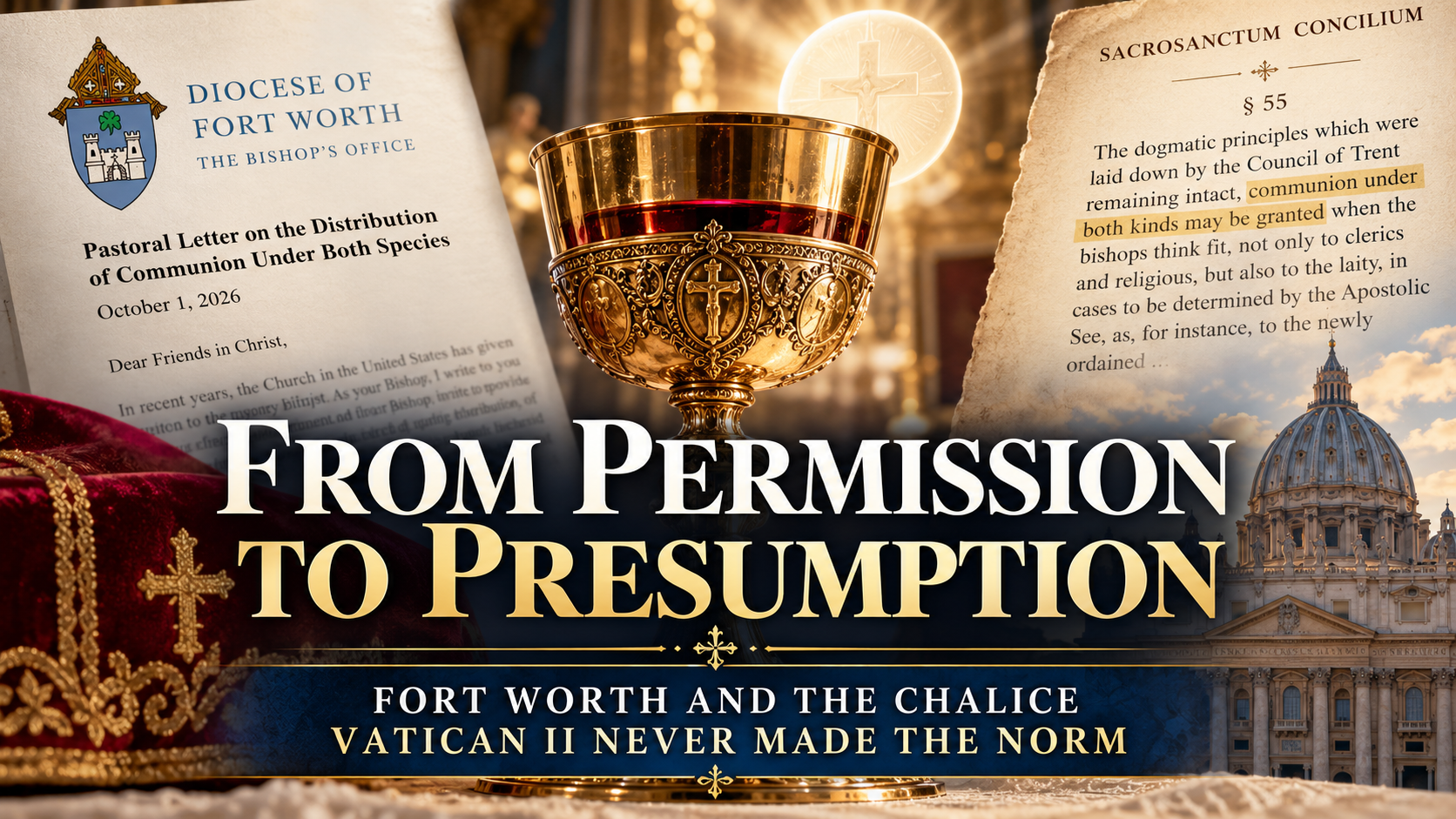
- FROM PERMISSION TO PRESUMPTION: Fort Worth and the Chalice Vatican II never made the NormBishop Michael Olson has implemented strict limitations on the distribution of Communion under both species in the Diocese of Fort Worth, prompting a discussion on the historical evolution of liturgical practices following Vatican II. This decision aims to reaffirm the doctrine of the Eucharist, emphasising that Christ is fully present under either species, while addressing misconceptions surrounding modern practices.
- AUGSBURG 2030: Can Rome commemorate a Confession it once confuted?Pope Leo XIV aims to revitalise the ecumenical spirit of the Augsburg Confession for its 2030 anniversary. However, historical responses from Rome highlight significant doctrinal differences between Catholics and Lutherans. True reconciliation must acknowledge these unresolved issues, as merely celebrating commonality risks glossing over critical theological distinctions that led to the Reformation.



Leave a Reply