

She Stood Beneath the Cross
MASS Stabant juxta Crucem
LESSON Judith 13: 22-25
GOSPEL St John 19: 25-27
HOMILIST Mt Revd Jerome Lloyd OSJV

In the Name of the Father, and of the Son, and of the Holy Ghost. Amen.
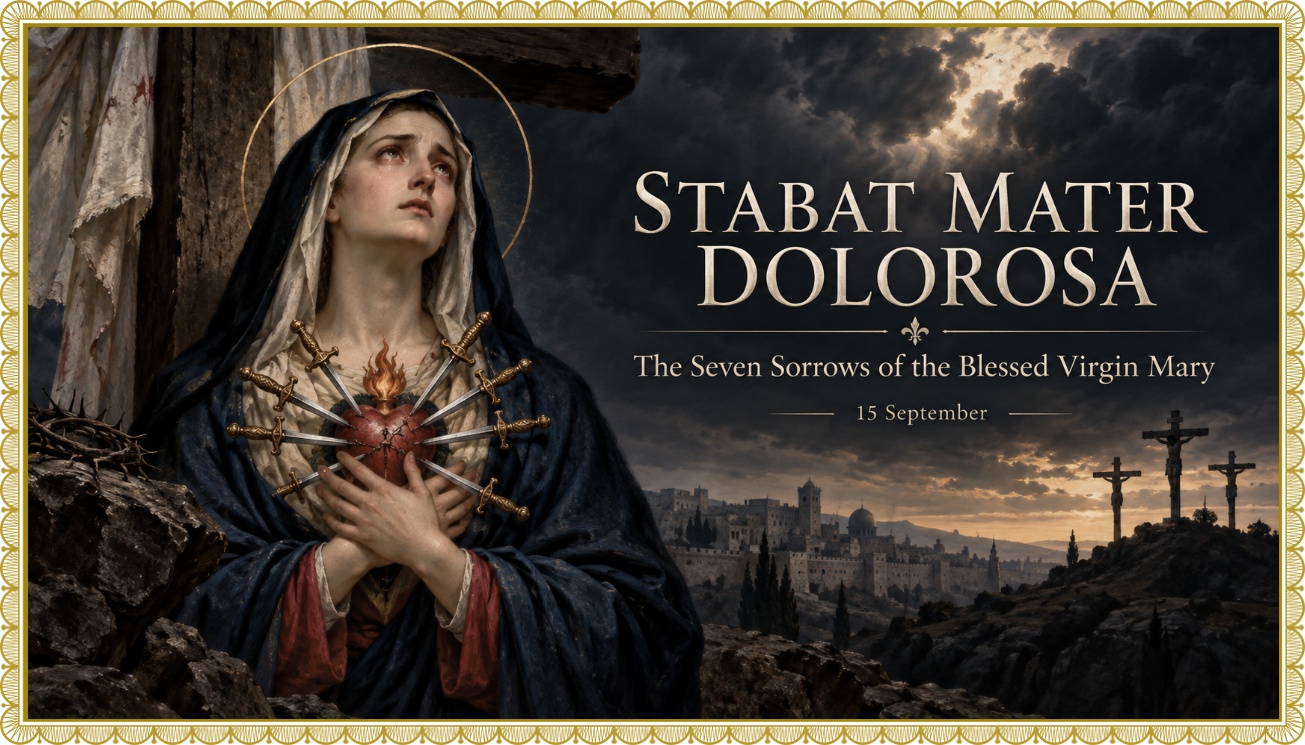
The liturgy gives us one word today which is sufficient for an entire spiritual life: stabat. She stood. Stabat juxta Crucem Jesu Mater ejus — there stood beside the Cross of Jesus His Mother. The Church does not begin by telling us that Mary wept, although surely she did. She does not begin with the sword of Simeon, although that sword has now entered to its full depth. She begins with the fact that Mary remained. The Apostles had scattered. The crowd mocked. The rulers supposed the matter finished. The soldiers divided His garments. Christ hung upon the Cross, and His Mother stood. That is the mystery the Church places before us today: not sorrow for its own sake, but fidelity when fidelity has become costly.
Yesterday the Church exalted the Holy Cross. Today she places us beside it. The order is exact. First Christ, then Mary; first the Sacrifice, then the Mother who suffers with the Victim. Mary never competes with her Son. Her whole greatness lies in her relation to Him. Her Sorrows are holy because they are bound to His Passion; her compassion is profound because her charity towards Him is perfect; her spiritual martyrdom derives from her union with the Redeemer whose Flesh she gave Him and whose mission she received with her Fiat. The closer the charity, the deeper the compassion. This is why St Bernard can speak of the sword passing through Mary’s soul when the soldier’s lance could no longer inflict pain upon the dead Christ. She is Queen of Martyrs not because an executioner killed her, but because love joined her interiorly to the Passion of her Son.
Yet this feast is not merely about something which happened to Mary. It teaches us what happens to faith when Providence brings us to a place we would never have chosen. We are tempted to imagine that fidelity to God should make life intelligible. We pray, we obey, we try to live rightly, and somewhere beneath it there can remain the expectation that God will therefore arrange events in a recognisably satisfactory manner. Mary destroys that bargain. No creature had believed more perfectly. No creature had obeyed more fully. No creature loved Christ with greater purity. And still she stood beneath the Cross.
This is where St Thomas Aquinas gives us an indispensable distinction. If Mary’s will was perfectly conformed to God, and God willed that the salvation of mankind should be accomplished through Christ’s Passion, did Mary therefore have to desire the torture and death of her Son? Thomas answers no. The Passion considered in itself was evil: the suffering and murder of the innocent. Considered in relation to the saving end ordained by God, it was the instrument of Redemption. Mary could recoil from the Passion as the suffering of her Son and yet remain perfectly united to the divine will by consenting to the good which God brought through it. Her sorrow did not contradict her obedience.
That distinction matters because Christian resignation is often badly understood. Faith does not ask us to call evil good. A grieving mother need not pretend that death is desirable. A sick man need not enjoy pain. A victim of injustice does not have to say that injustice is somehow just because God has permitted it. Our Lord Himself prayed that the chalice might pass while remaining perfectly obedient to the Father. Holiness does not mean becoming insensible. It means refusing to make suffering into an argument against God. Mary does not say that Calvary is good in itself. She says, by remaining there, that God is still good even at Calvary.
The Collect of today’s Mass makes precisely this movement. It recalls that the sword of sorrow passed through the most sweet soul of the glorious Virgin and then asks that, by venerating her Transfixion and the Passion of Christ, we may obtain the saving fruit of that Passion. The liturgy does not invite us merely to admire Mary’s sorrow. It draws us through her sorrow into Christ’s Sacrifice. The Stabat Mater makes the same demand: Juxta Crucem tecum stare — let me stand with thee beside the Cross. That is not sentimental poetry if we pray it seriously. We are asking not merely to observe Calvary, but to remain faithful when some share of its pattern enters our own life.
There comes a point in almost every Christian life when action reaches its limit. There are illnesses which cannot be cured, losses which cannot be undone, consequences which cannot be removed, and circumstances which no amount of intelligence or effort can reverse. Mary could not remove the nails, revoke Pilate’s sentence, silence the mockers or shorten the three hours. She could stand. But standing there was not doing nothing. It was an act of faith, hope, charity and obedience when everything visible appeared to contradict the promise.
This is the mystical force of stabat. Mary does not judge God by appearances. At Nazareth she had heard that her Son would receive the throne of David and that of His kingdom there would be no end. On Calvary He appears dispossessed even of His garments. She had been told that He was holy and the Son of God; now He is executed between criminals. If faith were merely confidence in circumstances, it would have died beneath that Cross. But Mary’s faith rests not upon circumstances but upon God. Her Fiat survives because the One to whom it was given has not changed, even when everything she sees is incomprehensible.
The question for us is therefore not whether we will suffer; the Gospel has never promised otherwise. The question is whether our Fiat survives suffering. It is easy to trust Providence when Providence coincides with our plans. It is easy to speak of surrender when the thing surrendered has not yet been asked for. Mary shows us a faith which does not withdraw consent when obedience becomes painful. She does not understand Good Friday by pretending that it is Easter. She simply refuses to treat Good Friday as though God had ceased to be God.
St John Damascene gives the feast another dimension. Mary had not suffered the ordinary pains of childbirth when she brought forth Christ; at the Passion she endured, by compassion, the travail which Bethlehem had not required. Yet he immediately completes the thought by turning towards the Resurrection. The pain is transformed by Easter joy. This is why the Church celebrates today in white. The colour is not incidental. The Mother of Sorrows is not being mourned. She is already crowned. The liturgy sings Alleluia because it remembers Calvary from the far side of the empty tomb.
That changes the Christian understanding of sorrow. There is a grief which says: this has happened, therefore nothing has meaning. Christian sorrow says something else: this has happened, and I may not understand it, but God has not ceased to be faithful. The wound is real, but it is not sovereign. Mary allows the sword to pass through her soul, but she does not allow the sword to define God.
And this brings us to one of the most remarkable texts of today’s Mass, the Communion: Felices sensus beatæ Mariæ Virginis, qui sine morte meruerunt martyrii palmam sub Cruce Domini. Blessed are the faculties of the Blessed Virgin Mary which, without death, merited the palm of martyrdom beneath the Cross of the Lord. The Church does not merely call her sorrowful; she gives her the palm of martyrdom. She has not died, yet she is crowned as martyr because her whole interior life has remained united to Christ beneath the Cross.
There is the climax of the feast. The sword does not have the final word. The Cross does not have the final word considered merely as instrument of torture. Death does not have the final word. The liturgy sees already the palm. It sees victory hidden inside endurance. It sees fidelity crowned.
That is the lesson for those who carry their own hidden crosses. The Church does not ask us to admire suffering, still less to seek it. She asks us, when suffering comes, not to abandon Christ within it. There may be moments when we can do very little outwardly. We may not be able to solve the problem, repair the loss or understand why Providence has permitted it. But there remains something profoundly Christian which can still be done: we can stay with Christ. We can pray when prayer feels dry. We can refuse bitterness. We can continue in charity. We can surrender what cannot be changed. We can stand.
And when we find ourselves unable to stand by our own strength, the feast gives us the Mother of Sorrows. Devotion to her Seven Sorrows is not counting griefs as though suffering were a spiritual achievement. It is learning how a Christian suffers: without denying the wound, without accusing God, without abandoning Christ, and without forgetting the Resurrection.
Yesterday the Church exalted the Cross. Today she shows us the Mother beneath it. And at Holy Communion she tells us where such fidelity ends: not in defeat, but in the martyr’s palm.
Stabat Mater dolorosa.
She stood beneath the Cross because she still believed.
And the sword pierced her heart, but it could not conquer her faith.
In the Name of the Father, and of the Son, and of the Holy Ghost. Amen.
Homilies Archive

Mass Propers


DAILY MASS ONLINE
One of the earliest online apostolates dedicated to the Traditional Latin Mass, Old Roman TV began broadcasting the Holy Sacrifice on the Feast of the Assumption, 15 August 2008. During the COVID-19 pandemic, additional programming — devotions, catechesis, and conferences — was added to support the faithful in prayer and formation.
Support the daily Holy Mass on Old Roman TV by offering a Mass intention — for loved ones, thanksgiving, or the repose of souls. Your intention helps sustain the sacred liturgy and brings grace to those you remember before God’s altar.
SUPPORT THE DAILY MASS ONLINE
Likely the world’s longest-running daily online broadcast of the
Traditional Latin Mass, streaming faithfully since the
Feast of the Assumption 2008.

This apostolate cannot continue without immediate help
Please support us with a contribution toward
chapel rent, sacristy supplies, operating costs, and web-hosting.
Our essential monthly costs reach £1,000.


Leave a Reply