

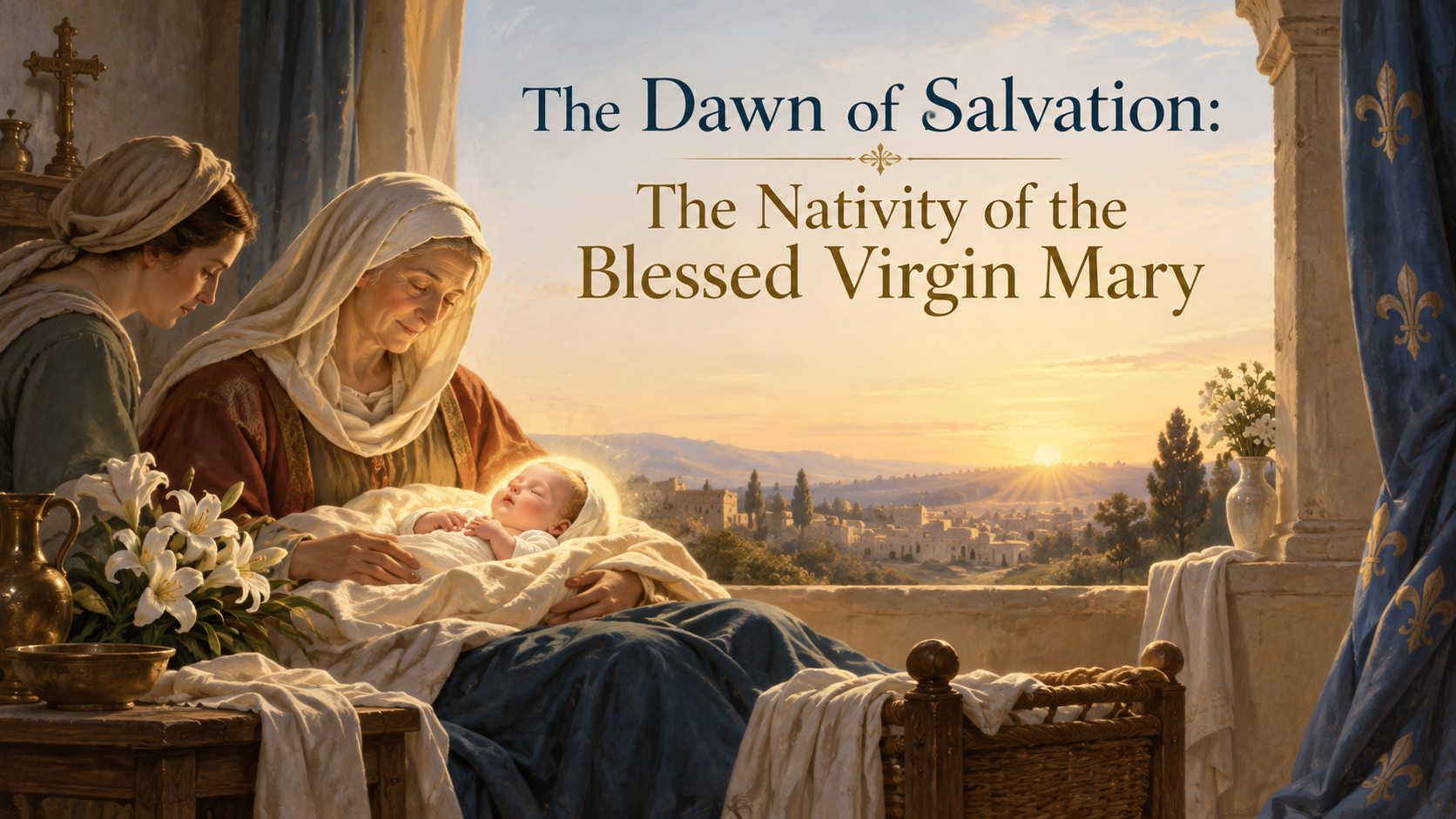
The Dawn of Salvation
MASS Salve, sancta parens
LESSON Proverbs 8: 23-35
GOSPEL St Matthew 1: 1-16
HOMILIST Mt Revd Jerome Lloyd OSJV

In the Name of the Father, and of the Son, and of the Holy Ghost. Amen.
“My heart hath uttered a good word: I speak my works to the King.” So begins the Introit of today’s Mass, and the Church places those words upon our lips because the birth we celebrate is already ordered towards the King who is to come. The Nativity of the Blessed Virgin Mary is not simply the birthday of a saint, nor even merely the birthday of the greatest of the saints. It belongs to the mystery of the Incarnation itself. The Collect gives us the key when it speaks of Mary’s birth as salutis exordium — the beginning of salvation. Salvation is not yet accomplished; Christ has not yet been born, Gabriel has not yet spoken, the Fiat has not yet been uttered, Bethlehem and Calvary are still in the future. Yet the Mother of the Redeemer has entered the world. The woman from whom the Eternal Word will receive His human nature is now alive upon the earth, and for that reason the Church sees in her Nativity not merely an event in the life of Mary, but the first visible dawn of the Incarnation.
There is something deeply consoling in the hiddenness of that beginning. The world does not know that anything important has happened. No emperor takes notice, no court sends messengers, no chronicler records the birth, and nothing in the outward appearance of history suggests that the divine plan has advanced. Yet in the providence of God something decisive has occurred. That teaches us something about the way God works. We are inclined to judge significance by visibility, scale and immediate consequence; we expect the important work of God to look important at once. But the economy of salvation repeatedly contradicts that instinct. Nazareth is hidden, Bethlehem is small, Calvary appears to the world as defeat, and even the Resurrection takes place before the world understands that anything has changed. The Nativity of Our Lady belongs to that same divine pattern. God is already acting before men recognise the action, already preparing before they understand what is being prepared.
That is why this feast has always been associated with the image of the dawn. Mary is not the Sun; Christ alone is the Sun of Justice. She possesses no light independently of Him. But the dawn is luminous because the sun is approaching, and its beauty lies precisely in what it announces. So it is with Our Lady. Everything in her comes from Christ and everything in her leads towards Christ. Her Immaculate Conception, her holiness, her virginity, her divine maternity, her obedience, her sorrows and her glory all belong to the work of His grace. This is why the Church has never feared speaking magnificently about Mary. There is no rivalry between the honour given to the Mother and the glory of the Son, because her greatness manifests His power. The masterpiece does not diminish the artist; it reveals him. The holiness of Mary glorifies the grace of Christ, and the more perfectly we understand what God accomplished in her, the more clearly we see the power of the Redeemer.
The Epistle today speaks in the majestic language of Wisdom: “The Lord possessed me in the beginning of His ways.” In its highest and proper sense, that divine Wisdom belongs to the Eternal Word, yet the Church applies the passage to Mary because she existed eternally in the knowledge and providence of God as the woman chosen to become the Mother of the Word made flesh. Mary is entirely a creature; she does not pre-exist creation and she possesses nothing by nature that belongs to God alone. Yet her vocation is not accidental. Before Abraham was called, before David received the promise, before Isaiah spoke of the Virgin who would conceive, God knew the one whom He would prepare for His Son. The Incarnation enters history in time, but it belongs to the eternal counsel of God, and the Mother from whom Christ will take flesh belongs to that divine ordering. This should correct our own impatience with Providence, because what appears sudden to us is never sudden to God. He sees the end from the beginning, and He often prepares for years what we only recognise in a single moment.
The mystery of the Immaculate Conception belongs naturally here. Mary is born today already the perfect work of grace. She is not outside redemption; she is its first and most perfect fruit. The merits of Christ preserve her from the stain of original sin before the sacrifice of Calvary has taken place in time. The Son saves His Mother in the most exalted manner, not by cleansing her after the stain has been contracted, but by preserving her from contracting it at all. This is an important truth because it shows how thoroughly Marian doctrine remains Christological. Even Mary’s greatest privilege is His gift. Her Immaculate Conception does not mean that she has no need of a Redeemer; it means that the Redeemer has acted in her with supreme perfection. The grace by which she enters the world spotless is the fruit of the same Cross beneath which she will one day stand.
The Gospel gives us the genealogy of Jesus Christ, and at first this may seem an unexpected choice for a feast of Mary’s birth. Yet it is precisely the right Gospel, because it tells us why Mary matters. Abraham, Isaac, Jacob, Juda, Jesse, David, the kings, the exile, the return: generation follows generation until the long succession reaches Joseph, “the husband of Mary, of whom was born Jesus, Who is called Christ.” At that point the grammar changes. Joseph does not beget Jesus. The genealogy of Israel reaches Mary, and through her the direct intervention of God enters the succession. She stands where promise becomes fulfilment, daughter of Israel and Mother of Israel’s Messiah. The line has passed through holiness and sin, greatness and failure, fidelity and weakness, yet the promise has not been defeated. God remains faithful despite the imperfection of those through whom His providence moves. That too is a truth we need to remember whenever the weakness of men tempts us to doubt the fidelity of God.
The Church has always seen Mary in this mystery as the New Eve. The first Eve receives the word of the serpent and turns from God; Mary receives the word of the angel and submits herself to God. Eve’s disobedience belongs to the tragedy of the Fall, while Mary’s obedience belongs to the coming of the One who will overcome it. Yet the order must remain clear: Christ is the New Adam, Christ is the Redeemer, Christ alone conquers sin and death. Mary is entirely subordinate to Him and entirely dependent upon His grace. And nevertheless her consent is real. God does not use her as an unconscious instrument. He asks, and she responds: “Behold the handmaid of the Lord: be it done to me according to thy word.” In that answer we find the spiritual heart of her life. She belongs to God, and because she belongs to Him, she is free to receive His will without bargaining with it.
That is where this feast becomes an examination of our own souls. We cannot imitate Mary’s unique privileges, but we can imitate the disposition with which she receives them. We can ask whether we truly belong to God as she belonged to God. We can ask whether we receive His will, or merely ask Him to confirm our own. We can ask whether we allow grace to change us, or only so far as it leaves our preferences undisturbed. Holiness begins not in remarkable experiences, public influence or even in being thought devout, but in surrender. Mary is great because she is entirely receptive to God. She does not make herself the centre of the divine plan; she allows God to act in her. Her soul magnifies the Lord because she does not magnify herself.
This is why the Collect asks that the solemnity of her Nativity should give us an “increase of peace”. Christian peace is not the absence of suffering. Mary’s life will not be easy. Simeon will tell her that a sword will pierce her soul; she will flee into Egypt, know misunderstanding and separation, and finally stand beneath the Cross. Yet she possesses peace because she is rightly ordered towards God. Peace comes when the soul ceases fighting the truth, when we stop trying to make God’s will conform to ours and begin asking that our will be conformed to His. Mary possesses that peace because the whole movement of her life is a Fiat. Her obedience is not passive resignation but the deepest form of spiritual freedom: she is free because she belongs to God.
There is one further mystery which ought never to be lost in the contemplation of this feast. The child born today will one day give the Eternal Word the flesh in which He saves us. The hands nailed to the Cross are hands formed from the humanity He receives from Mary. The Blood poured out for our redemption belongs to the human nature He takes from her. The Sacred Heart opened by the lance is formed beneath her own heart. The Incarnation is not an abstraction, and neither is the divine maternity. God truly becomes man, and Mary truly becomes His Mother. So when the Church celebrates her birth, she is already looking towards Bethlehem and Calvary. The cradle of Mary points towards the manger of Christ, and the manger towards the Cross.
Perhaps, then, the most fitting prayer today is not that we should understand every detail of God’s plan for our lives, but that we should trust Him when we do not understand it. There may be something in our lives at present which appears unfinished or fruitless, some prayer whose answer we cannot see, some sacrifice which seems to have disappeared without result, some period of obscurity in which God appears silent. The Nativity of Our Lady teaches us not to despise hidden beginnings. On 8 September the world saw only a child; God saw Nazareth, Bethlehem, Calvary and the empty tomb. The whole mystery was already held within His providence, though almost no one could perceive it. The same Providence governs our lives, and the same God asks from us the trust which He perfected so beautifully in Mary.
So today we rejoice in the Nativity of the Blessed Virgin Mary, and we thank God for the Mother He prepared for His Son. We ask her intercession, but we also ask for something of her interior disposition: her humility, her confidence in Providence, her readiness to obey, her willingness to let God be God. The Annunciation has not yet occurred, Bethlehem is still ahead, and Calvary lies beyond it, but already the darkness is giving way. The dawn has appeared because the Sun is coming. Mary is born, and Christ draws near.
In the Name of the Father, and of the Son, and of the Holy Ghost. Amen.
Homilies Archive

Mass Propers


DAILY MASS ONLINE
One of the earliest online apostolates dedicated to the Traditional Latin Mass, Old Roman TV began broadcasting the Holy Sacrifice on the Feast of the Assumption, 15 August 2008. During the COVID-19 pandemic, additional programming — devotions, catechesis, and conferences — was added to support the faithful in prayer and formation.
Support the daily Holy Mass on Old Roman TV by offering a Mass intention — for loved ones, thanksgiving, or the repose of souls. Your intention helps sustain the sacred liturgy and brings grace to those you remember before God’s altar.
SUPPORT THE DAILY MASS ONLINE
Likely the world’s longest-running daily online broadcast of the
Traditional Latin Mass, streaming faithfully since the
Feast of the Assumption 2008.

This apostolate cannot continue without immediate help
Please support us with a contribution toward
chapel rent, sacristy supplies, operating costs, and web-hosting.
Our essential monthly costs reach £1,000.


Leave a Reply