
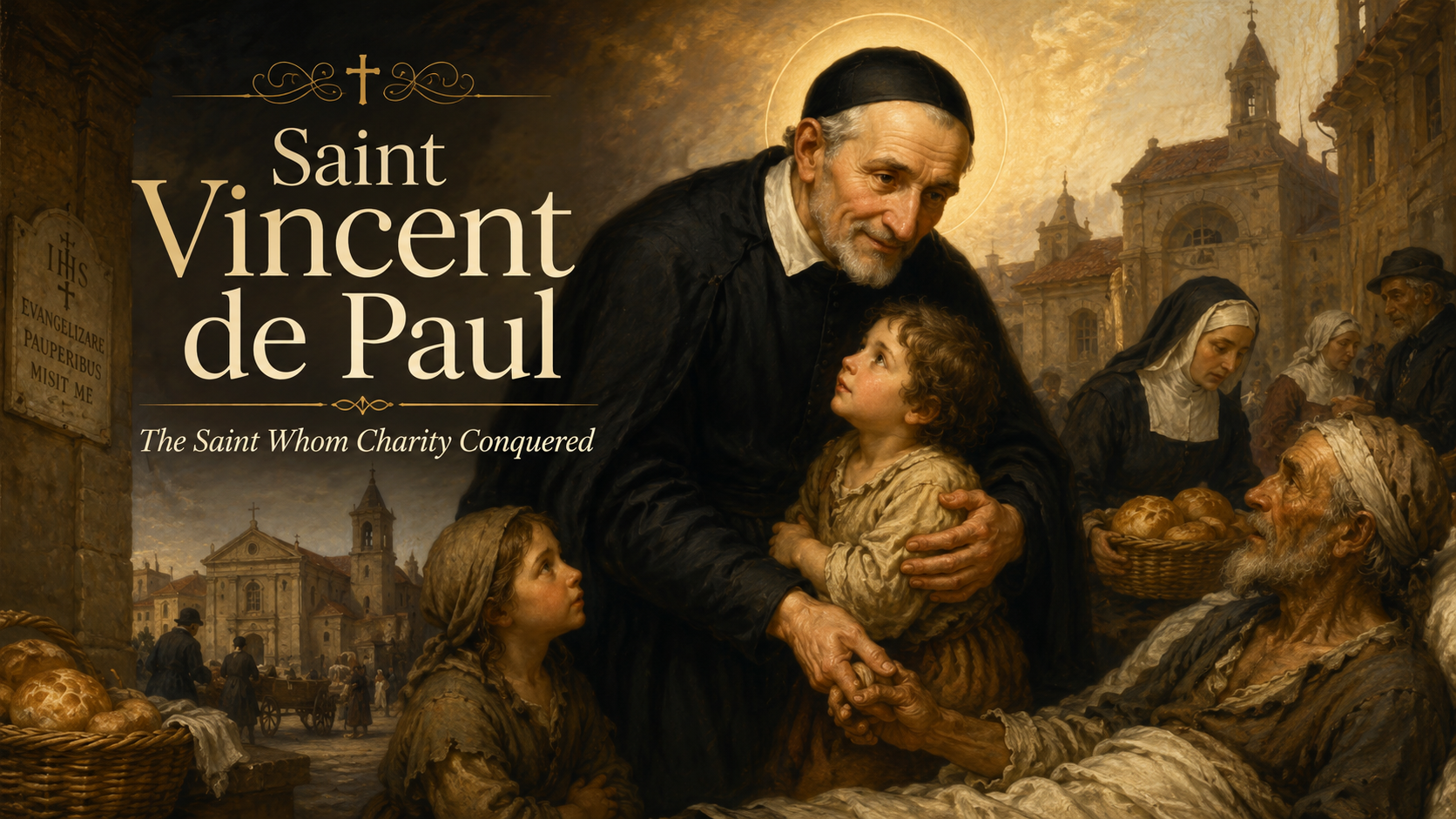
TheSaint Vincent de Paul: The Saint Whom Charity Conquered
Before Saint Vincent de Paul became the father of the poor, reformer of the clergy and organiser of some of the greatest charitable works in Catholic history, he was an ambitious young priest seeking security and advancement. His sanctity was the work of a long conversion in which divine Providence gradually emptied him of self-interest and gave him the Heart of Jesus Christ for the abandoned. The traditional feast of 19 July honours not merely the founder of institutions, but the interior man whose prayer became service, whose humility became authority, and whose charity embraced both the bodies and the immortal souls of the poor.

The familiar image of Saint Vincent de Paul is that of an elderly priest bending protectively over an abandoned child. His broad, weathered face is marked by fatigue and kindness; his cassock is plain; his hands are extended towards the helpless. So completely has his name become identified with Catholic charity that the man himself can disappear behind the institutions, societies and collections conducted under his patronage. He risks becoming an emblem of respectable benevolence rather than the formidable supernatural personality he truly was.
Vincent was no merely amiable philanthropist. He was a missionary, founder, reformer of priests, spiritual director, organiser of famine relief, protector of foundlings, counsellor of bishops, visitor of prisons, royal adviser and defender of Catholic doctrine. He could plead with queens, withstand ministers, instruct seminarians, correct religious, comfort convicts and persuade the wealthy to surrender fortunes for people they would otherwise never have seen. He moved among the highest and lowest ranks of seventeenth-century France without being seduced by the one or embittered by the other.
Yet his greatness did not consist principally in the magnitude of his undertakings. It consisted in the conquest of his heart by divine charity. The young ecclesiastic who had once hoped that the priesthood might secure his worldly future became the priest who would spend himself without reserve for people who could offer him nothing. The man naturally capable of shrewdness and irritation became renowned for simplicity and meekness. The organiser of vast enterprises remained convinced that Providence—not Vincent de Paul—was their true author.
The history of his life is therefore the history of a conversion. Grace did not destroy his practical intelligence, tenacity or capacity for government. It purified them, until qualities that might have served ambition became instruments of mercy.
The Country Boy Who Sought a Benefice
Vincent was born in the village of Pouy, near Dax in Gascony, probably in 1581. His parents, Jean de Paul and Bertrande de Moras, belonged to the rural farming class. They were not among the utterly destitute, but their life was laborious, frugal and vulnerable to the uncertainties of land, harvest and weather. As a boy Vincent tended livestock and knew the long roads, rough fields and social humiliations of peasant existence.¹
His intelligence persuaded his father that the boy might rise through education and the ecclesiastical state. Vincent studied first with the Franciscans at Dax and later pursued theology at Toulouse. His family made real sacrifices for him, and the young man appears to have understood the priesthood partly as a means of attaining a respectable position from which he could repay their investment and assist them materially.
He was ordained in 1600, exceptionally young by later standards. The first years of his priesthood remain obscure, and later biographies accumulated dramatic traditions around them, including captivity by Barbary corsairs and a prolonged temptation against the Faith. The alleged captivity rests upon letters whose interpretation and authenticity have been debated, while modern Vincentian scholarship has also questioned the historicity of the temptation narrative as told by his first biographer, Louis Abelly. These stories belong to the received hagiographical tradition, but Vincent’s demonstrable transformation does not depend upon them. What can be seen with certainty is a gradual conversion from clerical self-advancement towards complete apostolic self-surrender.²
Vincent did not become a saint because he had never desired comfort. He became a saint because grace taught him to desire something greater. His early ambitions render his later sanctity more, not less, intelligible. The father of the poor knew from within the temptation to use sacred things for personal security.
Providence frustrated his plans. Positions proved uncertain, schemes failed, and the stability he sought repeatedly eluded him. Gradually, the priest ceased asking how his ordination might solve his own circumstances and began to perceive the immense responsibility imposed by the character he had received.
Under the influence of Pierre de Bérulle and the spiritual renewal associated with the French school, Vincent contemplated more deeply the mystery of the Incarnate Word and the dignity of the priesthood. The priest existed not for benefice or status but to continue the mission of Jesus Christ, sent by the Father to preach the Gospel to the poor.
The Happiness of Clichy
In 1612 Vincent became parish priest of Clichy, a village outside Paris. There he discovered the happiness of genuine pastoral fatherhood. He repaired the church, instructed the people, promoted reception of the sacraments and formed a small group of candidates for the ecclesiastical state. He later remembered the people of Clichy with deep affection and declared that even the pope could scarcely be happier than he had been among those good parishioners.³
This was no small stage in his conversion. Vincent had once sought a parish as an ecclesiastical possession; at Clichy he began to receive a parish as a people entrusted to his soul. The difference is the difference between career and vocation.
The priesthood ceased to appear primarily as something Vincent possessed. It became the form in which Christ intended to possess Vincent.
His pastoral joy at Clichy also contradicts any reduction of his later apostolate to social service. Vincent’s first great satisfaction came from catechesis, worship, confession and the ordinary sanctification of a Christian people. He loved the poor not only because they lacked food, medicine or shelter, but because they were frequently deprived of instruction, sacramental care and priests willing to seek their salvation.
This conviction would govern everything that followed. Vincent never separated bodily misery from spiritual abandonment. He would feed the hungry, but he would also teach them to know God. He would nurse the sick, but he would also prepare them for confession and death. He would relieve the peasant, but he would also form the priest upon whose fidelity the peasant’s soul depended.
The Dying Peasant of Gannes
In 1613 Vincent entered the household of Philippe-Emmanuel de Gondi, General of the Galleys of France, as tutor and chaplain. The position placed him among the powerful and brought him into contact with Madame de Gondi, Marguerite de Silly, whose estates contained large numbers of neglected country people.
In January 1617 Vincent was called to the bedside of a dying peasant at Gannes. The man was regarded as respectable and religious, but Vincent persuaded him to make a general confession. The penitent afterwards acknowledged publicly that he had concealed grave sins and believed himself rescued from eternal loss through that confession.
Madame de Gondi was horrified. If a man generally considered good had remained in such danger, what must be the condition of the thousands of poor people who lacked instruction, zealous confessors and opportunities to understand the state of their souls?
At her request Vincent preached in the church of Folleville on 25 January 1617, the feast of the Conversion of Saint Paul. He explained how to make a good general confession. The response was so great that additional priests had to be summoned to hear the penitents. Vincent later regarded that sermon as the first mission and the seed from which the Congregation of the Mission would grow.⁴
The date possesses a providential eloquence. Folleville occurred on the feast of an Apostle conquered by grace and sent to evangelise the nations. It marked a further conversion in Vincent himself. He saw with new clarity that the rural poor were not merely disadvantaged; they were in danger of living and dying without sufficient knowledge of the Faith and without access to priests capable of reconciling them to God.
“The harvest indeed is great, but the labourers are few” became the governing text of his priesthood. The words were not an attractive missionary slogan. They described souls in danger and a clergy unequal to their need.
The young priest’s life had been preoccupied with obtaining a position. Now he began to be consumed by the absence of labourers.
Châtillon and the First Charity
Later in the same decisive year, Vincent became parish priest of Châtillon-les-Dombes. Shortly before Mass one Sunday, he was informed that a family in a distant house lay ill, destitute and without anyone to assist them. He spoke of their plight in his sermon.
When Vincent went to visit them that afternoon, he found the road crowded with parishioners carrying provisions. The response was generous, but it was also uncoordinated. More food had arrived than the family could use immediately, while nothing ensured that assistance would continue once the first emotional enthusiasm had passed.
Vincent saw at once that charity required order. Good intentions could produce waste on one day and abandonment on the next. He therefore gathered women of the parish into the first Confraternity of Charity, arranging that members would take turns visiting and assisting the sick poor. The rule he composed concerned not only food and medicine but the manner in which service was to be offered: reverently, kindly and with attention to the spiritual as well as bodily condition of the recipient.⁵
This episode discloses Vincent’s genius. He was moved by suffering, but he did not mistake emotion for effective love. Compassion had to acquire memory, discipline and permanence. The poor must not be dependent upon the fluctuating feelings of benefactors.
Benedict XVI later observed that Vincent knew how to give permanent form to service of the marginalised. Love, the Pope explained elsewhere, requires organisation if it is to become an ordered service of the ecclesial community.⁶ Vincent learned that truth at Châtillon. He did not bureaucratise mercy; he made mercy dependable.
His method was characteristically incarnational. He did not begin with an abstract system for the improvement of society. A sick family lay unattended. Parishioners possessed the means to help. Vincent placed one reality before the other and devised a form by which Christian responsibility could endure after the sermon had been forgotten.
This practical order was itself an expression of reverence. The poor were not objects into which generosity could be poured. They were persons whose changing needs had to be known, whose homes had to be entered and whose dignity had to be preserved.
Saint John Chrysostom had taught that Christians must recognise Christ in the hungry man whom they pass outside the church. He did not oppose reverence for the Eucharistic altar; he condemned the contradiction of honouring Christ sacramentally while neglecting Him in His afflicted members.⁷ Vincent gave this patristic vision a stable apostolic form. The poor man was an altar, but an altar whose sheets required changing, whose wounds required washing and whose soul required the sacraments.
The Missionaries of the Poor
Vincent eventually returned to the Gondi household, but his purpose had changed. He preached missions across the estates, catechised the country people, prepared them for confession and established confraternities to continue the works of mercy after the missionaries departed.
Other priests joined him. In 1625 the Gondis endowed a company devoted to the evangelisation of rural populations, and in 1626 Vincent and his companions bound themselves to live in community for that purpose. The Congregation of the Mission received papal approval from Urban VIII in 1633. Its members became known as Lazarists after their establishment at the former priory of Saint-Lazare in Paris.⁸
Vincent wanted missionaries who were learned enough to teach accurately but humble enough to speak intelligibly. He distrusted preaching designed to exhibit the preacher. Eloquence that won admiration without conversion had failed in its purpose.
His characteristic virtues were simplicity, humility, meekness, mortification and zeal. Simplicity he called “my Gospel.” It meant more than an uncomplicated manner. It was truth of intention: seeking God without duplicity, saying things as they were and refusing to construct an advantageous false image of oneself.⁹
This virtue did not make Vincent naïve. He was shrewd, observant and capable of negotiating with persons skilled in courtly intrigue. Simplicity did not require him to disclose imprudently everything he knew. It required that what he said be true and that what he did be governed by an undivided purpose.
His missionaries were to approach the poor without condescension. They were not bearers of cultural superiority but servants sent by Christ. The rough language, ignorance or suspicion of country people could not become an excuse for impatience. The missionary must first reverence the soul concealed beneath unpromising appearances.
Vincent knew that the poor can be difficult. Poverty does not remove the effects of original sin, confer infallibility or make every demand reasonable. His charity was therefore neither romantic nor ideological. He loved actual people, not an idealised social category.
Saint Louise de Marillac
Providence gave Vincent a collaborator whose gifts were unlike his own and therefore indispensable to his mission. Louise de Marillac was intelligent, devout, exacting and deeply sensitive. Widowed in 1625, she had suffered years of interior uncertainty and scruple. Vincent became her director, repeatedly teaching her to trust Providence rather than anticipate crosses that God had not yet sent.
Their spiritual friendship developed gradually. Vincent’s patience, breadth and confidence steadied Louise’s anxious precision; her administrative discipline, attentiveness and capacity for formation gave concrete expression to works that might otherwise have exceeded his personal reach.
Louise visited the Confraternities of Charity, corrected disorders, instructed members and ensured that the intentions of the foundation were being carried out. She did not function merely as Vincent’s assistant. She became his friend, co-worker and co-founder in one of the most fruitful spiritual partnerships in Catholic history.¹⁰
The confraternities had initially depended upon women of social position. Many served generously, but some found the more degrading tasks difficult and sent servants to perform them. Vincent and Louise recognised the need for women who would offer not merely money or occasional time, but themselves.
Marguerite Naseau, a country woman who had taught herself to read while tending cattle and then instructed village girls, became an early embodiment of this vocation. Her service demonstrated that the poor themselves were not merely recipients of charity; they could become its agents.
In 1633 a small group of women began to live in community under Louise’s direction. These were the first Daughters of Charity. Their mode of life differed from that of enclosed religious because their vocation required them to enter homes, streets, hospitals and prisons. Vincent famously described their convent as the houses of the sick, their cell as a rented room, their chapel as the parish church and the streets of the city as their cloister.¹¹
Their active life was not an escape from contemplation. On the contrary, only women formed by prayer, humility and obedience could serve amid such relentless demands without becoming merely harassed workers. Vincent taught them that an urgent summons from a sick person did not draw them away from God: they could “leave God for God,” departing from prayer to meet the same Lord hidden under the appearance of suffering.¹²
This was not permission to neglect prayer whenever activity beckoned. Vincent knew the difference between apostolic action and restlessness. Prayer disclosed Christ in the poor; service tested whether prayer had been real. Each returned the Daughter to the other.
Saint Francis de Sales, whom Vincent knew and revered, had taught that true devotion perfects rather than neglects the duties of one’s state. Vincentian spirituality carried this Salesian principle into the alleys and sickrooms of Paris. Holiness was not measured by the sweetness of religious emotion, but by conformity to the will of God in the duty immediately present.
The Convicts of the Galleys
The office of the Gondi family brought Vincent into contact with men condemned to the French galleys. Before embarkation they were imprisoned in degrading conditions: chained, underfed, diseased and treated as though punishment had extinguished their humanity.
Vincent entered their prisons, spoke with them, heard their confessions and sought reforms in their treatment. In 1619 Louis XIII appointed him royal almoner to the galleys, giving him wider access and responsibility. He helped obtain more suitable accommodation for prisoners awaiting transfer and arranged continuing material and spiritual ministry to the rowers. The Daughters of Charity later brought food, medicine and care to these men.¹³
A popular legend claims that Vincent once placed himself in the chains of a galley slave. The story in its familiar form is not securely established by the earliest evidence and should not be presented as certain history. Yet it expresses something true about his charity: he crossed the boundary respectable society had erected around the condemned.
Vincent neither denied their crimes nor confused mercy with the abolition of justice. He understood that punishment could be legitimate while cruelty remained sinful. The convict did not cease to possess a soul because he had gravely abused his freedom.
Cornelius à Lapide, commenting upon the judgement of the nations in Saint Matthew 25, explains Christ’s identification with His afflicted brethren: what charity performs towards them for Christ’s sake, Christ receives as rendered to Himself. Vincent lived that exegesis among chains and disease. He sought the Lord not in an imaginary innocence of the prisoner, but beneath the real guilt and degradation of a man still purchased by the Precious Blood.¹⁴
The Foundlings
Among the darkest miseries of seventeenth-century Paris was the fate of abandoned infants. Children left in public care were exposed to neglect, sale, deliberate mutilation for begging, disease and death. Vincent, Louise, the Ladies of Charity and the Daughters began rescuing and caring for them.
The work became vast and costly. At one point the Ladies appeared ready to withdraw their support. Vincent addressed them with controlled but unmistakable force. They had become the mothers of these children according to grace, he told them; the children’s natural mothers had abandoned them, and the Ladies must now decide whether they too would forsake them.
The appeal succeeded. The work continued.¹⁵
Vincent did not manipulate his hearers through vague sentiment. He placed a real moral responsibility before women who possessed the means to act. Their wealth could become either an instrument of Providence or a barrier behind which they concealed themselves from the suffering of others.
Saint Augustine warns that a person may distribute possessions without possessing charity, because the apparent generosity may be secretly governed by love of praise. The value of the act depends upon what is loved in the giving.¹⁶ Vincent’s benefactors were therefore required to move beyond the agreeable consciousness of being generous. The children needed sustained expenditure, competent care and perseverance when the first emotional appeal had faded.
The foundling was not a symbol. He was a particular child requiring baptism, nourishment, protection and education. Vincent could comprehend thousands without losing sight of the one.
France in Misery
War, civil disorder, disease and famine devastated large regions of France during Vincent’s later life. Lorraine, Champagne and Picardy suffered especially from military violence, destroyed crops, displaced populations and the breakdown of ordinary social life.
Vincent’s network of missionaries, Daughters and lay benefactors became an instrument of extensive relief. Money, food, clothing, medicine, seed and agricultural tools were sent into ruined territories. Priests and Sisters fed the hungry, nursed the sick, buried the dead, sheltered refugees and helped families return to cultivation. Vincent attended to the smallest practical details because charity is betrayed when lofty intention is not translated into competent provision.
During the Fronde he appealed to Queen Anne of Austria and urged Cardinal Mazarin to take steps for peace and the relief of the population. When political counsel failed, Vincent did not console himself with the purity of his protest. He intensified the practical work of mercy.¹⁷
Here his charity entered public affairs without becoming captive to faction. He spoke to rulers because their decisions affected the poor, but he did not transform the Church’s works into an instrument of party politics.
Benedict XVI’s later teaching describes the balance Vincent embodied. The Church cannot replace the State, but neither may she withdraw from the struggle for justice. Even the most just social order cannot abolish the need for loving personal concern. A bureaucracy may distribute resources, but it cannot of itself provide the human presence demanded by suffering and loneliness.¹⁸
Vincent organised relief on an extraordinary scale, yet the work remained personal because its motive remained supernatural. The hungry person was not merely a unit within a population crisis. He was a neighbour encountered under Providence and a member of Christ.
Father of the Clergy
The missions among country people revealed that their fruits would not endure without good priests. Vincent therefore came to regard clerical formation as one of the greatest services he could render to the poor.
At the request of the Bishop of Beauvais, he began retreats for candidates approaching ordination. These developed into more sustained forms of priestly preparation. From 1633 the Tuesday Conferences gathered clergy at Saint-Lazare to consider the virtues, knowledge and pastoral duties required by their state. Vincent’s Congregation also became deeply involved in seminaries and the implementation of the Tridentine programme of clerical reform.¹⁹
Vincent understood that an unworthy priest wounds the poor most severely. The wealthy might travel, seek learned advisers or find alternative churches. The rural labourer depended upon the priest placed in his parish. If that priest was ignorant, worldly or negligent, the poor could be deprived of catechesis, confession, the Holy Sacrifice, preparation for marriage and the last sacraments.
The dignity of the priesthood was therefore not a matter of clerical prestige. It was the poor man’s spiritual inheritance.
Vincent could be exacting about priestly standards because his reverence for the priesthood was theological. The priest stood at the altar, absolved sinners and carried Christ to the dying. A frivolous or ambitious priest did not merely discredit a profession; he obscured the action of Christ from souls entrusted to him.
Pius XI later cited the Vincentian conviction that few works could equal the formation of good priests. Saint John Paul II likewise observed that evangelisation of the poor and formation of the clergy remained the two central dimensions of Vincent’s vision.²⁰
They were not separate apostolates. The poor needed priests, and priests needed to recover the poverty, humility and zeal of the Gospel.
The Saint at Court
Vincent’s reputation brought him into the counsels of the monarchy. He attended Louis XIII during the king’s final illness and was later appointed by Queen Anne of Austria to the Council of Conscience, which advised upon ecclesiastical appointments and benefices.
The shepherd boy of Gascony now participated in decisions affecting bishops and dioceses. He approached the task with fear because an unsuitable appointment could burden the Church for a generation. He opposed candidates whom he judged unworthy and sought pastors of doctrine, discipline and apostolic virtue.
Court did not make him courtly. He used access to plead for the Church and the poor, but he never seemed entirely at home among ceremonial refinement and political calculation. His plain appearance and direct manner remained those of a country priest.
Influence did not become his identity. When political forces prevailed against him or his position diminished, his apostolate did not collapse. He had never confused proximity to power with the action of Providence.
This detachment gave him freedom. He could speak firmly because he sought no personal advancement. The man who wants nothing for himself is difficult to purchase and difficult to intimidate.
Charity and Catholic Truth
Vincent’s gentleness did not produce doctrinal indifference. He became an important opponent of Jansenism, whose errors concerning grace, human freedom, the sacraments and access to Communion threatened the spiritual life of the faithful.
He had known and respected the Abbé de Saint-Cyran, but increasingly recognised the dangers of the movement associated with him and with Jansenius. Vincent supported the appeal of bishops to Rome and acceptance of the papal condemnation of the disputed propositions.
Yet he opposed error without cultivating hatred of persons. He gave truthful testimony where justice required it and discouraged bitter polemic. His object was not the humiliation of adversaries but the protection of souls and the integrity of Catholic doctrine.²¹
This firmness belongs essentially to his charity. Vincent did not believe that love required silence where theological error deprived souls of confidence in God or alienated them from the sacraments.
Charity without truth becomes complicity in spiritual harm. Truth without charity becomes an occasion of vanity and cruelty. Vincent held them together because both were ordered towards salvation.
The contemporary tendency to contrast doctrinal fidelity with pastoral compassion would have been unintelligible to him. Doctrine reveals the God Who is loved and the good for which the neighbour is created. Mercy cannot flourish by becoming uncertain about either.
The Heart of the Saint
Vincent’s external achievements can conceal the mystical foundation of his life. He was not fundamentally an administrator who fortified himself with religion. He was a man of prayer whose contemplation took apostolic form.
He rose early, practised mental prayer, examined his conscience and required his communities to seek the will of God before multiplying activity. He feared haste because haste can disguise self-will beneath the appearance of zeal. Yet once a work had been discerned as God’s will, his perseverance was formidable.
Dom Prosper Guéranger contrasted Vincent’s supernatural fruitfulness with the feverish activity of those who place confidence in their own schemes. Vincent’s works matured slowly because he allowed Providence to precede him. He did not consider every need a personal command from God, nor every attractive idea a divine inspiration. He prayed, observed, consulted and waited.²²
This holy patience could try his collaborators. Louise de Marillac sometimes perceived the urgency of a situation before Vincent was prepared to act. Their friendship became fruitful partly because her promptness and his deliberation corrected one another.
Vincent’s confidence in Providence did not excuse poor planning. Providence was not chance baptised with religious language. It was the wise government of God, requiring the creature to act prudently while surrendering the outcome.
His spirituality was profoundly Christocentric. He contemplated Jesus Christ as the One sent by the Father to evangelise the poor. The missionary did not bring his own project to suffering humanity; he entered the continuing mission of the Incarnate Word.
He also emphasised conformity of the human heart to the Heart of Christ. God asked first for the heart because the value of sacrifice depended upon the love with which it was made. The poor widow might give more than the wealthy benefactor because her smaller offering contained a greater surrender.
Saint Thomas Aquinas explains the theological structure of this intuition. Mercy is sorrow at another’s misery as though it were in some sense one’s own, and almsgiving becomes formally an act of charity when performed for God’s sake.²³ Vincent did not merely observe suffering from outside. Charity drew the sufferer’s need within the horizon of his own responsibility before God.
“With the Strength of Our Arms”
Vincent distinguished affective love from effective love. Affective love speaks tenderly of God and experiences compassion. Such movements can be genuine, but they are incomplete until the will acts.
“Let us love God,” he told his missionaries, “but let it be with the strength of our arms and the sweat of our brows.”²⁴
The sentence is not a manifesto of activism. Vincent was warning against devotional feeling that refuses the Cross. It is easier to admire sacrifice than to continue serving when the recipient is ungrateful, the work repetitive, the funds insufficient and no one applauds.
Effective love returns after the first enthusiasm. It washes the same wound, visits the same sickroom, teaches the same ignorant child and bears the same difficult personality. It submits imagination to duty.
Benedict XVI observed that love is not merely sentiment. Sentiments may kindle love, but mature love engages intellect and will.²⁵ Vincent had already embodied this theology. The heart moved by compassion must place the body at the service of the good.
His charity was therefore practical without becoming utilitarian. Efficiency mattered because waste injured the poor, but measurable success was not the final standard. Fidelity to God’s will remained possible even where visible results were small.
The missionaries sent to distant fields sometimes died without seeing the harvest. Vincent grieved, but he did not regard their lives as wasted. The servant supplied obedience; God retained the fruit.
Meekness Conquered
Vincent’s gentleness was acquired, not effortless. He acknowledged that his natural temperament was capable of hardness and irritability. Grace did not render him bloodless or indecisive; it placed strength under the government of charity.
Meekness for Vincent was the disciplined power by which anger ceased to serve wounded pride and became available for the defence of others. He could confront negligence, disorder or injustice, but he laboured not to humiliate the person corrected.
Saint Francis de Sales profoundly influenced this transformation. Vincent regarded the Bishop of Geneva’s gentleness as an image of Jesus Christ. From him he learned that firmness is most powerful when purified of personal violence.
This is why Vincent could command without becoming domineering. He governed priests, Sisters, charitable associations and extensive works, yet his authority did not depend upon theatrical force. People obeyed because they recognised that he sought the work rather than himself.
His humility was similarly active. Vincent frequently spoke of his faults and insignificance, sometimes in terms that modern sensibility finds excessive. Yet this abasement did not make him incapable of responsibility. True humility had freed him from the need to appear important; it had not made him deny the duties Providence had imposed.
He could sit in the Council of Conscience and still know himself as the son of a farmer. He could direct institutions across Europe and remain convinced that God could accomplish His work without Vincent de Paul.
The Poor as Lords and Masters
Vincent repeatedly taught his followers to regard the poor as their “lords and masters.”²⁶ This did not mean that the poor were morally impeccable, administratively sovereign or entitled to every demand they might make. It expressed the reversal of status revealed in the Gospel.
Christ, the Lord and Master, had taken the form of a servant. He had chosen to identify Himself with the hungry, sick, imprisoned and abandoned. Those serving the poor therefore approached persons before whom natural social hierarchy had been supernaturally overturned.
The Sister might possess education, health and resources, yet she stood as servant before a sick woman who possessed none of them. The benefactor might be wealthy, but the poor man gave him the opportunity to exercise mercy and obtain treasure in heaven.
Vincent insisted that harsh or unattractive appearances must not prevent this recognition. The poor, he observed, may sometimes possess little human charm; one must turn the medal and see by the light of faith the Son of God Who chose poverty.
This is among the most penetrating features of his spirituality. Charity does not wait until suffering becomes aesthetically appealing. It does not require the victim to perform gratitude or innocence for the comfort of the benefactor.
The difficult poor remain poor. The sinful prisoner remains imprisoned. The sick person who complains remains sick. Christ has not promised to appear only beneath agreeable disguises.
His Holy Death
In his final years Vincent’s health declined severely. His legs were swollen and ulcerated; fever, weakness and difficulty walking increasingly confined him. The man who had spent decades attending the afflicted was required to accept the service of others.
He continued to dictate correspondence, receive visitors, direct his communities and concern himself with distant missions. Yet the narrowing of his physical world completed the lesson of dependence he had preached throughout his life.
Vincent died at Saint-Lazare in the early morning of 27 September 1660, seated in his chair and surrounded by his brethren. His death was peaceful and without drama, like the quiet extinguishing of a lamp whose oil had been consumed.²⁷
Saint Louise de Marillac had died six months earlier. The two collaborators who had served Providence together were separated only briefly in death.
Vincent was beatified by Benedict XIII in 1729 and canonised by Clement XII in 1737. His feast entered the Roman calendar on 19 July. Leo XIII later proclaimed him heavenly patron of charitable associations.²⁸
The patronage was fitting, but it can be misunderstood. The Church did not canonise administrative skill, fundraising capacity or philanthropic scale. She canonised a priest in whom the theological virtue of charity had acquired extraordinary visibility.
The Portrait Given by the Liturgy
The traditional Mass of 19 July does not attempt a chronological biography. It identifies the supernatural form of Vincent’s life.
The Introit applies to him the words of Psalm 91: “The just shall flourish like the palm tree: he shall grow up like the cedar of Libanus.” Vincent’s foundations spread because their founder had first been planted “in the house of the Lord.” The outward branches were sustained by a hidden root.
The Collect gathers his vocation into two works: God strengthened him with apostolic virtue “to evangelise the poor and to promote the dignity of the ecclesiastical order.” The poor required the Gospel, and the Gospel required holy priests. Vincent’s life cannot be divided into humanitarian service on one side and ecclesiastical reform on the other. Each existed for the salvation of souls.
The Epistle presents the Apostles as hungry, persecuted, buffeted and treated as the refuse of the world. The Gospel sends the seventy-two as lambs among wolves, without purse or scrip, to heal the sick and proclaim that the kingdom of God has drawn near.²⁹
The Church therefore honours Vincent not as a successful manager but as an apostolic man. He belongs among those labourers whose poverty permits Christ to act through them.
The liturgy also protects his memory from sentimentalisation. The Apostle of Charity is formed by sacrifice, contempt of the world, missionary danger and radical dependence upon God. The tenderness of the old priest was the fruit of mortification.
The Saint Needed Now
Saint Vincent’s relevance cannot be reduced to the obvious fact that poverty still exists. His particular witness is needed because modern society can possess extensive welfare systems while losing personal mercy.
A human being may be assessed, classified, referred and processed by numerous agencies without being known. Vincent valued organisation, competence and continuity, but the system existed for the person. Once the institution begins to treat the individual as material for its procedures, charity has been inverted.
He also judges the secularisation of Catholic charitable work. Vincent served bodily needs with immense seriousness, but he would not have understood a Catholic institution that considered the immortal soul an embarrassing addition. The poor possess the same right as the wealthy to doctrine, prayer, confession, reverent worship and hope of eternal life.
This does not authorise coercion. Christian charity does not exchange bread for religious conformity. Benedict XVI insisted that love must be free and may never become a technique of proselytism. Yet he also warned that this does not mean excluding God and Christ, since the deepest human suffering may be precisely the absence of God.³⁰
Vincent therefore exposes the false choice between material assistance and evangelisation. A starving man needs food, not a substitute sermon. But once fed, he has not ceased to possess a soul. Catholic charity seeks the integral good of man because Christ redeemed the whole man.
The saint also judges clerical comfort. A Church cannot speak continually of the poor while tolerating priests who do not catechise, visit, hear confessions, preach clearly or prepare souls for death. Vincent knew that clerical formation was itself a preferential service to the poor.
He judges politicised compassion, which distributes concern according to ideological usefulness. Vincent served abandoned infants, rural peasants, convicts, refugees, sick people, displaced nobles and Christian captives. Misery created a claim upon mercy, but Catholic truth governed the form of the response.
He judges institutional vanity. Charitable works can become occasions for branding, reputation and moral self-display. Vincent raised enormous resources and issued appeals, but publicity was justified only when it produced assistance. The poor were never scenery for his holiness.
He judges activism without contemplation. Meetings, strategies, initiatives and public campaigns may create the appearance of vitality while concealing the absence of prayer and grace. Vincent’s works endured because he believed action must proceed from the will of God rather than from the psychological need to be active.
He judges devotion without sacrifice. The person who speaks warmly of charity but refuses inconvenience has not yet passed from affective to effective love.
Yet Vincent does not merely accuse. He offers a way of conversion.
He teaches that one need not begin as a heroic saint. The ambitious young priest became the father of the poor through repeated obedience to grace. God used disappointments, pastoral encounters, difficult collaborators, administrative burdens and the demands of suffering people to detach him from himself.
His life therefore gives hope to anyone conscious of mixed motives. Sanctity does not require that every intention have been pure from the beginning. It requires that grace be permitted to purify it.
Vincent’s hands are the great symbol of his life. As a young man they reached towards security; as a saint they opened towards the abandoned. They held the Host, absolved the sinner, washed the prisoner, blessed the child, wrote the rule, distributed relief and steadied the dying.
The charity visible in those hands began in the Heart of Christ.
Saint Vincent de Paul did not simply create works of mercy. He became merciful. He did not simply organise charity. He was conquered by Charity Himself. The priest who once sought to arrange a future for himself surrendered his future to Providence and received in return innumerable children, priests, missionaries, Sisters and poor people who called him father.
His feast on 19 July is therefore not a celebration of philanthropy. It is the commemoration of a supernatural transformation: of self-interest into oblation, authority into service, wealth into alms, prayer into labour and labour into prayer.
“Let us love God,” Vincent still says to a Church tempted equally by sentimental words and impersonal systems, “with the strength of our arms and the sweat of our brows.”
There is no merely social programme in that summons. It is the Cross translated into charity.
- Benedict XVI, Deus Caritas Est, nos. 31–34, especially the teaching that charity must not become coercive proselytism but cannot therefore exclude God or the integral spiritual good of man.
- John E. Rybolt, C.M., ed., Vincent de Paul: The World of the Poor, and the biographical collections hosted by DePaul University, which distinguish the older birth date of 1576 from the date now generally accepted by Vincentian historians, 1581.
- Stafford Poole, C.M., “The Formative Years of a Saint: Vincent de Paul, 1595–1617,” Vincentian Heritage Journal, vol. 13, no. 2; Stafford Poole, C.M., and Douglas Slawson, C.M., “A New Look at an Old Temptation: Saint Vincent de Paul’s Temptation Against Faith and Resolution to Serve the Poor,” Vincentian Heritage Journal, vol. 11, no. 2. The studies illustrate the scholarly dispute surrounding episodes narrated by Abelly.
- Louis Abelly, The Life of the Venerable Servant of God Vincent de Paul, Book I; Pierre Coste, C.M., The Life and Works of Saint Vincent de Paul, vol. I. DePaul University provides access to both principal biographical traditions.
- Louis Abelly’s account of Folleville remains the primary early narrative; see also the DePaul commemoration and transcription of the Folleville tradition.
- Daughters of Charity, “Our Story,” on Châtillon-les-Dombes in 1617 and the establishment of the Confraternities of Charity.
- Benedict XVI, Angelus Address, 26 September 2010; Encyclical Deus Caritas Est, nos. 20–21, on charity requiring ordered communal form.
- Saint John Chrysostom, Homily 50 on Saint Matthew, nos. 3–4.
- DePaul University, Life and Works of Vincent de Paul collection; John Paul II, Letter to the Congregation of the Mission, 18 July 2004.
- Saint Vincent de Paul, Correspondence, Conferences, Documents, vol. XII; Robert P. Maloney, C.M., “Simplicity Revisited.”
- Louise Sullivan, D.C., “The Hands of Providence: Vincent de Paul, Louise de Marillac, and Feminine Charitable Activity in France, 1617–1660,” Vincentian Heritage Journal, vol. 14, no. 1.
- Daughters of Charity, historical accounts of the foundation in 1633 and the vocation’s service among the sick, imprisoned and abandoned.
- John Paul II, Apostolic Exhortation Vita Consecrata, no. 82; Thomas McKenna, C.M., “The Prayer of the Active Apostle,” Vincentian Heritage Journal, vol. 19, no. 1.
- John E. Rybolt, C.M., “Vincent de Paul and the Galleys of France,” Vincentian Heritage Journal, vol. 34, no. 1.
- Cornelius à Lapide, The Great Commentary, commentary on Matthew 25:31–46.
- Louis Abelly, Life of Vincent de Paul; Antoine Dégert, “Saint Vincent de Paul,” The Catholic Encyclopedia, vol. XV.
- Saint Augustine, Sermon 40 on the New Testament, nos. 7–8; see also Homilies on the First Epistle of Saint John.
- Pierre Coste, C.M., The Life and Works of Saint Vincent de Paul, vols. II–III; Benedict XVI’s summary of Vincent’s encounter with the extremities of French society.
- Benedict XVI, Deus Caritas Est, nos. 26–29, especially the distinction between the responsibilities of the State and the indispensable personal service of charity.
- Paul VI, Apostolic Letter Summi Dei Verbum, 4 November 1963, identifying Saint Vincent and the Congregation of the Mission among the principal agents of French seminary reform.
- Pius XI, Encyclical Ad Catholici Sacerdotii, 20 December 1935; John Paul II, Letter to the Congregation of the Mission, 18 July 2004.
- Pierre Coste, C.M., The Life and Works of Saint Vincent de Paul, on Saint-Cyran, the Jansenist controversy and Vincent’s support for the Roman condemnation.
- Dom Prosper Guéranger, The Liturgical Year, “19 July: Saint Vincent de Paul, Confessor”; Robert P. Maloney, C.M., The Way of Vincent de Paul.
- Saint Thomas Aquinas, Summa Theologiae, II–II, q. 30, aa. 1–4, and q. 32, a. 1.
- Saint Vincent de Paul, Conference to the Congregation of the Mission, in Correspondence, Conferences, Documents, vol. XI; Robert P. Maloney, C.M., The Way of Vincent de Paul.
- Benedict XVI, Deus Caritas Est, no. 17, on love’s maturation beyond transient sentiment into an act engaging intellect and will.
- Saint Vincent’s description of the poor as “lords and masters” is recurrently documented in Vincentian sources and studies of his apostolic spirituality.
- Louis Abelly, Life of Vincent de Paul, Book I; DePaul University’s Vincentian biographical collection.
- Antoine Dégert, “Saint Vincent de Paul,” The Catholic Encyclopedia; Congregation of the Mission historical records on his beatification, canonisation and patronage.
- Missale Romanum, 19 July, Mass of Saint Vincent de Paul; John E. Rybolt, C.M., “Liturgical Prayers in Honor of Saint Vincent de Paul,” Vincentian Heritage Journal, vol. 27, no. 2.
related articles


Latest articles
- Today’s Mass: September 05 Saint Lawrence JustinianSaint Lawrence Justinian, the first Patriarch of Venice, dedicated his life to the poor and the establishment of monasteries, rejecting noble marriage. Renowned for his humility and pastoral dedication, he emphasised the spiritual integrity of Venice’s safety. He was a precursor to the reforms of the Council of Trent, dying on 8 January 1455.
- 06.09.26 Nuntiatoria CXXII: NOMEN MANET, RES DEESTThis edition of Nuntiatoria explores the disconnect between the names of Catholic institutions and the realities they signify. Despite retaining their titles, many aspects of Catholicism—such as episcopal authority in China and religious practice in Poland—exhibit deteriorating substance. The piece cautions against superficial continuity, stressing the importance of genuine faith and practice over mere nomenclature.
- ORDO w/c 06.09.26The document outlines the liturgical schedule for the week of 6 to 13 September 2026, highlighting significant religious observances such as the Fifteenth Sunday after Pentecost and the Nativity of the Blessed Virgin Mary. It reflects on themes of compassion, holiness, fidelity, and humility, underscoring their importance in Christian life.
- The Fifteenth Sunday after Pentecost: When the Procession of Death Meets the Lord of LifeThe Fifteenth Sunday after Pentecost focuses on the transformative power of Christ, emphasising the supernatural life granted through grace. The liturgy highlights the Church’s role as a nurturing mother, mourning the spiritually dead while seeking their restoration. Christ’s compassion leads to resurrection, demonstrating that true life is found in dependence on Him.
- If Cecchin Is Right, Fatima Is WrongFr Stefano Cecchin, President of the Pontifical International Marian Academy, has declared opposition to apparitions that speak of divine punishment, suggesting they are false. This stance contradicts fundamental Catholic doctrine, including teachings from Scripture, the Catechism, and specifically the Message of Fatima, which warns of divine consequences for sin.



Leave a Reply