
Standing Watch in the Eternal City: The Roman Lenten Stations — History, Liturgy, Saints, and Spiritual Meaning
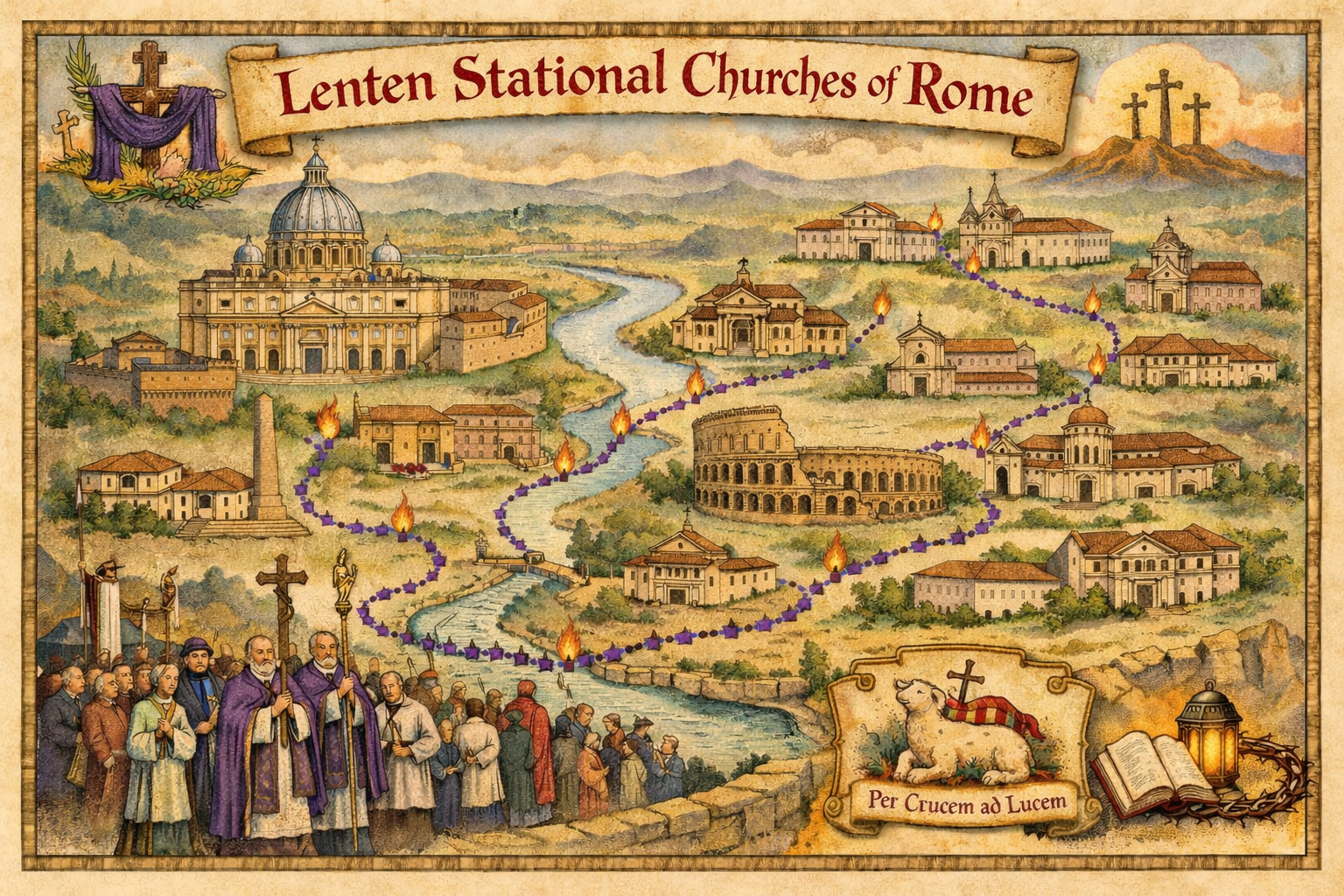
The Lenten stational churches of Rome are not an antiquarian survival but an enacted ecclesiology. In the Roman statio, the Church gathers under her bishop, moves penitentially through sacred space, venerates martyrs and confessors, and hears the Scriptures proclaimed within walls that themselves interpret the mystery being celebrated. From Late Antiquity through the consolidation under Gregory the Great and into the medieval period, the stational system formed Rome into a living catechism. During Lent above all, doctrine was walked, penance was embodied, and the saints themselves became teachers of conversion.
The word statio—a watch-post, a guard—was early adopted by Christians to denote days of fasting and steadfast prayer. Tertullian already speaks of such “stations” as ascetical observances.^1 In Rome, by the fourth century, the term had acquired a liturgical precision: the solemn gathering of the Church at a designated basilica under the Bishop of Rome. With the Constantinian peace, monumental churches rose over apostolic and martyrial sites, including San Giovanni in Laterano, cathedral of the Roman Pontiff; Old St. Peter’s Basilica, built over the tomb of St Peter; and Santa Croce in Gerusalemme, associated with St Helena and the relics of the Passion. These were not interchangeable venues but theological statements in stone, each with a patron and a memory that shaped the liturgy celebrated within.
Gregory the Great and the Stabilisation of the Lenten Stations
By the sixth century the Lenten stations were already recognisable in form, as evidenced by the Leonine and Gelasian sacramentaries.^2 The pontificate of Gregory the Great consolidated and stabilised this inherited tradition.^3 The faithful gathered at a collecta church, processed with litanies to the stational basilica, and there heard the Mass sung by the Pope. The procession was hierarchical and penitential, manifesting the Church Militant in ordered ranks.
Under Gregory, chant assumed architectural function. The Introit, Gradual, and antiphons accompanied movement through urban space, reinforcing the ascetical rhythm of Lent.^4 The structure of the Roman Rite, already sober and theologically dense, became inseparable from Rome’s sacred geography.
The Titular Saints and the Theological Logic of Place
The selection of stational churches during Lent was never arbitrary. The titular patron saints and relics of each basilica shaped the spiritual resonance of the day’s liturgy for catechumens and pilgrims alike.
Ash Wednesday is kept at Santa Sabina, a fifth-century basilica on the Aventine. The sobriety of its early Christian architecture—bare nave, unadorned columns, luminous clarity—mirrors the stark summons of the liturgy: “Remember, man, that thou art dust.” St Sabina herself, a Roman matron martyred for the faith, stands as witness to conversion at personal cost. The pilgrim begins Lent in the company of a martyr whose fidelity unto death gives weight to the ashes imposed upon the brow.
The First Sunday of Lent leads the faithful to San Giovanni in Laterano, mother and head of all churches. The Gospel of Christ’s temptation in the desert is proclaimed in the cathedral of the Bishop of Rome, emphasising ecclesial unity at the outset of spiritual combat. The Lateran’s dedication to Christ the Saviour and its relics of the Apostles root the Lenten struggle not in private resolve but in apostolic communion. Pilgrims stood beneath the great apse mosaic of Christ enthroned, reminded that the desert victory of the Lord is exercised within His visible Church.
Laetare Sunday draws the Church to Santa Croce in Gerusalemme, where relics of the True Cross are enshrined. Midway through Lent, when the Introit bids Jerusalem rejoice, the faithful pray in the presence of the wood of redemption. The patronage of St Helena, discoverer of the Cross, deepens the typology: the mother who sought the instrument of salvation becomes an image of the Church seeking Christ crucified. For catechumens approaching Baptism, the Cross is no longer abstraction but tangible sign.
Other Lenten stations reinforce similar theological logic. The basilica of St Clement, martyr and third successor of Peter, speaks of apostolic continuity and fidelity under persecution. Churches dedicated to St Lawrence, deacon and martyr, recall the cost of diaconal charity and the fire of purification. At St Paul Outside the Walls, the Lenten readings resonate against the memory of the Apostle who “buffeted his body” lest he be cast away (1 Cor 9:27). The saints are not ornamental patrons; they are interpretative lenses through which the liturgy is read.
For medieval pilgrims, these associations were immediate. Guidebooks listed not merely architectural marvels but the indulgences attached to the stations, the relics venerated, and the saints honoured.^5 The pilgrim entered not an anonymous hall but a communion of witnesses. To pray the Collect in Santa Sabina or Santa Croce was to do so beneath the gaze of those who had sealed the faith with blood or confession.
Carolingian Diffusion and Medieval Deepening
The Carolingian reform transmitted Roman liturgical structures throughout Western Christendom. Roman books were imported north of the Alps, and the prestige of Roman usage reshaped cathedral worship.^6 Although the precise geography of Rome could not be reproduced, the conceptual link between liturgical day, sacred place, and patron saint influenced medieval ecclesial life across Europe.
During the High Middle Ages, the papal stational Mass became increasingly elaborate in ceremonial expression, yet the theological foundations endured. The Church advanced toward Easter as a disciplined body under her bishop, surrounded by martyrs and confessors whose relics testified to the cost of discipleship. Medieval Itineraria recorded the Lenten stations as indispensable elements of penitential pilgrimage.^7
Even the disruptions of the Avignon exile did not erase the stational memory. The Missale Romanum of 1570 preserved the ancient assignments within the Lenten Masses.^8 Thus, the Tridentine codification conserved the Roman instinct: the liturgy remains tied to place, saint, and ecclesial unity.
Spiritual Meaning for Pilgrims Then and Now
To keep station is to stand watch. The Roman Church understood Lent as a season of vigilance. The procession through the city mirrored Israel’s desert pilgrimage and Christ’s ascent to Jerusalem. Catechumens underwent scrutiny; penitents sought reconciliation; the faithful fasted together. The saints enshrined in the stational churches embodied the virtues required for the journey—courage, perseverance, charity, obedience unto death.
The pilgrim who walked from collecta to basilica did not merely traverse streets; he traversed salvation history. The martyrs taught steadfastness; the confessors taught doctrinal fidelity; the Apostles taught unity. The architecture proclaimed permanence; the chant instilled penitential rhythm; the bishop presiding ensured visible communion.
In an age prone to abstraction, the Roman Lenten stations remind us that conversion is incarnational. It is walked, sung, fasted, and endured in communion with the saints. The city became catechism. The basilicas became homilies in stone. The saints became living commentaries on the Collect and Gospel of the day.
Thus the stational system reveals the Church as militant and pilgrim, hierarchical and communal, penitential and hopeful. One stands one’s station not alone, but in the company of martyrs, apostles, and confessors. And in standing watch with them, one is strengthened for the Paschal victory.
- Tertullian, De Oratione, c. 19 (PL 1:1181–1182).
- Sacramentarium Veronense (Leonine Sacramentary), Verona, Biblioteca Capitolare, MS LXXXV; C. L. Feltoe (ed.), The Sacramentary of the Church of Verona (Cambridge: CUP, 1896).
- Cyrille Vogel, Medieval Liturgy: An Introduction to the Sources (Washington, D.C.: Pastoral Press, 1986), 55–72.
- Joseph A. Jungmann, The Mass of the Roman Rite, vol. I (Westminster, MD: Christian Classics, 1986), 107–120.
- John F. Baldovin, The Urban Character of Christian Worship (Rome: Pont. Institutum Studiorum Orientalium, 1987), 137–165.
- Yitzhak Hen, The Royal Patronage of Liturgy in Frankish Gaul (London: Boydell, 2001), 85–112.
- Baldovin, Urban Character, 162–170.
- Missale Romanum (Rome: Paulus Manutius, 1570), Lenten Mass rubrics.
related articles


Latest articles
- Today’s Mass: September 05 Saint Lawrence JustinianSaint Lawrence Justinian, the first Patriarch of Venice, dedicated his life to the poor and the establishment of monasteries, rejecting noble marriage. Renowned for his humility and pastoral dedication, he emphasised the spiritual integrity of Venice’s safety. He was a precursor to the reforms of the Council of Trent, dying on 8 January 1455.
- 06.09.26 Nuntiatoria CXXII: NOMEN MANET, RES DEESTThis edition of Nuntiatoria explores the disconnect between the names of Catholic institutions and the realities they signify. Despite retaining their titles, many aspects of Catholicism—such as episcopal authority in China and religious practice in Poland—exhibit deteriorating substance. The piece cautions against superficial continuity, stressing the importance of genuine faith and practice over mere nomenclature.
- ORDO w/c 06.09.26The document outlines the liturgical schedule for the week of 6 to 13 September 2026, highlighting significant religious observances such as the Fifteenth Sunday after Pentecost and the Nativity of the Blessed Virgin Mary. It reflects on themes of compassion, holiness, fidelity, and humility, underscoring their importance in Christian life.
- The Fifteenth Sunday after Pentecost: When the Procession of Death Meets the Lord of LifeThe Fifteenth Sunday after Pentecost focuses on the transformative power of Christ, emphasising the supernatural life granted through grace. The liturgy highlights the Church’s role as a nurturing mother, mourning the spiritually dead while seeking their restoration. Christ’s compassion leads to resurrection, demonstrating that true life is found in dependence on Him.
- If Cecchin Is Right, Fatima Is WrongFr Stefano Cecchin, President of the Pontifical International Marian Academy, has declared opposition to apparitions that speak of divine punishment, suggesting they are false. This stance contradicts fundamental Catholic doctrine, including teachings from Scripture, the Catechism, and specifically the Message of Fatima, which warns of divine consequences for sin.



Leave a Reply