
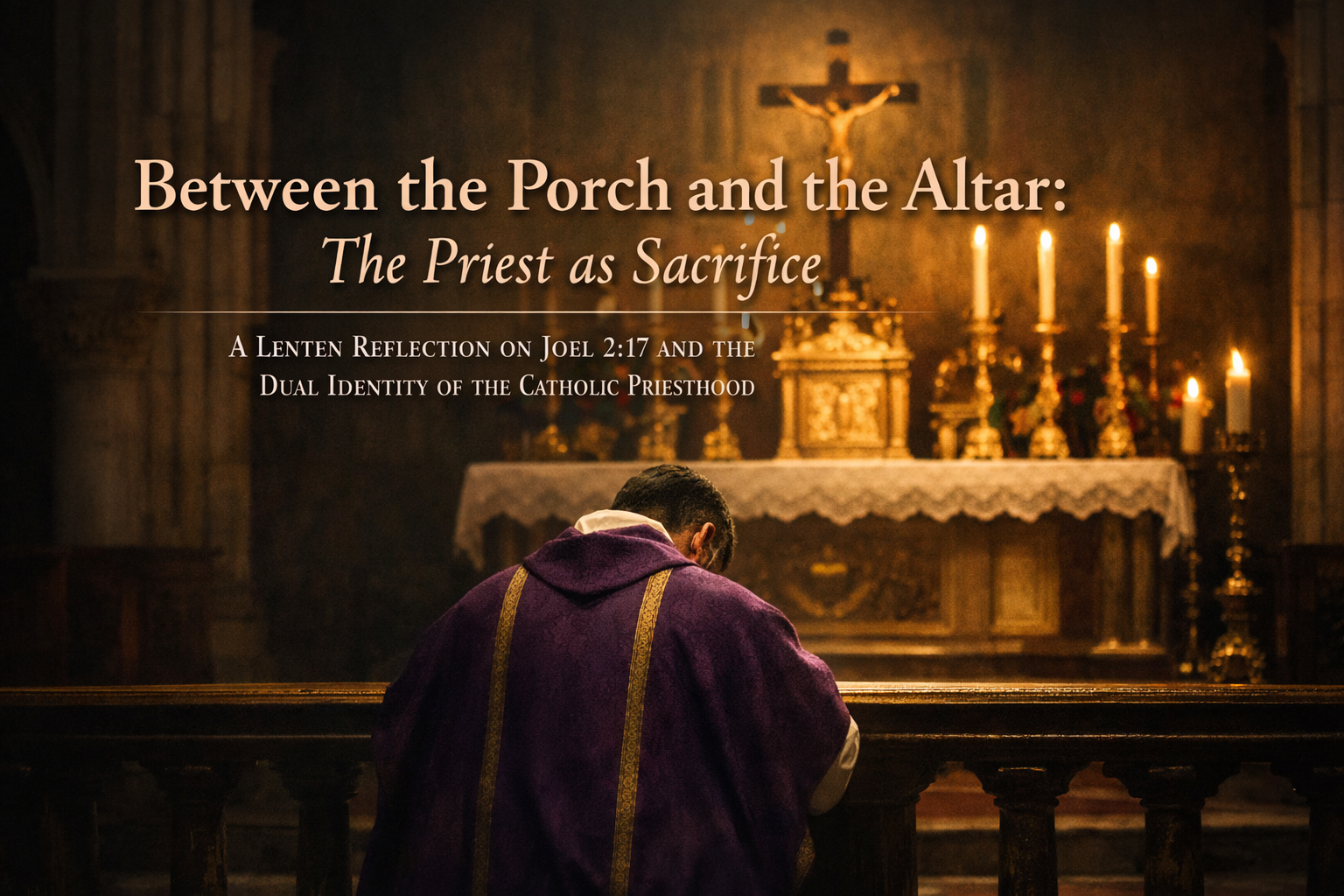
Between the Porch and the Altar: The Priest as Sacrifice

A Lenten Reflection on Joel 2:17 and the Dual Identity of the Catholic Priesthood
In the liturgical landscape of Lent, there is a boundary line where the sacred meets the broken. The Prophet Joel describes it with surgical precision: “Between the porch and the altar let the priests, the ministers of the Lord, weep” (Joel 2:17). For the Catholic priest, this is more than a poetic image; it is an architectural map of his soul. To be a priest is to be a man “caught” in the middle—a mediator who stands between the “porch” (the world and the people) and the “altar” (the divine presence). But the priest does not stand there as a mere gatekeeper. He stands there as a victim.
The Paradox: Offeror and Victim
The essence of the Catholic priesthood is found in the Totus Christus (the whole Christ). On the hill of Calvary, Jesus Christ did not offer a bull or a goat; He was the High Priest who offered Himself. Therefore, the priest, acting in persona Christi, cannot truly offer the Sacrifice of the Mass if he refuses to be part of the sacrifice himself. As St. Augustine famously noted: “He is both the Victor and the Victim, and the Victor because He is the Victim; He is both the Priest and the Sacrifice, and the Priest because He is the Sacrifice.” If the priest is to be an effective “Offeror,” he must first accept his identity as “Victim.” This Lent, we are reminded that a priesthood without victimhood is merely a career; it is the denial of self that transforms a job into a salvific mission.
The Theology of Priestly Tears
Why does Joel command the priests to weep? In the Patristic tradition, tears were often called a “second baptism.” When the priest weeps between the porch and the altar, he is engaging in reparation. St. John Chrysostom, in his treatise On the Priesthood, emphasizes the staggering weight of this responsibility: “The priest must be as pure as if he were standing in the very heavens… for he is an ambassador for the whole world, petitioning God to be merciful to the sins of all.” When the priest weeps, he is not weeping for his own sorrows. He is weeping for the sins of the world that he has “collected” at the porch. He brings those sins to the altar to be consumed by the fire of the Eucharist. His life of priestly perfection—his celibacy, his obedience, and his poverty—is a life of “slow-motion martyrdom.” By denying himself the legitimate joys of the world, the priest becomes a living sacrifice of reparation. He pays a debt he does not owe, on behalf of a people who often do not know they are in debt.
Lent: The Crucible of Perfection
The Lenten season is the “opportune time” for the priest to re-examine his union with Christ’s victimhood. It is a call to move beyond the functional and into the sacrificial. St. Gregory Nazianzen warned those who would approach the altar without this sense of self-denial: “A man must first be cleansed, then cleanse; be filled with wisdom, then make wise; become light, then enlighten; be made near to God, then bring others near.” This “cleansing” is the work of Lent. It is the stripping away of the ego so that only the High Priest remains. Every act of Lenten penance performed by a priest—every fast, every extra hour in the confessional, every silent vigil—is an act of “priestly perfection” that heals the Mystical Body of Christ.
The Altar is a Grave and a Throne
To the world, the life of a priest looks like a series of “nos.” No family of his own, no pursuit of wealth, no autonomy of will. But in the logic of the Altar, these “nos” are the necessary conditions for a supreme “Yes.” The priest weeps because he feels the distance between God’s holiness and man’s indifference. But in that weeping, he finds his greatest power. When he is most “victim,” he is most “priest.” When he is most emptied of himself, he is most filled with the power of the Resurrection. This Lent, let us pray for our priests, that they may have the courage to stand between the porch and the altar—not just to speak the words of the liturgy, but to become the liturgy.
Fr. Paolo Miguel R. Cobangbang is a priest of the Old Roman Apostolate based in Biñan City, the Philippines. He is a postulant in the Congregation for Divine Charity and promoter of the Teresian Carmelites of the Holy Face.
related articles


Latest articles
- Today’s Mass: September 04 Feria of Sunday XIV Post PentecostThe Fourteenth Sunday After Pentecost emphasises the importance of serving one master—God—over the flesh. It urges Christians to focus on spiritual over temporal concerns, warning against anxiety. The readings highlight the contrast between the fruit of the spirit and the works of the flesh, encouraging a pursuit of divine life.
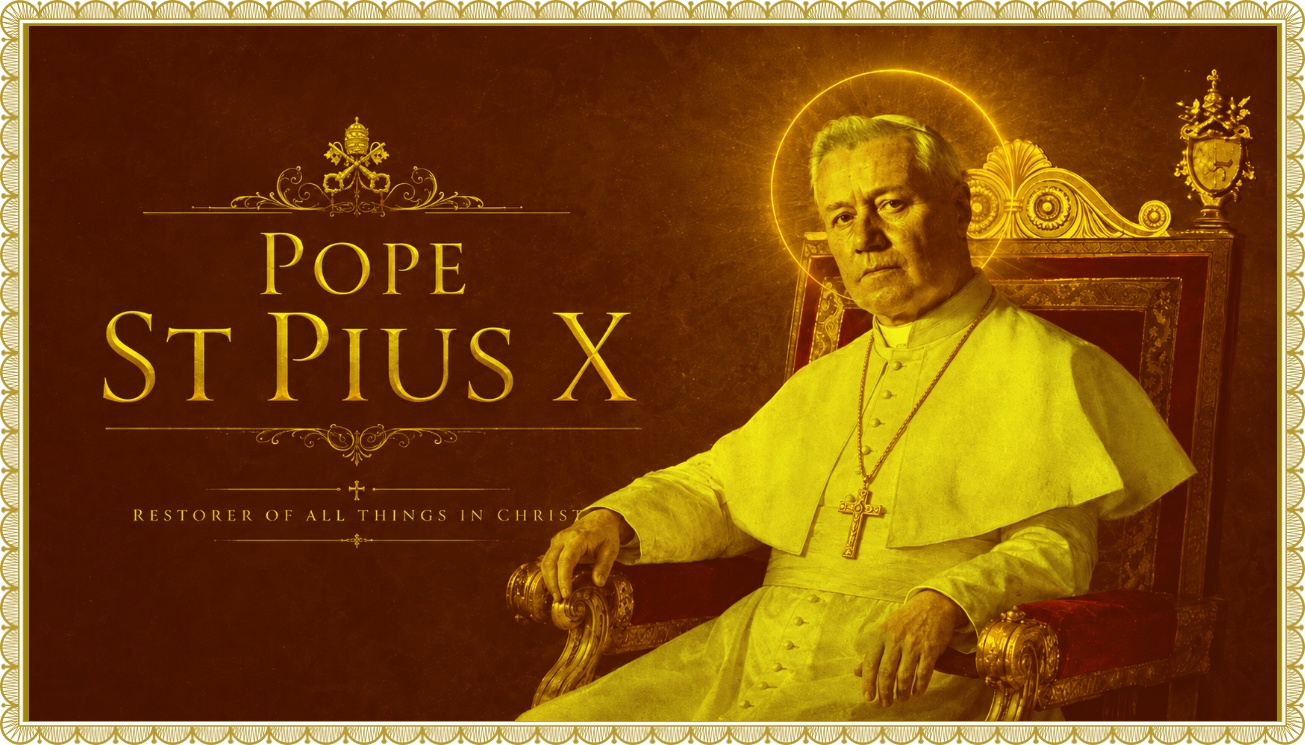
- Today’s homily: St Pius X, PopeThe text reflects on the life and legacy of Pope St Pius X, who was chosen from humble beginnings to reform the Church. His pontificate focused on defending the Catholic Faith, restoring liturgical sanctity, and fostering deeper connections between believers and Christ. Pius X exemplified a balance of truth and pastoral charity.
- Today’s Mass: September 03 Pope St Pius X,Pope St Pius X, born Giuseppe Melchiorre Sarto, was a significant reformer who emphasised preserving the Catholic Faith against Modernism. His pontificate (1903-1914) featured reforms in liturgy, frequent Holy Communion, and seminaries, rooted in a pastoral desire to restore everything in Christ. He died in 1914 and was canonised in 1954.
- Today’s homily: St Stephen of HungaryThe homily reflects on the life of Saint Stephen of Hungary, illustrating his transition from a powerful ruler to a saint. He embraced the responsibilities of kingship guided by faith, understanding his authority as stewardship. His legacy teaches that true governance comes with surrender to God, ultimately placing his kingdom under the protection of the Blessed Virgin Mary.
- Today’s Mass: September 02 St. Stephen the GreatSt. Stephen the Great, King of Hungary (977-1038), was a significant Christian ruler who reinforced the faith throughout Hungary. Anointed king in 1000 by Pope Sylvester II, he fought against paganism and promoted the Church. He was canonised in 1083 and is the patron saint of Hungary, symbolising national identity.



Leave a Reply