
Bridge or Breach? Bishop Schneider’s Appeal to Pope Leo XIV and the SSPX Question
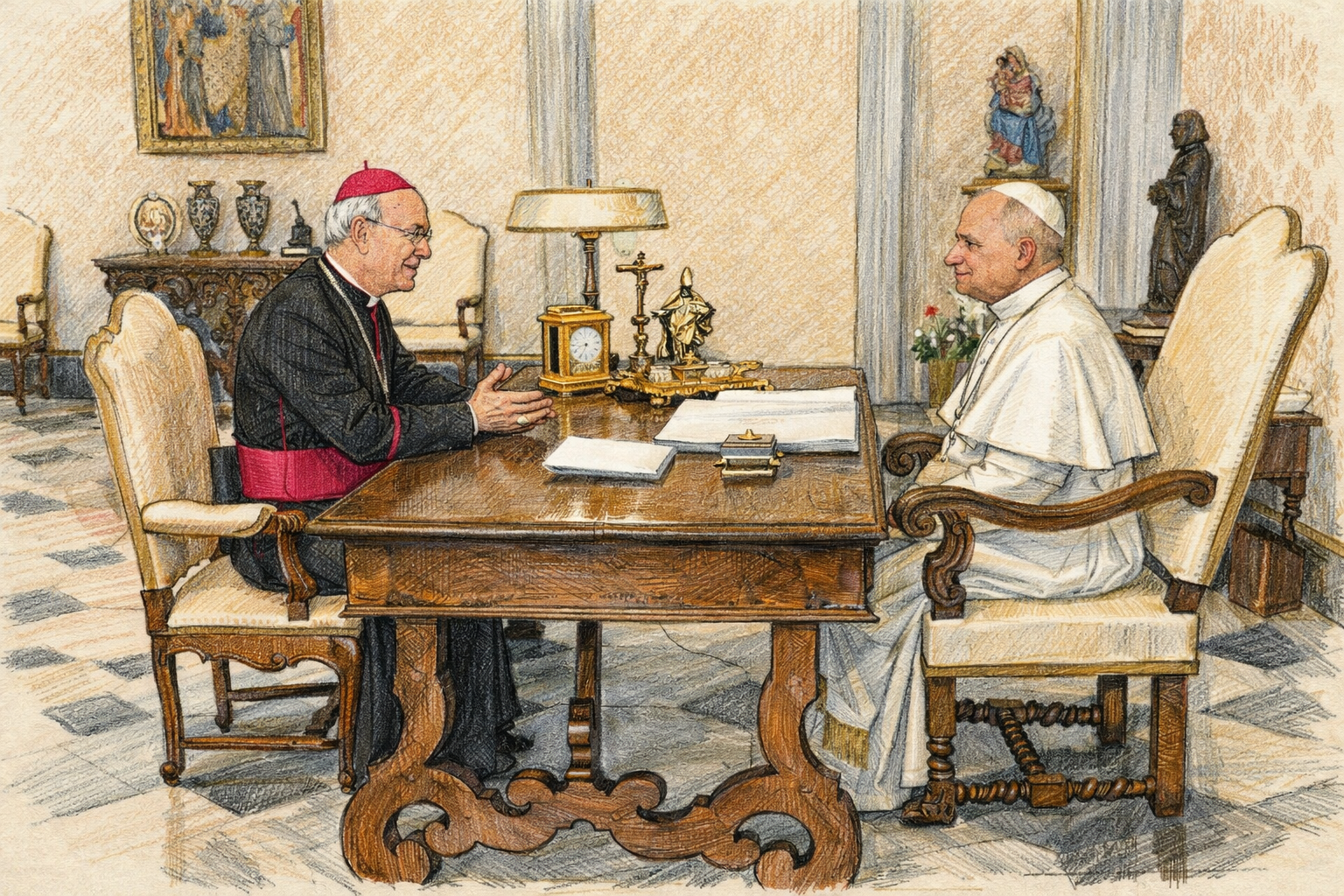
In a development that may prove decisive for the trajectory of this pontificate, Bishop Athanasius Schneider has issued a public appeal to Pope Leo XIV, urging him to grant the Apostolic Mandate for the episcopal consecrations announced by the Priestly Society of Saint Pius X (SSPX).¹
Published by Vatican journalist Diane Montagna, the appeal reframes what many had treated as a strictly canonical controversy.² Schneider situates the question not merely within procedural law but within ecclesiology, history, and the pastoral responsibility of the Roman Pontiff.
Beyond Juridical Reflex
The dominant reaction in some ecclesial quarters has been immediate: consecration without pontifical mandate equals schism. Schneider challenges this reflex. He argues that equating every act of disobedience with formal schism represents a narrowing of the Church’s historical self-understanding and risks elevating canonical form above doctrinal substance.
The bishop recalls that the first millennium did not operate under the later centralized model of episcopal appointments. The Council of Nicaea required provincial episcopal consent, not explicit papal authorization for every consecration.³ Furthermore, the 1917 Code of Canon Law treated episcopal consecration without pontifical mandate as a grave delict punishable by suspension, not automatic excommunication for schism.⁴
Schneider’s thesis is precise: schism concerns refusal of submission to the Roman Pontiff as such. It does not arise ipso facto from every canonical irregularity.
The Vatican II Fault Line
The deeper tension, he contends, lies elsewhere. The current crisis exposes unresolved doctrinal ambiguities stemming from the Second Vatican Council and subsequent developments. Schneider cites the Council’s explicitly pastoral character, as clarified by Pope Paul VI, who stated that the Council did not define new dogmas in an extraordinary manner.⁵
If the Council did not bind the Church with new infallible definitions, Schneider asks, why must assent to its non-definitive pastoral formulations be made a condition of canonical normalization for the SSPX? The Society continues to profess the traditional Professio fidei used by bishops before 1967.⁶
The implication is clear: what was once sufficient for Catholic orthodoxy cannot logically become insufficient unless the standard of communion has shifted.
Appeal to Precedent and Prudence
Schneider invokes historical precedents: St Athanasius’ resistance during the Arian crisis, and the unauthorized episcopal consecrations carried out under persecution. These examples are not presented as normalizing disobedience but as illustrating that extraordinary crises have occasionally required extraordinary measures.
He also cites the warnings of Pope Benedict XVI, who acknowledged that past ecclesiastical divisions were sometimes exacerbated by insufficient efforts at reconciliation.⁷ Benedict’s question remains pressing: can the Church afford to allow communities desiring unity to drift further away?
The SSPX today reports 733 priests, 264 seminarians, five seminaries, and apostolates in seventy-seven countries.⁸ Whatever one’s judgment of its canonical status, it constitutes a significant ecclesial reality.
Synodality and Selective Generosity
Perhaps the most pointed dimension of Schneider’s appeal concerns consistency. The contemporary Church frequently speaks of synodality, pastoral accompaniment, and inclusivity. Pope Leo XIV himself has emphasized visible unity with separated Christians.⁹ Schneider asks whether such breadth can exclude those who profess the Catholic faith in its traditional form and explicitly acknowledge papal primacy.
If generosity is extended ecumenically, should it not also be extended internally?
A Moment of Definition
The decision before Pope Leo XIV is not reducible to administrative compliance. It will define the theological posture of his pontificate toward traditional Catholicism. Granting the mandate would not resolve doctrinal disagreements, but it could create conditions for calm theological clarification within visible unity. Refusal, particularly if accompanied by punitive measures, risks solidifying a division that neither side professes to desire.
Schneider concludes with a reminder embedded in the papal title itself: Summus Pontifex — the supreme bridge-builder.
Whether this moment becomes a bridge or a breach will shape not only relations with the SSPX, but the broader credibility of ecclesial unity in an age already marked by fracture.
- Athanasius Schneider, “A Fraternal Appeal to Pope Leo XIV to Build a Bridge with the Priestly Society of St. Pius X,” 24 February 2026.
- Diane Montagna, publication of Bishop Schneider’s appeal, 24 February 2026.
- Council of Nicaea I, Canon 4 (325).
- 1917 Code of Canon Law, canon 2370.
- Paul VI, General Audience, 12 January 1966.
- Professio fidei Tridentina, promulgated by Pius IV (1564), used until 1967.
- Benedict XVI, Letter to the Bishops on the occasion of the publication of Summorum Pontificum, 7 July 2007; Letter concerning the remission of excommunications, 10 March 2009.
- SSPX Annual Statistics, 2026.
- Leo XIV, Homily for Ecumenical Vespers, 25 January 2026; Apostolic Letter In Unitate Fidei, 23 November 2025.
A Fraternal Appeal to Pope Leo XIV to Build a Bridge with the Priestly Society of St. Pius X
by Bishop Athanasius Schneider
The current situation regarding the episcopal consecrations in the Priestly Society of St. Pius X (SSPX) has suddenly awakened the entire Church. Within an extraordinarily short time following the February 2ndannouncement that the SSPX will proceed with these consecrations, an intense and often emotionally charged debate has arisen throughout wide circles of the Catholic world. The spectrum of voices in this debate ranges from understanding, benevolence, neutral observation, and common sense to irrational rejection, peremptory condemnation, and even open hatred. Although there is reason for hope—and it is by no means unrealistic—that Pope Leo XIV could indeed approve the episcopal consecrations, already now proposals for the text of a bull of excommunication of the SSPX are being put forward online.
The negative reactions, though often well-intentioned, reveal that the heart of the problem has not yet been grasped with sufficient honesty and clarity. There is a tendency to remain at the surface. Priorities within the life of the Church are reversed, elevating the canonical and legal dimension—that is, a certain juridical positivism—to the supreme criterion. Moreover, there is at times a lack of historical awareness concerning the Church’s practice with respect to episcopal ordinations. Disobedience is thus too readily equated with schism. The criteria for episcopal communion with the Pope, and consequently the understanding of what truly constitutes schism, are viewed in an overly one-sided manner when compared with the practice and self-understanding of the Church in the Patristic era, the age of the Church Fathers.
In this debate, new quasi-dogmas are being established that do not exist in the Depositum fidei. These quasi-dogmas maintain that the Pope’s consent to a bishop’s consecration is of divine right, and that a consecration carried out without this consent, or even against a papal prohibition, constitutes in itself a schismatic act. However, the Church’s practice and understanding during the time of the Church Fathers, and for a long period thereafter, argue against this view. Furthermore, there is no unanimous opinion on this matter among the recognized theologians of the Church’s two-thousand-year tradition. Centuries of ecclesial practice, as well as traditional canon law, also stand in opposition to such absolutizing assertions. According to the 1917 Code of Canon Law, an episcopal consecration carried out against the will of the Pope was punished not with excommunication, but only with suspension. By this, the Church clearly manifested that she did not consider such an act to be schismatic.
The acceptance of papal primacy as a revealed truth is often confused with the concrete forms—forms that have evolved throughout history—through which a bishop expresses his hierarchical unity with the Pope. To believe in the Papal Primacy, to acknowledge the actual Pope, to adhere with him to all that the Church has taught infallibly and definitively, and to observe the validity of the sacramental liturgy, is of divine right. Yet, a reductive view that equates disobedience to a papal command with schism—even in the case of a bishop’s consecration performed against his will—was foreign to the Church Fathers and to traditional canon law. For example, in 357, St. Athanasius disobeyed the order of Pope Liberius, who instructed him to enter into hierarchical communion with the overwhelming majority of the episcopate, which was in fact Arian or semi-Arian. As a result, he was excommunicated. In this instance, St. Athanasius disobeyed out of love for the Church and for the honor of the Apostolic See, seeking precisely to safeguard the purity of doctrine from any suspicion of ambiguity.
In the first millennium of the Church’s life, episcopal consecrations were generally performed without formal papal permission, and candidates were not required to be approved by the Pope. The first canonical regulation on episcopal consecrations, issued by an Ecumenical Council, was that of Nicaea in 325, which required that a new bishop be consecrated with the consent of a majority of the bishops of the province. Shortly before his death, during a period of doctrinal confusion, St. Athanasius personally selected and consecrated his successor—St. Peter of Alexandria—, in order to ensure that no unsuitable or weak candidate would assume the episcopate. Similarly, in 1977, the Servant of God Cardinal Iosif Slipyj secretly consecrated three bishops in Rome without the approval of Pope Paul VI, fully aware that the Pope would not allow it because of the Vatican’s Ostpolitik at the time. When Rome learned of these secret consecrations, however, the penalty of excommunication was not applied.
To avoid misunderstanding, under normal circumstances—and when there is neither doctrinal confusion nor a time of extraordinary persecution—one must, of course, do everything possible to observe the canonical norms of the Church and to obey the Pope in his just injunctions, in order to preserve ecclesiastical unity both more effectively and visibly.
But the situation in the life of the Church today can be illustrated with the following parable: A fire breaks out in a large house. The fire chief allows only the use of new firefighting equipment, even though it has been shown to be less effective than the old, proven tools. A group of firefighters defies this order and continues to use the tried-and-tested equipment—and indeed, the fire is contained in many places. Yet these firefighters are labelled disobedient and schismatic, and they are punished.
To extend the metaphor further: the fire chief permits only those firefighters who acknowledge the new equipment, follow the new firefighting rules, and obey the new firehouse regulations. But given the obvious scale of the fire, the desperate struggle against it, and the insufficiency of the official firefighting team, other helpers—despite the fire chief’s prohibition—selflessly intervene with skill, knowledge, and good intentions, ultimately contributing to the success of the fire chief’s efforts.
Faced with such rigid and incomprehensible behavior, two possible explanations present themselves: either the fire chief is denying the seriousness of the fire, much like in the French comedy Tout va très bien, Madame la Marquise!; or, in fact, the fire chief desires that large parts of the house burn, so that it may later be rebuilt according to a new design.
The current crisis surrounding the announced—but as yet unapproved—episcopal consecrations in the SSPX exposes, before the eyes of the whole Church, a wound that has been smouldering for over sixty years. This wound can be figuratively described as ecclesial cancer—specifically, the ecclesial cancer of doctrinal and liturgical ambiguities.
Recently, an excellent article appeared on the Rorate Caeli blogspot, written with rare theological clarity and intellectual honesty, under the title: “The Long Shadow of Vatican II: Ambiguity as Ecclesial Cancer” (Canon of Shaftesbury: Rorate Caeli, February 10, 2026). The fundamental problem with some ambiguous statements of the Second Vatican Council is that the Council chose to prioritize a pastoral tone over doctrinal precision. One can agree with the author when he says:
“The problem isn’t that Vatican II was heretical. The problem is that it was ambiguous. And in that ambiguity, we’ve seen the seeds of confusion that have flowered into some of the most troubling theological developments in modern Church history. When the Church speaks in vague terms, even if unintentionally, then souls are at stake.”
The author continues:
“When a doctrinal ‘development’ seems to contradict what came before, or when it requires decades of theological gymnastics to reconcile with previous magisterial teaching, we have to ask: Is this development, or is it rupture disguised as development?” (Canon of Shaftesbury: Rorate Caeli, February 10, 2026).
One may reasonably assume that the SSPX desires nothing more than to help the Church emerge from this ambiguity in doctrine and liturgy and to rediscover her saving perennial clarity—just as the Church’s Magisterium, under the guidance of the Popes, has done unequivocally throughout history after every crisis marked by doctrinal confusion and ambiguity.
In fact, the Holy See should be grateful to the SSPX, because it is currently almost the only major ecclesiastical reality that forthrightly and publicly points out the existence of ambiguous and misleading elements in certain statements of the Council and the Novus Ordo Missae. In this endeavor, the SSPX is guided by a sincere love for the Church: if they did not love the Church, the Pope, and souls, they would not undertake this work, nor would they engage with the Roman authorities—and they would undoubtedly have an easier life.
The following words of Archbishop Marcel Lefebvre are deeply moving and reflect the attitude of the current leadership and most members of the SSPX:
“We believe in Peter, we believe in the successor of Peter! But as Pope Pius IX says well in his dogmatic constitution, the pope has received the Holy Ghost not to make new truths, but to maintain us in the faith of all time. This is the definition of the Pope made at the time of the First Vatican Council by Pope Pius IX. And that is why we are persuaded that in maintaining these traditions we are manifesting our love, our docility, our obedience to the Successor of Peter. We cannot remain indifferent before the degradation of faith, morals, and the liturgy. That is out of the question! We do not want to separate ourselves from the Church; on the contrary, we want the Church to continue!”
If someone considers having difficulties with the Pope to be among his greatest spiritual sufferings, that in itself is a telling proof that there is no schismatic intent. True schismatics even boast of their separation from the Apostolic See. True schismatics would never humbly implore the Pope to recognize their bishops.
How truly Catholic, then, are the following words of Archbishop Marcel Lefebvre:
“We regret infinitely, it is an immense pain for us, to think that we are in difficulty with Rome because of our faith! How is this possible? It is something that exceeds the imagination, that we should never have been able to imagine, that we should never have been able to believe, especially in our childhood–then when all was uniform, when the whole Church believed in her general unity and held the same Faith, the same Sacraments, the same sacrifice of the Mass, the same catechism.”
We must honestly examine the evident ambiguities regarding religious freedom, ecumenism, and collegiality, as well as the doctrinal imprecisions of the Novus Ordo Missae. In this regard, one should read the recently published book by Archimandrite Boniface Luykx, a Council peritus and renowned liturgical scholar, with its eloquent title A Wider View of Vatican II. Memories and Analysis of a Council Consultor.
As G. K. Chesterton once said: “Upon entering the church, we are asked to take off our hat, not our head.” It would be a tragedy if the SSPX were completely cut off, and the responsibility for such a division would rest primarily with the Holy See. The Holy See should bring the SSPX in, offering at least a minimum degree of Church integration, and then continue the doctrinal dialogue. The Holy See has shown remarkable generosity toward the Communist Party of China, allowing them to select candidates for bishops—yet her own children, the thousands upon thousands of faithful of the SSPX, are treated as second-class citizens.
The SSPX should be allowed to make a theological contribution with a view to clarifying, supplementing, and, if necessary, amending those statements in the texts of the Second Vatican Council that raise doctrinal doubts and difficulties. This must also take into account that, in these texts, the Magisterium of the Church did not intend to pronounce itself with dogmatic definitions endowed with the note of infallibility (cf. Paul VI, General Audience, January 12, 1966).
The SSPX makes exactly the same Professio fidei as that made by the Fathers of the Second Vatican Council, known as the Tridentine-Vatican Professio fidei. If, according to the explicit words of Pope Paul VI, the Second Vatican Council did not present any definitive doctrines, nor intend to do so, and if the faith of the Church remains the same before, during, and after the Council, why should the profession of faith that was valid in the Church until 1967 suddenly no longer be considered valid as a mark of true Catholic belief?
Yet the the Tridentine-Vatican Professio fidei is considered by the Holy See to be insufficient for the SSPX. Would not the Tridentine-Vatican Professio fidei in fact constitute “the minimum” for ecclesial communion? If that is not a minimum, then what, honestly, would qualify as a “minimum”? The SSPX is required, as a conditio sine qua non, to make a Professio fidei by which the teachings of a pastoral, and not definitive, nature from the last Council and the subsequent Magisterium must be accepted. If this is truly the so-called “minimum requirement,” then Cardinal Victor Fernández appears to be playing games with words!
Pope Leo XIV said at the ecumenical Vespers on January 25, 2026, at the conclusion of the Week of Prayer for Christian Unity, that there is already unity between Catholics and non-Catholic Christians because they share the minimum of Christian faith: “We share the same faith in the one and only God, the Father of all people; we confess together the one Lord and true Son of God, Jesus Christ, and the one Holy Spirit, who inspires us and impels us towards full unity and the common witness to the Gospel” (Apostolic Letter In Unitate Fidei, 23 November 2025, 12). He further declared: “We are one! We already are! Let us recognize it, experience it and make it visible!”
How can this statement be reconciled with the claim made by representatives of the Holy See and some high-ranking clergy that the SSPX is not doctrinally united with the Church, given that the SSPX professes the Professio fidei of the Fathers of the Second Vatican Council—the Tridentine-Vatican Professio fidei?
Further provisional pastoral measures granted to the SSPX for the spiritual good of so many exemplary Catholic faithful would stand as a profound testimony to the pastoral charity of the Successor of Peter. In doing so, Pope Leo XIV would open his paternal heart to those Catholics who, in a certain way, live on an ecclesiastical periphery, allowing them to experience that the Apostolic See is truly a Mother also for the SSPX.
The words of Pope Benedict XVI should awaken the conscience of those in the Vatican who will decide on the permission of episcopal consecrations for the SSPX. He reminds us:
“Looking back over the past, to the divisions which in the course of the centuries have rent the Body of Christ, one continually has the impression that, at critical moments when divisions were coming about, not enough was done by the Church’s leaders to maintain or regain reconciliation and unity. One has the impression that omissions on the part of the Church have had their share of blame for the fact that these divisions were able to harden. This glance at the past imposes an obligation on us today: to make every effort to unable for all those who truly desire unity to remain in that unity or to attain it anew” (Letter to the Bishops on the occasion of the publication of the Apostolic Letter “motu proprio data” Summorum Pontificum on the use of the Roman Liturgy prior to the reform carried out in 1970, 7 July 2007)
“Can we be totally indifferent about a community which has 491 priests, 215 seminarians, 6 seminaries, 88 schools, 2 university-level institutes, 117 religious brothers, 164 religious sisters and thousands of lay faithful? Should we casually let them drift farther from the Church? And should not the great Church also allow herself to be generous in the knowledge of her great breadth, in the knowledge of the promise made to her?” (Letter to the Bishops of the Catholic Church concerning the remission of the excommunication of the four Bishops consecrated by Archbishop Lefebvre, March 10, 2009).[1]
Provisional and minimal pastoral measures for the SSPX, undertaken for the spiritual good of the thousands upon thousands of its faithful around the world—including a pontifical mandate for episcopal consecrations—would create the conditions necessary to calmly clarify misunderstandings, questions, and doubts of a doctrinal nature arising from certain statements in the documents of the Second Vatican Council and the subsequent Pontifical Magisterium. At the same time, such measures would provide the SSPX with the opportunity to make constructive contribution for the good of the entire Church, while maintaining a clear distinction between what belongs to divinely revealed faith and doctrine definitively proposed by the Magisterium, and what has a primarily pastoral character in particular historical circumstances, and is therefore open to careful theological study, as has always been the practice throughout the life of the Church.
With sincere concern for the unity of the Church and the spiritual good of so many souls, I appeal with reverent and fraternal charity to our Holy Father Pope Leo XIV:
Most Holy Father, grant the Apostolic Mandate for the episcopal consecrations of the SSPX. You are also the father of your numerous sons and daughters—two generations of the faithful who have, for now, been cared for by the SSPX, who love the Pope, and who wish to be true sons and daughters of the Roman Church. Therefore, stand aside from the partisanship of others and, with a great paternal and truly Augustinian spirit, demonstrate that you are building bridges, as you promised to do before the whole world when you gave your first blessing after your election. Do not go down in the history of the Church as one who failed to build this bridge—a bridge that could be constructed at this truly Providential moment with generous will—and who instead allowed a truly unnecessary and painful further division within the Church, while at the same time synodal processes that boast of the greatest possible pastoral breadth and ecclesial inclusivity were taking place. As your Holiness recently stressed: “Let us commit ourselves to further developing ecumenical synodal practices and to sharing with one another who we are, what we do and what we teach (cf. Francis, For a Synodal Church, 24 November 2024)” (Homily of Pope Leo XIV, Ecumenical Vespers for the Week of Prayer for Christian Unity, January 25, 2026).
Most Holy Father, if you grant the Apostolic Mandate for the episcopal consecrations of the SSPX, the Church in our day will lose nothing. You will be a true bridge-builder, and even more, an exemplary bridge-builder, for you are the Supreme Pontiff, Summus Pontifex.
+ Athanasius Schneider, Auxiliary Bishop of the Archdiocese of Saint Mary in Astana
24 February 2026
RELATED ARTICLES


Latest
- Today’s Mass: September 04 Feria of Sunday XIV Post PentecostThe Fourteenth Sunday After Pentecost emphasises the importance of serving one master—God—over the flesh. It urges Christians to focus on spiritual over temporal concerns, warning against anxiety. The readings highlight the contrast between the fruit of the spirit and the works of the flesh, encouraging a pursuit of divine life.
- Today’s homily: St Pius X, PopeThe text reflects on the life and legacy of Pope St Pius X, who was chosen from humble beginnings to reform the Church. His pontificate focused on defending the Catholic Faith, restoring liturgical sanctity, and fostering deeper connections between believers and Christ. Pius X exemplified a balance of truth and pastoral charity.
- Today’s Mass: September 03 Pope St Pius X,Pope St Pius X, born Giuseppe Melchiorre Sarto, was a significant reformer who emphasised preserving the Catholic Faith against Modernism. His pontificate (1903-1914) featured reforms in liturgy, frequent Holy Communion, and seminaries, rooted in a pastoral desire to restore everything in Christ. He died in 1914 and was canonised in 1954.
- Today’s homily: St Stephen of HungaryThe homily reflects on the life of Saint Stephen of Hungary, illustrating his transition from a powerful ruler to a saint. He embraced the responsibilities of kingship guided by faith, understanding his authority as stewardship. His legacy teaches that true governance comes with surrender to God, ultimately placing his kingdom under the protection of the Blessed Virgin Mary.
- Today’s Mass: September 02 St. Stephen the GreatSt. Stephen the Great, King of Hungary (977-1038), was a significant Christian ruler who reinforced the faith throughout Hungary. Anointed king in 1000 by Pope Sylvester II, he fought against paganism and promoted the Church. He was canonised in 1083 and is the patron saint of Hungary, symbolising national identity.


Leave a Reply