
The Miracle Reinterpreted: “Sharing,” Multiplication, and the Doctrinal Stakes

The Claim and Its Contemporary Context
In 2025–2026, a series of papal remarks attributed to Pope Leo XIV—in a Vatican message connected with food security discussions (June 2025), in a Corpus Christi homily (June 2025), and in reported pastoral remarks in Africa—have framed the feeding of the five thousand in terms of “sharing,” at one point describing this as the “real miracle.” In that context, he stated that “the real miracle… lies in sharing rather than in selfishly hoarding what we have.”¹ These formulations closely echo language previously employed by Pope Francis in catecheses and Angelus addresses (notably 6 June 2018 and 26 July 2020), where the miracle was likewise presented primarily as an awakening to generosity rather than a supernatural multiplication.²
This is not a question of rhetorical nuance alone, nor of pastoral emphasis taken in isolation. It signals a deeper interpretive tendency—one that risks relocating the centre of gravity of the Gospel account from divine action to human response. The issue must therefore be examined not as a matter of tone, but of theology. For what is at stake is nothing less than the nature of miracle itself, the identity of Christ as revealed in His works, and the coherence of the Church’s Eucharistic doctrine. If the miracle is misunderstood at its root, the entire structure of its meaning begins to shift.
This article argues that identifying the miracle as “sharing” constitutes a theological mischaracterisation incompatible with the plain sense of Scripture, the unanimous witness of the Fathers, the precision of scholastic theology, and the doctrinal framework of the Church’s magisterium.
The Scriptural Witness: Objective Increase, Not Moral Redistribution
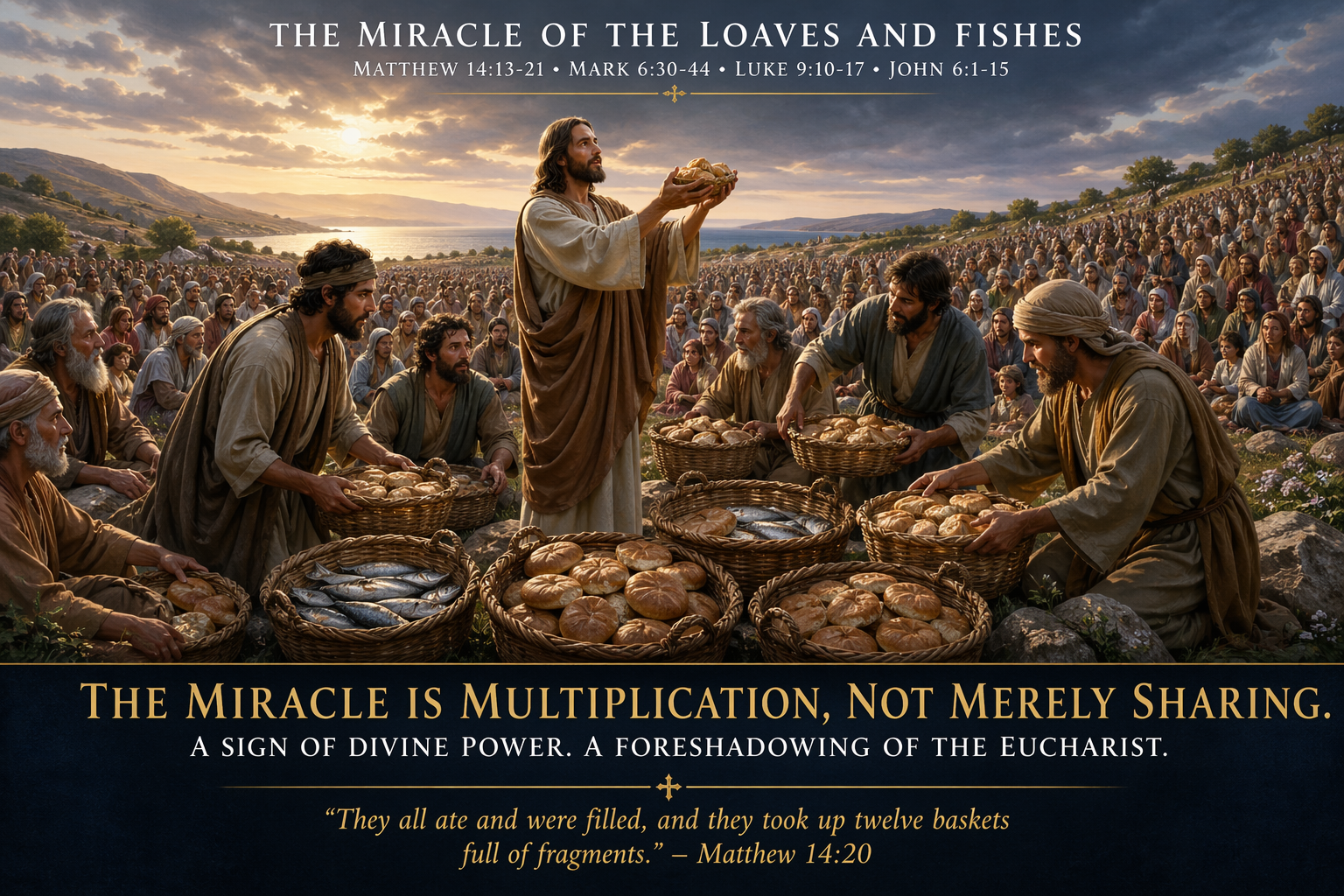
The feeding of the five thousand is attested in all four Gospels—Matthew 14:13–21, Mark 6:30–44, Luke 9:10–17, and the Gospel of John (6:1–15). The narratives are marked by empirical detail that resists reduction to allegory or moral instruction alone. Christ blesses (εὐλόγησεν), breaks (ἔκλασεν), and gives (ἐδίδου) the loaves; the verbs describe His action, not any redistribution by the crowd.³
The Evangelist’s language admits of no ambiguity: “καὶ ἔφαγον πάντες καὶ ἐχορτάσθησαν… καὶ ἦραν τὸ περισσεῦον τῶν κλασμάτων δώδεκα κοφίνους πλήρεις” (“and they all ate and were filled… and they took up what remained over of the fragments, twelve baskets full”).⁴ The text insists on universal satiation and measurable surplus. No element suggests hidden provisions or communal pooling. Rather, the structure is unmistakable: insufficiency → divine act → superabundance.
The Johannine account intensifies the point by establishing the impossibility of a natural solution. Philip calculates the cost and finds it inadequate (John 6:7), thereby closing the door to any humanly sufficient explanation. Christ nevertheless feeds the multitude, and the narrative proceeds directly into the Bread of Life discourse (John 6:22–59), where the miracle is interpreted in explicitly Eucharistic terms. The sequence is deliberate. The miracle is not merely followed by teaching; it grounds the teaching. It is a sign that reveals a deeper reality. The multiplication of loaves is ordered toward the revelation of Christ as the Bread come down from heaven.
Thus, at the level of the text itself, the “sharing” interpretation fails to account for what is most prominent: the objective increase, the measurable surplus, and the theological trajectory of the narrative.
The Patristic Consensus: Multiplication as Divine Causality
The Fathers of the Church, reading these texts within the living tradition, exhibit no hesitation in their interpretation. St Augustine teaches that Christ multiplied the loaves in His hands as God multiplies seed in the earth, compressing into an instant what ordinarily unfolds through time.⁵ The miracle, for Augustine, is not a departure from divine action but its intensification—an unveiling of what God always does, now made visible in a single moment.
St John Chrysostom speaks even more directly, insisting that Christ caused the bread to increase, thereby manifesting Himself as Creator.⁶ This is not a lesson in ethics but a revelation of identity. The act discloses who Christ is.
St Hilary of Poitiers observes that the loaves are not diminished by distribution but multiplied through it, while St Cyril of Alexandria emphasises that Christ provides food beyond nature, prefiguring the Eucharist.⁷ ⁸ In each case, distribution is secondary; it is the means by which the already-multiplied bread is conveyed. The miracle itself lies in the increase.
Across these witnesses, the pattern is uniform. There is no trace of an interpretation that identifies the miracle with human sharing. The Fathers are not divided on this point. Their unanimity is itself a form of evidence—testimony not merely to an interpretation, but to the received understanding of the Church.
Scholastic Precision: The Nature of Miracle
The scholastic tradition brings analytical clarity to what the Fathers affirm. St Thomas Aquinas defines a miracle as that which occurs outside the order of created nature.⁹ This definition is not arbitrary; it establishes the boundary between divine and natural causality. A miracle, properly speaking, is not merely rare or striking—it is an effect that cannot be produced by created causes.
Sharing, however virtuous, remains within the scope of human action. It presupposes no suspension of natural law and no direct intervention of divine power in the order of being. It therefore cannot constitute a miracle in the strict sense. To identify sharing as the miracle is to redefine the category itself.
This point is reinforced by later theologians. Adolphe Tanquerey classifies the feeding of the five thousand explicitly as a miracle of multiplication—an increase of matter without proportionate cause.¹⁰ Reginald Garrigou-Lagrange insists that a true miracle must exceed the entire created order; an explanation reducible to human behaviour fails that test.¹¹ The scholastic tradition does not merely prefer the multiplication interpretation; it requires it.
Magisterial Framework: Divine Action and Eucharistic Continuity
The Church’s magisterium confirms and secures this doctrinal structure. The First Vatican Council teaches with precision: “Si quis dixerit, miracula nulla fieri… anathema sit” (“If anyone says that no miracles are performed… let him be anathema”), and further that miracles are signs by which divine revelation is made credible.¹² They are not reducible to moral exempla or communal experiences; they are acts that surpass created causes and reveal the hand of God.
The Council of Trent defines that, in the Eucharist, “per conversionem totius substantiae panis in substantiam corporis Christi” (“by the conversion of the whole substance of bread into the substance of the Body of Christ”).¹³ This is not symbolic language but ontological precision. The substance is changed. The miracle of the loaves has always been read in continuity with this teaching. Christ multiplies bread beyond nature, and later transforms it beyond nature. The two are not identical, but they are ordered to one another. The first prepares for the second.
If the feeding of the five thousand is reduced to sharing, this continuity is disrupted. The typological bridge between miracle and sacrament is weakened, if not severed. The Eucharist risks being interpreted in the same moralised key—as a sign of unity rather than a transformation of substance. The implications are not remote; they are immediate and far-reaching.
Doctrinal Consequences: From Miracle to Moralism
The redefinition of the miracle has cascading effects. First, it alters the concept of miracle itself, relocating it from divine intervention to human action. This stands in tension with the teaching of the First Vatican Council. Secondly, it reshapes Christology by presenting Christ primarily as a moral teacher who inspires generosity, rather than as the divine agent who exercises dominion over creation. Thirdly, it destabilises Eucharistic theology by obscuring the continuity between Christ’s miracles and the sacramental economy.
What appears at first as a pastoral emphasis thus reveals itself as a structural shift. The axis moves from God to man, from creation to cooperation, from ontology to ethics. Each of these movements carries consequences, and together they amount to a reconfiguration of the theological landscape.
Conclusion: The Integrity of the Sign and the Stakes of Precision
The convergence of scriptural detail, patristic unanimity, scholastic precision, and magisterial teaching yields not a probable conclusion, but a certain one. The feeding of the five thousand is a true supernatural multiplication of matter, effected by Christ as Creator and ordered toward the revelation of His divine identity and the prefiguration of the Eucharist.
Yet the matter does not end at definition. It extends to the life of the Church and the faith of the faithful. For when the nature of a miracle is obscured, the clarity of revelation is diminished. When divine action is recast as human virtue, the horizon of faith contracts. The Gospel becomes less a disclosure of what God does and more an encouragement of what man might achieve. The result is not merely a different emphasis; it is a different vision of Christianity itself—one in which transcendence recedes and immanence takes its place.
The formulations attributed to Pope Leo XIV—especially insofar as they echo those of Pope Francis—must therefore be judged with sobriety and precision. Charity requires that they be read in the best possible light; truth requires that they be measured against the Church’s doctrinal grammar. When so measured, they cannot be sustained as accurate descriptions of the miracle’s essence. At best, they represent an imprecise pastoral gloss that risks misunderstanding; at worst, they introduce a conceptual shift that, if followed through, would unsettle the coherence of Catholic doctrine and the faithful’s grasp of divine reality.
The Church has never denied that the miracle calls forth sharing. Indeed, it demands it. The abundance created by Christ is given to be distributed; the gift becomes the ground of generosity. But this is the response, not the cause. It is the fruit, not the root. The moral dimension is real, but it is derivative. It flows from the miracle; it does not constitute it.
And here the final clarity must be stated without dilution. If Christ did not multiply the loaves, He did not reveal Himself as Creator in that act. If He did not reveal Himself as Creator, the sign loses its force. If the sign loses its force, the discourse that follows it—“I am the Bread of Life”—is deprived of its foundation. If that foundation is weakened, the Church’s proclamation of the Eucharist stands on diminished ground. The chain is unbroken, and therefore it must not be weakened at any point.
The stakes, then, are not confined to a single Gospel episode. They extend to the integrity of the Church’s proclamation, to the realism of the Eucharist, and to the faithful’s understanding of who Christ is. Precision here is not pedantry; it is fidelity. It is the difference between a faith rooted in divine action and a faith reduced to human aspiration.
The distinction admits no ambiguity. The miracle is not sharing. Sharing is the response to the miracle.
- Pope Leo XIV, Message to FAO Conference, June 2025 (reported text).
- Pope Francis, General Audience, 6 June 2018; Angelus, 26 July 2020.
- Novum Testamentum Graece, 28th ed., Matthew 14:19–20.
- Matthew 14:20 (Greek text cited).
- St Augustine, In Ioannis Evangelium Tractatus, 24.1 (PL 35:1593).
- St John Chrysostom, Homiliae in Matthaeum, 49.3 (PG 58:508).
- St Hilary of Poitiers, De Trinitate, VIII.9 (PL 10:246).
- St Cyril of Alexandria, Commentarius in Ioannem, IV (PG 73:584–585).
- St Thomas Aquinas, Summa Theologiae, I, q.105, a.7.
- Adolphe Tanquerey, Synopsis Theologiae Dogmaticae, I, n. 98.
- Reginald Garrigou-Lagrange, De Revelatione, I, p. 186.
- First Vatican Council, ch. 3 (Denz. 3034).
- Council of Trent, Session XIII, ch. 4 (Denz. 1642).
RELATED ARTICLES


Latest
- QUI BENE DISTINGUIT, BENE DOCET ~ He who distinguishes well, teaches well: Spiritual Conference for Nuntiatoria CXXIIIIn a series of Tuesday conferences, the speaker explores themes about recognising reality, receiving divine gifts, and understanding spiritual truths. He highlights the importance of making careful distinctions to maintain sound judgment, especially in an age consumed by distractions and superficial assessments. True wisdom lies in distinguishing truth from perception and nurturing an authentic inner life centred on Christ.
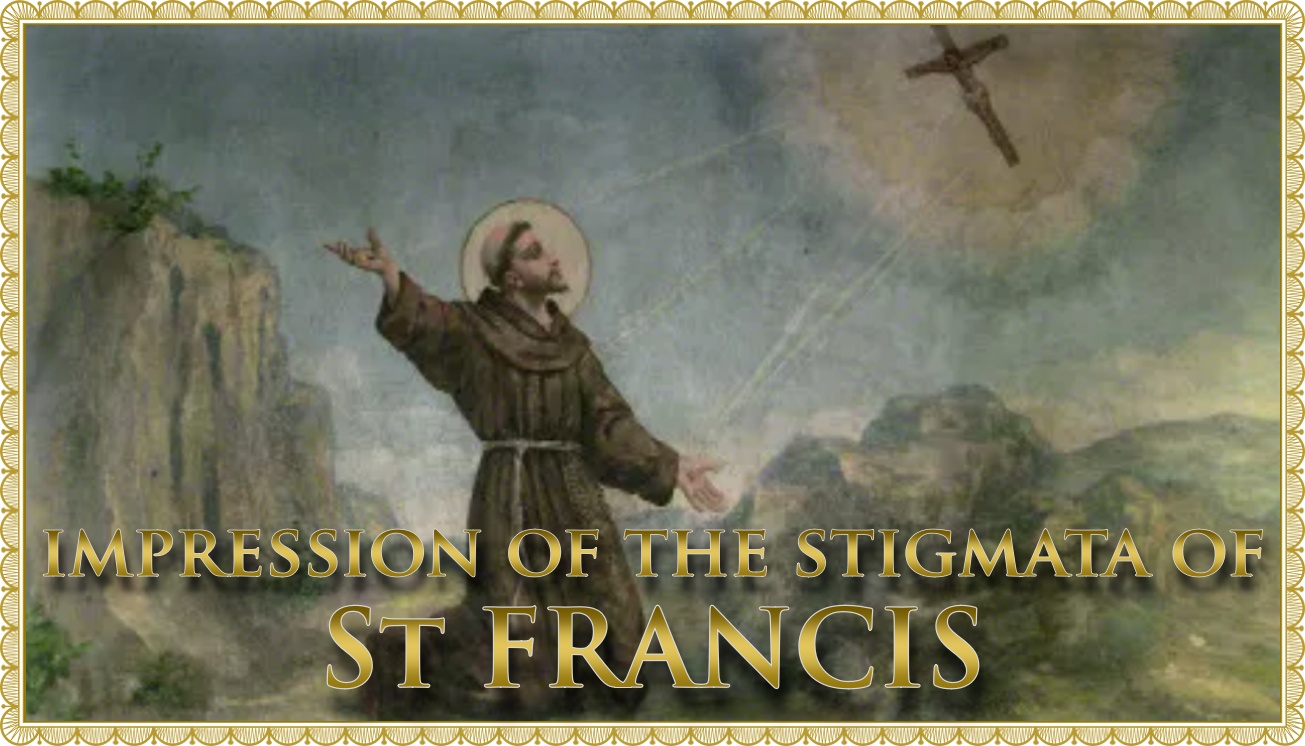
- Today’s homily: Impression of the Stigmata upon St FrancisFrom serving the lepers he once shunned to receiving Christ’s wounds upon Mount Alvernia, Saint Francis shows how grace transforms a soul through obedient love. His stigmata call us to let the Cross shape our lives, beginning with the particular act of mercy or sacrifice we have been reluctant to offer.
- Today’s Mass: September 17 Impression of the Stigmata of St Francis of AssisiSaint Francis received the stigmata because he had first allowed the Cross to transform his soul. His wounds were not a spectacle, but God’s answer to a world growing cold: the visible sign of a life consumed by crucified love. We may never bear Christ’s wounds in our flesh, but we must bear their likeness through penance, fidelity, patience, mercy and sacrificial love.
- Sermon for Stigmata of St. FrancisToday marks the feast of St. Francis’ stigmata, celebrating his transformation from a wealthy merchant’s son to a devoted preacher of poverty and humility. He founded the Franciscan order, emphasising evangelisation and simplicity. His experience of receiving the stigmata exemplifies the Christian doctrine of redemption through suffering, distinguishing it from other faiths.
- Today’s homily: Wednesday Michaelmas EmberThe homily reflects on the significance of fasting and prayer in the Christian faith, emphasising their role in spiritual growth and self-mastery. By juxtaposing scripture from Amos and the Gospel of Mark, it highlights the need for gratitude and humility during abundance, urging believers to recognise their dependence on God. True repentance transforms and restores one’s relationship with Him.



Leave a Reply