
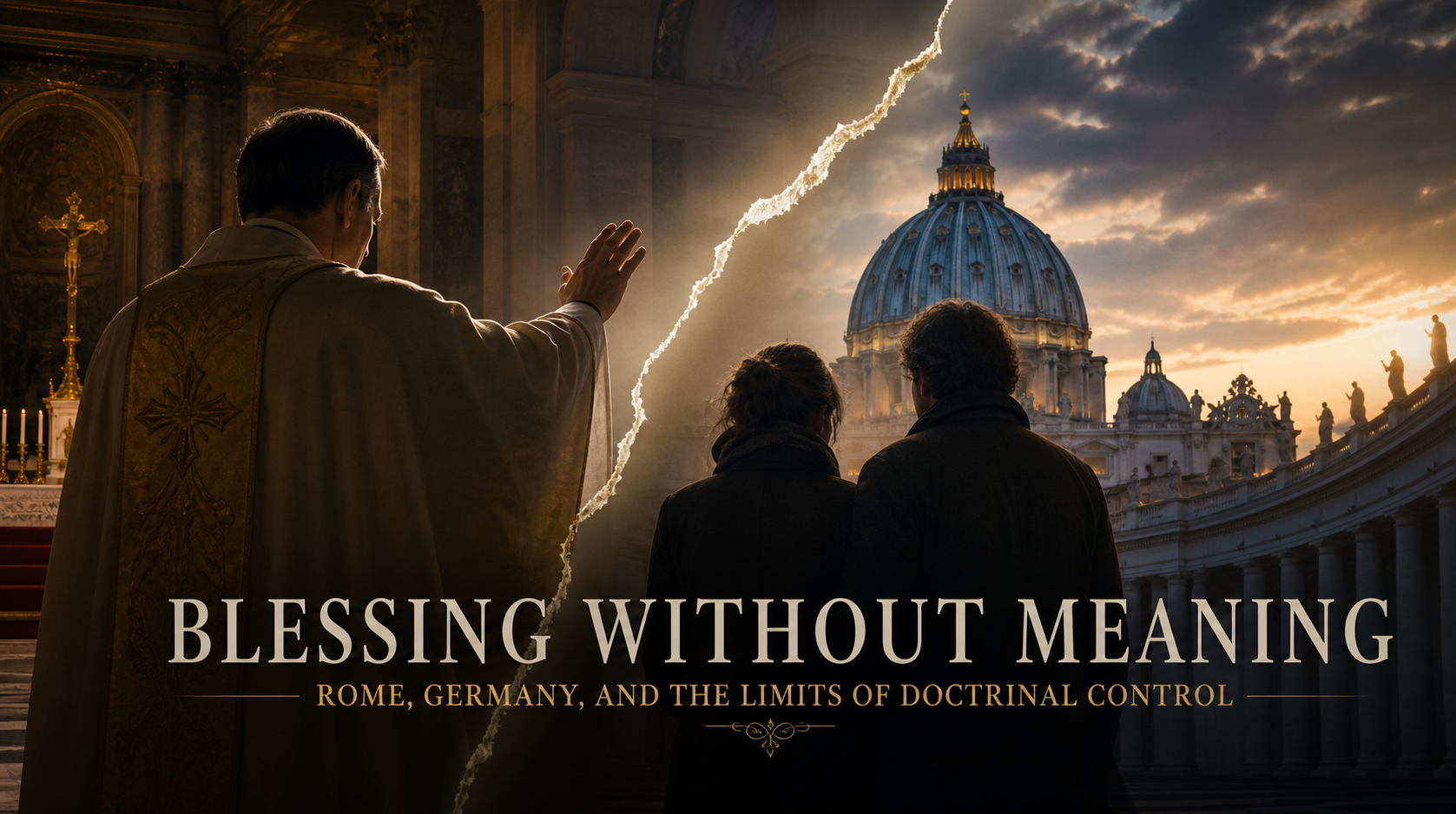
Blessing Without Meaning: Rome, Germany, and the Limits of Doctrinal Control

The dispute between Rome and the German episcopate over the blessing of couples has now passed beyond conjecture into documented fact. A formal letter from the Dicastery for the Doctrine of the Faith, signed by Víctor Manuel Fernández and dated 18 November 2024, rejects the German bishops’ proposed Vademecum for such blessings. The reasoning offered is not incidental. It is decisive. The German approach, Rome states, risks transforming what must remain an informal, non-signifying gesture into something structured, recognisable, and therefore doctrinally misleading¹.
This intervention does more than settle a procedural question. It exposes a deeper tension at the heart of the Church’s present pastoral language. For the issue is no longer whether such blessings are permitted. That question has already been answered in the affirmative under Pope Francis through Fiducia supplicans. The question now is whether such blessings can remain what they are claimed to be once they pass from theoretical allowance into the lived and repeated actions of the Church’s ministers.
They cannot.
The Most Charitable Reading
The most charitable reading of Fiducia supplicans must be stated first, and stated clearly, if any serious evaluation is to proceed. At its most defensible, the document affirms that a priest may bless individuals who are not living in full conformity with the Church’s moral teaching, asking that they receive the grace necessary to amend their lives and conform themselves more perfectly to the Gospel. The blessing, in this reading, is not an endorsement of the person’s present situation, but a petition for divine assistance in overcoming it.
This interpretation is neither novel nor controversial. It accords with the Church’s perennial pastoral instinct: that grace is not withheld from sinners, but is precisely what is sought for their conversion. A blessing, so understood, is directed toward transformation. It presupposes not the goodness of the present condition, but the possibility of a better one.
Yet the document does not remain at this level of clarity. It introduces a further element which, though expressed with caution, alters the entire practical horizon. It allows that such individuals may present themselves together, and may be blessed together. It is here—at the point where the individual becomes visibly part of a relational unit—that the difficulty begins to emerge.
For when two persons stand together and receive a blessing as a pair, the act is no longer perceived as directed to isolated individuals. It is perceived, almost inevitably, as directed to them precisely in their togetherness. The sign shifts, however carefully the intention is qualified. What is meant to be a blessing of persons for conversion is received as a blessing of a couple as such.
Thus the tension is not abstract. It lies in the gap between intention and perception, between what is said to occur and what is visibly enacted.
The Limits Rome Now Imposes
The Fernández letter returns to this tension and attempts to impose clear boundaries upon it. Reiterating the principles of Fiducia supplicans, it insists that no blessing may be given in a manner that appears to legitimise a union which the Church does not recognise as marriage. From this follows a series of prohibitions: no rites, no quasi-rites, no fixed texts, no semi-liturgical forms, no stable pastoral frameworks. Such blessings must remain spontaneous, non-liturgical, and devoid of any element that could suggest institutional recognition².
The reasoning is internally consistent. A structured act becomes intelligible. An intelligible act communicates meaning. Once meaning is communicated, the act risks being interpreted as approval. That interpretation, Rome insists, must be prevented.
Yet in preventing that interpretation, the Church is compelled to restrict the act itself to such a degree that its intelligibility becomes uncertain. The blessing must be given, but not in such a way that it becomes recognisable as a consistent or communicative act.
The German Application
The German bishops, represented by figures such as Georg Bätzing and Reinhard Marx, approached the matter from the opposite direction. Accepting the permission granted by Rome, they sought to render it pastorally workable. If couples may be blessed, then priests require guidance. If guidance is provided, the practice becomes consistent. If consistent, it becomes recognisable and pastorally reliable.
Thus emerged the Vademecum: not a doctrinal manifesto, but a practical tool. It did not seek to redefine marriage, nor to deny the limits articulated by Rome. It sought simply to give shape to what had already been permitted.
It was precisely this act of giving shape that provoked the Vatican’s response. For in shaping the practice, the German bishops made visible what Rome had attempted to keep indeterminate. The blessing, once given form, began to signify. And once it signified, it could no longer be contained within the narrow interpretive boundaries set for it.
The Dicastery’s critique therefore identifies not merely an error of prudence, but a transformation of the act itself. What was intended as a spontaneous gesture had become, in effect, a “para-liturgical” form: structured, repeatable, and intelligible as a public ecclesial action³.
The Underlying Tension
The conflict can now be stated with precision. Rome permits the blessing of persons in irregular situations, yet forbids any form that would allow the blessing to be understood as affirming the relationship in which those persons stand. The act is authorised; its natural signification is denied.
This is not a superficial contradiction. It touches upon the very nature of ecclesial action. For in the Church’s theological tradition, an act is not merely something done; it is something that signifies. Its meaning is not an optional addition, but an intrinsic property.
As Thomas Aquinas teaches, a blessing invokes divine favour upon that which is understood under a certain aspect of the good⁴. One blesses not in abstraction, but in recognition of what something is, or is called to be. The intelligibility of the act is therefore inseparable from its meaning.
This principle is echoed in the magisterial teaching of Pope Pius XII, who insists that the Church’s rites “signify and effect” the realities they express⁵. Their power and clarity depend upon the unity of sign and truth.
If that unity is disrupted—if the act is performed while its meaning is denied—the act itself becomes unstable. It no longer clearly communicates what it is intended to communicate, and therefore cannot reliably fulfil its purpose.
Authority and Its Limits
The intervention of Víctor Manuel Fernández must be understood in this light. It is not a reversal of policy, but an attempt to preserve the distinction upon which the policy depends. Rome is enforcing its own limits.
Yet those limits rely upon a separation between act and meaning that cannot be sustained once the act becomes part of ordinary pastoral life. Authority can define what is permitted. It cannot indefinitely control how that permission is perceived once it is enacted publicly and repeatedly.
The faithful do not interpret actions according to qualifying clauses or theological footnotes. They interpret them according to their visible form. And the visible form, once stabilised, inevitably carries meaning.
Thus the German initiative did not introduce a new problem. It revealed the inherent tension within the existing framework.
Conclusion
The present dispute is therefore not merely disciplinary, nor even primarily pastoral. It concerns the coherence of doctrinal expression within the life of the Church. The most charitable reading of Fiducia supplicans seeks to bless individuals for their conversion, not to affirm their relationships. Yet once those individuals are blessed together in a recognisable way, the distinction becomes increasingly difficult to maintain.
The Fernández letter does not resolve this tension. It brings it into full view. For once the Church permits an act whose natural meaning must be continually denied, the capacity to govern that meaning begins to erode. And what is no longer governed in sign will not long remain stable in doctrine.
¹ Dicastery for the Doctrine of the Faith, Letter to Bishop Stephen Ackermann, 18 November 2024.
² Dicastery for the Doctrine of the Faith, Fiducia supplicans, 18 December 2023.
³ Ibid.; cf. Fernández letter, critique of structured and semi-liturgical forms.
⁴ Thomas Aquinas, Summa Theologiae, II-II, q. 84, a. 2.
⁵ Pope Pius XII, Mediator Dei, 20 November 1947.
RELATED ARTICLES


Latest
- Today’s Mass: September 26 SS. Cyprian and Justina, MartyrsThe persecution of Diocletian broke out at that time, and Cyprian and Justina were seized and presented to Diocletian himself, who judged them. Justina was scourged and Cyprian was torn with iron hooks. After this they were both sent back to Diocletian in chains. He commanded that their heads be cut off, and they died; martyrs for the Faith!
- 27.09.26 Nuntiatoria CXXV: VERITAS NON MUTATUR CONSENSUThis edition emphasises that truth remains constant, regardless of institutional consensus. It explores how authority should serve existing realities rather than define them, stressing the importance of preserving the Church’s traditions and teachings. The Church’s role is to guard and transmit truth, not to create it through agreement or procedure.
- ORDO w/c 27.09.26The week begins with the Eighteenth Sunday after Pentecost, honouring various saints, culminating in the feast of St Francis of Assisi. Key celebrations include St Wenceslaus, St Michael the Archangel, St Jerome, and St Thérèse of the Child Jesus. The period highlights the call to surrender worldly attachments in devotion to God.
- Rupnik’s accusers appeal to Leo XIV: the women are still outside the doorThe text explores the concept of “spiritual denial” within the Catholic Church regarding serious allegations against church leaders. It argues that this denial, often perceived as loyalty, leads to evasion of uncomfortable truths. The piece emphasises that acknowledging these failures does not undermine the Church’s integrity, urging faithful confrontation of wrongdoing while maintaining justice for all involved.
- TRADITIONIS CUSTODES BY THE NUMBERS: WHAT ROME’S 2025 DECREE REGISTER ACTUALLY SHOWSThe Vatican’s 2025 decree register clarifies the status of the Traditional Roman Mass, detailing 34 decrees concerning 33 jurisdictions and 55 parish churches. While 41 locations have renewed permissions, this system requires repeated authorisation from Rome, indicating administrative dependency on continuous approval for traditional practices rather than expanding opportunities.






Leave a Reply