
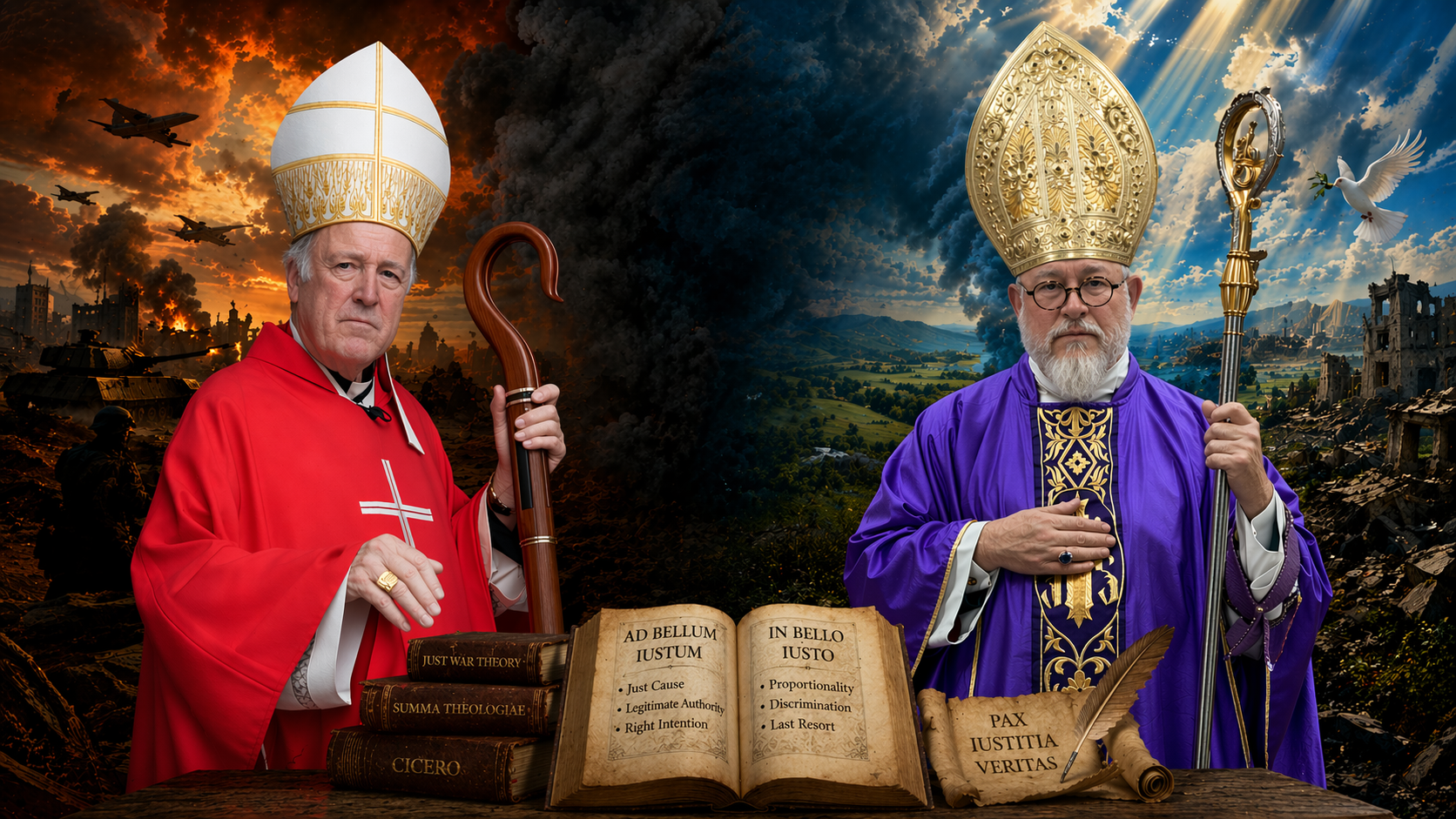
A Response from the Titular Archbishop of Selsey to His Eminence Cardinal McElroy: Gaza, Iran, and the Demands of Just War
The recent intervention of His Eminence Robert W. McElroy, asserting that military action in relation to Iran fails to meet the criteria of Catholic just war doctrine—principally on the grounds that it lacks “just cause” and fails the test of proportionality¹—demands a careful and serious reply. His Eminence further argues that the absence of an “imminent and objectively verifiable attack” renders such action morally illegitimate.¹ He is correct in one respect: the tradition of the Church does not permit moral ambiguity in matters of war and peace. Where force is employed, it must be justified according to principles rooted in truth, not expediency.
Yet it is precisely here that the present analysis falters.

The Central Error: A Misdescribed Object of Judgment
The difficulty lies not in the principles invoked, but in the object to which they are applied. The conflict under consideration is treated as though it were a conventional interstate war: a discrete engagement between identifiable parties, confined to a defined theatre. Upon this assumption, the criteria of just war are applied, and the conclusion is drawn that they are not met.
But the conclusion follows from the premise—and the premise is false.
What we are witnessing is not a classical war in the sense articulated by Augustine of Hippo and systematised by Thomas Aquinas. It is a hybrid system of mediated aggression, in which state and non-state actors operate in concert across multiple theatres. To isolate Gaza from that system is not to simplify the analysis; it is to distort it.
As Augustine himself observes, “peace is the tranquillity of order” (tranquillitas ordinis), and war is judged in relation to the restoration of that order, not merely the immediacy of injury.² A judgment that fails to apprehend the disorder in its full extent cannot rightly assess the means required to remedy it.
A Network, Not a Battlefield
Gaza is not an isolated theatre, nor are the actors within it autonomous. Hamas, Hezbollah, and the Islamic Revolutionary Guard Corps form part of a sustained and coordinated pattern of activity involving the provision of arms, training, finance, and strategic direction. The United Kingdom’s proscription of Hezbollah in its entirety reflects precisely this recognition: that its political and military dimensions are not separable in practice.³
Iran’s role is not incidental but constitutive. The IRGC—particularly through its Quds Force—has been identified in legislative and intelligence assessments as a principal instrument in the projection of Iranian power through proxy actors.⁴ The violence observed in Gaza and along Israel’s northern border is therefore not self-contained. It is the outward expression of a deeper and more durable infrastructure.
To analyse the symptom while ignoring the system is not prudence. It is misanalysis.
Mediated Aggression and Moral Attribution
The tradition to which His Eminence appeals does not confine responsibility to the immediate agent of violence. As Thomas Aquinas teaches, those who “counsel, command, consent to, or assist” in wrongdoing participate in its moral character.⁵ Causality, in this account, is not merely physical but moral.
In the present case, the aggression is mediated but no less real. Hamas acts locally; its capacity is externally sustained. Hezbollah operates across a different frontier; its resources are similarly derived. The IRGC functions as a coordinating force within this network. Responsibility, therefore, is not diminished by distribution. It is extended by it.
A moral judgment that ignores causality is not cautious—it is false.
The Wider Field of Threat
The analysis offered by His Eminence acknowledges the malign character of the Iranian regime, yet it does not fully integrate the extent of its activity. The United Kingdom’s Intelligence and Security Committee has described Iran as posing a “wide-ranging, persistent and unpredictable threat” to British interests, including operations within the United Kingdom itself.⁶ In February 2023, the Director General of MI5, Ken McCallum, confirmed that security services had disrupted at least 15 credible plots backed by Iran since 2022, several involving threats to life.⁷ One such disruption in 2022 targeted an individual in the United Kingdom associated with Iranian dissident networks, demonstrating the regime’s willingness to project violence beyond its borders.⁸
These are not abstract concerns. They are concrete manifestations of a strategy that extends beyond the Middle East into Europe and the United Kingdom. A conflict that operates across such a field cannot be morally assessed as though it were regionally contained.
Just Cause and the Question of Imminence
If, as His Eminence contends, the absence of an “imminent and objectively verifiable attack”¹ nullifies just cause, then the tradition itself must be read far more narrowly than either Augustine of Hippo or Thomas Aquinas would permit.
For Augustine, wars may be just when undertaken to redress wrongs and secure peace.⁹ For Aquinas, just cause includes the necessity of confronting grave and certain harm.¹⁰ The Catechism of the Catholic Church requires “lasting, grave, and certain damage” as the condition for legitimate defence.¹¹ It does not require temporal immediacy.
Where a networked system of aggression demonstrates sustained intent, repeated action, and increasing capacity, the moral question is not whether an attack is imminent in the narrowest sense, but whether the threat has become sufficiently grave and certain to warrant defensive action. To insist upon absolute imminence is to risk confusing prudence with paralysis.
Proportionality and the Burden of Prudence
None of this absolves those who act from the demands of proportionality and discrimination. On the contrary, it intensifies them. The conduct of operations within densely populated environments presents grave moral dangers, particularly where adversaries embed themselves among civilian populations.
Yet proportionality must be assessed comparatively. It requires weighing the foreseeable harms of action against the foreseeable harms of inaction. If a networked threat is permitted to consolidate—through rearmament, strategic coordination, and continued external support—the long-term harms may exceed those of immediate intervention.
The moral calculus is therefore prudential. It demands judgment grounded in reality, not abstraction imposed upon it.
Conclusion: Fidelity to Reality and to Tradition
Your Eminence is right to insist that the use of force must be judged according to the principles of just war. On this there can be no compromise. But those principles cannot be applied to a misdescribed reality without producing a misdirected judgment.
The conflict before us is not a conventional war, but a hybrid confrontation with a networked system of aggression extending across borders and into the very societies now called to judge it. To omit this reality is not to exercise restraint. It is to diminish the scope of moral reasoning itself.
And where moral reasoning is diminished, judgment cannot stand.
Nor can we conclude without recalling that behind every analysis lie human lives—innocent, vulnerable, and often voiceless. The faithful must not allow the complexity of modern conflict to harden the heart or obscure the command of charity. We are bound to pray for peace—but for a peace founded upon truth, not illusion; upon justice, not evasion. Let the Christian conscience be neither naïve nor indifferent, but formed in the full light of reality and ordered toward the restoration of that true peace which is, as the Fathers teach, the tranquillity of order.
✠Jerome Seleisi
¹ National Catholic Reporter, “Washington Cardinal says US war with Iran fails to meet Catholic just war principles,” April 2026, quoting Cardinal McElroy’s assessment that the conflict lacks “just cause” and an “imminent and objectively verifiable attack.”
² City of God, XIX.13.
³ UK Home Office, Proscribed Terrorist Organisations (London: Home Office, 2025).
⁴ U.S. Congressional Research Service, Iran’s Foreign and Defense Policies (Washington, D.C., 2024), pp. 32–35.
⁵ Summa Theologiae, I–II, q. 76, a. 3.
⁶ UK Parliament, Intelligence and Security Committee, Iran (HC 251, 2023), p. 3.
⁷ Ken McCallum, Director General of MI5, speech at the Royal United Services Institute, London, 8 February 2023.
⁸ ISC report and UK security disclosures, 2022–2023.
⁹ City of God, XIX.7.
¹⁰ Summa Theologiae, II–II, q. 40, a. 1.
¹¹ Catechism of the Catholic Church, §2309.
Related Articles


Latest Articles
- Today’s Mass: September 19 S. Eustace & Companions, MartyrsSt. Eustachius, formerly General Placidus, experienced a transformative vision of Christ while hunting. After converting with his family, he endured persecution, losing them temporarily. Reuniting after military success, he ultimately refused to worship pagan deities, leading to his martyrdom with his family. They were later honoured with a church.
- Sermon for St. Eustacius/ Seventeenth Sunday after PentecostThe feast of St. Eustacius, celebrated on the Seventeenth Sunday after Pentecost, commemorates early Christian martyrs who refused to renounce their faith. Despite limited historical knowledge of St. Eustacius, his story embodies the courage of many Christians who, facing persecution from the Roman Empire, chose martyrdom over idolatry, ultimately shaping the Church’s foundation.
- Today’s Mass: September 19 St. Januarius, Bishop and Companion MartyrsSt. Januarius and companion martyrs were martyred during the persecution under Diocletian. St. Januarius, patron of the city of Naples and bishop of Beneventum, was beheaded with his deacons and some others.
- Sermon for St. Januarius and his CompanionsToday we celebrate the feast of St. Januarius and his companions. About St. Januarius little is known except that he was among the many martyrs during the great persecution under the Emperor Diocletian.
- 20.09.26 Nuntiatoria CXXIV: QUOD ACCEPIMUS, CUSTODIMUS ET TRADIMUSThe editorial emphasises the importance of understanding our inheritance as custodians rather than owners. It highlights the obligation to preserve and transmit the Christian Faith, sacraments, and traditions to future generations. Through gratitude and fidelity, those who receive must ensure that what has been entrusted does not end with them.


Leave a Reply