
Refusal Without Words? Communion, Posture, and the Quiet Mechanics of Exclusion in Charlotte

A visible moment within a test case already opened by Rome.
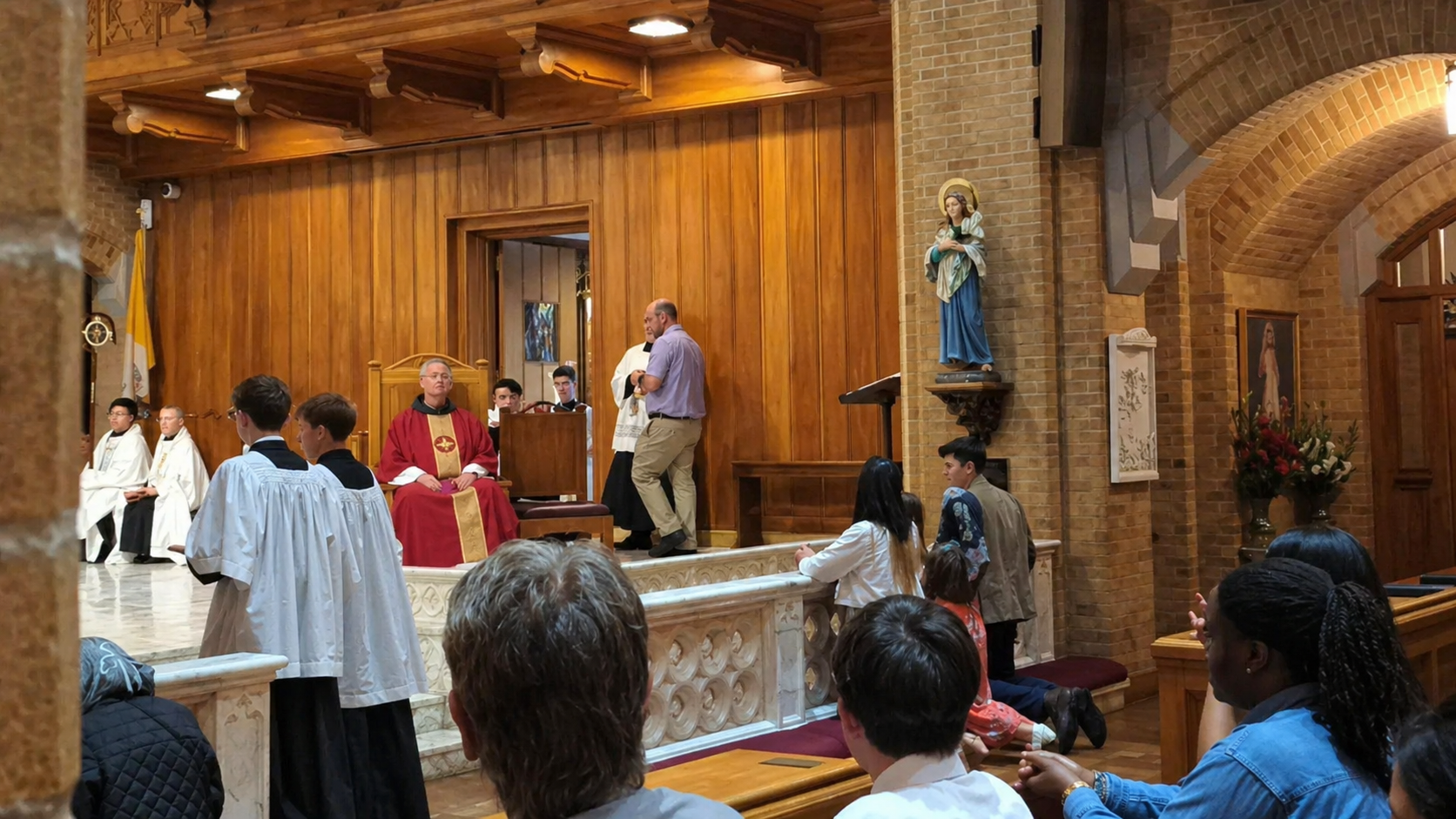
Video footage widely circulated in recent days—reported to be from a Confirmation Mass at Our Lady of Grace parish in Greensboro within the Diocese of Charlotte—has sharpened an already recognised ecclesial conflict. It shows a family—two adults and two children—kneeling at the altar rail while Holy Communion is distributed elsewhere to a standing line. No minister approaches them. When distribution concludes, they depart without receiving. Present in the sanctuary, seated opposite them in clear eyeline and observing, is His Excellency Michael T. Martin, Bishop of Charlotte. No words are captured. No explicit refusal is heard. Yet the outcome is plain: the faithful present themselves for Holy Communion and do not receive.
This moment does not arise in isolation. As already examined in Rome Opens the File on Charlotte — A Test Case for Liturgical Authority, the Holy See has formally received hierarchical recourse concerning the liturgical directives of the diocesan ordinary, thereby situating what might otherwise appear a local pastoral dispute within a wider and more consequential question: the nature and limits of episcopal authority in regulating the sacred liturgy.¹ The case has been treated in multiple Catholic outlets as a significant development precisely because it tests whether particular episcopal directives—especially those affecting posture, reception, and long-standing devotional customs—are consistent with universal norms or represent an overextension of diocesan discretion.² The present image must therefore be read not as anecdote, nor as isolated controversy, but as evidence situated within an already recognised canonical and ecclesial inquiry.
From allegation to evidential convergence.
Reports—originating from several eyewitness accounts and subsequently repeated across a small network of outlets—have described kneeling communicants being passed over during the distribution of Holy Communion at a Confirmation Mass in the Diocese of Charlotte. While the incident has not been independently confirmed by diocesan authorities or by major Catholic news agencies, photographs and film footage itself establishes a critical fact: a liturgical configuration in which kneeling communicants are left unserved while others receive. Such reporting, though limited in sourcing, is not without contextual plausibility. It emerges within a documented framework of diocesan policy that has restricted or removed altar rails and kneelers and has emphasised a standing, processional mode of reception.³ The convergence of claim, policy, and visual evidence does not yet constitute juridical proof; it does, however, establish a credible and materially significant scenario requiring explanation.
The governing distinction: refusal and effect
Canonical discipline does not ultimately turn on the presence of a spoken refusal. It turns on whether the faithful, properly disposed, are able in fact to receive the sacraments. The law is explicit. Sacred ministers “may not deny the sacraments to those who seek them at appropriate times, are properly disposed, and are not prohibited by law from receiving them.”⁴ The faithful possess a corresponding right: “Christ’s faithful have the right to receive assistance from the sacred pastors out of the spiritual goods of the Church, especially the word of God and the sacraments.”⁵ This right is not merely theoretical; it is juridically real and pastorally binding. Moreover, the Church has addressed directly the question of posture in the reception of Holy Communion. The Congregation for Divine Worship and the Discipline of the Sacraments states unequivocally that it is not licit to deny Holy Communion “to any of Christ’s faithful solely on the grounds… that the person wishes to receive the Eucharist kneeling or standing.”⁶
The implication is inescapable. Where the faithful present themselves for Holy Communion, properly disposed, and are not impeded by any canonical prohibition, yet nevertheless do not receive because the mode of distribution does not accommodate them, the absence of reception cannot be dismissed as incidental. It must be evaluated as a failure of access within the act of distribution itself. The distinction between explicit refusal and effective exclusion collapses when the result is the same: the faithful depart without the Sacrament.
The Charlotte question: authority under examination
The broader dispute within the Diocese of Charlotte is not merely pastoral but juridical. In early 2026, a group of diocesan clergy submitted a hierarchical recourse to the Holy See challenging the authority of the diocesan bishop to impose certain liturgical restrictions, including limitations on kneeling and the removal of altar rails.⁷ The Dicastery for Divine Worship has acknowledged receipt of such concerns, placing the matter within the formal processes of ecclesiastical review.⁸ Commentators have recognised the significance of this development. It is not simply a question of local preference, but of whether episcopal governance in liturgical matters is being exercised within the bounds established by universal law.⁹
Within this context, the image acquires juridical weight. It is no longer a question of abstract norms or theoretical rights. It becomes a question of whether the implementation of policy has produced conditions incompatible with those norms. The issue is not merely what has been decreed, but what has been made possible—or impossible—in practice.
Structural denial: exclusion without declaration
What the footage reveals is not an isolated irregularity but a condition capable of repetition. No minister refuses. No prohibition is spoken. No confrontation occurs. Yet Communion is distributed only within a standing procession; ministers are positioned away from the altar rail; those who remain kneeling are not incorporated into the act of distribution. The effect is consistent, predictable, and structurally embedded. This is what may properly be termed structural denial: exclusion effected not by explicit verbal refusal but by the configuration of the system itself. What is permitted in principle is nullified in practice. Such a condition is particularly difficult to address because it presents no single act of refusal to contest. Instead, it manifests as a pattern, a procedure, a method that yields exclusion while maintaining the formal appearance of compliance.
The limits of episcopal authority
The diocesan bishop is the moderator of the liturgy in his diocese, but he is not its proprietor. His authority is exercised within the framework of the Church’s universal discipline. The Code of Canon Law makes clear that the regulation of the sacred liturgy depends on the authority of the Church as a whole and that the Apostolic See retains ultimate oversight.¹⁰ The bishop’s role is to ensure fidelity to that discipline, not to redefine it. Where local practice introduces conditions that effectively restrict what the universal Church permits, a tension arises between governance and law. Canonical commentary on the Charlotte case has already identified this tension as central: whether episcopal directives have exceeded their legitimate scope by imposing restrictions not found in universal norms.⁹
Where practice contradicts permission, governance ceases to regulate and begins to obscure. And where access to the Eucharist is conditioned by such obscurity, the issue is no longer one of liturgical preference but of sacramental justice. The faithful are not petitioners before the altar; they are recipients of a sacrament to which they have a right when properly disposed.
The image as argument
The force of the imagery lies precisely in its simplicity. The altar rail—long associated with Eucharistic reverence—stands occupied. The communicants kneel. Ministers pass elsewhere. The bishop remains present. The communicants depart without receiving. No rhetorical embellishment is required. The imagery itself constitutes a form of argument, compressing into a single moment the tension between policy and practice, between permission and accessibility. It renders visible what might otherwise remain abstract: the lived consequences of liturgical regulation.
Conclusion: the fiction of permitted impossibility
This imagery does not prove an explicit refusal. It does not establish motive. It does not resolve the canonical process now underway. But it establishes something that cannot be dismissed. The faithful presented themselves for Holy Communion and did not receive because the system did not serve them. Where a right exists in principle but cannot be exercised in practice, it is not a right but a fiction. And where the faithful approach the altar and depart without receiving—not by refusal, but by arrangement—the question is no longer whether denial has occurred, but whether it has been obscured beneath the forms of compliance.
¹ Nuntiatoria, “Rome Opens the File on Charlotte — A Test Case for Liturgical Authority,” 28 April 2026.
² Jonathan Liedl, “How the Charlotte dubia may impact liturgy disputes beyond North Carolina,” National Catholic Register, 26 January 2026.
³ Catholic World Report, “Dozens of Charlotte priests query Vatican over bishop’s move to abolish altar rails, kneelers,” 13 January 2026.
⁴ Code of Canon Law (1983), can. 843 §1.
⁵ Code of Canon Law (1983), can. 213.
⁶ Congregation for Divine Worship and the Discipline of the Sacraments, Redemptionis Sacramentum (2004), n. 91.
⁷ Catholic World Report, 13 January 2026.
⁸ InfoVaticana, “The Vatican examines the decisions of Martin, bishop of Charlotte regarding traditional liturgy,” 28 April 2026.
⁹ Jonathan Liedl, National Catholic Register, 26 January 2026.
¹⁰ Code of Canon Law (1983), can. 838 §§1–4.
RELATED ARTICLES


Latest ARTICLES
- Today’s homily: Our Lady of WalsinghamThe Mass reflects on the significance of Walsingham, Loreto, and the Christian soul as “Holy Houses” that embody the connection between heaven and earth. It highlights Mary’s central role in the Incarnation and emphasises the importance of inner conversion by inviting believers to reflect on their own hearts as dwelling places for God.
- Today’s Mass: September 24 Our Lady of WalsinghamThe Feast of Our Lady of Walsingham commemorates the vision of Mary that inspired Richeldis de Faverches to build a replica of her house in Nazareth in 1061. This shrine became a significant pilgrimage site, attracting royal visits until its destruction in 1538. The revival of pilgrimage in the 20th century reaffirmed its spiritual importance.
- Sermon for Blessed Virgin Mary of RansomToday, we commemorate the feast of the Blessed Virgin Mary of Ransom, which honours the Mercedarians, a religious order founded in 1218 to free Christian captives from the Moors in Spain. Their mission persists today, highlighting the ongoing relevance of ransoming captives amidst contemporary persecution, combining spiritual redemption with social responsibility.
- OUR LADY OF RANSOM: THE MOTHER OF THE REDEEMER AND THE BREAKING OF CHAINSThe Feast of Our Lady of Ransom, celebrated on 24 September, commemorates the Mercedarian Order’s mission to redeem Christian captives, embodying the concept of liberation from sin through Christ’s sacrifice. This day’s significance links historical devotion with England’s Catholic restoration, connecting the feast to both the Incarnation and personal spiritual freedom.
- Today’s Mass: September 23 Pope Saint Linus, MartyrPope Saint Linus, a nobleman from Tuscany, became an early Christian leader, first in Gaul and then as the Pope after Saint Peter. He was martyred for his faith, noted for his role in baptising and appointing bishops. Saint Thecla, inspired by Saint Paul, chose virginity and endured persecution, ultimately receiving martyrdom.





Leave a Reply