
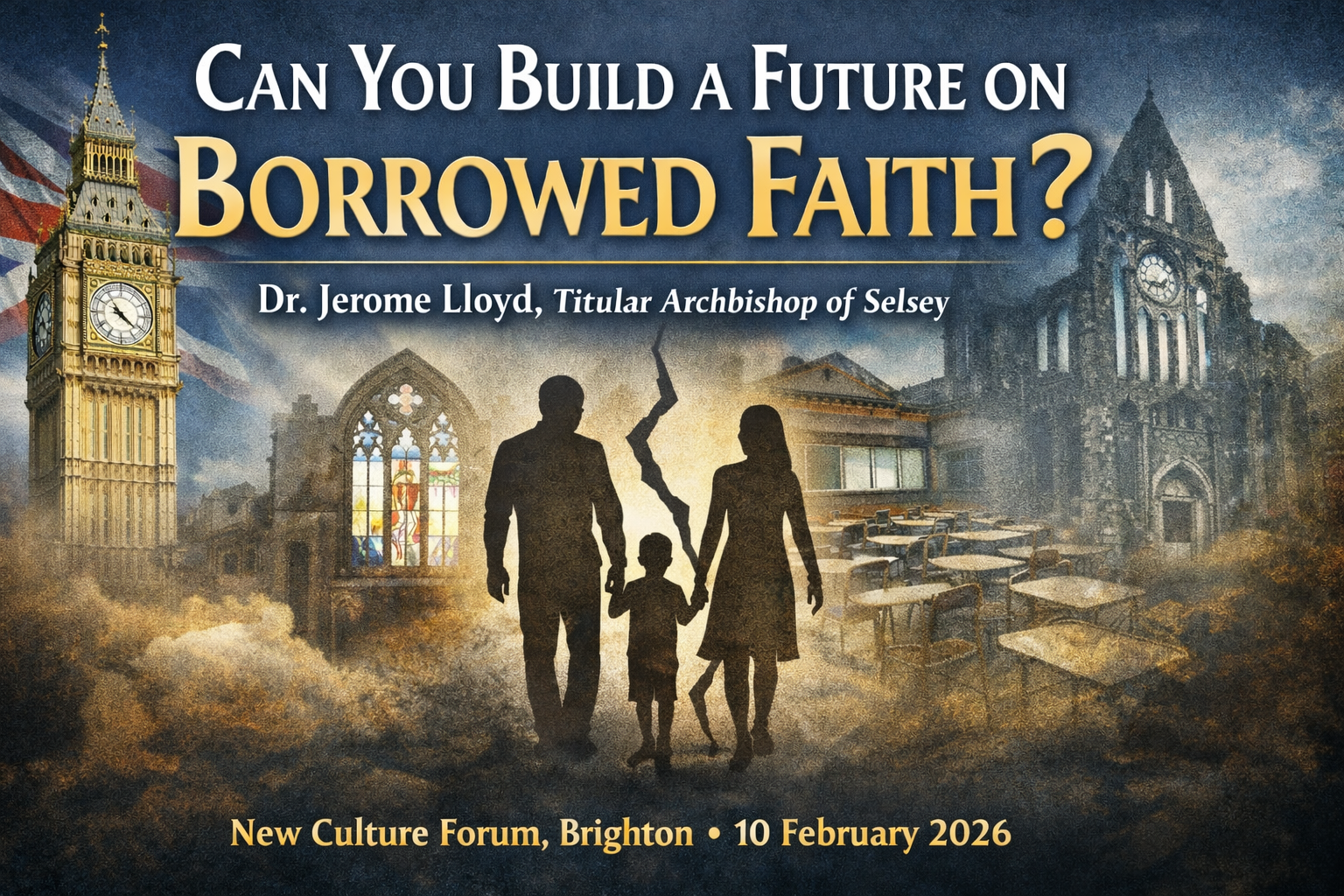
Can You Build a Future on Borrowed Faith? Civilisational Exhaustion and the Moral Credit of Britain
On 10 February 2026, the Titular Archbishop of Selsey, Dr Jerome Lloyd, addressed the New Culture Forum in Brighton under the title Can You Build a Future on Borrowed Faith? What began as an event lecture has since become something more significant: a diagnosis of Britain’s civilisational condition.
The argument advanced was neither confessional nor partisan. It was anthropological. The central claim was stark: that Britain has attempted, for two generations, to preserve the moral language of Christianity while quietly discarding the metaphysical and moral convictions that made that language intelligible. The result, Dr Lloyd suggested, is a civilisation living on moral credit.
Demography as Moral Autobiography
The Archbishop began not with rhetoric but with arithmetic. Fewer than half of adults in England and Wales are now married.¹ The total fertility rate stands at approximately 1.44 children per woman—well below the replacement level of 2.1.² One-person households account for roughly 29 per cent of households in the United Kingdom.³ Population growth in recent years has been driven overwhelmingly by net migration rather than natural increase.⁴
These are not moral judgements. They are demographic facts.
Yet demography is not morally neutral. A society that does not reproduce itself biologically is unlikely to reproduce itself culturally. The decline of marriage and fertility is not simply a private matter; it affects the density of intergenerational transmission. Fewer siblings, fewer cousins, fewer grandchildren mean fewer informal networks of obligation and memory. Where the family thins, the state expands.
Mental health indicators trace a parallel curve. The Adult Psychiatric Morbidity Survey records rising prevalence of anxiety and depressive disorders, particularly among younger cohorts.⁵ Loneliness has become sufficiently widespread to warrant a dedicated ministerial portfolio.⁶ Suicide remains one of the leading causes of death among men under fifty.⁷
These are not isolated trends. They describe a society organised around radical autonomy, surprised to discover that autonomy without attachment yields isolation.
From Oath to Process
To illuminate the shift, Dr Lloyd invoked Harold Godwinson’s oath of 1064, sworn upon relics. In the medieval imagination, an oath was not a procedural formality but an appeal to an objective moral order. Breaking it was a rupture not merely political but ontological.
The Cosmati pavement of Westminster Abbey embodies the same worldview. Its geometry and inscriptions place temporal authority within a cosmic frame. The monarch was crowned not on neutral ground but within a symbolic map of reality.
Modern Britain retains the form while attenuating the conviction. When institutions fail, we commission inquiries, publish reports, issue apologies, and promise reform. The Independent Inquiry into Child Sexual Exploitation in Rotherham (1997–2013), chaired by Professor Alexis Jay, concluded that at least 1,400 girls were abused—an estimate described as conservative.⁸ Parallel investigations in Rochdale, Oxfordshire, and Telford reveal similar patterns of institutional paralysis.⁹
One survivor testified: “They said I was choosing that lifestyle. I was thirteen.”¹⁰
The failure was not evidential but moral. Fear of reputational damage, fear of appearing discriminatory, fear of causing offence paralysed judgement. Compassion was redefined as silence.
The pattern extends. The National Crime Agency records tens of thousands of missing children reports annually.¹¹ Meanwhile, parliamentary debates increasingly frame assisted suicide as an extension of autonomy and dignity.¹²
At the beginning of life, more than 250,000 abortions were recorded in England and Wales in 2022—the highest number since the Abortion Act 1967.¹³ That Act did not declare abortion morally neutral; it carved out exceptions so that women would not be prosecuted for homicide under specified circumstances. It presupposed that human life possessed inherent worth. Contemporary proposals for abortion up to birth represent not adjustment but anthropological rupture.
Anthropology Unmoored
The Archbishop’s thesis rests upon anthropology. Historic Britain operated with an implicit Christian understanding of the human person: intrinsic dignity, moral limits, freedom ordered toward truth, and duties prior to rights. Modern liberal abstraction increasingly treats identity as self-constructed and desire as sovereign.
Law detached from a shared account of the human becomes procedural rather than persuasive. Compliance rooted in conviction gives way to compliance rooted in habit—or fear.
This anthropological drift manifests in the academy. Universities once prided themselves on testing ideas in open contest. Increasingly, ideas are screened for risk and managed for reputational impact. Debate is celebrated rhetorically while constrained administratively. Intellectual pluralism narrows even as the vocabulary of inclusion expands.
Hostility toward national inheritance follows. Statues are reassessed, language scrutinised, curricula revised under the assumption that tradition is primarily a structure of domination. A culture that trains itself to view its own foundations chiefly as oppressive will eventually lose confidence in sustaining them.
Coronation Without Coherence
The 2023 Coronation of King Charles III offered a vivid illustration. The Cosmati pavement remained. The liturgy remained. The language remained. Yet the ceremony unfolded in a cultural climate where Christian metaphysical claims are treated as symbolic heritage rather than binding truth.
The monarch—whose adultery was a matter of public record—was installed as Supreme Governor of the Church of England in a ceremony framed as inclusive continuity.¹⁴ The contrast with mid-twentieth-century court protocol, which restricted divorcees from the monarch’s presence at accession, is historically documented.¹⁵ The issue is not personal morality but symbolic coherence. Authority detached from moral intelligibility becomes pageantry.
Symbols without belief decorate; they do not bind.
Moral Credit and Civilisational Exhaustion
For sixty years, Britain attempted to retain the ethical language of Christianity—dignity, equality, compassion—while discarding the doctrinal and metaphysical claims that grounded them. This experiment has yielded what might be called moral credit: inherited instincts operating after the account that funded them has been closed.
But moral credit does not replenish itself.
The civilisational question is not whether Christianity should be imposed. It is whether any durable moral order can survive once it consumes its inheritance while repudiating its source.
A confident culture can accommodate difference because it knows what it is. An insecure culture confuses tolerance with self-erasure. The more a society refuses to name its foundations, the more brittle it becomes.
The statistics are not the cause of the crisis. They are its symptoms.
Britain today confronts not merely economic or political turbulence but anthropological uncertainty. The recovery of civilisational coherence will not be achieved through nostalgia or coercion. It will require intellectual honesty about the roots of the moral language we continue to employ.
Whether the nation is prepared for that honesty remains an open question.

¹ Office for National Statistics, Marriages in England and Wales: 2021–2022 release.
² Office for National Statistics, Births in England and Wales: 2022.
³ Office for National Statistics, Families and Households in the UK: 2023.
⁴ Office for National Statistics, UK Population Overview: Migration and Natural Change, 2023.
⁵ NHS Digital, Adult Psychiatric Morbidity Survey: 2014 (latest full survey); ONS supplementary mental health reporting.
⁶ UK Government, Appointment of Minister for Loneliness, 2018.
⁷ Office for National Statistics, Suicides in the UK: 2022 registrations.
⁸ Alexis Jay, Independent Inquiry into Child Sexual Exploitation in Rotherham (1997–2013), 2014.
⁹ Home Office, Group-based Child Sexual Exploitation: Characteristics of Offending, 2020; Telford CSE Independent Inquiry Report, 2022.
¹⁰ Jay Report, survivor testimony summary.
¹¹ National Crime Agency, UK Missing Persons Unit Annual Data Reports.
¹² UK Parliament, Assisted Dying Bill Debates (2023–2025 session).
¹³ Department of Health and Social Care, Abortion Statistics, England and Wales: 2022.
¹⁴ Biographical and historical record of Charles III and the 2023 Coronation service.
¹⁵ Contemporary court protocols and biographical accounts of early reign of Elizabeth II.
related articles


Latest articles
- Today’s homily: Christ the KingThe homily reflects on Christ’s kingship as seen in the Gospel narrative. It contrasts earthly authority with divine truth, emphasising that true allegiance to God requires genuine obedience and transformation. Believers are called to examine their personal commitments and respond to Christ’s demands in everyday life, ultimately recognising their identity as bearers of God’s image.
- Sermon for Christ the KingToday marks the celebration of Christ the King and the Twenty Second Sunday after Pentecost, a feast asserting Christ’s sovereignty against totalitarianism. St. Paul emphasised Christ’s supremacy over power and principalities, challenging early Gnostic beliefs. The early Church’s victory over evil is affirmed in Christ’s resurrection, offering hope and unity amidst contemporary struggles.
- Today’s Mass: October 25 SOVEREIGNTY OF OUR LORD JESUS CHRIST, SUPREME KINGThe Feast of the Sovereignty of Our Lord Jesus Christ celebrates Christ’s dual kingship by birth and conquest. Established by Pius XI, it aims to deepen faith and counter anti-clericalism. The liturgical observance underscores His authority as King, advocating for societal recognition of His reign to bring peace and harmony.
- TRADITION BEHIND THE FENCEThe Vatican’s prohibition of the traditional Ad Petri Sedem pilgrimage to St Peter’s Basilica has sparked controversy, especially among traditional Catholics. While some cite scheduling conflicts, the broader issue lies in the restrictive policies of Traditionis custodes, which may confine traditional liturgical practices to specific enclaves, risking the transmission and recognition of Catholic Tradition within the wider Church.
- Today’s Mass: October 24 St Raphael the ArchangelThe Feast of Saint Raphael the Archangel highlights his healing powers as depicted in the Book of Tobit, where he aids Tobit and his son, Tobiah. Venerated as a protector of travellers and the blind, Raphael is celebrated for his miraculous interventions. His legacy includes support for nurses, matchmakers, and Catholic studies.





Leave a Reply