
“Let Us Reason Together”? Ecumenism, Reason, Holy Orders, and the Scandal of Visible Contradiction
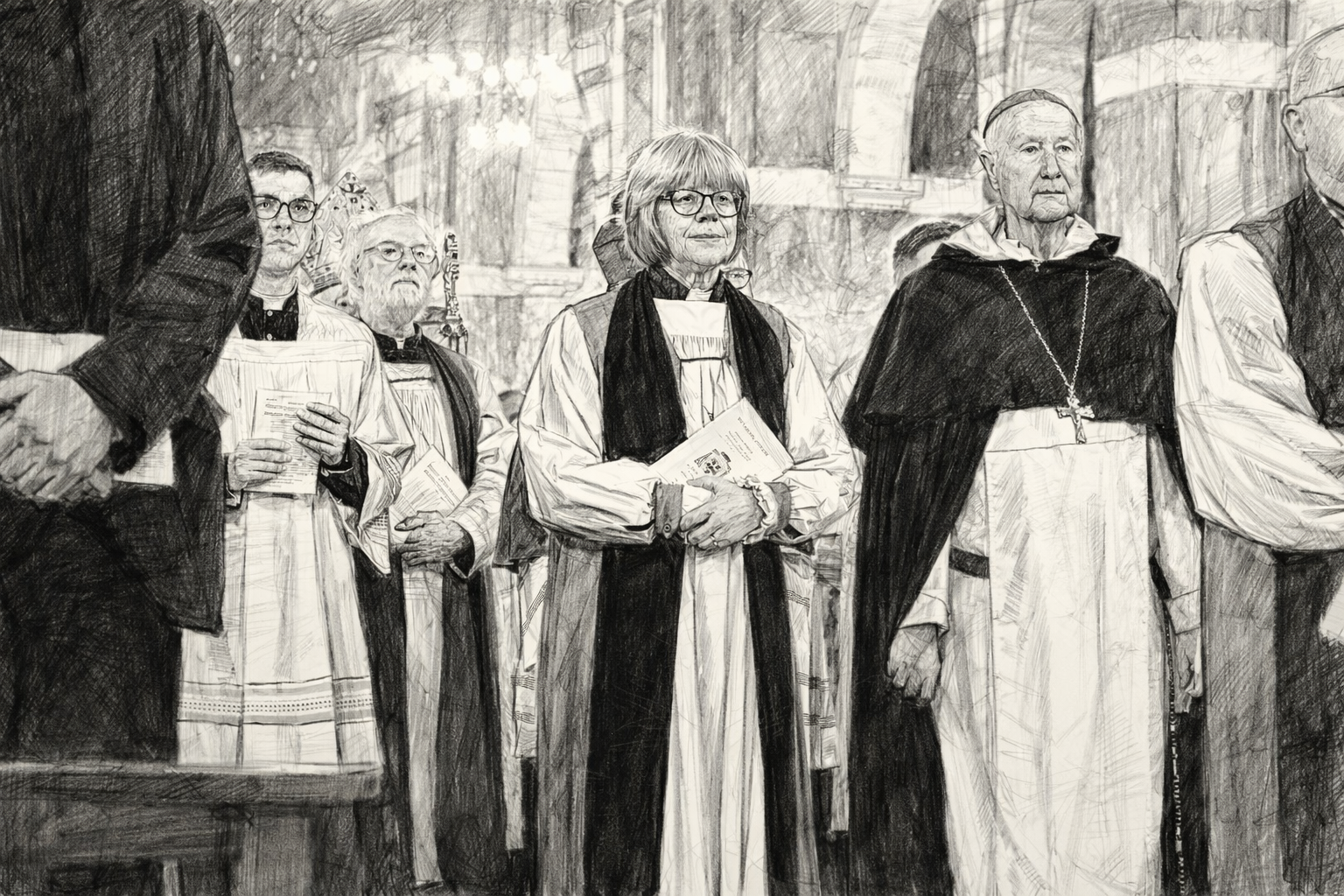
The solemn pontifical vespers held at Westminster Cathedral on Tuesday, 20 January 2026, formed part of the annual observance of the Week of Prayer for Christian Unity. Presided over by Cardinal Vincent Nichols, the service brought together senior Catholic and Anglican figures, including the Archbishop of York, a number of Anglican bishops in choir dress, and the Archbishop of Canterbury-elect, Sarah Mullally.¹
The principal theological address was delivered by Rowan Williams, who framed the occasion through an explicit appeal to Pope Benedict XVI. Williams urged the congregation to “remember where Pope Benedict’s theological inspiration comes from,” describing an era in which reason was understood “not as a tool of argument, but as a vehicle of vision,” enabling human beings to behold the order of creation together. He warned that “a human family which does not believe in reason is a family terminally and fatally divided,” not because some argue better than others, but because a shared rational language has been lost.²
Citing Isaiah’s injunction—“Come, let us reason together”—Williams insisted that the prophetic summons should not be misconstrued as an invitation to dispute. Rather, it called human beings to explore, listen, and learn together in the confidence that a shared humanity remains possible. On this reading, Benedict XVI was presented above all as a theologian of dialogical confidence: one whose approach to those “outside the Christian Body and outside the Roman Catholic Church” was grounded in hope that human beings could reason together and rediscover common ground.³
Taken at face value, the service thus functioned as a conventional ecumenical observance within the Week of Prayer: marked by shared prayer, courteous presence, and a homiletic appeal to reason as a unifying principle. What it did not attempt—either explicitly or implicitly—was to address the substantive theological questions that continue to divide Christian bodies. It is precisely this silence, together with the theological freight placed upon Benedict XVI’s name, that demands closer scrutiny.
Rowan Williams’ Benedict: Reason Abstracted from Truth
Williams’ invocation of Benedict was not incidental; it was programmatic. Benedict was presented as the theological patron of a form of ecumenism grounded in conversation rather than confession. Yet the Benedict who emerged from this address was a selective one: a Benedict of vision and dialogue, detached from the Christological and ecclesiological content that gives his account of reason its determinate shape.
For Benedict XVI, reason (logos) is not a neutral conversational space but a faculty ordered to truth and ultimately to the Word made flesh. In the Regensburg Address—the most authoritative exposition of his thought on reason—Benedict rejected any reduction of reason to a merely procedural function: “Not to act in accordance with reason is contrary to God’s nature.”⁴ Reason, in this vision, does not merely sustain dialogue; it judges it. It orders discussion toward truth rather than leaving it indefinitely open.
Williams’ appropriation therefore performs a decisive abstraction. Reason is retained; its telos is bracketed. Dialogue is affirmed; assent is deferred. Unity becomes something to be managed rather than received. The Church appears not as the locus of truth into which one is incorporated, but as one participant among others in an ongoing rational exchange.
This abstraction has immediate consequences for ecumenism.
The Pre-Conciliar Catholic Settlement on Unity
The pre-Vatican II magisterium addressed precisely this relocation of unity from truth to process. Pius XI, in Mortalium Animos (1928), warned against ecumenical projects that sought unity through dialogue while leaving unresolved the question of where the Church of Christ subsists: “The union of Christians can only be promoted by promoting the return to the one true Church of Christ of those who are separated from it.”⁵
Unity, in this teaching, is not negotiated through rational convergence but received through incorporation into the visible Body of Christ. Reason is not suspended before doctrine; it is ordered to assent to it. Against this background, the visible grammar of the Westminster Cathedral vespers acquires unmistakable theological significance.
Holy Orders and the Problem of Visible Contradiction
The decisive difficulty is the prominent, unqualified presence of the Archbishop of Canterbury-elect—a woman publicly styled and received as a bishop—within a Catholic liturgical service. From a Catholic standpoint this is not a matter of tone or pastoral tact but of sacramental reality. The Church has defined definitively that she has no authority whatsoever to confer priestly ordination on women. John Paul II stated in Ordinatio Sacerdotalis that this judgment “is to be definitively held by all the Church’s faithful.”⁶
This contradiction is compounded by the Church’s settled judgment on Anglican orders themselves. Since Leo XIII’s Apostolicae Curae (1896), Anglican orders have been held “absolutely null and utterly void.”⁷ Subsequent developments—above all the ordination of women—have only deepened that rupture.
Crucially, the problem is not confined to Catholic assessment. Within the Anglican Communion itself, the election and recognition of women bishops has resulted in what Anglican bodies explicitly describe as “impaired” and, in some cases, “broken communion.” A substantial majority of Anglican provinces—principally within the Global South—do not recognise women’s ordination to the episcopate and therefore do not acknowledge the ecclesial standing of Sarah Mullally’s claimed orders.¹² The public presentation of the Archbishop of Canterbury-elect as a bishop at Westminster Cathedral thus represented a claim contested within her own communion before the Catholic question is ever reached, normalising a fracture that Anglicanism itself formally acknowledges and continues to manage through structural separation.
As the Anglican Primates associated with the Global Anglican Future Conference have stated plainly, “the ordination of women to the episcopate has resulted in impaired and broken communion within the Anglican Communion.”¹²
From a Catholic perspective, this magnifies rather than mitigates the scandal. Ecumenical gestures presuppose clarity about what is being acknowledged and what is not. When a figure whose claim to Holy Orders is rejected by the Catholic Church and by the majority of the Anglican Communion is presented liturgically without qualification, the result is not unity but confusion—confusion about the nature of Holy Orders, the meaning of episcopal ministry, and the conditions under which Christian reconciliation can be pursued in truth.
An Aggravating Factor: Public Dissent and Ecclesial Scandal
The incoherence was further intensified by the participation of Timothy Radcliffe, who processed publicly alongside the Archbishop of Canterbury-elect. Radcliffe has repeatedly questioned the definitiveness of the Church’s teaching on women’s ordination. In an interview with La Croix International (October 2023), he argued that the question should not be regarded as closed, claiming that “the Church has changed its mind before on things once thought settled.”¹³
Such claims directly contradict the clarification of the Congregation for the Doctrine of the Faith that the teaching of Ordinatio Sacerdotalis “has been set forth infallibly by the ordinary and universal Magisterium.”¹⁴ When a cardinal who publicly questions a definitive doctrine processes liturgically alongside a woman whose very claim to Holy Orders the Church teaches to be impossible, the result is not courtesy but objective scandal: a public act that confuses the faithful regarding what the Church teaches and binds.
Ecumenism or Establishment Diplomacy?
The surrounding rhetoric emphasised “visible togetherness” and assurances that “what unites us is much more than what divides us.”¹⁵ The language of the World Council of Churches and the wider British ecclesial context situate the service within an establishment culture in which Anglicanism and Roman Catholicism function as parallel moral institutions underwriting civic cohesion.¹⁶ Such gestures may serve social civility; they do not resolve theological contradiction.
Conclusion
The failure of the Westminster Cathedral vespers was not one of courtesy or intention, but of truth and judgment. What was presented as an ecumenical observance became, in effect, a public enactment of the most divisive contention in contemporary Christendom: the ordination of women. This single innovation has fractured every denomination in which it has been introduced, dividing Anglicanism, splintering Protestant communions, and proving the greatest single barrier to reconciliation wherever it has occurred.
That this contention was not merely present but paraded—in the sanctuary of England’s principal Catholic church—matters profoundly. The public presentation of a woman styled as a bishop, whose claim to Holy Orders is rejected not only by the Catholic Church but by significant sectors of her own communion, transformed a gesture of prayer into a sign of contradiction.
More grave still was the theological framework supplied to justify this display. Pope Benedict XVI was invoked as the patron of a unity grounded in “reason,” yet his teaching was abstracted from its Christological and ecclesiological substance. Reason was retained; truth was deferred. Dialogue was celebrated; conversion was bracketed. Benedict’s name was used to legitimise precisely the kind of procedural unity the pre-conciliar magisterium warned against.
The presence of a cardinal who has publicly questioned the definitiveness of the Church’s teaching compounded the scandal. The Church’s infallible doctrine was not merely ignored; it was protested by gesture. The faithful were left not with clarity but with confusion.
At a deeper level, the fact that such an occasion could occur at all—publicly, liturgically, and without explanatory comment—points to a wider disorder within the contemporary Church. What was once instinctively recognised as requiring clarification, correction, or restraint is now permitted to pass in silence. This is not simply the result of misplaced ecumenical enthusiasm, but of an ecclesial culture in which doctrinal confidence has been eroded, sacramental categories blurred, and the avoidance of offence elevated above the duty to teach. In such a climate, contradiction no longer provokes alarm; it is absorbed, aestheticised, and left uninterpreted.
Unity without truth is not unity. Reason detached from truth becomes a solvent, not a bond. And gestures that elevate the very innovations that have divided Christendom most deeply—while papal teaching is relativised or resisted—cannot plausibly be presented as steps toward reconciliation. They are signs, rather, of a deeper ecclesial crisis in which the desire to appear united has eclipsed the duty to be faithful.
That this spectacle unfolded under the presidency of Cardinal Vincent Nichols—the Ordinary charged with safeguarding sacramental integrity and doctrinal clarity in England’s principal Catholic church—underscores a final and sobering point: when a bishop permits visible contradiction to pass without qualification, silence itself becomes an ecclesial act with catechetical consequences.
- Church Times, “Let us reason together, not argue, Lord Williams says during service to mark Christian Unity Week,” 21 January 2026.
- Rowan Williams, address at Westminster Cathedral, quoted in Church Times, 21 January 2026.
- Ibid.; cf. Isaiah 1:18 (RSV).
- Benedict XVI, Address at the University of Regensburg, “Faith, Reason and the University: Memories and Reflections,” 12 September 2006.
- Pius XI, Mortalium Animos (6 January 1928), §10.
- John Paul II, Ordinatio Sacerdotalis (22 May 1994), §4.
- Leo XIII, Apostolicae Curae (13 September 1896).
- Global Anglican Future Conference Primates’ Communiqués (2013–2023), describing relations with provinces ordaining women to the episcopate as involving “impaired” or “broken communion”; cf. Global South Fellowship of Anglican Churches, “Cairo Covenant” (2019); and Church of England, House of Bishops’ Declaration on the Ministry of Bishops and Priests (2014).
- Timothy Radcliffe OP, interview with La Croix International, October 2023.
- Congregation for the Doctrine of the Faith, Responsum ad dubium concerning Ordinatio Sacerdotalis, 28 October 1995.
- Robert Innes, statement reported in Church Times, 21 January 2026.
- World Council of Churches, “Week of Prayer for Christian Unity 2026: One Body, One Spirit,” official materials.
RELATED ARTICLES


LATEST ARTICLES
- Today’s homily: St Pius X, PopeThe text reflects on the life and legacy of Pope St Pius X, who was chosen from humble beginnings to reform the Church. His pontificate focused on defending the Catholic Faith, restoring liturgical sanctity, and fostering deeper connections between believers and Christ. Pius X exemplified a balance of truth and pastoral charity.
- Today’s Mass: September 03 Pope St Pius X,Pope St Pius X, born Giuseppe Melchiorre Sarto, was a significant reformer who emphasised preserving the Catholic Faith against Modernism. His pontificate (1903-1914) featured reforms in liturgy, frequent Holy Communion, and seminaries, rooted in a pastoral desire to restore everything in Christ. He died in 1914 and was canonised in 1954.
- Today’s homily: St Stephen of HungaryThe homily reflects on the life of Saint Stephen of Hungary, illustrating his transition from a powerful ruler to a saint. He embraced the responsibilities of kingship guided by faith, understanding his authority as stewardship. His legacy teaches that true governance comes with surrender to God, ultimately placing his kingdom under the protection of the Blessed Virgin Mary.
- Today’s Mass: September 02 St. Stephen the GreatSt. Stephen the Great, King of Hungary (977-1038), was a significant Christian ruler who reinforced the faith throughout Hungary. Anointed king in 1000 by Pope Sylvester II, he fought against paganism and promoted the Church. He was canonised in 1083 and is the patron saint of Hungary, symbolising national identity.
- QUAERITE PRIMUM REGNUM DEI – Seek First the Kingdom: Spiritual Conference for Nuntiatoria CXXIA spiritual conference, “Seek First the Kingdom,” emphasises prioritising God’s reign within individuals over earthly concerns. It explores the necessity of internalising Christ’s teachings, the importance of discernment, and the critical evaluation of the faith in relation to contemporary issues. A genuine Catholic life centres on Christ, fostering holiness and transformation.



Leave a Reply