
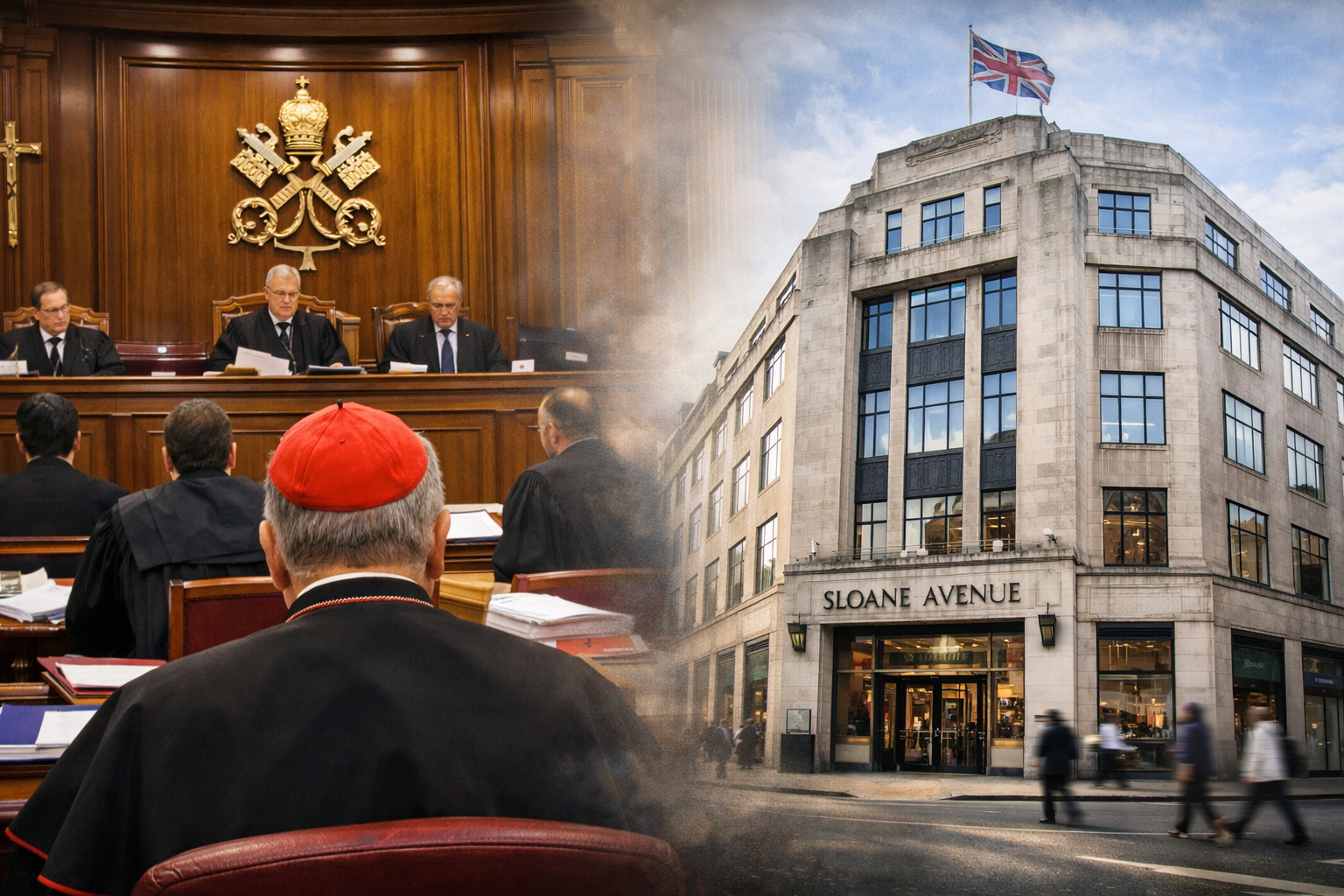
Justice on Trial: The Becciu Appeal and the Crisis of Institutional Accountability
The continuing appeal proceedings arising from the Vatican’s disastrous London property investment have moved beyond the fate of any one defendant. With the recusal of the Vatican’s chief prosecutor and the intervention of the highest court in Vatican City State, the case now stands as a searching test of whether the Church’s own legal and administrative structures are capable of real accountability rather than symbolic reform.²³

At the centre remains Giovanni Angelo Becciu, the former Sostituto of the Secretariat of State, whose 2023 conviction for financial crimes marked the first time a cardinal had been sentenced by a Vatican criminal court.¹ Yet the most recent developments do not primarily concern his guilt or innocence. They concern whether the process itself can command credibility.
A Trial About Procedure as Much as Guilt
The London property affair—an opaque €350 million investment culminating in a substantial loss—was meant to be the showcase for post-2014 Vatican financial reform. Instead, it has exposed how fragile those reforms remain when tested by complex cases involving senior clerics, overlapping jurisdictions, and improvised legal mechanisms.⁴⁵
The intervention of the Vatican Court of Cassation to block a procedurally defective prosecutorial appeal was not a mere technicality. It was a reminder that legality cannot be subordinated to outcomes, however desirable those outcomes may appear. Justice that relies on shortcuts ceases to be justice and becomes theatre.³⁸
More striking still was the decision of the Promoter of Justice, Alessandro Diddi, to step aside. His recusal—after sustained defence objections concerning impartiality—casts a long shadow over the prosecution’s conduct. Even if no malice is ultimately established, the appearance of compromised neutrality is itself corrosive. In modern legal systems, credibility collapses long before verdicts do.²⁷
Transparency Without Maturity
The Vatican has frequently defended the Becciu prosecution as proof that “no one is above the law.” That slogan, while rhetorically effective, conceals a deeper problem: accountability is not achieved merely by prosecuting high-profile figures. It requires mature institutions capable of operating according to stable rules, predictable procedures, and clear divisions of authority.¹⁰
The London property case unfolded under a legal regime that was repeatedly modified during the investigation itself. Emergency papal decrees altered criminal procedure mid-stream. Evidence rules shifted. Jurisdictional competencies blurred.⁶ Such measures may be defensible in states of necessity, but they sit uneasily with claims of systemic reform. Rule by exception is not reform; it is managed instability.
Governance Failure, Not Merely Personal Corruption
What the Becciu affair ultimately illustrates is not simply the moral failure of individuals, but the structural failure of governance within the Roman Curia. The Secretariat of State operated for years with minimal external oversight, vast discretionary power, and weak internal controls. Financial recklessness was not an aberration; it was enabled by design.⁹
That context matters. Without it, trials risk becoming scapegoating exercises—punishing a few visible figures while leaving intact the cultures and mechanisms that produced the scandal in the first place. True accountability would ask harder questions: why controls failed, who approved them, and why warnings were ignored.¹²
Ecclesial Reform or Managerial Optics?
For the faithful, the stakes are not abstract. Financial scandals wound trust, undermine moral authority, and weaken the Church’s witness. When reform is presented primarily as managerial modernisation—compliance offices, auditors, prosecutors—without a corresponding recovery of moral responsibility and institutional humility, cynicism follows.¹¹
The current appeal phase therefore matters enormously. Not because it must deliver a particular verdict, but because it must demonstrate that the Church’s legal system can function without improvisation, pressure, or reputational panic. A fair acquittal would serve justice better than a flawed conviction. Likewise, a confirmed conviction achieved through unimpeachable process would carry far greater moral weight than one obtained at the cost of procedural integrity.¹⁰
A Moment of Decision
The Vatican now faces a choice. It can treat the Becciu case as an embarrassment to be contained and concluded, or as a moment of reckoning—a chance to acknowledge that reform is not merely about prosecuting the past but about building institutions worthy of the Church’s moral claims.⁵
Institutional accountability is not optional for a Church that preaches justice. It is part of her credibility. If the law is to be more than an instrument of convenience, it must be allowed to restrain power, including ecclesiastical power. Only then can transparency become something more than a slogan, and reform something more than a press release.¹¹
The Becciu appeal will not decide the future of Vatican governance on its own. But it will reveal, with uncomfortable clarity, whether the Church has learned how to govern herself under law—or whether she remains trapped between moral aspiration and institutional immaturity.
¹ Vatican City State Tribunal, Sentenza nel procedimento penale n. 69/2021 (16 December 2023), conviction and sentencing of Cardinal Giovanni Angelo Becciu and co-defendants.
² Catholic News Agency, “Vatican prosecutor steps aside as London property trial appeal moves forward” (January 2026).
³ Vatican City State, Corte di Cassazione, ruling on the inadmissibility of the Promoter of Justice’s appeal on procedural grounds.
⁴ Secretariat of State of the Holy See, disclosures and reporting on the Sloane Avenue, London property investment.
⁵ Pope Francis, Motu proprio On Transparency, Control and Competition in Public Contracts (1 June 2020).
⁶ Pope Francis, Rescriptum ex audientia modifying Vatican criminal procedure during the London property investigation.
⁷ The Catholic Herald, “Prosecutor challenged in Vatican’s ‘trial of the century’ as appeals resume” (2024).
⁸ Vatican City State, Law No. CCCLI on the Judicial System (2020 revision).
⁹ Cardinal George Pell, “The Vatican’s financial reforms are real—but fragile,” Spectator Australia (2019).
¹⁰ Benedict XVI, Address to the Roman Rota (21 January 2012).
¹¹ Second Vatican Council, Gaudium et Spes, §76.
¹² Joseph Ratzinger, Church, Ecumenism and Politics (Ignatius Press).
RELATED ARTICLES


Latest ARTICLES
- Today’s Mass: October 24 St Raphael the ArchangelThe Feast of Saint Raphael the Archangel highlights his healing powers as depicted in the Book of Tobit, where he aids Tobit and his son, Tobiah. Venerated as a protector of travellers and the blind, Raphael is celebrated for his miraculous interventions. His legacy includes support for nurses, matchmakers, and Catholic studies.
- 25.10.26 Nuntiatoria CXXIX: CHRISTUS REXThe text discusses the relationship between Christ’s kingship and authority within the Church amidst contemporary challenges. It contrasts ecclesiastical power with genuine faith, emphasising that authority must protect divine truth rather than alter it. The witness of imprisoned priests illustrates the enduring significance of fidelity to Christ over institutional conformity.
- THE DOMESTIC CHURCH: 25 October – 2 November 2026 A Home with Room for Heaven: Preparing for All Saints and All SoulsThe content outlines a week’s plan for traditional Catholic families to prepare for the feasts of All Saints and All Souls. Emphasising daily prayers, remembrance of the deceased, and engagement with children’s activities, it aims to integrate Catholic customs into family life, enriching spiritual practices and fostering a shared faith experience.
- ORDO w/c 25.10.26The text outlines the liturgical calendar for the last week of October and the beginning of November, highlighting key celebrations. Notable events include the Feast of Christ the King, St Evaristus, the Vigil of Saints Simon and Jude, and the Feast of All Saints, emphasising themes of holiness, unity in faith, and the Church’s teachings.
- Christ the King: The Sovereignty of the Crucified RedeemerThe Mass of Christ the King articulates core Catholic beliefs about Jesus’ divine authority, redemptive sacrifice, and the essence of His Kingdom. It emphasises Christ as Prophet, Priest, and King, whose sovereignty is inseparable from His mission of reconciliation, calling the faithful to acknowledge His authority and embrace moral duties rooted in divine truth.





Leave a Reply