
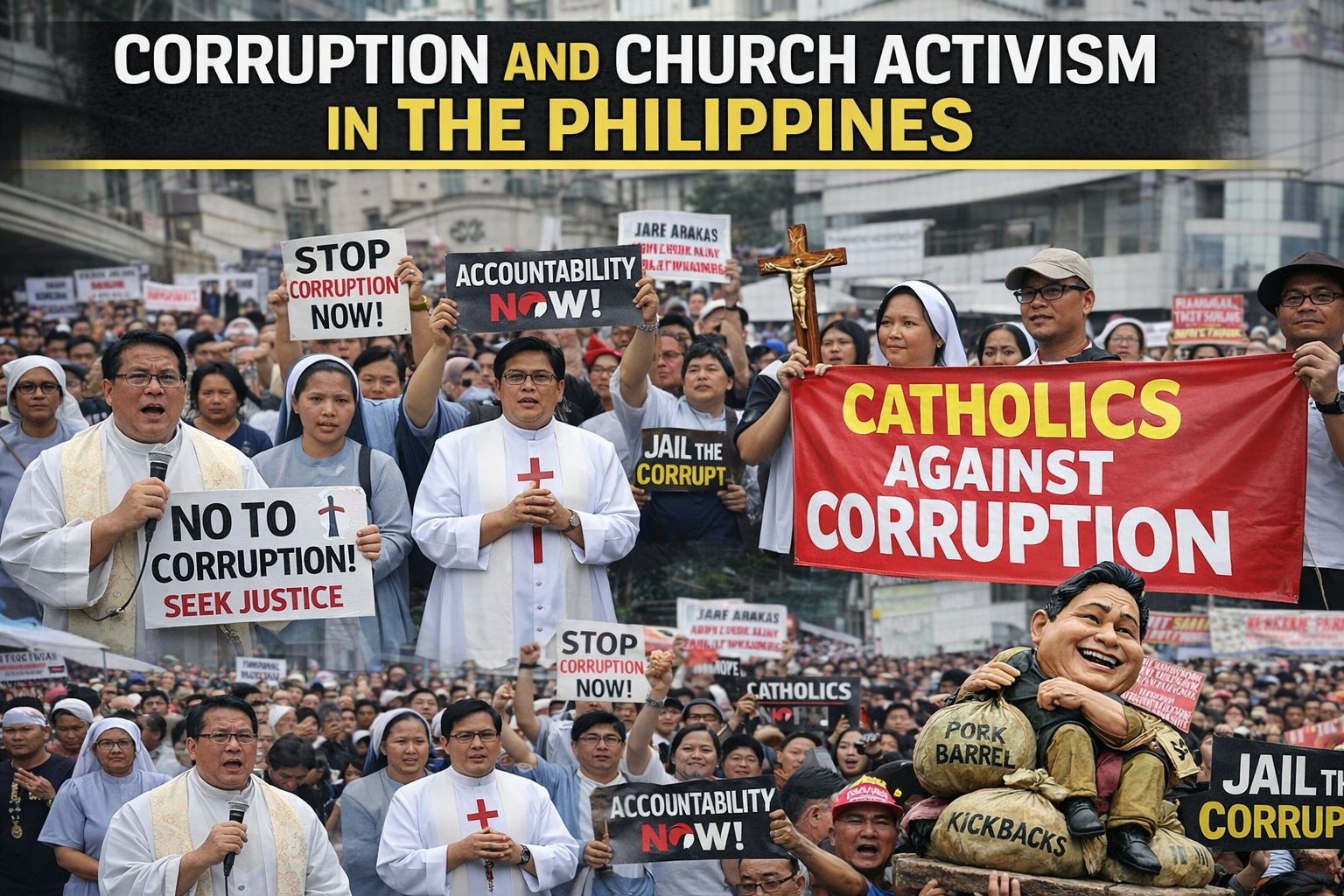
Faith in the Streets: Corruption, Conscience, and Catholic Activism in the Philippines

A Moral Crisis Rooted in Governance Failure
The present eruption of public anger in the Philippines over corruption must be understood against a backdrop of chronic governance weakness, uneven development, and repeated scandals involving public infrastructure. Allegations surrounding flood-control projects—funds earmarked to protect vulnerable communities from natural disasters—have proven particularly incendiary. In a country routinely struck by typhoons and flooding, the misuse of such funds is not perceived merely as financial malpractice, but as an act of moral violence against the poor.
It is within this context that the Catholic Church has once again entered the public square. The Church’s intervention has not been framed in technocratic terms, nor as a call for regime change, but as a moral indictment: corruption is a sin that kills indirectly, by depriving the weak of protection, dignity, and hope. One widely circulated episcopal statement likened corruption to a “flood more destructive than any storm,” because it systematically erodes trust, accountability, and social cohesion.¹
The Episcopal Voice and the Limits of Silence
The renewed visibility of the Catholic Bishops’ Conference of the Philippines (CBCP) is neither accidental nor reactionary. Historically, the Philippine episcopate has intervened most decisively when civil authority appeared morally discredited or structurally incapable of reform. Recent pastoral letters and public appeals have therefore focused less on policy specifics and more on first principles: justice, stewardship, restitution, and the moral obligations of those who wield power.²
Crucially, the bishops have resisted overt alignment with political parties or opposition blocs. Instead, they have framed civic engagement as an extension of Christian discipleship, urging the faithful to act peacefully, lawfully, and prayerfully. This posture reflects an awareness of the Church’s vulnerability to politicisation, while also rejecting the idea that moral neutrality is possible in the face of systemic injustice.
Popular Devotion as Moral Expression
The fusion of religious devotion and civic protest reached its most striking expression during the January Traslación of the Black Nazarene, an event that draws millions of barefoot penitents into the streets of Manila each year. Traditionally marked by intense personal piety, the procession in 2026 became an unplanned but unmistakable forum for moral protest. Chants demanding accountability were heard alongside prayers, while placards condemning corruption appeared amid the press of devotees.³
To external observers, this convergence may appear disorderly or inappropriate. Within the Filipino religious imagination, however, it is deeply coherent. The Black Nazarene—Christ wounded, burdened, and enduring—is not a private symbol. He is carried through the streets precisely because faith is understood as embodied, communal, and socially consequential. For many participants, to carry Christ while remaining silent about injustice would be an act of dissonance.
People Power and the Church’s Moral Memory
The present moment inevitably recalls the Church’s role in the 1986 People Power Revolution, when bishops, religious, and lay movements helped mobilise peaceful resistance to authoritarian corruption. Contemporary Church leaders have been careful not to invoke that episode triumphalistically. Nevertheless, the moral grammar is recognisably similar: appeals to conscience rather than ideology, to non-violence rather than coercion, and to solidarity rather than class struggle.⁴
This historical memory explains why the Church still possesses moral leverage even amid declining institutional trust. While political parties and state agencies are widely perceived as compromised, the Church—despite its own internal crises—retains a symbolic authority rooted in sacrifice, continuity, and proximity to the poor.
Internal Tensions and the Risk of Moral Exhaustion
The Church’s renewed activism has not gone unchallenged. Some Catholics warn that repeated public interventions risk entangling the Church in partisan conflict or creating unrealistic expectations of political efficacy. Others point to unresolved issues of transparency and accountability within ecclesial structures themselves, arguing that prophetic critique must be accompanied by internal reform.
These objections are serious and, in part, justified. Yet they also underscore the dilemma facing the Philippine Church. Silence would be interpreted as acquiescence; activism invites scrutiny. The current strategy—clear moral teaching without partisan endorsement, public witness without revolutionary rhetoric—represents an attempt to walk this narrow path with prudence.
A Witness That Refuses Normalisation of Injustice
What is unfolding in the Philippines is best understood not as “Church activism” in the modern ideological sense, but as moral refusal. The Church is refusing to normalise corruption as cultural inevitability or administrative inconvenience. It is insisting that theft from the public purse—especially when it endangers lives—is a grave injustice demanding repentance, restitution, and reform.
Whether this renewed moral witness will translate into lasting institutional change remains uncertain. What is already clear, however, is that the Church has once again chosen to disturb the peace of injustice rather than preserve the comfort of silence. In doing so, it has reaffirmed a perennial Christian truth: a faith that never troubles power risks becoming ornamental, and a Church that forgets the poor forgets Christ Himself.
¹ Catholic Bishops’ Conference of the Philippines, pastoral appeal on corruption and flood-control scandals, 2025.
² Catholic News Agency, “Thousands protest corruption in Philippines as bishops demand accountability,” 2025.
³ National Catholic Reporter, “Filipino Catholics express outrage over corruption during Black Nazarene procession,” January 2026.
⁴ Crux, “Recalling People Power: Filipino Church joins anti-corruption protests,” 2025.
RELATED ARTICLES


LATEST ARTICLES
- Today’s Mass: September 19 S. Eustace & Companions, MartyrsSt. Eustachius, formerly General Placidus, experienced a transformative vision of Christ while hunting. After converting with his family, he endured persecution, losing them temporarily. Reuniting after military success, he ultimately refused to worship pagan deities, leading to his martyrdom with his family. They were later honoured with a church.
- Sermon for St. Eustacius/ Seventeenth Sunday after PentecostThe feast of St. Eustacius, celebrated on the Seventeenth Sunday after Pentecost, commemorates early Christian martyrs who refused to renounce their faith. Despite limited historical knowledge of St. Eustacius, his story embodies the courage of many Christians who, facing persecution from the Roman Empire, chose martyrdom over idolatry, ultimately shaping the Church’s foundation.
- Today’s Mass: September 19 St. Januarius, Bishop and Companion MartyrsSt. Januarius and companion martyrs were martyred during the persecution under Diocletian. St. Januarius, patron of the city of Naples and bishop of Beneventum, was beheaded with his deacons and some others.
- Sermon for St. Januarius and his CompanionsToday we celebrate the feast of St. Januarius and his companions. About St. Januarius little is known except that he was among the many martyrs during the great persecution under the Emperor Diocletian.
- 20.09.26 Nuntiatoria CXXIV: QUOD ACCEPIMUS, CUSTODIMUS ET TRADIMUSThe editorial emphasises the importance of understanding our inheritance as custodians rather than owners. It highlights the obligation to preserve and transmit the Christian Faith, sacraments, and traditions to future generations. Through gratitude and fidelity, those who receive must ensure that what has been entrusted does not end with them.


Leave a Reply