
Devotion Without Order: The Black Nazarene, the 2026 Traslación, and the Crisis of Catholic Worship in the Philippines
From Penitential Procession to Mass Phenomenon: History, Context, and the 2026 Traslación

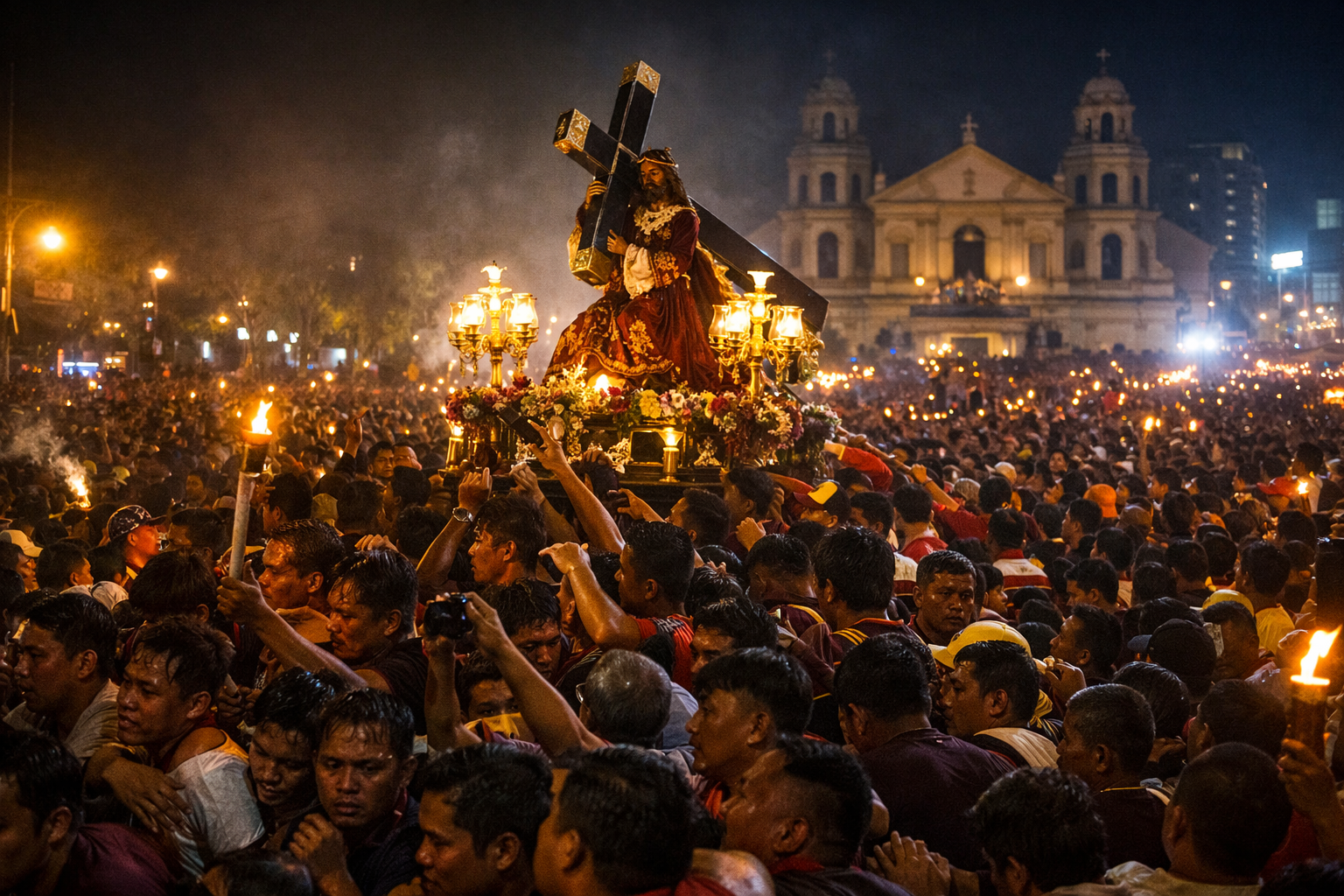
The annual Traslación of the Poong Hesus Nazareno, held each year on 9 January, ranks among the largest religious gatherings in the world. It commemorates the historical transfer of a life-sized image of Christ carrying the Cross from Intramuros to Quiapo Church, now the Minor Basilica of the Black Nazarene. In its contemporary configuration, the procession begins at Quirino Grandstand and traverses central Manila before returning the image to its shrine.¹
The image itself originated in Mexico in the early seventeenth century and reflects the Counter-Reformation devotional idiom of the Spanish Catholic world: Christ rendered with deliberate physical realism, burdened by the Cross, visibly marked by suffering, yet steadfast in obedience.² Introduced to the Philippines during the colonial period, the image became inseparable from Filipino Catholic identity. Its darkened appearance—variously attributed to age, smoke, and exposure—has only intensified its symbolic association with endurance, affliction, and perseverance in faith.³
For much of its history, the Traslación functioned as a penitential public act, characterised by clerical oversight, prayer, and relative order. Participation was demanding, but it was also intelligible: the image served as a devotional sign, directing attention beyond itself to Christ’s redemptive suffering.⁴ Longstanding devotees consistently recall a procession that, while fervent, remained recognisably prayerful and restrained.
That character has not survived unchanged. The Traslación’s transformation into a mass phenomenon unfolded gradually, shaped by rapid urbanisation, demographic pressure, and the altered social conditions of Manila. As economic insecurity deepened across the twentieth century, large-scale popular devotions increasingly functioned as sites of religious consolation and collective identity. Media saturation—and later social media—amplified this effect, reinforcing the assumption that physical presence, and particularly physical proximity to the image, constituted the essence of participation.⁵
By the early twenty-first century, the Traslación had become not merely a devotional event but a recurring institutional stress point, straining pastoral oversight, public safety, and theological coherence alike. The extension of the route, escalating crowd density, and the ritualised struggle to touch the andas or its rope reshaped the devotional logic of the event. Within this environment, a functional theology of immediacy took hold: the tacit belief that physical contact itself secures divine favour, intervention, or protection.⁶
The 2026 Traslación: Scale, Duration, and Consequences
These dynamics reached an unambiguous expression in the 2026 Traslación. Official figures released by Church authorities and the National Capital Region Police Office placed participation between 7.3 million and 9.6 million people, among the highest totals ever recorded.⁷ The precise number remains contested, but the magnitude does not.
The procession commenced in the early hours of 9 January 2026 and concluded only at approximately 10:50 a.m. on 10 January, extending for nearly 31 hours—the longest Traslación on record.⁸ Throughout this period, large portions of the route were marked by sustained crowd compression, exhaustion, and repeated surges toward the image.
Official reports confirmed at least two deaths linked to the event.⁹ Medical teams recorded over 1,700 injuries, with hundreds of additional incidents requiring emergency intervention for heat stress, dehydration, trampling, and loss of consciousness.¹⁰ ¹¹ These outcomes were not aberrational. They were consistent with patterns observed in previous years, indicating that injury and risk have become structurally embedded features of the modern Traslación.
This reality inevitably raises questions of institutional responsibility, particularly at the level of episcopal governance. The scale, predictability, and recurrence of serious injuries and fatalities mean that the risks associated with the Traslación are no longer speculative but demonstrable. Continued authorisation of the event in its present form therefore implies an accepted level of foreseeable harm. While civil authorities bear responsibility for crowd management, the Church cannot evade scrutiny where a devotional practice, operating under ecclesial auspices, repeatedly places the faithful in danger. Pastoral solicitude cannot be reduced to logistical coordination; it includes the moral obligation to assess whether the tolerated risks remain proportionate to the spiritual goods claimed, and whether alternative forms of expression might better safeguard both faith and life.¹²
Notably, these harms arose not from external disruption but from the internal dynamics of the devotion itself. The concentrated drive to reach the image—to touch it, wipe it, or grasp the rope—repeatedly displaced concern for surrounding persons. What was once a penitential procession increasingly operated as a crowd-driven surge, governed more by emotional urgency and mass behaviour than by ordered worship.
This shift cannot be understood solely in sociological or logistical terms. It also reflects a broader modernist attenuation of liturgical and devotional discipline, in which form is treated as incidental, restraint as inauthentic, and solemnity as an impediment to “expressive” faith. Where earlier generations understood sobriety, order, and clerical mediation as integral to reverence, contemporary pastoral instincts often hesitate to correct excess for fear of appearing restrictive or “unpastoral.” The result is a vacuum of authority in which intensity substitutes for form and emotion displaces ritual order. Historically, Catholic devotion was never indifferent to structure; it was precisely structure that protected devotion from degeneration into chaos. The contrast between the restrained penitential processions of the past and the unmanaged volatility of the present is not accidental—it reflects a theological climate less confident in hierarchy, discipline, and objective norms of worship.¹³
This trajectory closely parallels the wider post-conciliar pattern of liturgical permissiveness, in which discipline has frequently been recast as rigidity, form as clericalism, and correction as pastoral failure. Within this framework, excess is tolerated so long as it is emotionally expressive, while sobriety is viewed with suspicion. In the Philippine context, this has produced a pastoral environment in which sincere popular devotion is often left unformed—or selectively instrumentalised—rather than guided toward sacramental and doctrinal depth. Appeals to inculturation, pastoral accompaniment, lived faith, or the voice of the poor are routinely invoked to justify non-intervention, even when devotional practice visibly contradicts the Church’s own principles of ordered worship and charity. The result is not empowerment of the faithful but abdication of responsibility: a hierarchy unwilling to impose limits yet willing to harness the spectacle of mass devotion in service of contemporary ideological narratives—social activism, emotivist spirituality, and ecclesial populism—that sit uneasily with the Church’s traditional understanding of worship, authority, and truth.¹⁴
*Where liturgical form is treated as optional and discipline as suspect, catechesis inevitably follows the same trajectory: clarity gives way to sentiment, and instruction yields to affirmation.*¹⁵

Devotion, Sacramentals, and Theological Drift
The Catholic Church has never denied that God may act through material means; Scripture itself attests to healing through contact.¹⁶ Nor has the Church rejected sacred images or popular devotions as such. What it has consistently maintained, however, is a clear distinction between sacramental grace, instituted by Christ, and devotional practices that merely dispose the faithful toward that grace.¹⁷
The contemporary Traslación exposes a growing theological slippage in practice. The image increasingly functions, for many participants, less as a sign pointing to Christ than as an operative source of blessing in its own right. Grace is implicitly treated as mechanical rather than personal, transactional rather than sacramental. This is not Catholic doctrine, but it is an observable devotional logic shaping behaviour on the ground.
The implications are not merely theoretical. When devotion overrides reason, when intensity substitutes for discernment, and when physical proximity is tacitly equated with salvific efficacy, the result is not deepened faith but distortion. The Church has never taught that endangering life, trampling others, or contributing to disorder constitutes piety. Charity remains the non-negotiable criterion of authentic worship.¹⁸
Resistance to reform is often defended on familiar grounds. The Traslación is said to be an irreplaceable expression of Filipino faith, a release for the poor, a channel for popular religiosity that must not be constrained by elite sensibilities or bureaucratic caution. Others argue that attempts at reform would simply drive devotion outside ecclesial structures altogether. These concerns are not frivolous, and they merit acknowledgment. Yet they are ultimately insufficient. Authentic popular piety has never been exempt from discernment, nor has cultural significance ever functioned as a moral override. A devotion does not cease to be sincere simply because it requires correction; nor does reform constitute hostility to faith. When preservation of form is purchased at the cost of human life, theological clarity, and sacramental priority, the appeal to tradition becomes an argument for inertia rather than fidelity.¹⁹
Why the 2026 Event Matters
The significance of the 2026 Traslación lies not simply in its scale, but in the clarity with which it forces a longstanding question into the open: at what point does a devotion, however sincere, require reform rather than repetition? Catholic history offers no shortage of precedents in which popular piety has been affirmed, corrected, or restrained when its form ceased to serve its end.²⁰
This is not an indictment of Filipino faith, nor a denial of the Christological instinct that animates devotion to the Black Nazarene. On the contrary, it is precisely because this devotion is genuine that its present configuration demands scrutiny. When an annual religious event reliably produces injury and death, obscures the primacy of the sacraments, and fosters theological confusion, pastoral responsibility cannot be discharged by affirmation alone.
The image of the Nazareno remains a potent witness to Christ’s Passion. But Christ instituted the sacraments, not the Traslación. Devotion is ordered to worship, not a substitute for it. The events of 2026 do not negate the Nazareno devotion; they underscore the urgent necessity of re-ordering it, so that what draws millions of faithful back to Quiapo leads them not into recurrent chaos, but toward a faith shaped by truth, charity, and sacramental reality.
In this context, the presence and mission of the Old Roman Apostolate in the Philippines assume a particular importance. The ORA exists precisely to preserve and transmit a form of Catholic life in which liturgy is sober and ordered, doctrine is clear, devotion is disciplined, and catechesis is unambiguous. By insisting on the primacy of the Holy Sacrifice of the Mass, the integrity of sacramental theology, and the proper ordering of popular devotion to worship, the Apostolate offers a concrete counter-witness to the modernist tendencies that have contributed to confusion, excess, and theological drift. Its mission is not oppositional for its own sake, nor dismissive of Filipino piety, but restorative: to re-anchor sincere devotion in objective truth, hierarchical order, and the perennial praxis of the Church. Where popular religiosity has been left vulnerable to sentimentalism, ideological capture, or pastoral abdication, the ORA’s work represents a necessary act of ecclesial charity—calling the faithful back not to novelty or spectacle, but to the authentic Catholic inheritance in which faith is formed, devotion purified, and worship rendered “in spirit and in truth.”²¹
When worship is ordered, faith is formed; when worship is surrendered to chaos, belief itself soon follows.

- Archdiocese of Manila, Primer on the Devotion to the Black Nazarene; Quiapo Basilica official materials.
- John F. Schwaller, The History of the Catholic Church in Latin America, New York, 2011.
- José Mario C. Francisco SJ, “Popular Religiosity and Filipino Catholicism,” Philippine Studies 52.
- Congregation for Divine Worship, Directory on Popular Piety and the Liturgy (2001), §§6–13.
- Niels Mulder, Filipino Popular Culture, Ateneo de Manila University Press, 2013.
- Jaime Bulatao SJ, Split-Level Christianity, Ateneo de Manila University Press.
- National Capital Region Police Office (NCRPO), official post-event briefing, January 2026.
- GMA News, “Traslacion 2026 ends after nearly 31 hours,” 10 January 2026.
- Philippine National Police, official incident report, January 2026.
- Department of Health – NCR, medical response summary, January 2026.
- Philippine News Agency, “Over 1,700 injuries recorded during Traslacion 2026,” January 2026.
- Congregation for Bishops, Apostolorum Successores (2004), §§43–47.
- Pope Pius X, Pascendi Dominici Gregis §§37–39; Joseph Ratzinger, The Spirit of the Liturgy.
- Congregation for Divine Worship, Redemptionis Sacramentum §§7–11; Alcuin Reid, The Organic Development of the Liturgy.
- Joseph Ratzinger, Address to the Roman Curia, 22 December 2005.
- Mark 5:27–34; Acts 19:11–12.
- Catechism of the Catholic Church §§1667–1679.
- Matthew 22:37–40; 1 Corinthians 13.
- Pope Paul VI, Evangelii Nuntiandi §§48–49.
- Congregation for Divine Worship, Directory on Popular Piety, §§9–12.
- Pope Pius X, Tra le sollecitudini; Pope Pius XII, Mediator Dei; Archbishop Marcel Lefebvre, They Have Uncrowned Him; Congregation for Divine Worship, Inaestimabile Donum (1980).
Related Articles


Latest Articles
- Today’s Mass: October 27 Vigil of SS Simon & Jude, ApostlesThe vigil of SS Simon and Jude celebrates their apostolic contributions and shared commemoration in the Church. St. Jude, author of a New Testament Epistle, and Simon, with a shared mission in Mesopotamia and Persia, exemplify zealous anticipation of liturgical solemnities. Their legacy is acknowledged through prayers and reflections in early Christian traditions.
- THE KING’S OATH AND THE DEAD OF SAINT GEORGE’SA tragic attack during a Christian funeral in Karak, Jordan, resulted in nine fatalities and numerous injuries. King Abdullah II has pledged severe retaliation, leading to the arrest of three suspects. The Latin Patriarchate supports the monarchy’s role in ensuring religious freedom, while the Orthodox community vows to remain in their homeland amidst ongoing concerns for their safety.
- THE LAW OF A CHURCH THAT HAS NOT YET BEEN REUNITEDAt the Angelicum conference, Orthodox and Anglican scholars discussed the future of ecclesiastical law alongside Vatican cardinals. Cardinal Koch advocated for a new ecumenical juridical order, connecting these discussions to the upcoming Synodal Assembly of 2028. The conference aimed to address how different Christian governance models could influence Catholic law and authority.
- ‘DWARFS TAVISTOCK’: Baroness Cass demands Inquiry into Brighton NHS ScandalBaroness Hilary Cass has called for an independent inquiry into Brighton’s WellBN practice, claiming it overshadowed the Tavistock scandal. An investigation revealed severe clinical failures affecting 78 children, alongside the distressing treatment of safeguarding GP Dr Sarah Redvers, who raised alarms about these practices and faced retaliation. Accountability within the NHS is urgently needed.
- “THAT’S JUST PARANOIA”: Dr Joseph Shaw and the Crisis beyond the Latin MassDr Joseph Shaw’s recent interview highlights his support for the Traditional Latin Mass but inadequately addresses the Society of Saint Pius X’s (SSPX) concerns regarding the Church’s doctrinal crisis. He dismisses SSPX’s fears as paranoia, yet the Society’s extensive theological arguments underscore that preserving the older liturgy is insufficient for restoring Catholic Tradition.





Leave a Reply