
Gold Before the Manger: Kingship Confessed in Silence

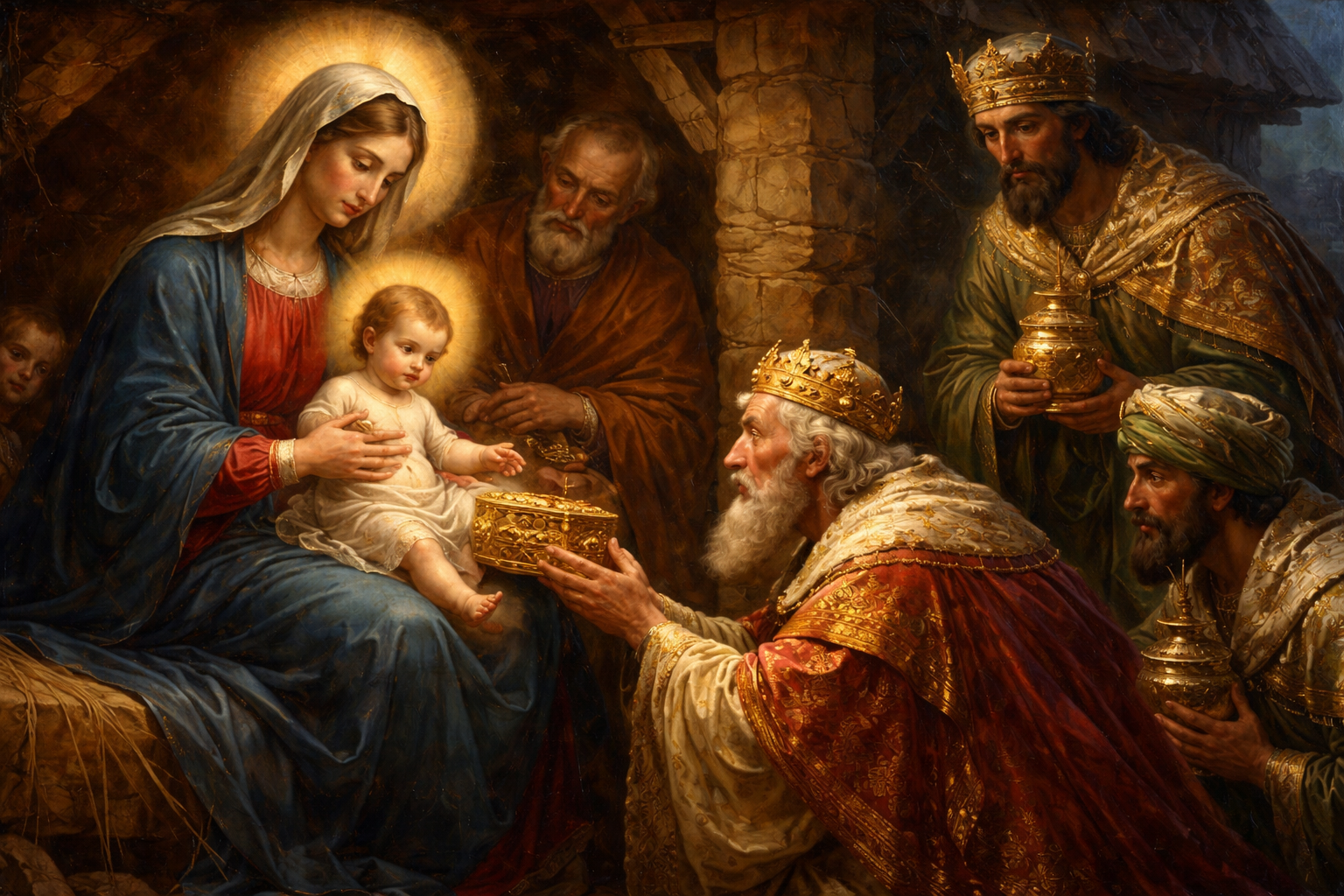
The gift of gold offered by the Magi to the Christ Child is not an incidental embellishment of the Nativity narrative, nor a quaint detail preserved for devotional colour. It is a theologically charged act of recognition, a confession rendered not in words but in matter. In the economy of salvation, gold speaks a precise language: it proclaims kingship, sovereignty, and rightful rule.
From the earliest strata of biblical symbolism, gold is reserved for what is most enduring, precious, and set apart. It resists corruption and decay and thus becomes the natural sign of permanence and authority. In the Old Covenant, gold belongs simultaneously to the cultic and the royal sphere. The Ark of the Covenant is overlaid with it; the menorah of the sanctuary is wrought from it; the Davidic crown is fashioned from it. When gold is placed before the Infant Christ, the gesture is not improvised but instinctively obedient to this symbolic grammar. The Magi offer tribute due to a king—not one enthroned in visible splendour, but one whose authority precedes history itself.¹
Patristic tradition is explicit. Leo the Great, preaching on the Epiphany, insists that the Magi “adore a King even in the lowliness of infancy,” and therefore offer gold because kingship is perceived by faith rather than by sight.² The offering is an act of theological discernment: the Magi see what Herod cannot. Gregory the Great reinforces this reading, explaining that gold signifies royal authority ordered to wisdom, confessing Christ as ruler not by worldly domination but by divine truth.³ From the beginning, therefore, the Church has read this gift not as poetic ornament but as doctrinal testimony.
Kingship Revealed Through Paradox
The significance of the gift intensifies when set against its setting. Gold is given to a Child who owns nothing. The King of kings receives the emblem of sovereignty while lying in poverty, wrapped in swaddling clothes rather than royal purple. This juxtaposition is not a contradiction but a revelation. The gold does not negate the manger; it interprets it. Christ’s kingship is real, absolute, and divinely instituted, yet exercised in humility and hiddenness. His authority does not depend on spectacle, coercion, or accumulation, but on who He is.⁴
Here the Epiphany corrects every worldly conception of power. Earthly kings gather gold to secure dominion; Christ receives gold precisely because His dominion does not depend upon it. The Magi’s offering therefore affirms that Christ is King by nature, not by delegation, election, or popular acclaim. As Augustine of Hippo teaches, Christ reigns not because He is exalted by men, but because all things are ordered under Him by divine right.⁵ He does not become King through recognition; He is recognised because He is King.
This kingship is not abstract or merely “spiritual.” It is covenantal and historical. The gold laid before Christ is offered to the promised Son of David, heir to the everlasting throne sworn by God Himself.⁶ The Magi kneel not before a vague symbol of authority, but before the fulfilment of Israel’s royal hope, in whom juridical kingship, prophetic promise, and divine sonship converge.
A Universal Crown
Gold also signifies the universality of Christ’s reign. The Magi are Gentiles—men of the nations—and their gift signals that the kingship of Christ is not confined to Israel but extends to all peoples. Gold, the common currency of empires, is laid at His feet as a sign that every political order, economy, and civilisation ultimately falls under His lordship.⁷ The offering anticipates the eschatological vision in which the nations bring their treasures before the true King, not as rivals but as subjects gathered into obedience.
This point is emphasised by Irenaeus of Lyons, who interprets the Magi as firstfruits of the Gentiles, submitting the powers of the world to Christ in seed form.⁸ Gold thus becomes a pledge that no realm—political, cultural, or economic—stands outside the scope of Christ’s authority.
Gold as Renunciation
There is also an ascetical and sacrificial dimension to the offering. In the ancient world, gold represented not merely wealth but stored labour—the crystallisation of human effort, time, and security. To give gold was to relinquish assurance and worldly stability. The Magi’s act is therefore not only homage but renunciation. They surrender material power in recognition of a higher authority.⁹
Here the scholastic tradition sharpens the moral edge of the text. Thomas Aquinas notes that gifts signify interior dispositions, and that the Magi’s offerings express rightly ordered loves: gold for kingship, frankincense for divinity, myrrh for mortality.¹⁰ Gold, therefore, represents not only recognition of Christ’s rule but the submission of temporal goods to eternal truth.
Epiphany thus confronts the believer not merely with a scene to admire, but with a decision to make. What do we treat as ultimate? What do we guard most jealously? To offer gold to Christ is to place what we most value—wealth, status, influence, control—under His rule.
From Bethlehem to the Altar
The Church has never abandoned this symbolism. The gold of the Magi is taken up and preserved in her liturgical life. Sacred vessels are fashioned from precious metals; royal feasts are marked with gold vesture and ornament; Epiphany iconography consistently highlights the gleam of the Magi’s gift. This is not aesthetic excess but theological continuity. Exterior splendour in divine worship is ordered not to God’s need, but to man’s instruction, confessing divine sovereignty through visible signs.¹¹
The Church continues to speak the same symbolic language as the Magi: Christ reigns here and now—above altar and throne alike.
From Bethlehem to Calvary and Beyond
Finally, the gold of the Magi casts a long shadow forward to the Cross and beyond it. The kingship it proclaims at Bethlehem will be revealed fully at Calvary. The Child who receives gold will one day wear a crown of thorns; the One acknowledged as King in silence will be proclaimed as such in mockery. Yet the offering of gold assures us that even there—especially there—His sovereignty is not denied but perfected.¹²
The arc does not end at the Cross. The Book of Revelation depicts the glory of the nations brought into the heavenly Jerusalem, purified and ordered under Christ’s eternal reign.¹³ The Magi’s gold is thus the first act in the final restoration of all things.
Gold is laid before the manger because every throne, visible or hidden, already belongs to Him.
Kingship Reduced and Restored
Modern ecclesial discourse has increasingly reframed Christ’s kingship through the language of “servant leadership,” often presented as a corrective to triumphalism or authoritarianism. While it is true—and dogmatically necessary—that Christ comes “not to be served but to serve,” the modern reduction of His kingship to service alone represents a theological truncation rather than a deepening. In the Catholic tradition, service flows from kingship; it does not replace it.
Patristic and scholastic theology insist that Christ is King ontologically, not functionally. His authority is rooted in His divine person and messianic office, not conferred by community recognition, pastoral utility, or historical circumstance. His abasement does not suspend His sovereignty but reveals its true form: rule exercised through truth and self-gift.
By contrast, much post-conciliar rhetoric—often influenced by sociological models of leadership—treats authority as something exercised from below, justified by consensus and relational credibility. Kingship becomes metaphorical or provisional, while obedience is reinterpreted as dialogue. The result is an inversion: Christ is admired as a moral exemplar while His sovereign claims are muted. His crown remains as symbol, but its demands are softened.
The Epiphany corrects this error at its root. The Magi do not bring gold because Christ serves; they bring gold because He reigns. His service on the Cross is not the negation of His kingship but its highest expression. To separate the two is not humility but domestication—a refusal to acknowledge that Christ’s authority judges, orders, and claims obedience from every age, including our own.
True Christian service is intelligible only because Christ is King. Where kingship is denied, service collapses into sentiment. Where kingship is confessed, service becomes sacrificial love under the rule of truth.
¹ Matthew 2:11; Exodus 25:10–11; Psalm 71:10–11; Isaiah 60:6.
² Leo the Great, Sermon 31 (On the Epiphany), §§3–4.
³ Gregory the Great, Homiliae in Evangelia, Homily 10.
⁴ Luke 2:7; Philippians 2:6–11.
⁵ Augustine, Enarrationes in Psalmos, Psalm 2.
⁶ 2 Samuel 7:12–16; Psalm 89:3–4; Matthew 1:1.
⁷ Daniel 7:13–14; Matthew 28:18.
⁸ Irenaeus, Adversus Haereses, III.9.2.
⁹ Proverbs 11:4; Matthew 6:19–21.
¹⁰ Thomas Aquinas, Summa Theologiae, III, q.36, a.3.
¹¹ Thomas Aquinas, Summa Theologiae, II–II, q.81, a.7.
¹² John 19:19; Colossians 2:14–15.
¹³ Revelation 21:24–26.
related articles


Latest articles
- Today’s homily: Christ the KingThe homily reflects on Christ’s kingship as seen in the Gospel narrative. It contrasts earthly authority with divine truth, emphasising that true allegiance to God requires genuine obedience and transformation. Believers are called to examine their personal commitments and respond to Christ’s demands in everyday life, ultimately recognising their identity as bearers of God’s image.
- Sermon for Christ the KingToday marks the celebration of Christ the King and the Twenty Second Sunday after Pentecost, a feast asserting Christ’s sovereignty against totalitarianism. St. Paul emphasised Christ’s supremacy over power and principalities, challenging early Gnostic beliefs. The early Church’s victory over evil is affirmed in Christ’s resurrection, offering hope and unity amidst contemporary struggles.
- Today’s Mass: October 25 SOVEREIGNTY OF OUR LORD JESUS CHRIST, SUPREME KINGThe Feast of the Sovereignty of Our Lord Jesus Christ celebrates Christ’s dual kingship by birth and conquest. Established by Pius XI, it aims to deepen faith and counter anti-clericalism. The liturgical observance underscores His authority as King, advocating for societal recognition of His reign to bring peace and harmony.
- TRADITION BEHIND THE FENCEThe Vatican’s prohibition of the traditional Ad Petri Sedem pilgrimage to St Peter’s Basilica has sparked controversy, especially among traditional Catholics. While some cite scheduling conflicts, the broader issue lies in the restrictive policies of Traditionis custodes, which may confine traditional liturgical practices to specific enclaves, risking the transmission and recognition of Catholic Tradition within the wider Church.
- Today’s Mass: October 24 St Raphael the ArchangelThe Feast of Saint Raphael the Archangel highlights his healing powers as depicted in the Book of Tobit, where he aids Tobit and his son, Tobiah. Venerated as a protector of travellers and the blind, Raphael is celebrated for his miraculous interventions. His legacy includes support for nurses, matchmakers, and Catholic studies.





Leave a Reply