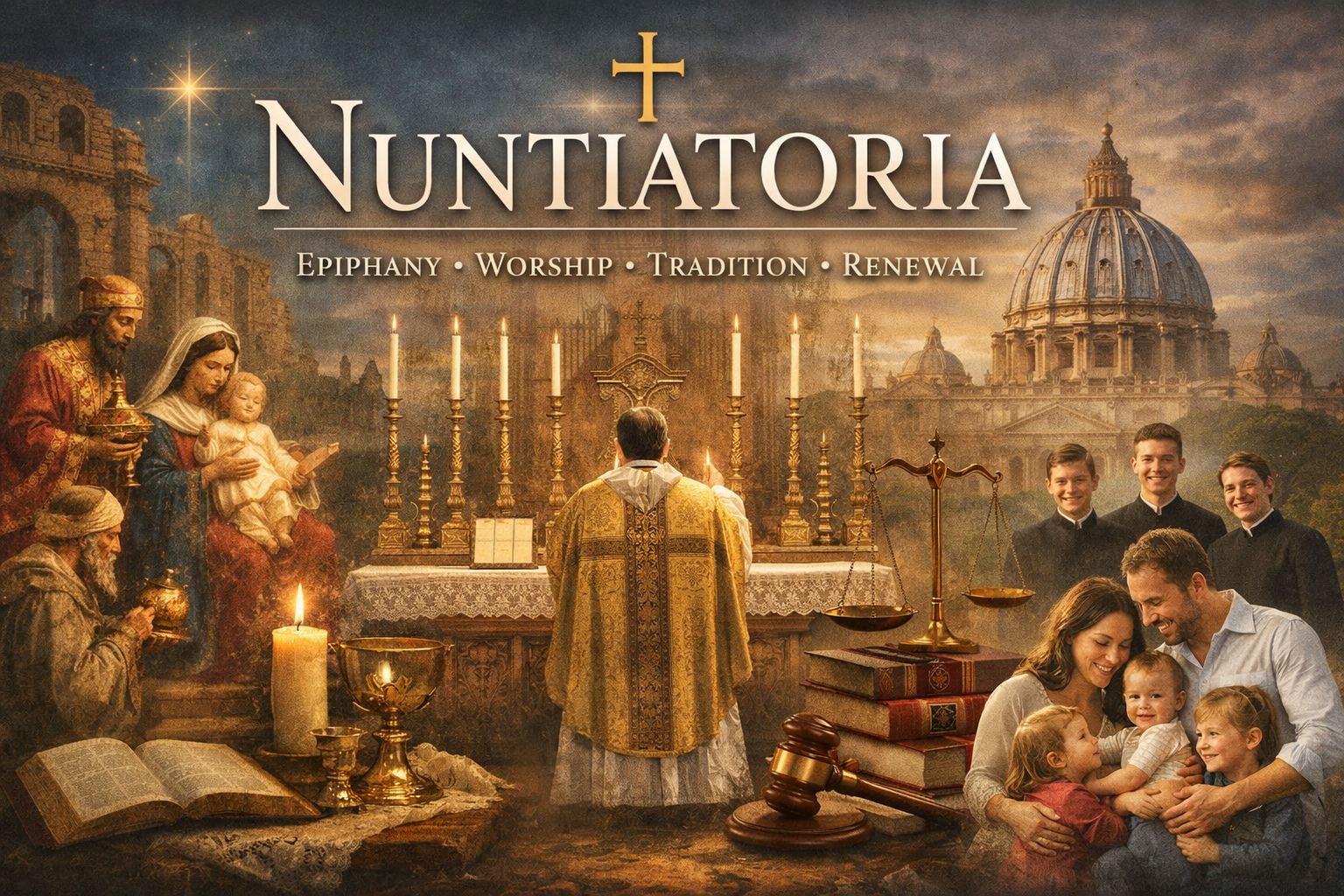
This edition of Nuntiatoria brings together reflections on Epiphany, worship, authority, and hope in a time of ecclesial strain. Addressing Christ’s kingship, the meaning of sacrifice, eastward prayer, liturgical conflict, juridical accommodation, and the unexpected vitality of traditional Catholic communities, it offers sober analysis alongside pastoral realism—naming present tensions honestly while pointing to fidelity as…
Pope Leo XIV’s message during his April 2026 Algeria visit advocates for Christian-Muslim unity under Our Lady of Africa. However, the author argues that true communion is rooted in doctrinal truth, not merely shared aspirations. The reflections highlight the dangers of obscuring theological distinctions and the need to confront uncomfortable realities facing Christian communities worldwide.
Henry VIII’s break with Rome was not pious reform but dynastic coercion. The later Protestant settlement completed the rupture by criminalising the Mass and martyring Catholics. Any Anglican claim to Catholic continuity collapses under the witness of the recusant martyrs.
The Confirmation of Election for Archbishop Sarah Mullally faced scrutiny when Paul Williamson asserted that he objected on safeguarding grounds during the ceremony. His claims of procedural flaws highlight a lack of public transparency regarding objection deadlines. This situation reveals systemic issues within the Church of England regarding accountability and safeguarding practices.
The Apostolic Altar emphasizes that early Christian worship was deeply rooted in sacrificial practices inherent in Second Temple Judaism. It argues that Christ’s sacrifice fulfilled rather than abolished such traditions, while the Eucharist represented a continuation of this sacrificial understanding. Ultimately, it asserts that the early Church recognized its liturgical structure as divinely ordered from apostolic teachings.
St. Hilary of Poitiers, a prominent defender of Christian orthodoxy in the 4th century, opposed Arianism, which claimed the Son was not co-eternal with the Father. Elected bishop around 350, he faced exile for his beliefs but ultimately revived the Church in Gaul. His legacy teaches perseverance in the pursuit of truth amid confusion.
The Octave of Epiphany commemorates Jesus’ baptism in the River Jordan, marking St. John the Baptist’s role in preparing Israel. John’s ministry emphasized repentance, while Jesus, sinless, embraced baptism to fulfill his vocation. This act signifies the beginning of his sacrificial mission, establishing a transformative understanding of Christian baptism as conferring salvation.
The reflection on the Sunday within the Octave of Epiphany emphasizes St. Paul’s call for Christians to present themselves as living sacrifices and resist conforming to worldly standards. It highlights the transformative power of the new covenant through Christ, encouraging believers to embody love, forgiveness, and community as members of the Body of Christ.
The celebration of the Holy Family within the Octave of Epiphany emphasizes Jesus’ early manifestations of divine authority. In his visit to the Temple at age twelve, he displayed wisdom, hinting at his future role. His teachings and actions challenged contemporary beliefs, asserting his identity as the Son of God and the bringer of forgiveness.
The hymn “As with Gladness Men of Old,” composed by William Chatterton Dix in 1860, reflects a theological journey from divine revelation to Christian obedience and worship. It illustrates how the Magi’s pilgrimage signifies ongoing grace and humility, emphasizing the necessity of sacrifice and moral integrity in pursuing holiness, culminating in eternal glory.
Cardinal Joseph Zen’s critique during the January 2026 Consistory of Cardinals highlights fundamental concerns about the Synod on Synodality, arguing it reduces authentic ecclesial discernment to manipulated process. He warns that this undermines ecclesiastical authority, erodes doctrine, and risks the Church’s unity, as seen in the Anglican crisis. Zen’s appeal urges Pope Leo XIV to rectify these issues.
The clergy of the Diocese of Charlotte have sought clarification from Rome regarding a bishop’s authority to eliminate altar rails and kneeling for Holy Communion. This raises concerns about compliance over doctrine, revealing a shift in liturgical practice. The issue signifies broader ecclesial challenges regarding obedience, tradition, and liturgical autonomy.
This edition of Nuntiatoria addresses the essence of worship and ecclesial authority within the Church amid contemporary challenges. It explores the significance of the Feast of the Epiphany, urging clarity in Christ’s revelation and confronting uncertainty in worship and authority. The aim is to affirm fidelity and pastoral honesty for enduring faith.
Pope Leo XIV’s extraordinary consistory in January 2026 aimed to address the Church’s crisis by focusing on synodality and mission, sidelining liturgy. Cardinal Muller emphasized external challenges over liturgical issues, revealing a misdiagnosis. This shift from theology to secular management risks further decline, as liturgy forms the Church’s core beliefs and practices.
The content outlines the liturgical calendar from January 11 to January 18, emphasizing the celebration of the Epiphany’s octave and various saints. Each day features specific masses and themes, highlighting Christ’s universal revelation, the interplay of glory and obedience, and the theological significance of figures like St Hilary and St Anthony in the context of faith and holiness.
The proposal for a traditionalist enclave within the Roman Catholic Church is criticized for failing to address the underlying ecclesiological issues of liturgical conflicts. Legal recognition does not resolve theological tensions inherent in the reformed rites. Instead, it may lead to a compromise of doctrine and identity, undermining traditionalist communities’ long-term stability.
The Magi’s gift of gold to the Christ Child symbolizes recognition of His kingship, transcending mere wealth. This act conveys that true authority is rooted in divine truth and humility, contrasting earthly power. The offering affirms Christ’s universal dominion and highlights believers’ call to submit their material goods under His sovereign rule.
The gift of frankincense, among the Magi’s offerings, symbolizes worship and divine recognition of Christ’s identity as God. Historically significant in Israel’s worship, it connects prayer to sacrifice, showcasing Christ’s priesthood and foreshadowing His future sacrifice. Ultimately, frankincense encapsulates the essence of Christian faith in Christ’s incarnation.
The gift of myrrh from the Magi signifies Christ’s inevitable death, embraced for redemption. The Church sees myrrh as a profound theological symbol, underscoring the inseparability of Christ’s Incarnation and sacrifice. This gift teaches that true glory comes through suffering, urging believers to accept the sacrificial nature of authentic Christian life.
The Feast of the Epiphany celebrates the public manifestation of Christ, especially at His Baptism in the Jordan, where the Trinity is revealed. This event marks Christ’s transition from hiddenness to His mission, demonstrating humility and divine glory. It emphasizes the sacramental life, connecting revelation with Christian baptism and transformation.
The miracle at Cana is central to the Epiphany, revealing Christ as King, Son, and Bridegroom through the transformation of water into wine. This act signifies divine authority and grace, fulfilling the covenant. The event emphasizes the Church’s understanding of sacramental reality and the need for belief, highlighting Christ’s role as the ultimate source of joy and fulfillment.
This text explores the significance of eastward orientation in Christian worship, emphasizing its deep theological roots. Turning toward the east symbolizes faith, salvation, and anticipation of Christ’s return. The practice, rooted in early Christianity, becomes a communal act of conversion and acknowledgment of divine presence, shaping a Church that is Christ-centered and oriented toward eternity.
The banning of Maccabi Tel Aviv supporters from a European fixture in Birmingham reveals a failure of West Midlands Police to disclose crucial intelligence about threats against Jewish fans, while instead framing them as a risk. This episode exemplifies a problematic shift in moral responsibility and highlights the influence of political pressure, undermining fair policing.
The future of the Catholic Church hinges on demographic realities rather than institutional changes. Traditionalist communities, such as St. Marys, exhibit significantly higher fertility rates than mainstream Catholics, suggesting a demographic shift. As these communities grow, they may become the central force in the Church, with implications for priesthood and sacramental life.
Corde natus ex Parentis is a fifth-century Latin hymn by Prudentius, emphasizing Christ’s eternal generation and role in creation and redemption. It serves as a theological foundation during Arianism, maintaining orthodoxy through liturgical practice. Translated by John Mason Neale, the hymn remains a vital expression of Christian faith and worship today.
The approved Feast of Nuestro Padre Jesús Nazareno on January 9 highlights the profound devotion to the Black Nazarene. This celebration emphasizes Christ’s paternal role and authority, suggesting that calling Him “Papa Jesus” aligns with Catholic faith. The term reflects the lived experience of His protection and providence among devotees.
The Peggie v NHS Fife ruling has garnered attention for its questionable judicial reasoning, which includes misattributions and selective citations of higher court rulings. This analysis critiques the lack of adherence to the common law’s requirement for accurate legal citation, highlighting a trend where emotionalism and modernism undermine professional legal standards, impacting public confidence in the tribunal system.
“We Three Kings” is a theological carol composed by John Henry Hopkins Jr. in 1857, emphasizing Christ’s Kingship, Divinity, and Sacrifice. It reclaims Epiphany as a significant manifestation of faith, reflecting patristic interpretations of the Magi. The hymn functions as a doctrinal pilgrimage, teaching and preserving the Church’s confession of Christ.
The clergy of the Diocese of Charlotte have sought clarification from Rome regarding a bishop’s authority to eliminate altar rails and kneeling for Holy Communion. This raises concerns about compliance over doctrine, revealing a shift in liturgical practice. The issue signifies broader ecclesial challenges regarding obedience, tradition, and liturgical autonomy.
Recent comments by Fr. Davide Pagliarani regarding episcopal consecrations without papal approval highlight a critical debate in Catholic ecclesiology. He argues for a “status necessitatis,” echoing past discussions by Archbishop Lefebvre. The SSPX critiques post-conciliar changes that dilute doctrinal authority, warning against a synodal model that undermines bishops’ roles in preserving apostolic faith.
Pope Leo XIV’s Extraordinary Consistory, held on January 7-8, 2026, aims to restore harmony in a Church facing doctrinal and synodal tensions. The consistory emphasizes consultative governance, contrasting previous centralization. Key issues include balancing tradition with reform, particularly concerning synodality and the Latin Mass, while seeking equilibrium amid diverse ecclesial perspectives.
The proposal for a personal ecclesiastical jurisdiction for the traditional Roman liturgy aims to address ongoing ecclesiastical tensions by providing a stable, juridical framework. It seeks recognition of two distinct Latin rites, moving from a situation of toleration to structured integration, while addressing deeper issues of modernism and theological divergence within the Church.
The Church of England’s collapse stems from a loss of doctrinal authority, not merely moral failures. The reliance on ethics over truth undermines its credibility and moral judgment. Recent reflections highlight ethical concerns instead of reclaiming doctrinal integrity, revealing a broader trend across Christianity where ethics supplants belief, jeopardizing authority and coherence.
The collapse of Nicolás Maduro’s regime reveals a moral asymmetry in Western progressive discourse, highlighting hostility toward Western power while excusing non-Western authoritarianism. Venezuelans celebrated Maduro’s removal as liberation from a failing system, which had transformed national oil assets into black-market operations, complicating global responses and revealing inconsistencies in anti-imperialist sentiments.
Rowan Williams’ article on migrants highlights cultural contributions while obscuring the distinction between legal and illegal migration. Critics argue that public discontent stems from visible illegal arrivals and associated costs, which diverts resources from domestic issues like poverty. A balanced approach should integrate compassion and law, prioritizing the common good for all citizens.
The feast of Our Lady’s Nativity, of ancient Eastern origin and established at Rome by the time of Pope St Sergius I, celebrates Mary as the immaculate New Eve and the dawn of salvation, the chosen tabernacle from whom the Redeemer would take His flesh. Today the Church also commemorates St Gorgonius, an officer of the imperial household at Nicomedia who, with his companion Dorotheus, embraced the Faith and suffered martyrdom under Diocletian in A.D. 303; his relics were later translated to Rome.
The content emphasises the disconnect between the names associated with Catholicism and the actual practices of faith. It highlights the importance of embodying belief through genuine actions, urging self-examination rather than mere external observance. Ultimately, it advocates for a restoration of sincerity in faith, calling individuals to authentically reflect their beliefs through their lives and worship.
Cardinal Raymond Leo Burke has declared the Virgin Mary as “Co-Redemptrix” amidst controversy over the Vatican’s restriction on this title. The debate revolves around the appropriateness of certain theological language and whether terminology historically used can still accurately express Marian cooperation in Redemption without compromising Christ’s unique role.
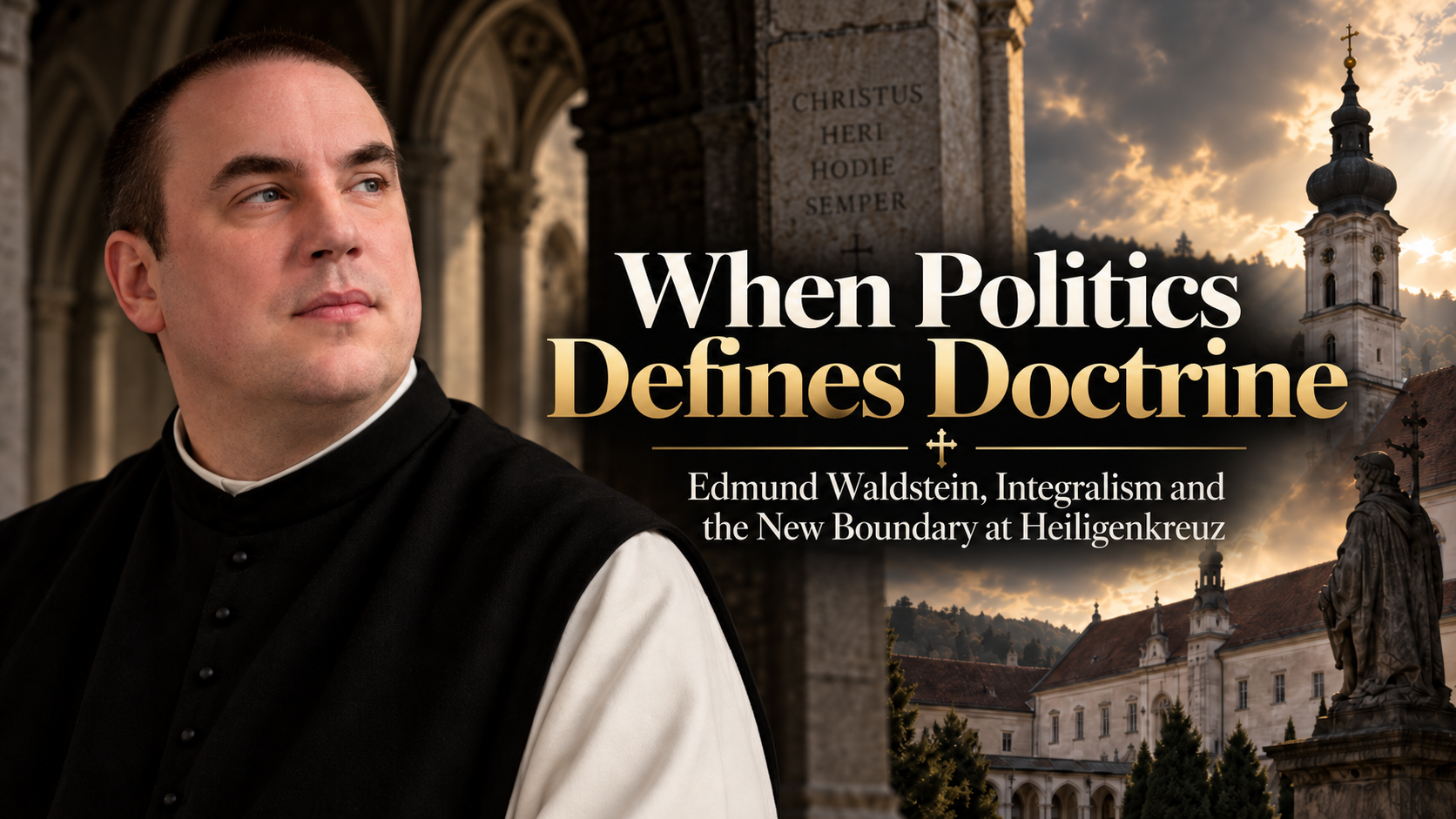
The ongoing exclusion of Father Edmund Waldstein from teaching at Heiligenkreuz has sparked debate on the limits of acceptable Catholic thought, particularly regarding integralism and its relationship to Church doctrine. Critics argue that Waldstein and similar positions challenge both Catholic teachings and democratic values, raising questions about the intersection of faith and politics.
The article discusses the distinction between Catholic orthodoxy and modern political ideologies, particularly the Right and Christian nationalism. It argues that Catholic beliefs about family, morality, and authority predate contemporary political classifications and should not be conflated with right-wing politics. The ordo amoris framework is presented as a guiding principle for evaluating political alliances while maintaining a focus on the common good and the Social Kingship of Christ.


 Pope Leo XIV’s message during his April 2026 Algeria visit advocates for Christian-Muslim unity under Our Lady of Africa. However, the author argues that true communion is rooted in doctrinal truth, not merely shared aspirations. The reflections highlight the dangers of obscuring theological distinctions and the need to confront uncomfortable realities facing Christian communities worldwide.
 Henry VIII’s break with Rome was not pious reform but dynastic coercion. The later Protestant settlement completed the rupture by criminalising the Mass and martyring Catholics. Any Anglican claim to Catholic continuity collapses under the witness of the recusant martyrs.
 The Apostolic Altar emphasizes that early Christian worship was deeply rooted in sacrificial practices inherent in Second Temple Judaism. It argues that Christ’s sacrifice fulfilled rather than abolished such traditions, while the Eucharist represented a continuation of this sacrificial understanding. Ultimately, it asserts that the early Church recognized its liturgical structure as divinely ordered from apostolic teachings.
 St. Hilary of Poitiers, a prominent defender of Christian orthodoxy in the 4th century, opposed Arianism, which claimed the Son was not co-eternal with the Father. Elected bishop around 350, he faced exile for his beliefs but ultimately revived the Church in Gaul. His legacy teaches perseverance in the pursuit of truth amid confusion.
 The Octave of Epiphany commemorates Jesus’ baptism in the River Jordan, marking St. John the Baptist’s role in preparing Israel. John’s ministry emphasized repentance, while Jesus, sinless, embraced baptism to fulfill his vocation. This act signifies the beginning of his sacrificial mission, establishing a transformative understanding of Christian baptism as conferring salvation.
 The reflection on the Sunday within the Octave of Epiphany emphasizes St. Paul’s call for Christians to present themselves as living sacrifices and resist conforming to worldly standards. It highlights the transformative power of the new covenant through Christ, encouraging believers to embody love, forgiveness, and community as members of the Body of Christ.
 The celebration of the Holy Family within the Octave of Epiphany emphasizes Jesus’ early manifestations of divine authority. In his visit to the Temple at age twelve, he displayed wisdom, hinting at his future role. His teachings and actions challenged contemporary beliefs, asserting his identity as the Son of God and the bringer of forgiveness.
 The hymn “As with Gladness Men of Old,” composed by William Chatterton Dix in 1860, reflects a theological journey from divine revelation to Christian obedience and worship. It illustrates how the Magi’s pilgrimage signifies ongoing grace and humility, emphasizing the necessity of sacrifice and moral integrity in pursuing holiness, culminating in eternal glory.
 Cardinal Joseph Zen’s critique during the January 2026 Consistory of Cardinals highlights fundamental concerns about the Synod on Synodality, arguing it reduces authentic ecclesial discernment to manipulated process. He warns that this undermines ecclesiastical authority, erodes doctrine, and risks the Church’s unity, as seen in the Anglican crisis. Zen’s appeal urges Pope Leo XIV to rectify these issues.
 The clergy of the Diocese of Charlotte have sought clarification from Rome regarding a bishop’s authority to eliminate altar rails and kneeling for Holy Communion. This raises concerns about compliance over doctrine, revealing a shift in liturgical practice. The issue signifies broader ecclesial challenges regarding obedience, tradition, and liturgical autonomy.
 This edition of Nuntiatoria addresses the essence of worship and ecclesial authority within the Church amid contemporary challenges. It explores the significance of the Feast of the Epiphany, urging clarity in Christ’s revelation and confronting uncertainty in worship and authority. The aim is to affirm fidelity and pastoral honesty for enduring faith.
 Pope Leo XIV’s extraordinary consistory in January 2026 aimed to address the Church’s crisis by focusing on synodality and mission, sidelining liturgy. Cardinal Muller emphasized external challenges over liturgical issues, revealing a misdiagnosis. This shift from theology to secular management risks further decline, as liturgy forms the Church’s core beliefs and practices.
 The content outlines the liturgical calendar from January 11 to January 18, emphasizing the celebration of the Epiphany’s octave and various saints. Each day features specific masses and themes, highlighting Christ’s universal revelation, the interplay of glory and obedience, and the theological significance of figures like St Hilary and St Anthony in the context of faith and holiness.
 The proposal for a traditionalist enclave within the Roman Catholic Church is criticized for failing to address the underlying ecclesiological issues of liturgical conflicts. Legal recognition does not resolve theological tensions inherent in the reformed rites. Instead, it may lead to a compromise of doctrine and identity, undermining traditionalist communities’ long-term stability.
 The Magi’s gift of gold to the Christ Child symbolizes recognition of His kingship, transcending mere wealth. This act conveys that true authority is rooted in divine truth and humility, contrasting earthly power. The offering affirms Christ’s universal dominion and highlights believers’ call to submit their material goods under His sovereign rule.
 The gift of frankincense, among the Magi’s offerings, symbolizes worship and divine recognition of Christ’s identity as God. Historically significant in Israel’s worship, it connects prayer to sacrifice, showcasing Christ’s priesthood and foreshadowing His future sacrifice. Ultimately, frankincense encapsulates the essence of Christian faith in Christ’s incarnation.
 The gift of myrrh from the Magi signifies Christ’s inevitable death, embraced for redemption. The Church sees myrrh as a profound theological symbol, underscoring the inseparability of Christ’s Incarnation and sacrifice. This gift teaches that true glory comes through suffering, urging believers to accept the sacrificial nature of authentic Christian life.
 The Feast of the Epiphany celebrates the public manifestation of Christ, especially at His Baptism in the Jordan, where the Trinity is revealed. This event marks Christ’s transition from hiddenness to His mission, demonstrating humility and divine glory. It emphasizes the sacramental life, connecting revelation with Christian baptism and transformation.
 The miracle at Cana is central to the Epiphany, revealing Christ as King, Son, and Bridegroom through the transformation of water into wine. This act signifies divine authority and grace, fulfilling the covenant. The event emphasizes the Church’s understanding of sacramental reality and the need for belief, highlighting Christ’s role as the ultimate source of joy and fulfillment.
 This text explores the significance of eastward orientation in Christian worship, emphasizing its deep theological roots. Turning toward the east symbolizes faith, salvation, and anticipation of Christ’s return. The practice, rooted in early Christianity, becomes a communal act of conversion and acknowledgment of divine presence, shaping a Church that is Christ-centered and oriented toward eternity.
 The banning of Maccabi Tel Aviv supporters from a European fixture in Birmingham reveals a failure of West Midlands Police to disclose crucial intelligence about threats against Jewish fans, while instead framing them as a risk. This episode exemplifies a problematic shift in moral responsibility and highlights the influence of political pressure, undermining fair policing.
 The future of the Catholic Church hinges on demographic realities rather than institutional changes. Traditionalist communities, such as St. Marys, exhibit significantly higher fertility rates than mainstream Catholics, suggesting a demographic shift. As these communities grow, they may become the central force in the Church, with implications for priesthood and sacramental life.
 Corde natus ex Parentis is a fifth-century Latin hymn by Prudentius, emphasizing Christ’s eternal generation and role in creation and redemption. It serves as a theological foundation during Arianism, maintaining orthodoxy through liturgical practice. Translated by John Mason Neale, the hymn remains a vital expression of Christian faith and worship today.
 The approved Feast of Nuestro Padre Jesús Nazareno on January 9 highlights the profound devotion to the Black Nazarene. This celebration emphasizes Christ’s paternal role and authority, suggesting that calling Him “Papa Jesus” aligns with Catholic faith. The term reflects the lived experience of His protection and providence among devotees.
 The Peggie v NHS Fife ruling has garnered attention for its questionable judicial reasoning, which includes misattributions and selective citations of higher court rulings. This analysis critiques the lack of adherence to the common law’s requirement for accurate legal citation, highlighting a trend where emotionalism and modernism undermine professional legal standards, impacting public confidence in the tribunal system.
 “We Three Kings” is a theological carol composed by John Henry Hopkins Jr. in 1857, emphasizing Christ’s Kingship, Divinity, and Sacrifice. It reclaims Epiphany as a significant manifestation of faith, reflecting patristic interpretations of the Magi. The hymn functions as a doctrinal pilgrimage, teaching and preserving the Church’s confession of Christ.
 Recent comments by Fr. Davide Pagliarani regarding episcopal consecrations without papal approval highlight a critical debate in Catholic ecclesiology. He argues for a “status necessitatis,” echoing past discussions by Archbishop Lefebvre. The SSPX critiques post-conciliar changes that dilute doctrinal authority, warning against a synodal model that undermines bishops’ roles in preserving apostolic faith.
 The collapse of Nicolás Maduro’s regime reveals a moral asymmetry in Western progressive discourse, highlighting hostility toward Western power while excusing non-Western authoritarianism. Venezuelans celebrated Maduro’s removal as liberation from a failing system, which had transformed national oil assets into black-market operations, complicating global responses and revealing inconsistencies in anti-imperialist sentiments.
 Rowan Williams’ article on migrants highlights cultural contributions while obscuring the distinction between legal and illegal migration. Critics argue that public discontent stems from visible illegal arrivals and associated costs, which diverts resources from domestic issues like poverty. A balanced approach should integrate compassion and law, prioritizing the common good for all citizens.



Leave a Reply