
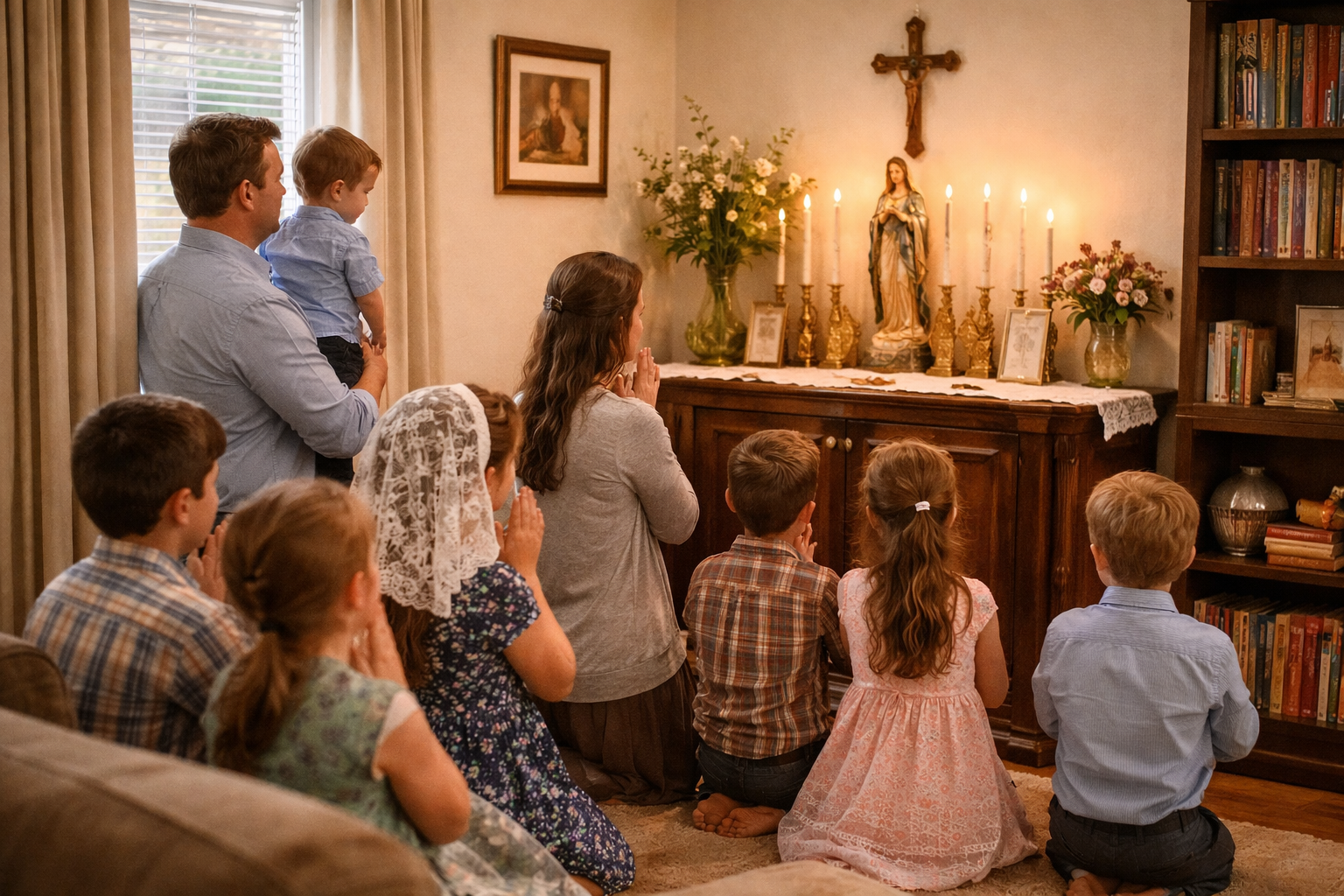
The Demographic Certainty of a Traditionalist Catholic Restoration
The long-term future of the Church will not be decided by synods, press statements, or the volatility of the ecclesiastical news cycle. It will be decided, with mathematical regularity, in the domestic hearth. When demographic reality is examined rather than institutional rhetoric, a stark divergence emerges between the mainstream Catholic population of the West and the concentrated Traditionalist communities that continue to live according to the Church’s perennial moral and liturgical order. This divergence is not rhetorical or ideological. It is statistical, compounding, and ultimately decisive.
The contemporary West is experiencing what demographers describe as demographic winter. In the United States, the total fertility rate has fallen to approximately 1.6 children per woman, well below the 2.1 replacement level required for population stability. Catholic fertility broadly mirrors this collapse. Immigration may temporarily obscure the decline, but it does not reverse it. Native Catholic populations are aging, shrinking, and consolidating. Parishes merge or close, schools contract, and vocations diminish, not primarily through persecution, but through attrition.¹
Against this backdrop stands a radically different model. The most visible American example is St. Marys, the geographic heart of the American apostolate of the Society of Saint Pius X. Comparable patterns are observable in other Traditional Latin Mass hubs across North America and Europe, but St. Marys offers a particularly clear case study because of its concentration, stability, and institutional maturity.
Within such communities, fertility estimates consistently range between 3.6 and 4.5 children per woman—more than double the mainstream Catholic average and nearly triple that of the surrounding secular culture. While these figures derive from community-level surveys rather than national census instruments, their effects are unmistakable: crowded schools, youthful congregations, expanding parish infrastructure, and a demographic pyramid that is broad at the base rather than inverted at the top. This divergence is not a sociological curiosity. It represents two fundamentally different civilisational trajectories: replacement versus expansion.
Fertility is never merely biological. It is the embodied consequence of theology, anthropology, and moral vision. Large Traditionalist families are not accidental. They are the lived expression of doctrines that the modern West—and increasingly the institutional Church—has struggled to sustain: marriage ordered toward procreation rather than self-expression; children received as blessings rather than lifestyle impediments; sacrifice understood as meaningful rather than pathological; time oriented toward inheritance rather than consumption. In this sense, the Traditionalist household functions as a theological manifesto written in flesh and blood. Where contemporary ecclesial documents often struggle to articulate a coherent anthropology, the Traditional family demonstrates one concretely, week after week and generation after generation.
Once a fertility gap of this magnitude exists, outcomes cease to be speculative and become arithmetical. Demography obeys mathematics, not ideology. If one conservatively estimates the current global practicing Traditionalist population at approximately one million souls, the implications of sustained above-replacement fertility are straightforward.
By the first generation of demographic renewal (approximately 2025–2050), the children of today’s Traditionalist families reach maturity. Even allowing for attrition, a fertility rate above 3.5 yields a population approaching four million. During the same period, mainstream parishes continue to merge or close as older cohorts die and younger ones fail to replace them.
By the second generation (2051–2075), the effects of compounding growth become unmistakable. The Traditionalist population plausibly reaches eight to twelve million, while the mainstream Church faces an accelerating crisis of clergy, finances, and attendance. At this stage, Traditionalists likely constitute fifteen to twenty percent of all practicing Catholics in the West—far beyond their current institutional representation.
By the third generation (2076–2100), a demographic tipping point is reached. Under conditions of continued retention, Traditionalists exceed twenty-five million and become the majority of practicing Catholics in many Western countries. What began as a marginalised remnant becomes the functional centre of gravity of ecclesial life.
Birth rates alone, however, do not explain the full magnitude of this shift. Traditionalist communities exhibit a pronounced vocation multiplier effect. Families formed around the Traditional Rite produce priests and religious at rates many times higher than the diocesan average. The reasons are structural rather than romantic. Boys regularly serve at the altar and see the priesthood embodied as a sacred vocation. Liturgy communicates transcendence rather than managerial functionality. Sacrifice and celibacy remain intelligible within a culture already ordered toward self-gift. As a result, even while diocesan seminaries close and priest shortages worsen, Traditionalist seminaries continue to expand.
This demographic reality brings the argument to its ecclesiological conclusion. This is why the work of the Old Roman Apostolate, the Society of Saint Pius X, and the Servants of the Holy Family is of such decisive importance. In the present moment, these apostolates may appear marginal, numerically insignificant, or even deliberately sidelined within the visible structures of the Church. Yet history and demography alike testify that fidelity sustained over time possesses a cumulative force far greater than institutional prominence. By endurance rather than influence, by perseverance rather than accommodation, these communities are laying the foundations for a future in which what is now dismissed as “exceptional” will once again be normal.
For this reason, the recovery of the Domestic Church is not ancillary but central to restoration. It is within the family—ordered toward sacrifice, fecundity, discipline, and the transmission of the faith—that the Church reproduces herself most securely when parishes close, seminaries empty, and diocesan structures contract. Where faith is lived daily rather than administered sporadically, continuity is assured even amid ecclesial disorder.²
It is within this same logic that the question of Holy Orders must be understood. The continuation of apostolic succession under conditions of crisis has never been a matter of convenience, ambition, or ideological preference. It is governed by the Church’s perennial principles of salus animarum suprema lex and epikeia.³ Where ordinary structures fail to provide the sacraments necessary for the life of the faithful, juridical regularity, while normative, is not absolute.
Historical precedent bears this out. From emergency ordinations during periods of persecution, to extraordinary missionary faculties granted outside normal canonical procedure, to the toleration and later regularisation of irregular acts during the Western Schism, the Church has repeatedly accepted measures that were canonically irregular but pastorally necessary.⁴ Such actions were not treated as innovations, but as provisional remedies employed to preserve sacramental life until normal order could be restored.
Within this framework, the continuation of Holy Orders under conditions of necessity—including episcopal consecrations undertaken outside ordinary canonical norms—is not a reckless gamble but a grave responsibility. It is a risk only in a narrow juridical sense. In the deeper theological sense, it is the refusal to act that would constitute the greater danger. Without bishops, there are no priests. Without priests, no sacraments. Without sacraments, no Church capable of demographic or spiritual renewal.
Thus the demographic thesis resolves into a sober ecclesiological judgment. The future of the Church will not be decided by bureaucratic decree, synodal process, or ideological consensus. It will be decided by whether the faith is transmitted, the sacraments preserved, and the priesthood continued. On present trajectories, this task is being carried not by the managerial centre, but by those communities willing to endure marginalisation for the sake of continuity.
The remnant does not need to win arguments. It need only remain faithful long enough for reality itself to vindicate it. Demography will do the rest. What is now labelled “extraordinary” will, by the quiet logic of life and vocation, become ordinary again. The Rome of all time is not being reconstructed in documents, but rebuilt in families, parishes, and seminaries—patiently, sacrificially, and irreversibly.
¹ Centers for Disease Control and Prevention, National Center for Health Statistics, Provisional Births Data for 2023 (April 2024); Pew Research Center, Religion and Family Formation in the United States (February 2025).
² Catechism of the Council of Trent, Part II, “The Sacrament of Matrimony”; Pope Leo XIII, Arcanum Divinae Sapientiae (1880).
³ 1917 Code of Canon Law, canon 87; 1983 Code of Canon Law, canon 1752; St Alphonsus Liguori, Theologia Moralis, Lib. I, Tract. I; Francisco Suárez, De Legibus, Book VI.
⁴ Eusebius of Caesarea, Ecclesiastical History, Books VI–VIII; Brian Tierney, The Crisis of Church and State, 1050–1300; Ludwig Hertling, Communio: Church and Papacy in Early Christianity.
⁵ United States Conference of Catholic Bishops / Center for Applied Research in the Apostolate, Survey of Ordinands to the Priesthood: Ordination Class of 2025 (April 2025); The Official Catholic Directory 2024.
⁶ Society of Saint Pius X, SSPX Statistics 2025 (January 2026); Society of Saint Pius X, Seminary Admissions 2025 (October 2025).
⁷ Priestly Fraternity of Saint Peter, General Statistical Overview (November 2025); Institut du Bon Pasteur, Rapport annuel / official statistical summaries (2024).
RELATED ARTICLES


Latest
- The Church Does Not Need Our Denial: Truth, scandal and the false defence of ecclesiastical reputationThe text explores the concept of “spiritual denial” within the Catholic Church regarding serious allegations against church leaders. It argues that this denial, often perceived as loyalty, leads to evasion of uncomfortable truths. The piece emphasises that acknowledging these failures does not undermine the Church’s integrity, urging faithful confrontation of wrongdoing while maintaining justice for all involved.
- The Dossier against the Victim: Bergoglio, Grassi and the Counter-Investigation the Church CommissionedAfter Fr Julio César Grassi was convicted of child sexual abuse, the Argentine Episcopal Conference, under Cardinal Bergoglio, commissioned a counter-investigation claiming his innocence, allegedly costing US$300,000. A new book by Grassi’s victim details intimidation faced by him post-conviction, highlighting the disparity in institutional support between the abuser and the victim.
- What takes priority? Leo XIV, Sexual Morality and the Synodal Reordering of Moral EmphasisPope Leo XIV has not rejected Catholic sexual morality, but his remarks hint at a pastoral shift prioritising issues such as justice and equality over sexual ethics. As the Amoris Laetitia synod approaches, concerns arise about whether moral teachings will remain authoritative as pastoral priorities evolve. The Church’s foundational beliefs may risk being undermined in this reordering.
- After the Mistrial: The Lindsay Clancy Spectacle DeepensThe mistrial concerning Lindsay Clancy’s case revealed a split jury regarding her criminal responsibility for the deaths of her three children. Although eleven jurors seemed to lean towards a lack of guilt due to mental illness, the incident highlights the complex interplay between compassion, public perception, and accountability in tragic cases.
- Today’s homily: Feria II of the Fifteenth Sunday Post PentecostSt Paul urges us not to grow weary in doing good: every prayer, sacrifice, act of charity and fidelity is seed sown for eternity. Our task is to persevere in the sowing and trust God for the harvest.


Leave a Reply