
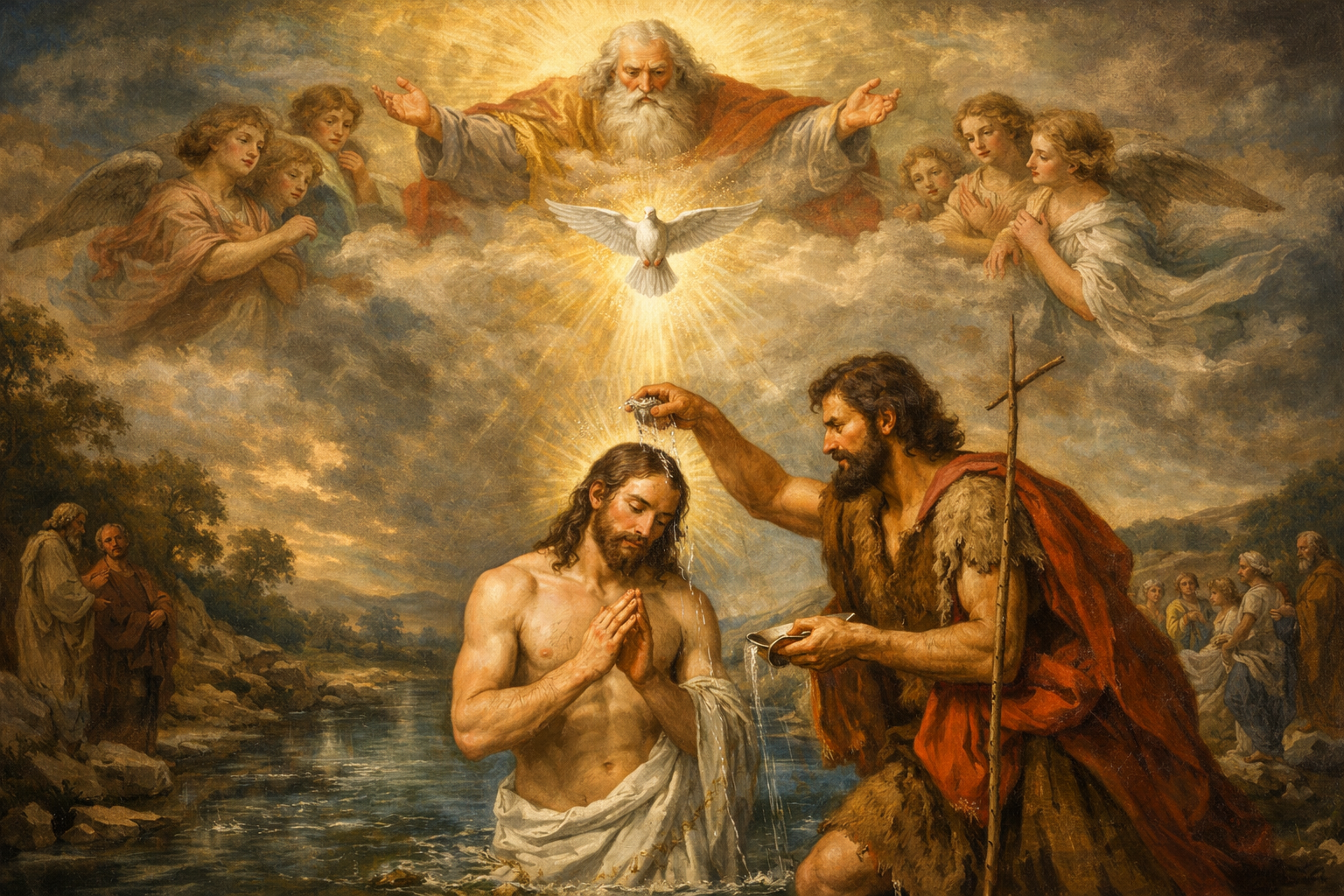
The Epiphany of the Jordan: Christ Manifested, the Trinity Revealed

Epiphany as Manifestation, Not Sentiment
The Feast of the Epiphany is the Church’s proclamation that the Incarnate Word has been made manifest in history. The Greek epiphaneia signifies not a private illumination but a public disclosure: what was hidden is now shown. From the earliest centuries, the Church has understood Epiphany as a composite mystery, gathering together several decisive moments in which Christ is revealed—above all the adoration of the Magi, the Baptism in the Jordan, and the miracle at Cana. These are not parallel devotional scenes but a single theological movement, each unveiling Christ under a distinct yet inseparable aspect.¹
The Baptism of Christ belongs intrinsically to Epiphany because it is the moment when the long-hidden life of Nazareth gives way to public revelation. At the Jordan, Christ does not merely begin His ministry; He is declared. The Father’s voice breaks the silence of the hidden years, and revelation moves from concealment to proclamation. As John Chrysostom observes, Christ “had been known before to John, but now He is made known to all,” for God speaks not for Christ’s sake, but for the sake of those who must recognise Him.²
From Hiddenness to Mission: Revelation Through Humility
The paradox at the heart of the Baptism is fundamental to its epiphanic character. The sinless One submits to a baptism associated with repentance. Rather than undermining Christ’s identity, this act reveals it. Divine glory is disclosed not by exemption from human conditions but by their assumption. Christ’s descent into the Jordan is the first public sign that His mission will be marked by humility before exaltation, obedience before glory.³
The Fathers are unanimous that Christ enters the waters not to be purified, but to purify. Gregory of Nazianzus captures the mystery succinctly when he writes that Christ “comes up from the water bearing up the world with Him.”⁴ The Baptism thus belongs to Epiphany because it reveals not only who Christ is, but how He saves: by entering fully into the condition of those He redeems. The kingship acknowledged by the Magi is here interpreted through the lens of self-emptying obedience, anticipating the logic of the Cross.⁵
The Trinitarian Epiphany at the Jordan
What sets the Baptism apart from the other epiphanic events is that it is not merely a manifestation of Christ, but an explicit revelation of God as Trinity. The Son stands in the waters, the Spirit descends visibly, and the Father’s voice resounds from heaven. Here, revelation reaches a unique clarity. Christ is not recognised by signs or inferred by wisdom; He is named by the Father Himself.⁶
Patristic theology repeatedly emphasises that this moment teaches the Church how to speak rightly about God. Hilary of Poitiers explains that the Father’s voice, the Son’s presence, and the Spirit’s descent together “confess the faith of the Gospel,” not by abstract instruction but by historical manifestation.⁷ For this reason the Eastern tradition has long called the feast Theophany, insisting that at the Jordan God reveals not only His action but His inner life as communion.⁸
The Jordan as New Creation
The Fathers also read the Baptism of Christ through the lens of Genesis. As the Spirit hovered over the primordial waters at the dawn of creation, so He now descends upon the Jordan, inaugurating a new creation in Christ. The waters, once associated with chaos, judgment, and death, are now claimed by the Creator Himself.⁹
Augustine of Hippo draws this cosmic dimension into sacramental theology, noting that when Christ entered the waters, “He consecrated the source of baptism.”¹⁰ The Jordan becomes the place where creation begins to recognise its Lord. This is why Epiphany is not merely anthropological—concerned with human recognition—but cosmic. The revelation at the Jordan is addressed to the whole created order, which is renewed through Christ’s descent.¹¹
Scholastic Reflection: Fittingness and Divine Pedagogy
Medieval scholastic theology synthesises this patristic inheritance by asking not whether Christ needed baptism, but why it was fitting that He should be baptised. The answer given is cumulative and revealing. Christ’s Baptism confirms John’s mission, manifests the Trinity, inaugurates Christ’s public ministry, sanctifies the waters, and prefigures the sacrament of baptism. Each of these purposes belongs to the logic of Epiphany, for each is a form of manifestation.¹²
In the scholastic vision, Christ’s actions are pedagogical. He teaches not only by what He says but by what He does and causes. As the Summa Theologiae explains, Christ’s Baptism was ordered not to His own sanctification but to ours, since “by His Baptism He inaugurated ours.”¹³ Epiphany, therefore, is not exhausted in revelation alone; it opens directly onto participation. What is revealed in Christ becomes operative in the Church.¹⁴
Sonship Revealed, Not Conferred
Both Fathers and scholastics are careful to insist that the Baptism does not make Christ the Son of God; it reveals Him as such. The Father’s declaration at the Jordan does not confer a new dignity but proclaims an eternal truth. This distinction is crucial for orthodox Christology and was repeatedly defended against early adoptionist misunderstandings.¹⁵ Epiphany is thus the manifestation in time of what Christ is from all eternity.¹⁶
Here the Jordan becomes the meeting point of eternity and history. What the Son is eternally with the Father is now spoken aloud within creation. Epiphany, therefore, is not about Christ’s transformation but about humanity’s illumination.¹⁷
From Jordan to Cana: Revelation Leading to Transformation
The Baptism also prepares the way for the miracle at Cana, traditionally linked to Epiphany in both East and West. At the Jordan, Christ is revealed as Son; at Cana, His glory is manifested through transformation. The waters sanctified in the Jordan become the waters changed into wine at the wedding feast. The sequence is deliberate. Revelation precedes transformation; identity precedes mission. Faith is awakened by recognition before it is sustained by signs.¹⁸
Ecclesial and Sacramental Consequences
For the Church, the Baptism of Christ establishes the meaning of Christian baptism. The heavens opened at the Jordan are not closed again. The Spirit who descends upon Christ continues to descend upon the Church, and the Father who names His Son continues to adopt sons in Him. Epiphany thus extends beyond Christ’s manifestation into the sacramental life by which the faithful are incorporated into what has been revealed.¹⁹
Spiritually, the Jordan offers a corrective to triumphalist religion. God reveals Himself not on a throne but in water; not amid acclaim but among sinners. The Epiphany of the Jordan teaches that divine glory is most clearly seen where humility and obedience are embraced.²⁰
Conclusion
When read through theological, patristic, and scholastic reflection, the Baptism of Christ emerges as one of the most concentrated moments of revelation in the Gospel. It belongs intrinsically to Epiphany because it manifests Christ’s identity, reveals the inner life of God, sanctifies creation, inaugurates the Messianic mission, and grounds the Church’s sacramental life. At the Jordan, God does not merely appear—He speaks, He acts, and He makes Himself known.²¹
- Missale Romanum (pre-1955), In Epiphania Domini, Antiphons of Lauds and Vespers.
- John Chrysostom, Homilies on Matthew, Homily XII.
- Catechism of the Council of Trent, II.2.
- Gregory of Nazianzus, Oration 39 (In Sancta Lumina), §14.
- Isaiah 42:1; Philippians 2:6–8.
- Matthew 3:16–17; Mark 1:9–11; Luke 3:21–22.
- Hilary of Poitiers, De Trinitate, II.1–2.
- Byzantine Menaion, Feast of Theophany, Great Blessing of Waters.
- Genesis 1:2; Psalm 28:3.
- Augustine of Hippo, Sermon 135, 1–2.
- Maximus the Confessor, Ambigua, 41.
- Peter Lombard, Sentences, III, dist. 4.
- Summa Theologiae, III, q.39, a.1.
- Summa Theologiae, III, q.39, a.3.
- Irenaeus, Adversus Haereses, III.17.
- Athanasius, Orations Against the Arians, I.45.
- Leo the Great, Sermon 36 (On the Epiphany).
- John 2:1–11; Missale Romanum (pre-1955), Epiphany Octave Antiphons.
- Romans 6:3–4; Galatians 4:4–7.
- Bernard of Clairvaux, Sermons for the Epiphany, I.
- Pius XII, Mystici Corporis, §§19–20.
related articles


Latest articles
- IVREA: WHEN SYNODALITY MEETS A CLOSED DOORIn the Diocese of Ivrea, disparate grievances have emerged among various communities regarding liturgical restrictions, clerical transfers, and financial transparency, leading to a crisis in confidence. The fundamental issue is whether Bishop ✠Salera’s authority translates into the listening and reconciliation he advocates, as congregations increasingly feel unheard and overlooked.
- Today’s homily: St Eustace & Co. Martyrs, XVII Post PentecostThe reflection on St Eustace and his family’s martyrdom highlights the profound commitment required of Christian households to love God entirely. Their example illustrates that true love for God often entails sacrifices, including comfort and earthly bonds, and that a family must priority spiritual unity over worldly concerns to cultivate faith and strive for eternal salvation.
- Today’s Mass: September 19 S. Eustace & Companions, MartyrsSt. Eustachius, formerly General Placidus, experienced a transformative vision of Christ while hunting. After converting with his family, he endured persecution, losing them temporarily. Reuniting after military success, he ultimately refused to worship pagan deities, leading to his martyrdom with his family. They were later honoured with a church.
- Sermon for St. Eustacius/ Seventeenth Sunday after PentecostThe feast of St. Eustacius, celebrated on the Seventeenth Sunday after Pentecost, commemorates early Christian martyrs who refused to renounce their faith. Despite limited historical knowledge of St. Eustacius, his story embodies the courage of many Christians who, facing persecution from the Roman Empire, chose martyrdom over idolatry, ultimately shaping the Church’s foundation.
- Today’s Mass: September 19 St. Januarius, Bishop and Companion MartyrsSt. Januarius and companion martyrs were martyred during the persecution under Diocletian. St. Januarius, patron of the city of Naples and bishop of Beneventum, was beheaded with his deacons and some others.




Leave a Reply