
The Conversion of St Paul: Grace, Authority, and the Anatomy of True Renewal
Introduction
The Feast of the Conversion of Saint Paul the Apostle confronts the Church with an uncomfortable but indispensable truth: Christianity begins not in affirmation, dialogue, or consensus, but in repentance. It is one of the few feasts in the calendar that commemorates not sanctity achieved over time, nor fidelity unto death, but the moment when a man is decisively overthrown by God.
This is why the Church does not present Paul’s conversion merely as an episode in apostolic history. She proposes it as a normative pattern—a template by which personal discipleship, ecclesial renewal, and even Christian unity must be measured. Conversion, as the Church understands it, is not the refinement of existing convictions, but their judgment by divine truth.
Celebrated on 25 January, the feast traditionally coincides with prayers for unity among Christians. This proximity is neither accidental nor sentimental. The liturgy insists that unity cannot be separated from truth, and truth cannot be embraced without conversion.
Saul of Tarsus: Certainty Without Truth
The figure of Saul as he appears in Acts 9 is often misunderstood. He is sometimes portrayed as misguided but sincere, harsh but devout. The text itself allows no such softening. Saul is confident, authorised, and theologically convinced. He is acting in good conscience—but that conscience is malformed.
This detail is critical. Saul is not morally indifferent, nor spiritually apathetic. He is zealous, disciplined, and purposeful. His persecution of the Church is not the result of ignorance alone, but of certainty divorced from truth.
Here the narrative strikes close to home. Saul embodies a perennial danger within religious life: the temptation to absolutise one’s own interpretation of God’s will, insulated from correction. His conversion therefore stands as a warning not only to unbelievers, but to the religiously committed.
The Road to Damascus: Grace as Interruption
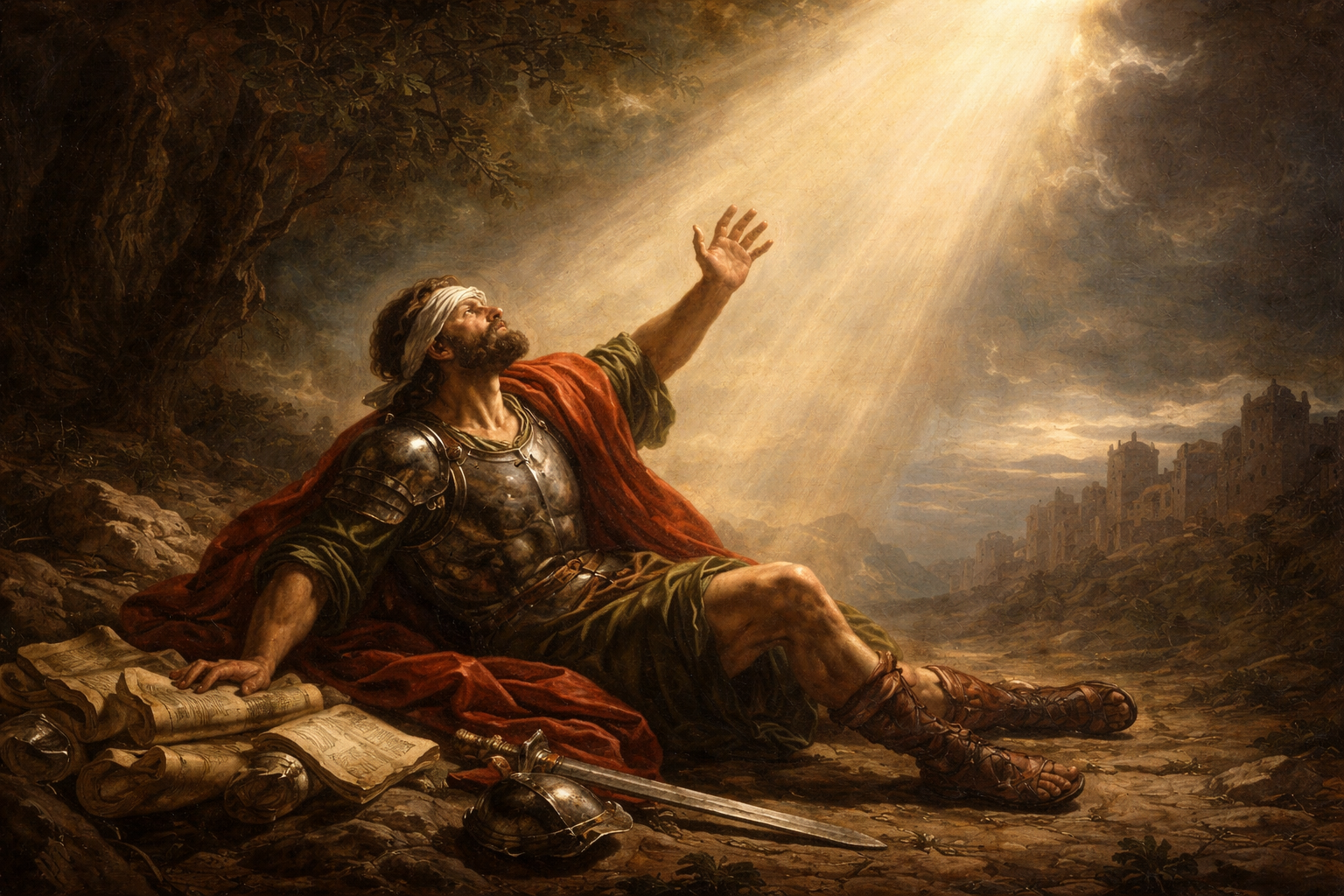
The encounter on the road to Damascus is abrupt, uninvited, and decisive. Christ does not wait for Saul to ask questions. He does not enter into debate. He intervenes.
Saul is struck down, blinded, and addressed directly: “Saul, Saul, why persecutest thou Me?” The charge is personal and absolute. To persecute the Church is to persecute Christ Himself. There is no separation between Christ’s mystical body and its visible members.
The violence of the encounter is not incidental. The Church has always understood that grace, while merciful, is not gentle in the face of entrenched error. St Augustine is explicit: Paul was “cast down in body that he might be raised in soul.”¹ Grace wounds in order to heal.
Blindness, Silence, and the Undoing of the Self
The liturgy lingers over Saul’s blindness. For three days he cannot see. He neither eats nor drinks. These details are not narrative ornamentation; they are theological instruction.
Blindness represents more than physical incapacity. It is the collapse of Saul’s former vision of reality. The man who thought he saw clearly is now reduced to dependence. The teacher must become a pupil. The accuser must learn to listen.
The Church teaches here that conversion requires unlearning. Before truth can be received, false certainty must be dismantled. Before mission can be entrusted, pride must be broken. Saul’s silence is as formative as his later preaching.
Ananias and the Necessity of the Church
One of the most theologically charged moments in the account is also one of the most easily overlooked: Saul is sent to Ananias.
This detail decisively excludes any interpretation of conversion as purely private or self-authenticating. Christ could have restored Saul’s sight directly. He chooses not to. Instead, He binds Saul’s healing to the ministry of the Church.
Ananias hesitates. He knows Saul’s reputation. Yet obedience is required of both men. Saul submits to the very community he sought to destroy. Ananias acts in trust, not self-protection.
St Bede draws attention to this moment as a safeguard against spiritual elitism. Even one chosen by Christ must enter through the Church, lest anyone presume that personal experience can replace ecclesial authority.²
Baptism, Mission, and Apostolic Obedience
When Saul’s sight is restored, it coincides with his baptism. Illumination and incorporation are inseparable. He does not merely regain physical vision; he is given a new identity.
Immediately, Saul begins to preach—but not autonomously. His mission unfolds within the apostolic order. Later, he will insist repeatedly that the Gospel he preaches is the same Gospel received and guarded by the Church. His authority is real, but never self-generated.
The Church therefore presents Paul not as a charismatic innovator, but as a man seized by truth and placed under obedience. His greatness lies not in originality, but in fidelity.
The Gospel of Loss
The Gospel appointed for the feast (Matthew 19:27–29) situates Paul’s conversion within the wider cost of discipleship. Those who follow Christ must leave behind lands, relationships, and securities.
This Gospel is not chosen at random. It anticipates the life Paul will live: rejection by his former allies, suspicion among early Christians, imprisonment, suffering, and martyrdom. Conversion is not an endpoint; it is a beginning marked by loss.
The Church refuses to present conversion as therapeutic or affirming. It is salvific—but it is costly. Grace does not preserve former status; it reorders it.
Unity Rooted in Conversion
The association of this feast with prayers for unity is among the most theologically incisive gestures of the calendar. Paul does not achieve unity with the Church through compromise. He achieves it by repentance.
The implication is unavoidable. Unity divorced from truth is not unity at all. Ecclesial communion presupposes shared submission to revelation. Dialogue has its place, but it cannot replace conversion.
In an age inclined to interpret unity as mutual recognition without doctrinal convergence, the Conversion of St Paul stands as a rebuke. The Church grows not by redefining truth, but by conforming men to it.
Contemporary Application
The feast speaks powerfully to the modern Church. It challenges:
- Clergy tempted to substitute pastoral strategy for repentance
- Theologians who prioritise process over doctrine
- Faithful who confuse sincerity with truth
- Ecumenical efforts detached from conversion
Paul’s conversion reminds the Church that renewal begins not with structural reform, but with moral and doctrinal submission to Christ.
Conclusion
The Conversion of St Paul is a feast of divine conquest. Christ does not negotiate with error; He overcomes it. He does not affirm Saul’s intentions; He overturns them. He does not leave him autonomous; He incorporates him into the Church.
Paul’s first question after his fall remains the only proper response to grace: “Lord, what wilt Thou have me to do?”
That question—asked in humility, answered in obedience—remains the Church’s only path to unity, truth, and life.
¹ St Augustine, Sermon 279, on the Conversion of St Paul; cf. Confessions, VIII.
² St Bede the Venerable, Commentary on the Acts of the Apostles, ad Acts 9.
³ Acts 9:1–22.
⁴ Matthew 19:27–29.
⁵ St John Chrysostom, Homilies on the Acts of the Apostles, Homily XX.
related articles


Latest articles
- TRADITION BEHIND THE FENCEThe Vatican’s prohibition of the traditional Ad Petri Sedem pilgrimage to St Peter’s Basilica has sparked controversy, especially among traditional Catholics. While some cite scheduling conflicts, the broader issue lies in the restrictive policies of Traditionis custodes, which may confine traditional liturgical practices to specific enclaves, risking the transmission and recognition of Catholic Tradition within the wider Church.
- Today’s Mass: October 24 St Raphael the ArchangelThe Feast of Saint Raphael the Archangel highlights his healing powers as depicted in the Book of Tobit, where he aids Tobit and his son, Tobiah. Venerated as a protector of travellers and the blind, Raphael is celebrated for his miraculous interventions. His legacy includes support for nurses, matchmakers, and Catholic studies.
- 25.10.26 Nuntiatoria CXXIX: CHRISTUS REXThe text discusses the relationship between Christ’s kingship and authority within the Church amidst contemporary challenges. It contrasts ecclesiastical power with genuine faith, emphasising that authority must protect divine truth rather than alter it. The witness of imprisoned priests illustrates the enduring significance of fidelity to Christ over institutional conformity.
- THE DOMESTIC CHURCH: 25 October – 2 November 2026 A Home with Room for Heaven: Preparing for All Saints and All SoulsThe content outlines a week’s plan for traditional Catholic families to prepare for the feasts of All Saints and All Souls. Emphasising daily prayers, remembrance of the deceased, and engagement with children’s activities, it aims to integrate Catholic customs into family life, enriching spiritual practices and fostering a shared faith experience.
- ORDO w/c 25.10.26The text outlines the liturgical calendar for the last week of October and the beginning of November, highlighting key celebrations. Notable events include the Feast of Christ the King, St Evaristus, the Vigil of Saints Simon and Jude, and the Feast of All Saints, emphasising themes of holiness, unity in faith, and the Church’s teachings.




Leave a Reply