
Accompaniment Without Truth: Avvenire and the Bishops’ Pedagogy of Surrender
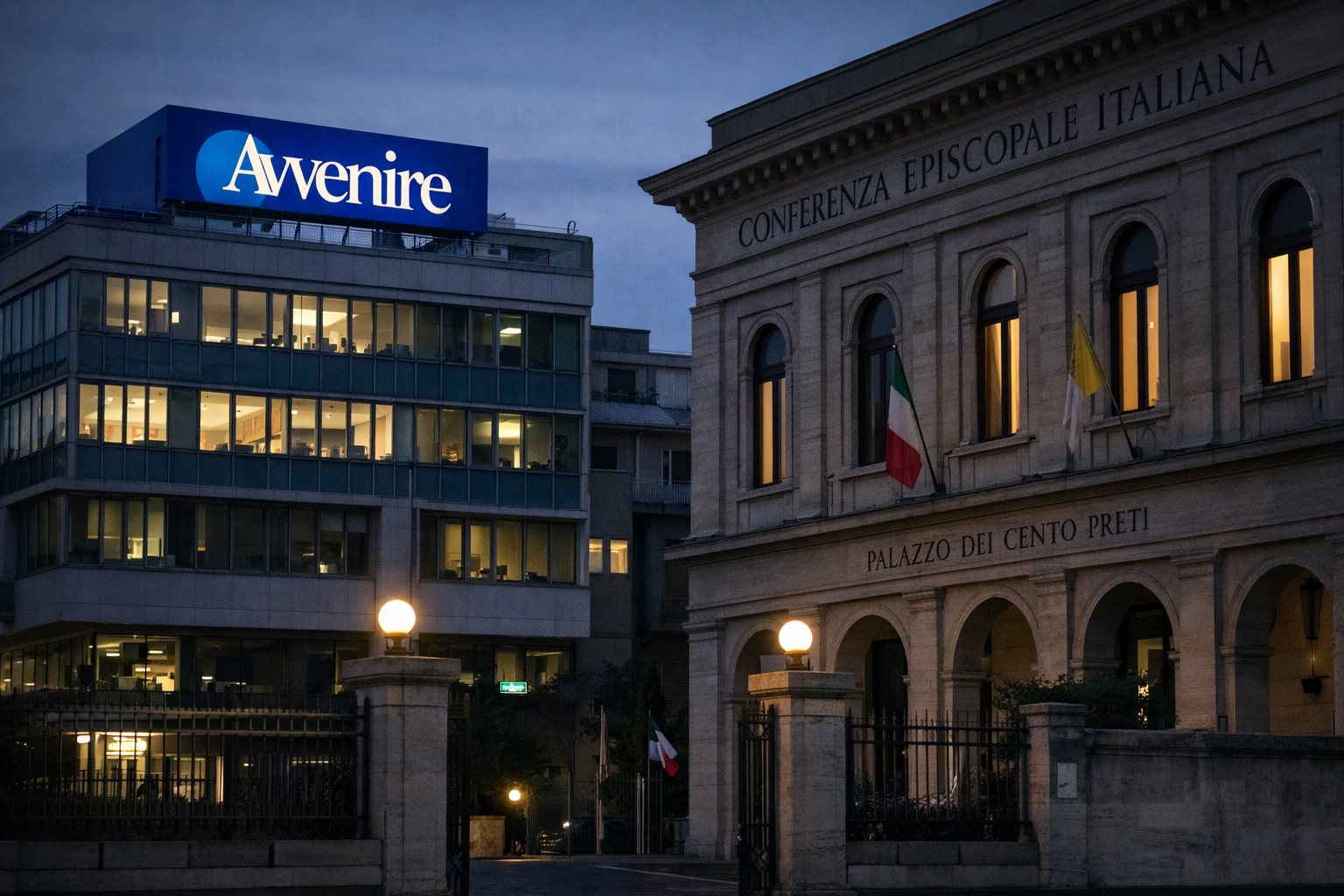
Avvenire is not an independent Catholic journal offering one opinion among many. It is the national Catholic daily founded in 1968 through the merger of L’Avvenire d’Italia and L’Italia, and it operates in close institutional alignment with the Italian Bishops’ Conference. Its editorial line is sustained by episcopal structures, funding, and moral authority. For this reason, what appears in Avvenire functions, in practice, as a form of episcopal catechesis—shaping the instincts of clergy, catechists, and laity regarding what is considered pastorally acceptable and morally intelligible.¹

It is against this background that the article “Come si cresce un figlio che non riesce a riconoscersi nel proprio corpo” must be read. From the outset, the framing already concedes the central anthropological dispute. The headline itself presupposes that a child’s inability “to recognise themselves in their own body” is a given pastoral datum rather than a claim requiring discernment or correction. The opening paragraph continues in the same register, describing “la questione dell’identità di genere in età adolescenziale” as a challenge that interrogates families, institutions, and religious communities alike. The body is thus presented as a problem to be managed, not as a meaningful and constitutive dimension of the person.²
This framing is not neutral. It reflects a secular anthropological assumption in which interior perception is treated as the locus of truth, while the body becomes a secondary or even obstructive reality. That such an assumption can be introduced without theological qualification in a bishops’ newspaper already signals a profound lapse in doctrinal vigilance. Catholic teaching on the unity of body and soul is not obscure or peripheral; it is foundational. Yet the article proceeds as though this teaching were, at best, optional background knowledge.
The article then seeks ecclesial legitimacy by invoking synodal language. It cites the final document of the Italian Church’s synodal assembly, urging local Churches “to promote recognition and accompaniment of homoaffective and transgender persons.” This appeal is significant. By foregrounding a synodal recommendation without doctrinal clarification, Avvenire situates its pastoral approach within the institutional life of the Church while leaving the impression that the categories employed—“transgender,” “recognition,” “accompaniment”—are already settled and unproblematic. No distinction is drawn between pastoral care for persons and moral evaluation of claims about identity.³
From here, the article moves into narrative exemplars, presenting two maternal testimonies described explicitly as “due madri, due percorsi con esiti diversi.” One child, we are told, “serenely embarked on the path of gender affirmation”; the other accepted what the article calls “desistance,” coming to recognise herself in her biological sex. Both outcomes are narrated with equal emotional sympathy and without any moral differentiation. The structure itself teaches: divergent paths are presented as equally valid resolutions of the same underlying condition. The reader is not invited to discern truth, but to respect outcomes. Experience, not reality, becomes normative.⁴
The language used to describe the first case is especially revealing. The path of “gender affirmation” is characterised by serenity and emotional relief. This vocabulary performs quiet but decisive work. Psychological calm is tacitly equated with moral legitimacy. The implicit suggestion is that if a choice produces serenity, it must therefore be good. Yet Catholic moral theology has never treated interior peace—particularly when transient, socially reinforced, or medically mediated—as a reliable indicator of objective moral truth. The absence of any such clarification in a bishops’ newspaper is not accidental; it is formative.⁵
The most theologically and pastorally revealing moment comes later in the article with a sentence that functions as a moral boundary-marker: “esiste un limite oltre il quale chi guarda dall’esterno non ha il diritto di andare.” There exists, we are told, a limit beyond which those observing from outside have no right to go. This line encapsulates the entire logic of secularised pastoral modernism. Moral reasoning is reframed as intrusion; judgment as violation; authority as overreach. Parents, priests, and the Church herself are implicitly instructed to stand down in the face of subjective claims.⁶
In a private secular outlet, such a claim would be unsurprising. In a bishops’ newspaper, it is devastating. The episcopal office exists precisely to judge, teach, and govern. Bishops are ordained not to abdicate moral reasoning, but to exercise it in charity and truth. When their official media teaches that judgment itself is illegitimate, the bishops undermine their own mandate. A Church that refuses to judge cannot teach; a Church that cannot teach cannot sanctify.
What makes this failure more serious is what the article omits. Nowhere does it reference the Church’s teaching on human nature, sexed embodiment, or the moral meaning of the body. There is no citation of the Catechism, no appeal to Scripture, no theological anthropology offered to guide parents or educators. The silence is instructive. Doctrine is not denied; it is bypassed. This is modernism not as slogan, but as method—the subordination of truth to experience and the quiet displacement of doctrine by contemporary consciousness.⁷
This pattern constitutes clear evidence of secularisation operating from within ecclesial structures. Moral categories drawn from psychology and social science replace theological ones. Compassion is redefined as non-interference. Truth is displaced by accompaniment. Over time, such framing habituates the faithful to an alternative catechism: the body is optional, identity is self-authored, parental authority is suspect, and the Church’s role is not to convert but to confirm.
The responsibility for this does not rest with journalists alone. Avvenire operates with episcopal knowledge and tolerance. The sustained absence of public correction or clarification from the Italian Bishops’ Conference functions as tacit approval. This is how secularisation advances ecclesially—not through explicit heresy, but through repetition, silence, and institutional permission.⁸
The tragedy is often justified in the name of mercy. Yet mercy severed from truth is not mercy but sentimentality. To refuse to speak truth about the human person—especially where children are concerned—is not compassion; it is neglect. When unreality is taught under episcopal auspices, however gently, the Church forfeits her credibility as teacher and guardian of the truth.
Avvenire therefore does more than reflect cultural confusion. It institutionalises it. It catechises Catholics into unreality—politely, therapeutically, and with episcopal acquiescence. That fact, documented in the article’s own words, stands as concrete evidence of secularisation and modernism at work within the Church’s public voice.
- Italian Bishops’ Conference (CEI), statutes and communications policy; historical accounts of the founding of Avvenire (1968).
- Catechism of the Catholic Church, §§362–365; Gaudium et Spes, §14.
- Final Document of the Italian Church’s Synodal Assembly; cf. Lumen Gentium, §§25–27.
- Pope John Paul II, Veritatis Splendor (1993), §§78–83.
- St Thomas Aquinas, Summa Theologiae, I–II, q. 19, a. 5; Pope Pius XII, Address to Catholic Physicians (1952).
- Catechism of the Catholic Church, §§2221–2223; John Paul II, Familiaris Consortio, §36.
- Pope Pius X, Pascendi Dominici Gregis (1907), §§7–15.
- Congregation for Catholic Education, Male and Female He Created Them (2019), §§30–35.
RELATED ARTICLES


Latest ARTICLES
- Today’s Mass: September 04 Feria of Sunday XIV Post PentecostThe Fourteenth Sunday After Pentecost emphasises the importance of serving one master—God—over the flesh. It urges Christians to focus on spiritual over temporal concerns, warning against anxiety. The readings highlight the contrast between the fruit of the spirit and the works of the flesh, encouraging a pursuit of divine life.
- Today’s homily: St Pius X, PopeThe text reflects on the life and legacy of Pope St Pius X, who was chosen from humble beginnings to reform the Church. His pontificate focused on defending the Catholic Faith, restoring liturgical sanctity, and fostering deeper connections between believers and Christ. Pius X exemplified a balance of truth and pastoral charity.
- Today’s Mass: September 03 Pope St Pius X,Pope St Pius X, born Giuseppe Melchiorre Sarto, was a significant reformer who emphasised preserving the Catholic Faith against Modernism. His pontificate (1903-1914) featured reforms in liturgy, frequent Holy Communion, and seminaries, rooted in a pastoral desire to restore everything in Christ. He died in 1914 and was canonised in 1954.
- Today’s homily: St Stephen of HungaryThe homily reflects on the life of Saint Stephen of Hungary, illustrating his transition from a powerful ruler to a saint. He embraced the responsibilities of kingship guided by faith, understanding his authority as stewardship. His legacy teaches that true governance comes with surrender to God, ultimately placing his kingdom under the protection of the Blessed Virgin Mary.
- Today’s Mass: September 02 St. Stephen the GreatSt. Stephen the Great, King of Hungary (977-1038), was a significant Christian ruler who reinforced the faith throughout Hungary. Anointed king in 1000 by Pope Sylvester II, he fought against paganism and promoted the Church. He was canonised in 1083 and is the patron saint of Hungary, symbolising national identity.



Leave a Reply