
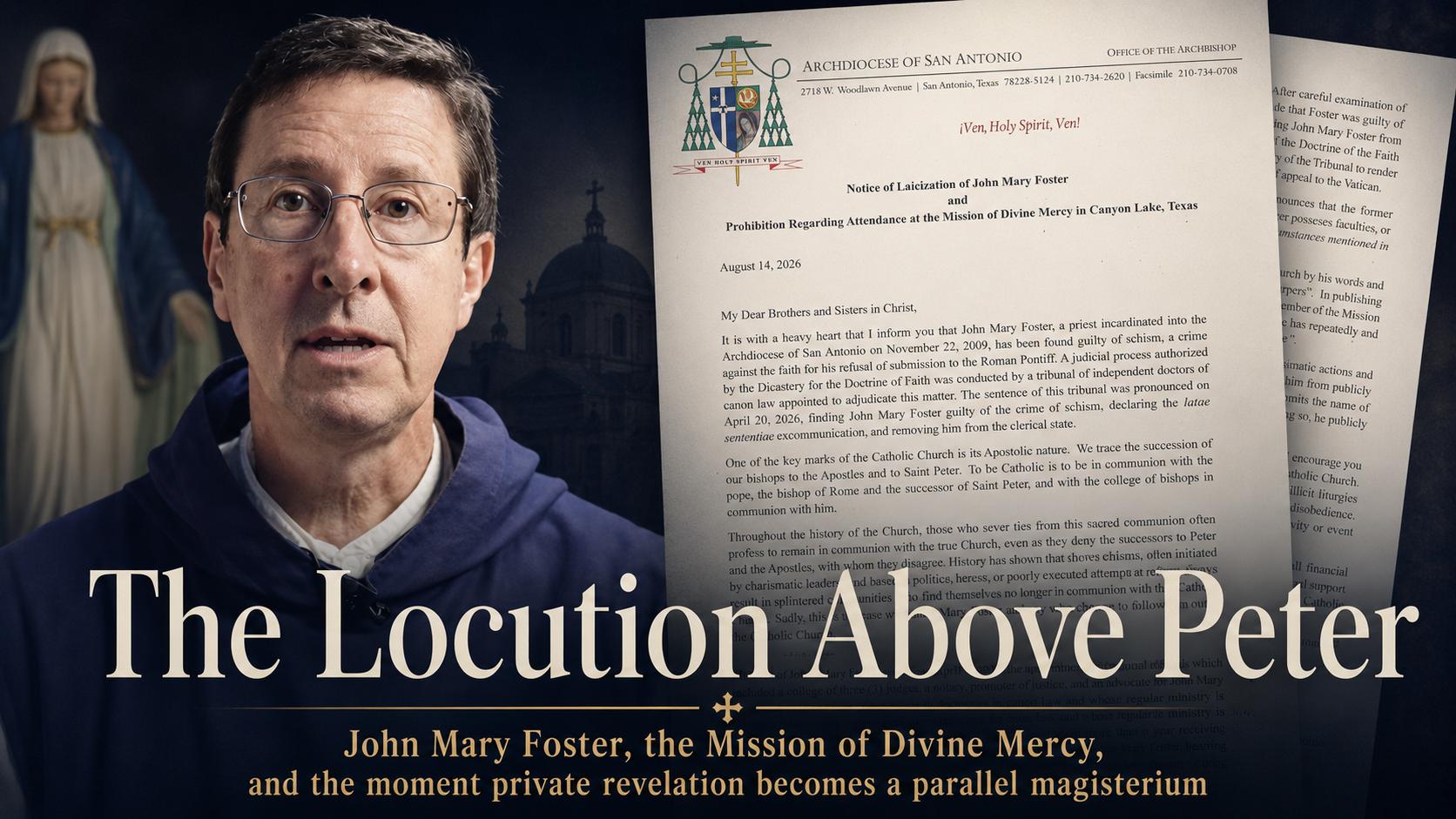
The Locution Above Peter: John Mary Foster, the Mission of Divine Mercy, and the moment private revelation becomes a parallel magisterium

Schism is one of the most carelessly used words in contemporary Catholic controversy. A priest celebrates the traditional Roman Mass without enthusiasm for the latest Roman policy and somebody calls him schismatic. A layman questions the prudence of a papal decision and somebody reaches for canon 751. A bishop resists a Roman innovation, a theologian distinguishes between the office of the Pope and the prudence of its occupant, a traditional community invokes necessity against a disciplinary command: sooner or later the accusation appears. This habitual inflation of the word has done considerable damage, because if every act of resistance is called schism, Catholics eventually lose sight of what schism actually is.
The case of John Mary Foster and the Mission of Divine Mercy at Canyon Lake, Texas, is therefore unusually instructive. Here we are not dealing simply with attachment to Tradition, criticism of a pontificate, resistance to an abusive command, canonical irregularity or even unauthorised sacramental ministry. We are dealing with a priest who has been judicially convicted of schism after a canonical trial; who denies that either Francis or Leo XIV was or is the Roman Pontiff; who intentionally omitted the recognised Pope from the Eucharistic Prayer because he denied that man to be Pope; who continued public ministry after his Ordinary prohibited it; and who, having been afforded an appeal, has now declined it because the authority to which he would appeal is itself regarded as illegitimate. Most revealingly of all, the Mission says that its certainty on these matters rests ultimately upon messages which it believes God, Our Lord and the Blessed Virgin have given through members of its own community.¹
That is what makes the case important. Foster’s story throws into relief the distinction between resisting an authority which one recognises and constructing a mechanism by which that authority can no longer judge one’s conduct at all.
Foster is not some self-created cleric who appeared yesterday at the head of an internet sect. He has been a priest since 1987. The Mission began its apostolate in the Archdiocese of San Antonio in 2001, initially with episcopal approval, and in 2009 Archbishop José Gómez approved its statutes and erected it as a private association of the faithful with juridical personality. Foster was incardinated into the Archdiocese on 22 November that year. The Mission developed retreats, Eucharistic adoration, spiritual conferences and a distinctive devotional life. Even in its present estrangement from San Antonio, its language remains recognisably Catholic: the Eucharistic Sacrifice, Our Lady, Divine Mercy, repentance, sacrifice, the Deposit of Faith and the necessity of fidelity in a Church in crisis.²
That background matters. The danger here is not obvious unbelief. It is precisely the opposite. The Mission’s claims are wrapped in Catholic devotion, made by people who plainly regard themselves as defending the Church and advanced through a vocabulary which will resonate strongly with Catholics appalled by the doctrinal confusion and ecclesiastical cowardice of recent decades.
The difficulty began with alleged private revelations.
According to the Mission’s own detailed account, Sister Amapola began receiving what she regarded as messages from Our Lady and Our Lord in December 2016. Foster came to regard them as authentic. The Mission says it informed Archbishop Gustavo García-Siller in 2017, supplied extensive documentation during a subsequent diocesan visitation and for some seven years refrained from publishing the messages publicly. It also complains, with some force, that the Archdiocese showed remarkably little interest in conducting a serious discernment during much of that period. The Mission says that auxiliary bishops had read at least some of the material without identifying doctrinal errors and that the principal instruction from the Archbishop was simply that the messages were not to be published.³
That history deserves to be stated fairly. If the Mission’s account is substantially correct, one may reasonably criticise the pastoral handling of the affair. Claims of continuing supernatural communication within an established Catholic apostolate are not matters to be left indefinitely in a chancery drawer. The Church herself insists upon careful investigation of alleged supernatural phenomena, precisely because genuine spiritual fruits, honest subjective experiences, theological error, human imagination and outright deception can become entangled. The present Roman norms expressly place responsibility for investigation upon the diocesan bishop, subject to the oversight of the Dicastery for the Doctrine of the Faith.⁴
But poor discernment by an Ordinary does not authenticate a locution. Nor does an episcopal failure to investigate confer upon the recipient of an alleged revelation the authority to authenticate it herself.
That is where the Mission crossed the decisive line.
In February 2024 it began publishing the messages. Their content had by then become explosive. Francis was not merely accused of error, disastrous government or even grave doctrinal dereliction. He was called a “usurper” occupying the Chair of Peter. Foster ceased naming him in the Eucharistic Prayer. Archbishop García-Siller ordered publication to cease. Foster and the Mission concluded that obedience to God required publication to continue. On 15 March 2024 the Archbishop withdrew Foster’s faculties and suppressed the Mission’s canonical status; the Mission challenged those decisions but continued its work.³
Had the whole crisis rested upon Foster’s judgment concerning Francis, the death of Francis and the election of a successor might have provided a natural terminus. It did not. After the election of Leo XIV, the Mission announced that its alleged messages identified him also as a usurper. Its February 2026 statement of faith could scarcely be clearer: the members profess loyalty to St Peter and to every legitimate successor, but simultaneously say that God has revealed that “both Francis and Leo are usurpers.” Its current FAQ explains that it generally avoids even calling Robert Prevost “Leo XIV”, precisely because it denies that he validly possesses the papal office.⁵
That destroys any attempt to reduce the affair to a dispute over the peculiarities of one pontificate. The Mission is no longer saying simply that Francis committed acts which should be resisted. It says the man universally recognised as his successor is not Pope either. More importantly, the decisive evidence is not some demonstrated defect in the conclave, a judgment of the competent Church authority, or a notorious canonical fact. The decisive evidence is what the Mission believes Our Lord has said through its own visionary.
Here the whole Catholic order of discernment has been turned upside down.
Private revelation has a place in Catholic life. The Church would have to discard a considerable portion of her own history to pretend otherwise. St Margaret Mary, Lourdes and Fatima cannot be explained by a rationalism which permits God to speak only until the death of the last Apostle and then requires Him to remain silent. St Thomas himself recognised the continuing existence of prophecy in the Church. The problem is not the possibility of private revelation.
The problem is its authority.
Even an approved apparition does not become an additional article of the Faith. Fatima does not stand beside Nicea. Lourdes cannot repeal canon law. A locution to a saint does not possess jurisdiction over a bishop. The Catechism states that private revelations do not belong to the Deposit of Faith and are to be discerned under the guidance of the Church’s Magisterium. The 2024 norms are equally explicit that ecclesiastical authority examines alleged supernatural phenomena and determines what public adherence or devotion may safely be permitted.⁶
At the Mission of Divine Mercy, however, the direction of judgment has effectively been reversed. The Church no longer finally judges the locution. The locution judges the Church.
The circle is now almost perfect. Why should Foster not submit to Leo XIV? Because Leo is not Pope. How does the Mission know Leo is not Pope? Because the alleged messages say so. Why should those messages prevail over ecclesiastical authority? Because they are believed to come from God. Who has determined that they come from God? Foster and the community receiving them. What happens when the competent ecclesiastical authority rejects the resulting conduct? That rejection is itself understood as further evidence of the corruption about which the messages warned.
A system constructed in that fashion becomes practically unfalsifiable. Every contradiction confirms it. Every prohibition proves persecution. Every canonical sanction becomes evidence that the hierarchy is corrupt. Every refusal by Rome vindicates the premise that Rome has been usurped.
And then came the trial.
The Archdiocese says proceedings began on 10 April 2025. A college of three priest-judges with doctorates in canon law heard the case; there were a notary, promoter of justice and an advocate for Foster; evidence included his public statements, homilies, teaching and conduct. On 20 April 2026 the tribunal pronounced sentence, finding him guilty of schism, declaring the latae sententiae excommunication and imposing dismissal from the clerical state. The Dicastery for the Doctrine of the Faith was notified and, according to San Antonio’s notice, acknowledged the tribunal’s authority to render the sentence. Foster chose not to appeal.¹
That procedure matters because canon law does not allow us simply to leap from controversial conduct to personal guilt. Canon 1321 requires an external violation which is gravely imputable by malice or culpability. Canons 1323 and 1324 recognise circumstances in which ignorance, error, fear, necessity or diminished imputability may excuse an offender or mitigate a penalty. The faithful also possess the right to defend themselves and to be judged according to law.⁷
Foster’s appeal to conscience is therefore not irrelevant. A man who, without culpability, is genuinely mistaken about a fact upon which an offence depends is not necessarily in the same canonical position as a man who knowingly and obstinately rejects an authority he recognises. Canon law is subtler than the internet.
But that cuts both ways. Foster had a tribunal before which precisely such questions could be examined. He had an advocate. The tribunal says it reached moral certitude after examining the evidence. And his own community now publicly confirms the continuing external conduct at issue. It states that it believes neither Francis nor Leo to have been Pope; it rejects the sentence as unjust; it has chosen not to appeal; and it says that God nevertheless requires Foster to continue his priestly ministry.⁸
One cannot simply answer a judicial finding of schism by asserting that one’s conscience says there is no schism. Conscience bears upon culpability; it does not confer jurisdiction, create facts or transform private revelation into a canonical court of final appeal.
The canonical definition itself is admirably spare. Schism is “the refusal of submission to the Supreme Pontiff or of communion with the members of the Church subject to him”. Canon 1364 attaches latae sententiae excommunication to the offence and provides that, where long-standing contempt or the gravity of scandal requires it, further penalties may be added, expressly including dismissal from the clerical state.⁹
This is precisely why the Foster case should cause traditional Catholics to insist upon accurate language elsewhere.
Resistance is not the same thing as schism.
To say to a Pope, Holy Father, you possess the office, but this act is wrong, is not the same thing as saying, you do not possess the office at all.
To say, this command exceeds your lawful authority, is not the same thing as saying, you possess no authority over me because you are an impostor.
To question the prudence of a disciplinary law is not to deny the Roman primacy. To preserve a traditional rite in circumstances of necessity is not, simply by that fact, to erect another Church. Canonical irregularity is not synonymous with schism. Nor does every illicit sacramental act demonstrate a refusal of communion with the Roman Pontiff.
This distinction is indispensable in any serious assessment of traditional Catholic resistance. If the word schism is to retain canonical meaning, one must look for precisely the thing canon 751 identifies: refusal of submission to the Supreme Pontiff or communion with those subject to him. The accusation cannot simply be inferred from traditional liturgy, criticism, disobedience or embarrassment caused to ecclesiastical authority.
In Foster’s case, however, the evidence is much more direct. The Mission denies that the recognised Roman claimant is the Roman Pontiff. Foster’s deliberate omission of the Pope from the Eucharistic Prayer was not an accidental rubric or a generic gesture of protest; the Mission itself explains that he omitted Francis because he did not believe him to be a valid Pope. The same judgment is now applied to Leo XIV.⁵ The issue is therefore not whether Foster accepts papal primacy as an abstract doctrine. He repeatedly says that he does. The issue is whether he accepts the concrete bearer of that primacy to whom the visible Church presently renders communion.
Every schismatic can theoretically preserve the doctrine of authority while denying its concrete application. An Eastern schismatic may profess belief in bishops while refusing communion with the bishops of the Catholic Church. A conclavist may profess the divine institution of the papacy while electing his own pope in a farmhouse. The doctrinal sentence “I believe in the papacy” cannot by itself resolve a question concerning refusal of submission to the man recognised by the Church as Pope.
There is another technical point which San Antonio’s announcement and the Mission’s reply both risk obscuring. The Archdiocese uses the familiar word “laicization” and says Foster has been “returned to the lay state”. Canonically, the more exact expression is dismissal from the clerical state. Foster has not been unordained. Canon 290 states explicitly that sacred ordination validly received never becomes invalid. Canon 292 provides that one who loses the clerical state loses the rights proper to it and is prohibited from exercising the power of orders, apart from the exception provided by canon 976.¹⁰
A priest is not made ontologically a layman by a tribunal.
That distinction, however, does not rescue Foster’s continued ministry. His Mass may remain sacramentally valid because dismissal does not destroy the character of Holy Orders; it is nevertheless celebrated contrary to the prohibition imposed upon him. Nor is it accurate to generalise from the validity of Mass to all sacramental ministry. Canon 966 requires not only priestly ordination but the faculty to exercise that power for valid sacramental absolution. Canon 976 supplies it to any priest in danger of death, and canon 986 §2 can actually oblige any priest to hear a confession in such circumstances. Outside such provisions, one cannot simply say that dismissal leaves every sacrament “valid but illicit”.¹¹ The Church’s sacramental law is more exact than that.
There is likewise a point to be made about Archbishop García-Siller’s prohibition upon attendance. His notice declares that Catholics are prohibited from attending Masses, liturgical activities or events sponsored by Foster or the Mission. That is pastorally unmistakable, but its wording should not be mistaken for a claim that a diocesan bishop possesses universal jurisdiction over every Catholic everywhere. Canon 381 gives a diocesan bishop ordinary, proper and immediate authority in the diocese entrusted to him; the Code separately regulates the territorial and personal reach of particular law and executive power.¹² The Archbishop unquestionably has extensive authority over Catholic worship and ecclesiastical activity within San Antonio and over those entrusted to his pastoral governance. Precisely how the notice binds every conceivable Catholic visitor is a narrower juridical question which cannot be resolved merely by the phrase “I prohibit all Catholics”.
That qualification does not vindicate the Mission. It simply applies to San Antonio the same principle which must be applied to Foster: authority has limits, and those limits matter.
Indeed, that is the central lesson of the whole affair.
There has been too much ultramontane nonsense in modern Catholic life. A Pope cannot make black white because he prefers grey. A bishop cannot command sin. An Ordinary cannot transform prudence into dogma by issuing a decree on headed paper. St Paul resisted St Peter to his face; St Thomas explains why a prelate can require public correction; Catholic moral theology has never reduced obedience to the surrender of reason and conscience. The grotesque notion that fidelity consists in agreeing enthusiastically with whatever comes from the latest ecclesiastical office-holder has done untold damage to the Church.
But there is an equal and opposite error.
The fact that authority has limits does not mean I become the authority who determines those limits without appeal. The fact that a Pope can be resisted does not mean that I can privately depose him. The fact that a bishop can act unjustly does not mean his jurisdiction evaporates when I judge him unjust. The fact that God may grant private revelations does not mean that an alleged revelation can place its recipient above the visible constitution of the Church.
Traditional Catholics, of all people, should understand this. Our entire case against ecclesiastical revolution rests upon the principle that Catholicism is received, not invented. Doctrine is received. Sacraments are received. Tradition is received. Authority itself is received. We oppose the modernist who treats the Faith as material to be reconstructed by contemporary consciousness.
We cannot then introduce the same principle through the back door by allowing private consciousness to reconstruct the papacy.
There is something genuinely tragic about the Mission of Divine Mercy. Its members do not write like people eager to leave the Catholic Church. They protest that they love her. They speak of the Blessed Sacrament, Our Lady, sacrifice, fidelity and the necessity of resisting corruption. They acknowledge that they might be wrong and ask for prayer. Their criticisms of the contemporary hierarchy include things which many faithful Catholics will recognise as painfully real. Even their complaint that ecclesiastical authorities too often fail to discern alleged supernatural phenomena with seriousness should not simply be dismissed.
But sincerity cannot cure a defective ecclesiology.
The moment a private revelation becomes the authority by which the identity of the Pope is decided, the hierarchy judged, a canonical sentence rejected, an appeal refused and continued ministry authorised, private revelation is no longer functioning as private revelation. It has become a parallel magisterium and a parallel jurisdiction.
That is the point at which the slogan “we must obey God rather than men” becomes dangerously easy. Every Catholic believes it. Every martyr proved it with his blood. The question is not whether God must be obeyed before men. Of course He must.
The question is who has established that God has commanded this particular act against the judgment of the Church?
In Foster’s case the answer finally returns to Sister Amapola’s alleged messages and the Mission’s discernment of them.
And there lies the trap.
If the Pope says the message is false, the message says he is not Pope. If the bishop prohibits publication, the message requires publication. If a tribunal condemns Foster, the message identifies the judgment with the rejection of Christ. If Rome offers an appeal, the message says the Roman claimant is a usurper. If dismissal forbids ministry, another message authorises ministry to continue.
There is nowhere left for the Church to speak.
Whatever else that structure may be, it cannot be Catholic obedience. For Catholic obedience admits lawful resistance because lawful resistance still recognises the objective constitution of the Church. It can say non possumus to an unlawful command without saying non es Papa to the man who issued it.
That is why the Foster affair deserves attention far beyond Texas. At a time when accusations of schism are being scattered recklessly across traditional Catholicism, here is a case which helps recover the term’s proper gravity. It demonstrates that criticism is not schism, resistance is not schism, irregularity is not schism, and even disobedience is not automatically schism.
But it also demonstrates where resistance can end if it loses its Catholic anchor.
There is a chasm between saying, “I recognise your authority, but I cannot obey you in this.” and saying, “I need not submit to you because God has privately revealed to us that you have no authority.”
The former can be the voice of Catholic resistance.
The latter has created another tribunal.
And once the final court of appeal is no longer Peter, the bishops, the law of the Church or even a tribunal competent to hear the case, but the locution received inside one’s own community, the problem is no longer simply that one has resisted the hierarchy.
The locution has been placed above it.
That is not the defence of Catholic Tradition.
It is the moment private revelation becomes a Church of its own.
¹ Archdiocese of San Antonio, “Notice of Laicization of John Mary Foster and Prohibition Regarding Attendance at the Mission of Divine Mercy in Canyon Lake,” 14 August 2026.
² Mission of Divine Mercy, “Out of Obedience: A Response to the Archbishop’s Statement and Decrees of March 15, 2024,” 24 July 2024.
³ Ibid.
⁴ Dicastery for the Doctrine of the Faith, Norms for Proceeding in the Discernment of Alleged Supernatural Phenomena, 17 May 2024, especially arts. 1–8, 21–23.
⁵ Mission of Divine Mercy, “Statement of Faith of February 3rd,” published 4 February 2026; “Frequently Asked Questions,” sections concerning Robert Prevost/Leo XIV and Jorge Bergoglio.
⁶ Catechism of the Catholic Church, n. 67; Dicastery for the Doctrine of the Faith, Norms for Proceeding in the Discernment of Alleged Supernatural Phenomena.
⁷ Code of Canon Law, cann. 1321–1326; cann. 221 §§1–3.
⁸ Mission of Divine Mercy, “Listening to God — Regarding the Sentence of ‘Excommunication’ and ‘Laicization’,” 2026.
⁹ Code of Canon Law, cann. 751 and 1364 §§1–2.
¹⁰ Code of Canon Law, cann. 290–293.
¹¹ Code of Canon Law, cann. 966, 976 and 986 §2.
¹² Code of Canon Law, cann. 13, 136 and 381 §1.
RELATED ARTiCLES


LATEST ARTICLES
- The Catholic Girl’s Guide, III: Whose Is This Image?Chapter III of the 1906 Catholic Girl’s Guide: the image of God, the immortal soul and the desire for eternal happiness, with a contemporary reflection on human dignity and Christian hope.
- The Young Man’s Guide, III: The Music of the SoulChapter III of the 1910 Young Man’s Guide: the rational soul, thought, the image of God and the responsibilities of Christian manhood, with a contemporary reflection on neuroscience and artificial intelligence.
- Today’s homily: St Cecilia, Virgin & MartyrTradition tells us that Cecilia was a Roman girl of a patrician family who had been brought up as a Christian. She fasted often and wore a coarse garment beneath her rich clothing. Although she had consecrated her virginity to God, her father betrothed her to a young pagan named Valerian.
- Today’s Mass: November 22 St Cecilia, Virgin & MartyrTradition tells us that Cecilia was a Roman girl of a patrician family who had been brought up as a Christian. She fasted often and wore a coarse garment beneath her rich clothing. Although she had consecrated her virginity to God, her father betrothed her to a young pagan named Valerian.
- Sermon for St Cecilia / Sunday Before AdventThe life of St Cecilia follows a pattern similar to many other Christian virgins who became martyrs, such as St Agnes, St Agatha and St Lucy. They were Christian virgins pressurised into marrying pagan husbands, and suffered persecution and martyrdom because they would not consent to losing their virginity and compromising their faith.
CURRENT EDITION


Today’s Mass Propers
- Today’s Mass: November 22 St Cecilia, Virgin & Martyr
 Tradition tells us that Cecilia was a Roman girl of a patrician family who had been brought up as a Christian. She fasted often and wore a coarse garment beneath her rich clothing. Although she had consecrated her virginity to God, her father betrothed her to a young pagan named Valerian.




Leave a Reply