
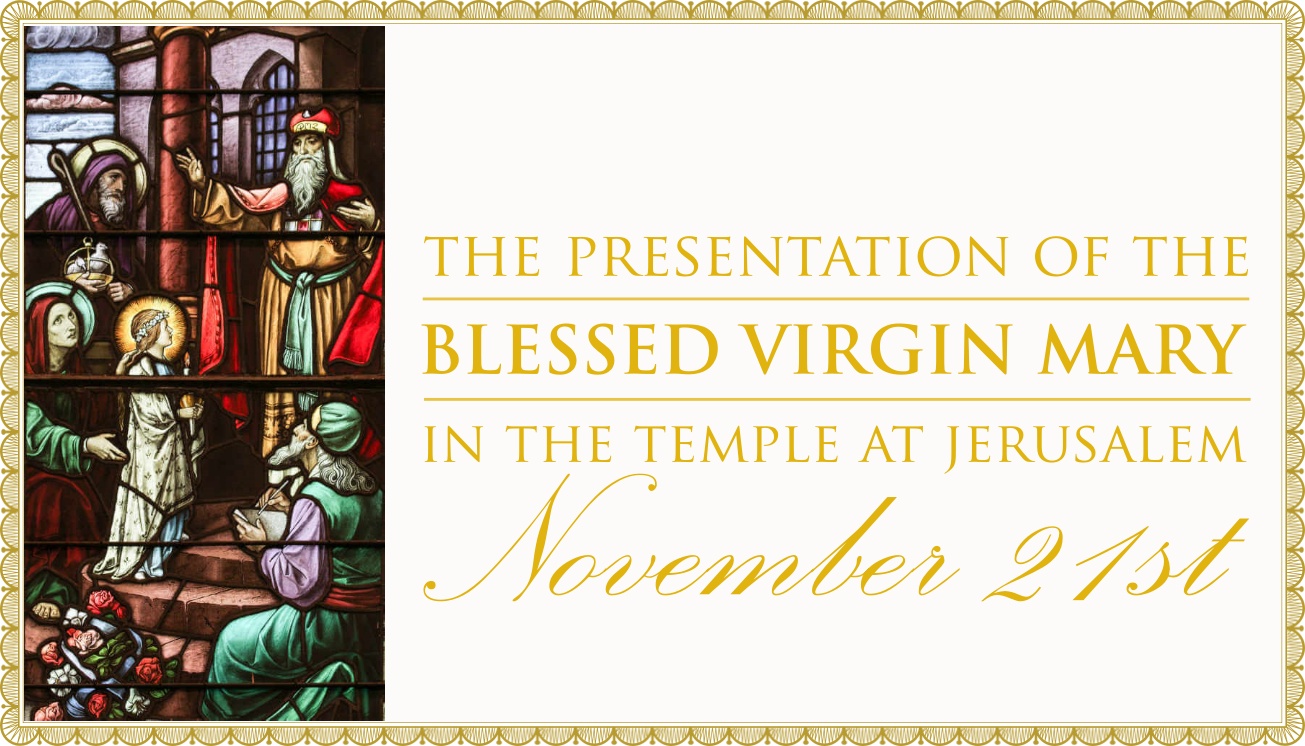
Presentation of the Blessed Virgin Mary
Today we celebrate the feast of the Presentation of the Blessed Virgin Mary. Today’s feast is based on a tradition not found in the canonical New Testament, but in the Protoevangelium of James. This tells the story of the birth of Mary from her parents Joachim and Anne, and how she was presented in the Temple at Jerusalem when she was three years old and subsequently lived there.
It is on the basis of this tradition that we celebrate the feasts of St. Joachim and St. Anne, and also celebrate the Presentation of the Blessed Virgin Mary today. Since the Protoevangelium of James is not part of the canonical Scriptures it is not accorded the same authority as them by the Church nor regarded as having the same level of historical value. In other words, it is not necessary to believe the traditions contained in the Protoevangelium of James as a matter of faith.
On the other hand, it is not a heretical document like the Gnostic gospels which taught a false doctrine of salvation by esoteric knowledge. Rather, the Protoevangelium of James is a document that is orthodox in faith, but does not contain traditions of the same historical value as the canonical Gospels. It is on this basis that the Church celebrates a feast day about a tradition from the early Church that is not a matter of faith, but also is recognised as consistent with what is received as of faith.
It is also noteworthy that this feast took hold of popular devotion much earlier in the East than in the West. It has been commemorated in the East since the sixth century and become one of the most important feasts of the liturgical year in the Byzantine rite. By contrast, in the West the observance of this feast did not really gain prominence until the later middle ages.
Tradition has it that a French nobleman, Philippe de Maizieres, who was chancellor at the court of the King of Cyprus, having been sent in 1372 as ambassador to Pope Gregory XI at Avignon, related to him the magnificence with which this feast was celebrated in Greece. This led to the adoption of this feast in Avignon. It has been observed in Rome since the time of Sixtus V in 1585. Hence, though it is now an important part of our liturgical year it has never received the same prominence from early times as it has in the Byzantine rite.
For many Christians since the time of the Protestant Reformation in the sixteenth century an emphasis on the veneration of the Blessed Virgin Mary detracts from the worship of Christ as the Word made flesh. However, it is important to emphasise that we honour Mary not as a figure of independent greatness in her own right, but precisely because of her unique relation to Christ, as the theotokos, the mother of the Word made flesh. We venerate Mary precisely because of the pivotal role she played in giving birth to the Saviour.
In the nineteenth century John Henry Newman noted that “if we take a survey at least of Europe, we shall find that it is not those religious communities which are characterised by devotion towards the Blessed Virgin Mary which have ceased to adore her Eternal Son, but those very bodies, (when allowed by law) which have renounced devotion towards her. The regard for his glory, which was professed in that keen jealousy of her exaltation, has not been supported by the event. They who were accused of worshipping a creature in his stead still worship him; their accusers who hoped to worship him so purely, they, wherever obstacles to the development of their principles have been removed, have ceased to worship him altogether.”
Regarding the Blessed Virgin Mary St. John Chrysostom states: “what thing greater or more famous than she, hath ever at any time been found or can be found? She alone is greater than heaven and earth…. Neither prophets, nor apostles, nor martyrs, nor patriarchs, nor angels, nor thrones, nor lordships, nor seraphim, nor cherubim, nor any other creature visible or invisible, can be found that is greater or more excellent than she.
She is at once the handmaid and parent of God, at once virgin and mother. She is the mother of Him who was begotten of the Father before all ages, and who is acknowledged by angels and men to be Lord of all. Wouldst thou know how much nobler is this virgin than any of the heavenly powers? They stand before him with fear and trembling, veiling their faces with their wings, but she offereth humanity to Him to whom she gave birth. Through her we obtain remission of sins.
Hail the, O Mother, heaven, damsel, maiden, throne, adornment and glory and foundation of our church! Cease not to pray for us to thy Son and our Lord Jesus Christ! That through thee we may find mercy in the day of judgement, and may be able to obtain those good things which God has prepared for them that love him, by the grace and goodness of our Lord Jesus Christ, to whom with the Father and the Holy Ghost, be ascribed all honour and glory and power, now and for ever and ever. Amen.”
by the Revd Dr Robert Wilson PhD (Cantab), Old Roman Apostolate UK




Leave a Reply