
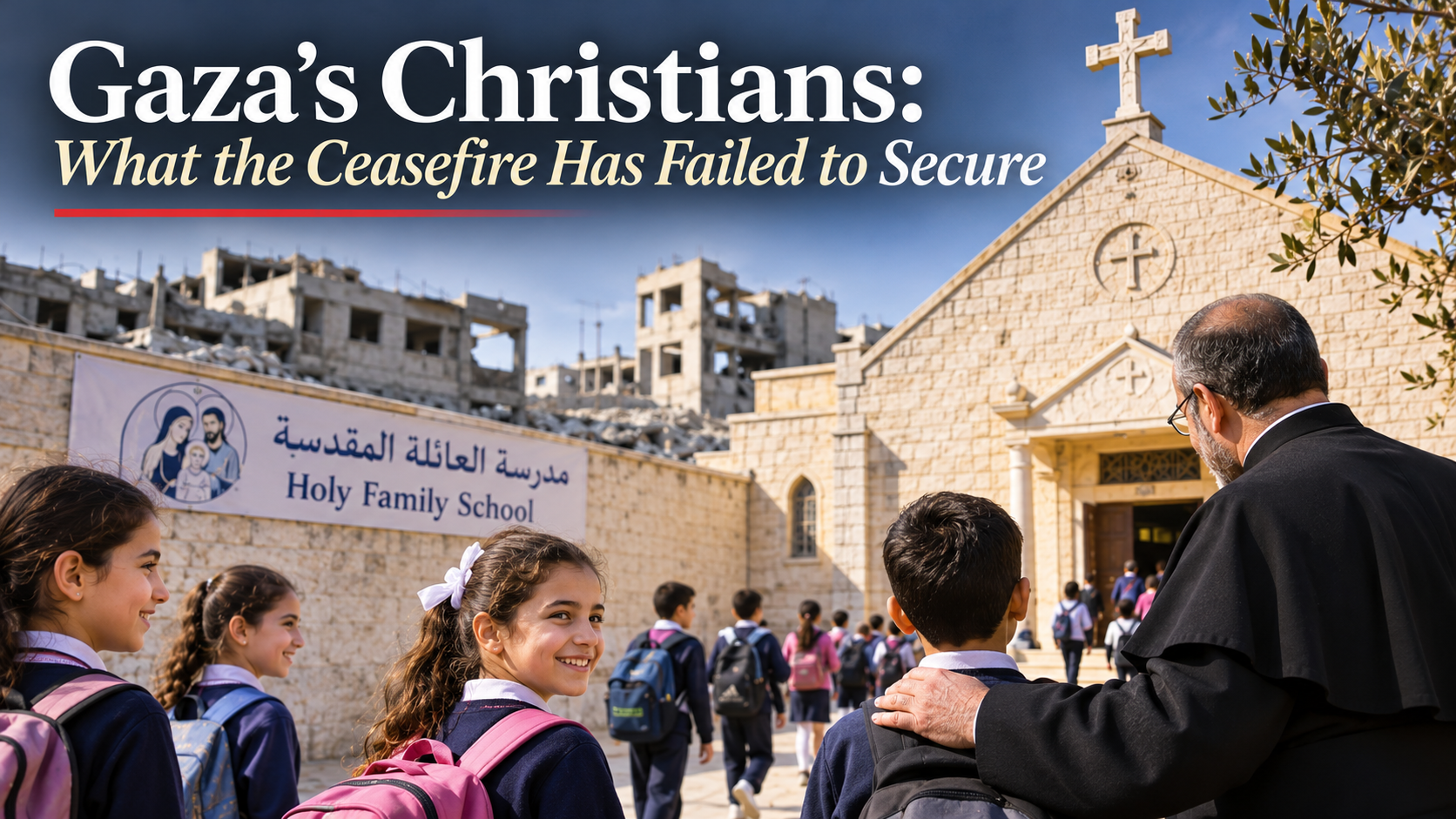
Fr Gabriel Romanelli’s account to Cardinal Claudio Gugerotti describes a Catholic community still facing violence, scarcity and uncertainty despite the ceasefire. The preservation of Gaza’s Christian presence requires practical security and sustained assistance.
Cardinal Claudio Gugerotti’s visit to the Holy Land has brought the circumstances of Gaza’s surviving Christians into sharper focus. Speaking by video from Jerusalem on 18 November with Fr Gabriel Romanelli, parish priest of Holy Family in Gaza, the Prefect of the Dicastery for the Eastern Churches heard that the ceasefire had reduced the number of daily deaths without bringing violence to an end. The condition of the parish remained extremely serious. It is an important distinction, since an agreement which restrains the fighting may nonetheless leave the people who endured it without the necessities of ordinary life.1
Gugerotti’s journey, scheduled for 16–21 November, was undertaken with the support of the Holy See and welcomed by the Assembly of Catholic Ordinaries of the Holy Land. Cardinal Pierbattista Pizzaballa, Latin Patriarch of Jerusalem, joined the conversation with Fr Romanelli. The purpose was pastoral, but the testimony received ought also to inform the practical demands which the local hierarchy and the Vatican make of those responsible for civilian security and humanitarian access.2
According to Vatican News, bombardments remained a source of fear, water was scarce, electricity almost nonexistent, and rain had flooded tents and temporary shelters. The consequences of those conditions cannot be understood through casualty statistics alone. Families require safe accommodation, food, medicine, the ability to travel when necessary and some confidence that they will not be forced to flee again. The reduction of fighting makes these things more attainable; it does not provide them automatically.1
Fr Romanelli was describing the life of a community in his pastoral care. His testimony should not be made to prove matters outside its scope. It does not independently establish responsibility for each military incident or the precise quantity of assistance admitted across Gaza. Those questions require different evidence, including the records of humanitarian organisations and the authorities controlling movement and supplies. The priest’s description is nevertheless direct evidence of what those worshipping and sheltering at Holy Family continue to experience.
The parish has acquired a significance exceeding the number of Catholics on its register. During the war its compound became a refuge and a centre of assistance for neighbours in need, regardless of their religious affiliation. This work expresses the Catholic obligation of charity and has continued in circumstances in which the ordinary administration of a small parish would itself have been difficult. The faithful require the sacraments, instruction, pastoral counsel and care for the dead while the same clergy and volunteers are asked to organise relief for those whose basic needs remain unmet.
Gugerotti described Holy Family as a living tabernacle, with the presence of Christ made visible through charity towards the poorest. The image should be understood in the devotional and pastoral sense intended. The Eucharistic tabernacle possesses its distinctive sacramental meaning; the Christian community bears witness to Christ by its worship and by practical love of those who suffer. The Cardinal’s words drew attention to the way the two are joined in the life of a parish whose resources are strained almost beyond endurance.1
The material needs of Gaza’s Christians cannot be detached from the future of the Catholic Church in the Holy Land. A building may survive the destruction of its surroundings and still be deprived of the people for whom it was erected. Churches can be repaired and furnishings restored; a community whose families depart may be much harder to reconstitute. The preservation of Christianity in the land of its origins concerns living congregations, their clergy and religious, their children and the institutions through which the Faith is transmitted.
Nor is the problem confined to the small Catholic parish in Gaza. The Latin Patriarchate, Eastern Catholic Churches and religious institutes maintain schools, healthcare facilities and charitable institutions whose work reaches beyond their own faithful. Those institutions depend upon the same conditions as other parts of civil society: freedom of movement, economic opportunity, security and the possibility of maintaining families in their own country. In the absence of such conditions, temporary charitable assistance can sustain life without securing a future.
Aid to the Church in Need reported on 11 November that Holy Family continued to struggle with limited electricity and severe living conditions, while an emergency programme included assistance for 148 Christian children facing the winter. Such identifiable projects demonstrate the importance of Catholic solidarity when it is translated into food, shelter and care. They do not establish that the wider needs of the population are being met, and they should not be presented as if the survival of one programme resolved the larger humanitarian crisis.3
The Holy See possesses diplomatic relationships which a parish priest does not. Its appeals for protection, humanitarian access and the rights of civilians cannot by themselves compel the parties to a conflict. They can establish public demands and sustain pressure long after a ceremonial visit has ended. It is therefore reasonable to ask what representations follow Gugerotti’s meetings, what assistance can be facilitated through Catholic institutions, and whether those responsible for ensuring access have provided verifiable improvements.
The economic difficulties of Christian communities beyond Gaza deserve the same attention. Pilgrimage supports employment and local institutions in Jerusalem and elsewhere, while also maintaining the connection between Catholics around the world and those whose families have cared for the sacred places over generations. Restoring safe pilgrimage would help, although it would be unreasonable to describe the return of visitors as a substitute for peace or viable civil life. A family cannot be expected to remain indefinitely because other Catholics wish to preserve a shrine.
Nuntiatoria previously examined the fragility of Christian access to Jerusalem’s holy places amid regional hostilities, distinguishing general security restrictions from evidence of specifically anti-Christian discrimination. The present testimony concerns a still more immediate question: whether the community has the practical possibility of living where its members already belong. Safeguarding religious buildings and safeguarding the people who worship within them are inseparable responsibilities.4
Assertions about the number of Christians remaining in Gaza should be treated carefully. Estimates depend upon when they were made, who was counted and how displacement was recorded. The present material does not provide a complete new census, nor an independent account of every recent attack. Neither limitation diminishes the central point of Fr Romanelli’s testimony: the cessation or reduction of organised fighting has yet to restore the normal conditions in which Christian families can remain and the parish can fulfil its mission.
Nor should the suffering of Christians be separated from that of their neighbours. Holy Family’s continuing service to people beyond the Catholic community is one reason its witness has attracted attention. Catholic charity does not cease at the boundaries of a congregation, and concern for a threatened Christian presence does not entail indifference towards the suffering of others. In Gaza the two responsibilities are practically connected.
The Cardinal has conveyed the Pope’s solidarity and has listened to a priest whose parish continues to live in danger. The substance of that encounter now requires follow-through. A ceasefire is a necessary beginning towards the restoration of security, but for Gaza’s Christians the decisive measures will be whether they can worship, educate their children, obtain the necessities of life and serve their neighbours without continuing fear. It is the permanence of those conditions, rather than another declaration of sympathy, which will determine the future of their community.
FOOTNOTES
1. Vatican News, Cardinal Gugerotti: The Church in Gaza Is a Tabernacle of Christianity, 18 November 2026.
2. Latin Patriarchate of Jerusalem, The Catholic Church in the Holy Land Welcomes Cardinal Gugerotti, 15 November 2026.
3. Aid to the Church in Need, Gaza: Church Sounds the Alarm for a Population at the End of Its Strength, 11 November 2026.
4. Nuntiatoria, The Empty Tomb Under Guard: War, Access and the Fragility of Christian Presence in Jerusalem, 20 March 2026.



Leave a Reply