
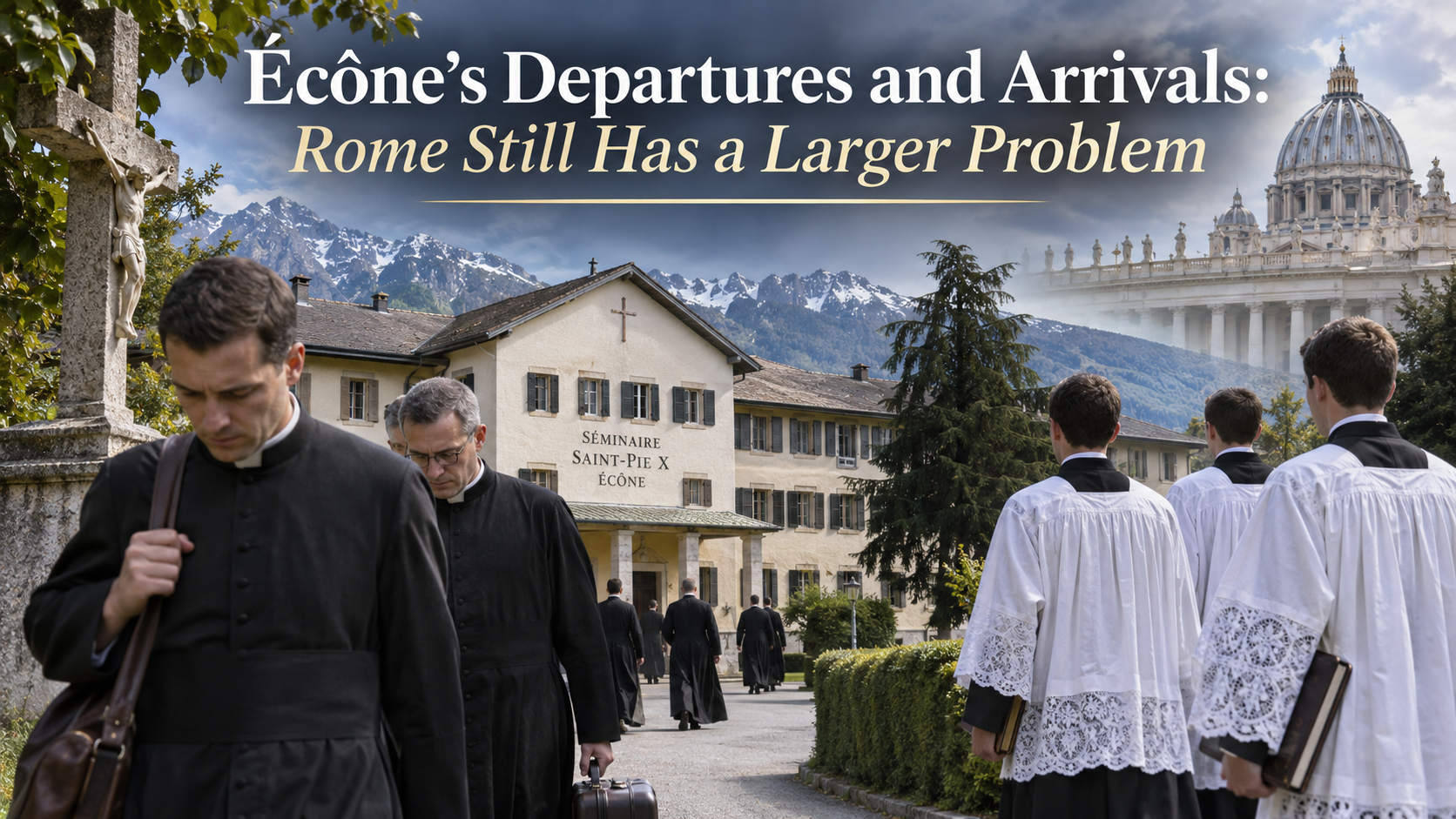
Reports of the departures of Fr Patrick Duverger and Fr Louis-Marie Turpault after July’s episcopal consecrations deserve careful scrutiny. New claims of another departure, alongside reports of priests joining the Society, make the wider question unavoidable: why does Rome offer an exit procedure while the doctrinal and pastoral dispute itself remains unresolved?
Two priests of the Society of St Pius X have recently become the subjects of reports concerning their departure from the Society following the episcopal consecrations at Écône on 1 July. The better-documented case is that of Fr Patrick Duverger, formerly the Society’s district superior for Belgium, the Netherlands and Luxembourg, whose arrival to serve a community associated with the Priestly Fraternity of Saint Peter in Viry-Châtillon was publicly announced. On 19 November Ad Vaticanum named Fr Louis-Marie Turpault, ordained at Écône in 2006, as another priest who had left. The reports require attention, although their significance cannot be established merely by placing two names beside the word departure.1
Duverger’s new appointment has an identifiable institutional record. An announcement associated with the FSSP community in the Diocese of Évry stated that the priest would arrive in October and that Bishop Michel Pansard had agreed to receive him. It therefore provides stronger evidence of his present ministry than speculation about his reasons for leaving. The decision of an individual cleric to serve within a canonical institution recognised by the Holy See is a serious personal and ecclesiastical matter, and the public has no entitlement to invent motives which the man himself has not supplied.2
The report concerning Fr Turpault is different in its degree of confirmation. Thomas Edwards of Ad Vaticanum stated that several sources had reported his departure and that he was understood to be working with the Interdiocesan Ecclesiastical Tribunal of Paris while continuing to celebrate the traditional Roman Mass. The latter details were expressly described as unconfirmed. They should remain attributed to the reporting until the relevant ecclesiastical institutions or the priest provide an authoritative account. It is particularly important not to convert a report of possible tribunal employment into proof of a completed canonical regularisation or an explanation of why he left.1
A further report published by Rorate Cæli on 19 November complicates the language of a second departure. It stated that three priests and one brother had left the Society in France following the consecrations, naming Fr Alexis Rampon in addition to Duverger and Turpault. The publication said that it had independently confirmed the information. It also reported that two priests had joined the Society in America. These are claims requiring identification of their underlying records, but they are now part of the public evidence and cannot be omitted from an account which purports to describe the movement of clergy after July.3
At this stage it would be misleading to announce either an exodus from the Society or a decisive reversal of the defections. The figures concern different locations, different periods and different levels of confirmation. Three departures in France do not establish the current rate of departures throughout the Society; two arrivals in America do not measure the whole flow of new clergy. A serious comparison would require the names, dates, canonical standing and institutional destinations of each priest, together with a consistent period of observation.
Nor has Nuntiatoria overlooked the larger movement in the other direction. Our investigation of 2 October examined diocesan and religious priests who had joined, or sought to join, the Society, including men formed within the post-conciliar ecclesiastical environment. The record included a Polish SSPX account that ten diocesan and religious priests had expressed the desire to enter over a three-year period and more recent publicly reported affiliations. These are evidence of a phenomenon extending beyond the few departures which have attracted attention since the summer. They do not constitute a verified balance sheet of worldwide transfers in November 2026, and no such total should be invented.4
The question deserves examination because Rome has actively provided a route for individual clerics who wish to leave the Society. Following the July consecrations, the Dicastery for the Doctrine of the Faith published a procedure requiring a priest to approach an ordinary willing to receive him, to address his canonical situation and to undertake specified commitments concerning ecclesiastical communion. Such a procedure may facilitate legitimate reconciliation, which the Church ought to desire. It does not by itself establish that the substantive disagreements concerning the Second Vatican Council, liturgical discipline and the interpretation of later magisterial teaching have been resolved.5
That distinction was central to Nuntiatoria’s earlier analysis of Fr Duverger’s move to the FSSP. The transfer of a priest into an institution which celebrates the older Roman liturgy can preserve aspects of his sacramental and pastoral work. The FSSP and SSPX nevertheless occupy different canonical positions and have made different judgements about the doctrinal questions which have divided the Society from the Holy See. The decision to enter one cannot responsibly be presented as nothing more than a change of employer or as a judgement upon the sincerity of everyone who remains with the other.6
To say this is not to deny the authority of the Roman Pontiff. The Catholic Church’s visible constitution includes the primacy of jurisdiction exercised by Peter’s successor, and episcopal consecrations without a pontifical mandate raise grave questions of lawful communion and ecclesiastical order. The bishops consecrated at Écône in July were the subjects of a decree issued by the Dicastery for the Doctrine of the Faith on 2 July. The Society has disputed the canonical assessment and pursued recourse. A coherent discussion requires distinguishing the validity of the sacrament, the lawfulness of the act, the existence of penalties and the evidence relevant to imputability.7
The controversy has also exposed a practical difficulty. The Holy See asks a priest returning from the Society to accept a set of ecclesiastical conditions, while Catholic clergy formed and ordained within the ordinary structures of dioceses continue to consider service with the Society. The reasons given in individual cases may differ. Some involve the celebration of the older rites, others the availability of a coherent doctrinal formation or dissatisfaction with ecclesiastical government. The fact of these movements does not prove every criticism made by the Society. It does demonstrate that condemnation and regularisation procedures have not eliminated the perceived problem.
Rome cannot simply assume that the departure of several priests vindicates its handling of the dispute. The Society cannot assume that the arrival of others vindicates the necessity which it invoked for consecrating bishops without a papal mandate. Both arguments use personal decisions to prove propositions which require separate theological, canonical and historical evidence. The choices of priests are facts to be investigated, not substitutes for an account of why those choices have become attractive or necessary to the men concerned.
The wider treatment of the traditional Roman liturgy belongs to that inquiry. The continuation of restrictions under Traditionis custodes, the decisions of bishops concerning established congregations, and the different treatment of communities attached to the older rites have all affected the circumstances in which traditional clergy and faithful live. A priest may regard these conditions as sufficient reason to seek another form of ministry. Whether he is right in doing so is a further question, and should be considered in relation to his obligations and the actual opportunities available to him.
The reporting of priestly departures is made still more difficult by the temptation to apply political terminology to ecclesiastical decisions. A cleric who leaves the Society has not necessarily repudiated the ancient liturgy; a diocesan priest who joins has not thereby demonstrated that the Roman primacy is illegitimate. The Church’s disputes about doctrine, discipline and government are rendered less intelligible when every personal decision is converted into evidence for one faction’s vindication.
For the faithful who depend upon these priests, the consequences are concrete. A change of ministry may preserve the Mass at which they worship and the sacramental assistance upon which they rely, or it may leave a community needing another pastor. The interests of those families require attention independent of the polemics surrounding their clergy. It is precisely here that ecclesiastical authority should demonstrate the charity and prudence which it repeatedly invokes in public.
The immediate public record now contains two named departures reported by Ad Vaticanum, a further named departure and two American arrivals reported by Rorate Cæli, and a wider history of clergy moving towards the Society documented before the latest events. It establishes a continuing exchange of priests across a canonical divide, not a settled verdict upon either side. The larger question remains why, more than four months after the consecrations, Rome is able to specify an individual procedure for priests leaving the Society while the underlying doctrinal and pastoral dispute continues to produce new entrants. Those who wish to explain the present movements must begin there.
FOOTNOTES
1. Thomas Edwards, Ad Vaticanum, Second SSPX Priest Leaves Society Following Illicit Episcopal Consecrations, 19 November 2026.
2. Ad Vaticanum, Former SSPX District Superior Joins FSSP Following Episcopal Consecrations, November 2026.
3. Rorate Cæli, SSPX Post-Consecration Priestly Moves: Three Leaving in France, Two Joining in America, 19 November 2026.
4. Nuntiatoria, Rome Built a Door Out of Écône. Priests Are Walking the Other Way, 2 October 2026.
5. UCA News, Vatican Sets Path for SSPX-Affiliated Priests, Faithful to Return, July 2026.
6. Nuntiatoria, The Door Out of Écône: What Must a Priest Leave Behind?, 13 November 2026.
7. Dicastery for the Doctrine of the Faith, Decreto Concerning the Episcopal Consecrations at Écône, 2 July 2026.


Leave a Reply