
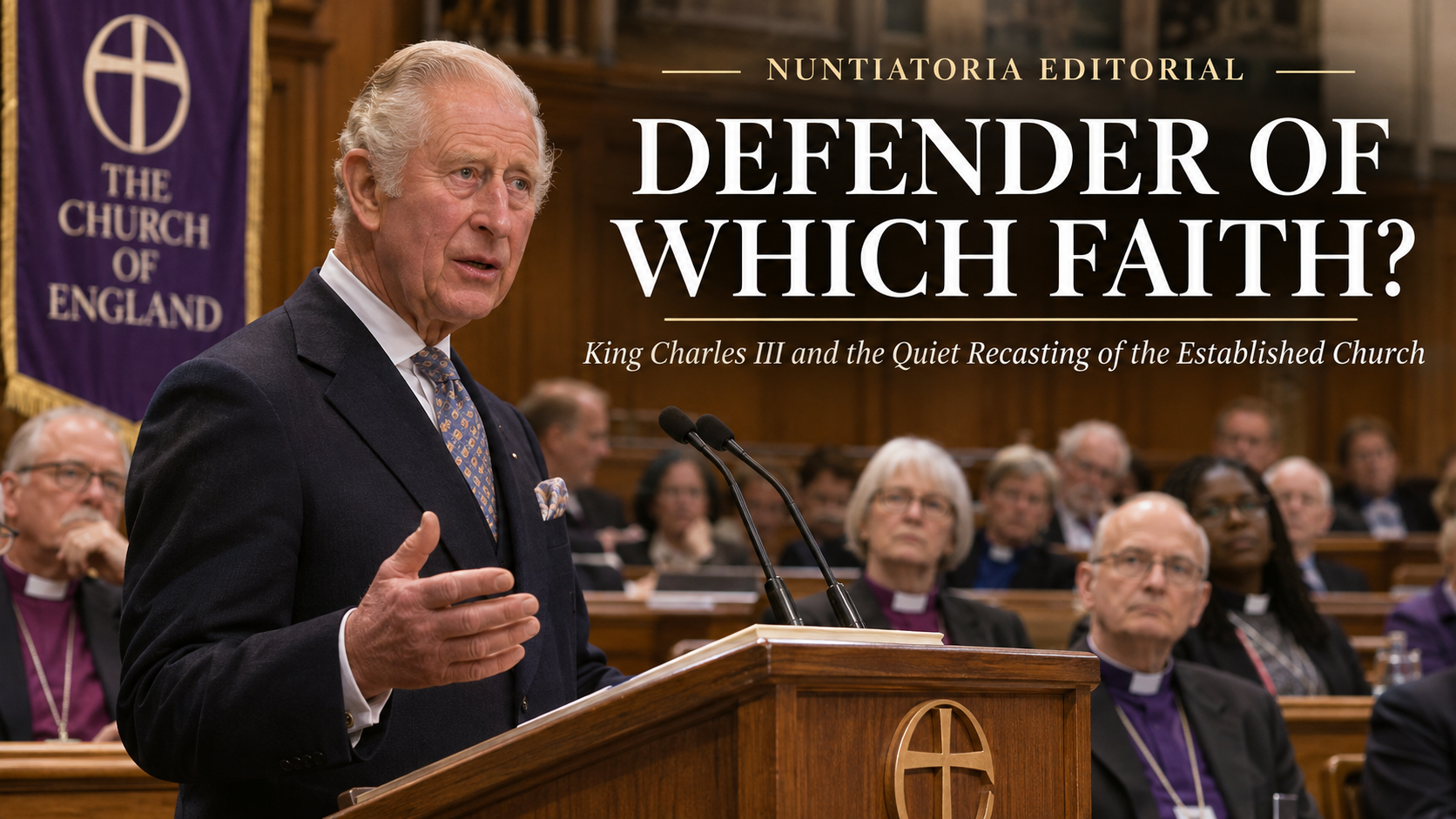
King Charles III and the Quiet Recasting of the Established Church
When King Charles III addressed the newly inaugurated General Synod of the Church of England on 17 November, he offered a description of the established Church’s purpose which deserves rather closer examination than the customary expressions of royal goodwill. The Church, he declared, protects “the very space for Faith itself – of every belief” within British society. He went on to describe Anglican Christianity as providing the conditions in which other religions “might flourish”.¹
There is nothing particularly surprising about a constitutional monarch defending the religious liberties of his subjects. Indeed, the sovereign of a country containing Christians, Muslims, Jews, Hindus, Sikhs, adherents of other religions and those professing none has an obvious obligation to uphold their lawful freedoms. The difficulty arises when that responsibility is transferred from the Crown to the Church of which the sovereign is Supreme Governor, and the purpose of a specifically Christian institution begins to be expressed in terms of the flourishing of religion generally.
The distinction matters because Christianity is founded upon definite claims concerning God, revelation, redemption and the means of salvation. Those claims cannot simply be accommodated within a general affirmation of religious belief without raising questions about their exclusive character. If Christ is indeed the Incarnate Son of God, the definitive revelation of the Father and the Saviour of mankind, Christianity possesses a significance which cannot be adequately described by its contribution to social harmony. Other religions may contain truths, encourage virtue and contribute positively to civic life. Their doctrines nevertheless differ, sometimes irreconcilably, from the Christian Faith.
Charles’s remarks become more revealing when examined against his own earlier statements. They belong to a developing understanding of the relationship between monarchy, religious belief and the established Church which began to attract public attention more than thirty years ago.
In 1994, during an ITV documentary presented by Jonathan Dimbleby, the then Prince of Wales expressed his preference for being regarded as “Defender of Faith, not the faith”. Explaining his position, he suggested that adherents of different religions were “all actually aiming for the same ultimate goal”.² The controversy at the time understandably concentrated upon the constitutional implications of altering the sovereign’s historic title. Yet the theological proposition underlying his remarks was considerably more interesting.
What exactly did he understand that common goal to be?
If he meant that human beings, whatever their religious convictions, possess a natural desire for God and seek answers to the fundamental questions of human existence, a Catholic theologian could recognise something true in the observation. The religious impulse is not peculiar to Christianity, and the natural knowledge of God belongs to the traditional Christian understanding of human reason.
But if the suggestion was that different religions, notwithstanding their contradictory accounts of God and salvation, provide equally valid means of reaching the same supernatural end, a very different proposition emerges. That understanding would fall within the religious indifferentism consistently rejected by Catholic doctrine. It would also sit uneasily with the historic formularies of the Church of England itself.
Charles subsequently qualified his position. In a BBC interview in February 2015, he explained that his intention had been to recognise the freedom of others to practise their religion while retaining his own responsibilities as Defender of the Faith. He considered it possible to be a defender of the established religion while also acting as a protector of other faiths.³ The clarification was important, and should not be disregarded simply because the earlier formulation lends itself more readily to criticism.
Nevertheless, the underlying conception of the established Church as a protector of religious pluralism remained.
Upon his accession in September 2022, Charles described himself to religious leaders as a committed Anglican Christian. He acknowledged his constitutional obligations towards the Church of England while identifying an additional responsibility to safeguard the religious diversity of the nation. This protection of religious space, he explained, arose both from his position as sovereign and from his personal Christian convictions.⁴
Today’s address brings that conception directly into the proceedings of the Church of England’s governing assembly. The King was no longer speaking merely about his responsibilities towards citizens of different religions. He was describing the established Church’s own contribution to the religious character of the nation.
It would be inaccurate, however, to present this development as a radical departure from the position of Elizabeth II. At Lambeth Palace on 15 February 2012, the late Queen expressly declared that the Church of England possessed a duty to protect the free practice of all faiths. She spoke of the established Church creating an environment in which other religious communities and those professing no faith could live freely.⁵ Her address to the General Synod in November 2015 likewise praised cooperation with people of other religions and none, while retaining a more explicit reference to the Church’s responsibility for spreading God’s word.⁶
The present King’s position therefore has a constitutional pedigree extending beyond his own reign. What distinguishes it is the theological language with which he has defended the idea, particularly his suggestion in 1994 that different religions share an ultimate destination.
There is a considerable difference between recognising that religious communities may contribute to a peaceful and prosperous nation and understanding religion itself as a collection of substantially equivalent approaches to the divine. The first is an ordinary observation about civil society. The second concerns the truth of revelation.
It is here that the history of the royal title provides an irony which ought not to be overlooked.
Fidei Defensor was conferred upon Henry VIII by Pope Leo X on 11 October 1521, in recognition of the King’s defence of Catholic doctrine against Martin Luther. The work which occasioned the honour, the Assertio Septem Sacramentorum, defended the seven sacraments and the authority of the Papacy. Whatever assistance Henry received in its composition, the title was bestowed in recognition of a defence of identifiable theological propositions.⁷
The subsequent history is familiar enough. Henry repudiated papal jurisdiction, assumed supremacy over the Church in England and established the foundations of the religious settlement which his successors would inherit. The title survived the repudiation of the authority which had originally bestowed it.
There is consequently something almost characteristically English about the modern sovereign retaining a title granted by a pope for defending Catholic orthodoxy while serving as Supreme Governor of an ecclesiastical establishment created through the Crown’s rupture with Rome. The history is complicated, certainly, but its complications do not justify treating the original purpose of the title as though it were merely the encouragement of religious sentiment.
At his coronation on 6 May 2023, Charles undertook to preserve the Church of England’s established settlement, including its doctrine, worship, discipline and government.⁸ That oath does not transform the King into an ecclesiastical theologian, nor does it require him to adjudicate every doctrinal controversy presently dividing Anglicanism. It does, however, confirm that the relationship between Crown and Church concerns a particular religious institution possessing an identifiable doctrinal inheritance.
That inheritance is rather less accommodating towards religious indifferentism than the modern vocabulary of interfaith harmony might suggest.
Article XVIII of the Thirty-Nine Articles, entitled Of obtaining eternal Salvation only by the Name of Christ, expressly rejects the proposition that salvation may be obtained through adherence to any religion whatsoever. Its concluding assertion is unequivocal: Scripture presents “only the Name of Jesus Christ, whereby men must be saved”.⁹
Catholics have substantial objections to the theology of the Thirty-Nine Articles, including their treatment of the sacraments, ecclesiastical authority and justification. Their significance in the present discussion lies elsewhere. They demonstrate that the Church of England’s historic confession of faith was never founded upon the idea that all religions are alternative expressions of an essentially common truth.
The question facing contemporary Anglicanism is therefore an internal one before it becomes a controversy with Catholicism. How does a Church whose historic formularies make definite claims about salvation through Christ reconcile those claims with a public role increasingly described through the protection and encouragement of religious pluralism?
The answer cannot be supplied simply by invoking tolerance.
Catholic doctrine distinguishes between the dignity of the human person, the rights of conscience, the legitimate requirements of civil society and the truth or falsity of particular religious propositions. Confusing these categories produces difficulties which neither goodwill nor constitutional courtesy can resolve.
Pope Benedict XVI expressed the distinction with characteristic precision in Caritas in Veritate (2009), where he rejected the assumption that religious freedom entails the equal theological validity of different religions.¹⁰ The Second Vatican Council’s declaration Dignitatis Humanae likewise grounded religious liberty in the dignity of the human person and the immunity from coercion properly owed to conscience, while expressly maintaining the obligation of individuals and societies towards religious truth.¹¹
The Congregation for the Doctrine of the Faith returned to the point in its 2002 Doctrinal Note on Some Questions Regarding the Participation of Catholics in Political Life, distinguishing the right to religious freedom from any supposed equality among religions as systems of belief.¹² The declaration Dominus Iesus (2000) had already addressed the theological danger arising when the uniqueness and universal salvific mediation of Jesus Christ are obscured by theories treating religious traditions as substantially equivalent paths to God.¹³
These distinctions are particularly important because they enable Catholics to defend the religious liberties of their fellow citizens without surrendering the truth claims of their own Faith.
A Catholic may defend the right of a Muslim to worship according to his conscience while maintaining that Islam is mistaken concerning the divinity of Jesus Christ. He may oppose antisemitism without denying that Christianity professes the fulfilment of the Old Testament revelation in the Messiah. He may work alongside Hindus, Sikhs, Jews, Protestants or those without religious belief in charitable and civic enterprises without suggesting that their theological disagreements have somehow ceased to matter.
Such cooperation is entirely intelligible within Catholic moral teaching. Indeed, the obligations of justice and charity require Christians to recognise the human dignity of those with whom they disagree.
What those obligations cannot require is the suspension of the Church’s missionary purpose.
This distinction has informed earlier Nuntiatoria examinations of religious liberty and evangelisation. In The Gospel Is Not Hostility, published on 16 October, we considered the increasing tendency to regard the public assertion of exclusive religious claims as potentially offensive to those whose convictions they contradict. The danger is that Christianity becomes acceptable principally insofar as its adherents refrain from pressing the implications of their beliefs upon others.¹⁴
More recently, our examination of Christian patriotism and Britain’s religious inheritance addressed the legitimacy of cooperation between Catholics and Protestants in preserving the Christian character of national life. Such cooperation need involve neither a denial of the Reformation’s theological consequences nor an abandonment of the duty to seek Christian unity in the truth.¹⁵
The same reasoning applies to the Crown’s proper protection of religious liberty. The sovereign may discharge that duty without requiring the established Church to understand its mission primarily through the religious diversity of the society surrounding it.
Indeed, one might reasonably ask whether the stronger defence of religious freedom is one which permits religious communities to acknowledge their profound disagreements openly, rather than encouraging them to speak as though their principal differences were merely cultural.
A genuinely plural society must be able to accommodate exclusive truth claims. Otherwise the freedom it extends to religious communities becomes conditional upon their willingness to conform their public language to an essentially relativist conception of belief.
The difficulties become clearer when we consider what the King actually said about Christianity itself.
His address was by no means devoid of Christian profession. He spoke personally of his baptism and confirmation, of a faith which had deepened throughout his life, and of following the teaching of Our Lord Jesus Christ. He expressed concern for persecuted Christian communities, particularly those of the Middle East. Referring to his meeting with Pope Leo XIV and his reception of the Ecumenical Patriarch Bartholomew, he suggested that closer relations between Christian traditions could assist in bringing Christ’s message of salvation to the world.¹
These passages are substantial enough to prevent any responsible commentator from presenting the address as an explicit rejection of Christianity’s salvific claims. They also suggest that Charles continues to understand his own religious identity in recognisably Christian terms.
Yet their presence makes the surrounding language more worthy of investigation. Having professed allegiance to Christ and acknowledged the importance of communicating His saving message, the King proceeded to explain the established Church’s contribution to the nation through the language of social cohesion and the flourishing of other religions.
The distinction between the two purposes was left unexplored.
There may be a perfectly coherent argument for saying that a Christian society, precisely because it recognises the dignity of the human person and the moral limits of coercion, ought to protect the lawful worship of those who reject Christianity. That argument would not require the Church of England to relinquish its distinctive confession. It would simply acknowledge the responsibilities of public authority and the social consequences of Christian moral principles.
But the King’s description goes further by placing the established Church itself at the centre of the protection of religious belief generally. The Church is presented as the institutional custodian of a religiously diverse national settlement.
One may wonder whether this understanding is becoming more attractive precisely because the religious authority of the establishment has diminished.
For much of its history, the Church of England could assume that its privileged constitutional position reflected the established religious identity of the nation. That assumption is increasingly difficult to sustain in a society where Christian affiliation has declined, religious practice is limited and substantial sections of the population no longer regard Anglicanism as possessing any particular authority over national life.
The establishment consequently faces an awkward question about its continuing purpose. If it cannot plausibly claim to express the religious convictions of most English people, upon what grounds does its privileged position remain justified?
The answer increasingly offered is that it serves everybody.
There is considerable truth in the observation that Anglican parishes, schools, chaplaincies and charitable institutions serve people irrespective of their personal beliefs. Their contribution to the common good deserves acknowledgement. Yet the fact that a Christian institution serves those outside its communion does not explain why its specifically Christian identity ought to command public recognition.
A parish church may offer assistance to every resident without distinction. Its religious purpose nevertheless remains bound to worship, preaching, pastoral care and the communication of Christian belief. These responsibilities do not disappear because the parish also provides a food bank, hosts community activities or maintains a historic building.
Our recent examinations of Church of England finances and administration have repeatedly encountered this problem. Institutional activity, however extensive, cannot itself demonstrate the vitality of religious life. Nor can appeals to evangelisation compensate for uncertainty about what is actually being proclaimed.¹⁶
The present royal address touches the same difficulty from another direction. The established Church is praised for sustaining the social conditions in which religion may flourish, while its obligation to proclaim definite truths risks becoming one contribution among others to the broader management of religious diversity.
Archbishop Sarah Mullally’s own welcome to the King emphasised the Christian presence of the Church of England in local communities and its Gospel calling.¹⁷ Those expressions preserve a more explicitly missionary account of Anglican identity. Nevertheless, the relationship between that calling and the King’s conception of the establishment as protector of religious pluralism remains unresolved.
Perhaps the difficulty is especially apparent from a Catholic perspective because Catholics possess an unusually intimate acquaintance with the history of the English religious settlement.
The established Church acquired its position through events which involved the rejection of papal jurisdiction, the appropriation of ecclesiastical institutions and the persecution of Catholics who refused to acknowledge the Crown’s spiritual supremacy. The English martyrs understood the distinction between their lawful obligations to the sovereign and their duties towards the Catholic Faith, even when the government of the day refused to recognise it.
Their witness established a principle which remains pertinent to the present discussion: civil loyalty cannot require religious indifferentism.
There is no reason to suppose that Charles wishes to revive the confessional coercion of the Tudor state, and every reason to welcome the religious liberties now enjoyed by Catholics and other communities. Yet the correction of historic injustices does not require the abandonment of theological distinctions. Britain can recognise the rights of those outside its established religion without pretending that all religions teach substantially the same thing.
The more fundamental concern is that Christianity itself may gradually be redefined in public life according to the social advantages it provides rather than the truth it professes.
There is a place for discussing the contribution of religion to social cohesion. Governments must consider such matters. Religious organisations, too, have legitimate responsibilities towards the common good. But Christianity cannot finally be justified by reference to its usefulness to the state. The Gospel was neither revealed nor entrusted to the Apostles because it might assist successive governments in maintaining agreeable relations between religious communities.
Its claims concern the eternal destiny of mankind.
King Charles’s address does not establish that he personally believes all religions to be equally true. His explicit Christian profession and his clarification of the 1994 controversy weigh against so simple a judgement. Nevertheless, the development of his public language, and the precedent established by Elizabeth II, reveal a conception of the established Church in which its distinctive religious claims are increasingly accompanied by a broader responsibility for the preservation of faith as a general social phenomenon.
The danger is that this secondary responsibility gradually becomes the principal justification for the institution’s existence.
The Church of England must determine for itself how its constitutional position relates to its historic doctrine and contemporary mission. Catholics need have no difficulty defending the religious liberties of every subject of the Crown, including those whose beliefs we regard as profoundly mistaken. Our own history supplies ample reason to insist upon those protections.
But if the Defender of the Faith increasingly describes the Church he governs as the guardian of faiths generally, a serious question remains. Does the established Church still understand the Christian revelation as a truth to which the nation is summoned, or has it become chiefly the historic institution through which the nation makes room for everybody else’s religious convictions?
The two purposes can coexist within a properly ordered understanding of religious liberty. They cannot be treated as interchangeable. The future of the establishment may depend rather more upon whether its leaders recognise that distinction than upon the continuing presence of bishops in the House of Lords or the maintenance of the royal title.
¹ The Royal Family, A Speech by The King at the Inauguration Ceremony for the 12th General Synod, 17 November 2026.
² David Tollerton, University of Exeter, Coronation 2023: The Coronation, the Church of England, and the Awkwardness of ‘Defending the Faith’, 4 May 2023; The Christian Science Monitor, Charles’s Comments Shake Britain’s Anglican Church, 6 July 1994.
³ The Guardian, Prince Charles Expresses Alarm About Radicalisation in Britain, 8 February 2015.
⁴ The Royal Family, The King’s Remarks to Faith Leaders, 16 September 2022.
⁵ The Royal Family, A Speech by The Queen at Lambeth Palace, 15 February 2012.
⁶ The Royal Family, A Speech by The Queen at the Inauguration of the General Synod, 24 November 2015.
⁷ British Library, Defender of the Faith; British Library Archives, Bull of Pope Leo X Conferring the Title Fidei Defensor, Cotton MS Vitellius B IV/1.
⁸ The Royal Family, The Coronation: History and Ceremonial.
⁹ Church of England, Articles of Religion, Article XVIII.
¹⁰ Benedict XVI, Caritas in Veritate, §55, 29 June 2009.
¹¹ Second Vatican Council, Dignitatis Humanae, §§1–2, 7 December 1965.
¹² Congregation for the Doctrine of the Faith, Doctrinal Note on Some Questions Regarding the Participation of Catholics in Political Life, §8, 24 November 2002.
¹³ Congregation for the Doctrine of the Faith, Dominus Iesus, §§4–6, 13–15, 6 August 2000.
¹⁴ Nuntiatoria, The Gospel Is Not Hostility, 16 October 2026.
¹⁵ Nuntiatoria, Christian Patriotism: A Catholic Case for Britain’s Christian Heritage, 13 November 2026.
¹⁶ Nuntiatoria, Bishop North’s Defence: Are Church Resources Truly Justified?, 2 November 2026.
¹⁷ Archbishop of Canterbury, Inauguration Speech to General Synod, 17 November 2026.





Leave a Reply