
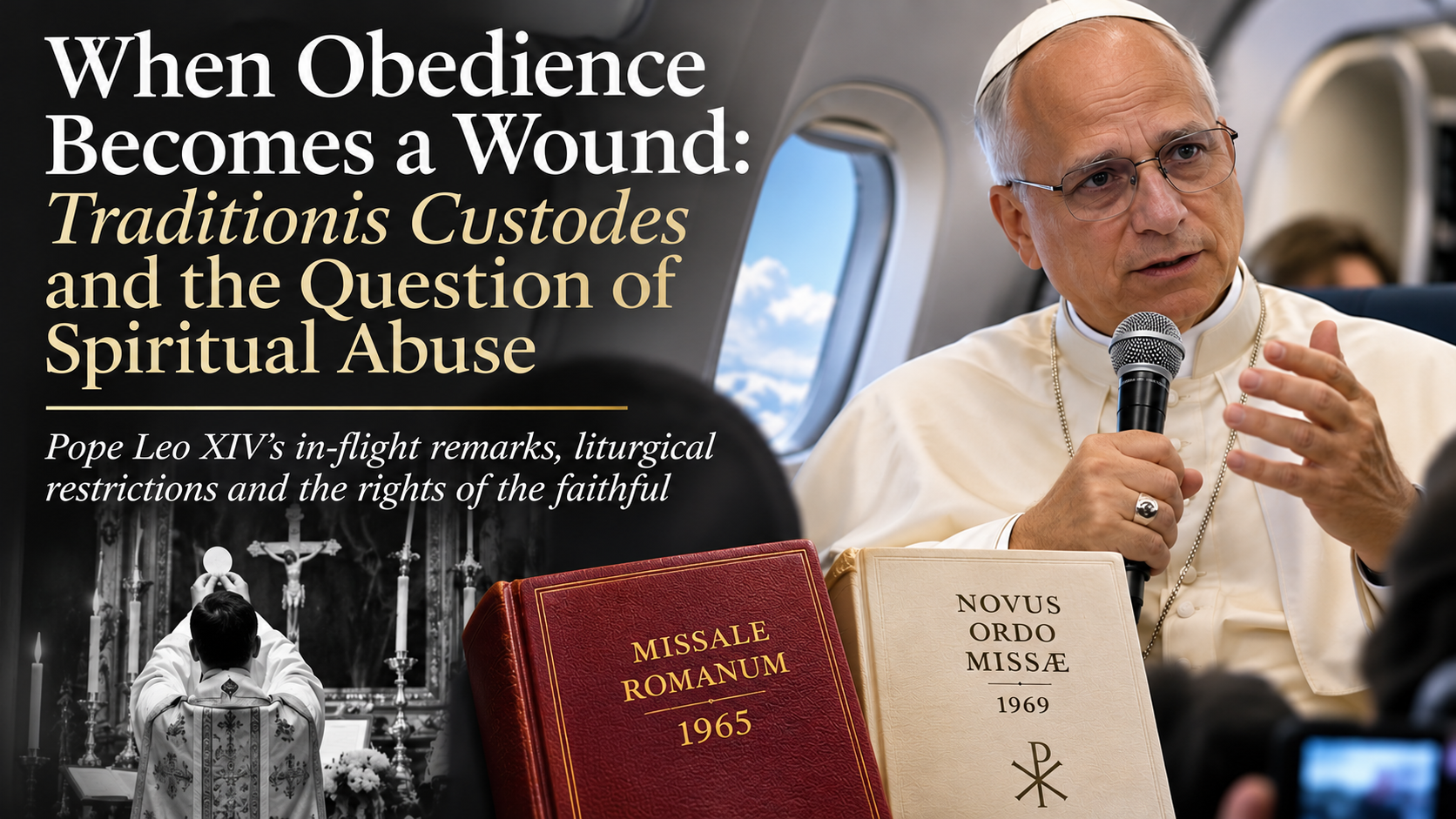
Pope Leo XIV has acknowledged the dangers of spiritual abuse while confirming that restrictions upon the traditional Roman Mass will continue. His description of the reformed liturgy as the “rite of Vatican II” introduces a remarkable historical irony into a controversy in which Catholics are increasingly suspected of disloyalty for cherishing forms of worship that the Council itself never ordered to be abandoned.
There was an uncomfortable conjunction in Pope Leo XIV’s press conference aboard the aircraft returning from Peru on 16 November. Jean-Marie Guénois of Le Figaro asked whether the Holy See was preparing legislation concerning spiritual abuse and whether the Pope intended to relax Traditionis Custodes, the restrictions imposed by Francis upon the traditional Roman Mass. Leo acknowledged the seriousness of spiritual abuse and the difficulty of defining it adequately in canon law. He then confirmed that Francis’s decision would continue to be followed.¹ The Pope was answering two distinct questions, and there is no suggestion that he intended to connect them. Their appearance together nevertheless invites an examination which the Church’s growing concern about spiritual abuse makes difficult to avoid. If religious authority can be exercised in ways that injure the spiritual welfare of those entrusted to it, what account should be taken of the consequences when ecclesiastical authority withdraws established forms of Catholic worship, disperses communities and treats attachment to an inherited liturgy as grounds for suspicion?
The distinction between spiritual injury and spiritual abuse must be preserved. The latter, as the expression is increasingly employed in discussions of canonical reform, generally concerns the exploitation of religious authority through manipulation of conscience, coercion or improper control. Its precise juridical treatment remains under consideration. A disciplinary decision does not constitute such an offence merely because it is unwelcome, or because those affected experience genuine distress. Nevertheless, ecclesiastical authority is subject to moral obligations extending beyond the demonstration of legal competence. A decision may be lawful and still be imprudent, disproportionate or pastorally injurious. Jurisdiction establishes who possesses the authority to act; it does not establish that every particular exercise of that authority serves the good of souls. The difficulty becomes particularly acute when those affected have conscientiously followed arrangements previously authorised and commended by the Church herself.
In 2007, Benedict XVI promulgated Summorum Pontificum, establishing a more generous juridical settlement for the celebration of Mass according to the Roman Missal of 1962. His accompanying letter recognised the spiritual value of the older Roman liturgy and acknowledged that Catholics attached to it could remain entirely faithful to the Pope, their bishops and the authority of the Second Vatican Council.² He was particularly attentive to younger generations who had discovered the traditional Mass without possessing any personal memory of the Church before the Council. Their attachment could not reasonably be dismissed as nostalgia for a vanished ecclesiastical culture, nor could it automatically be interpreted as an expression of hostility towards the Church’s legitimate authority. Benedict sought reconciliation and liturgical peace, recognising that an inheritance which had nourished the Church for centuries could not suddenly be regarded as spiritually harmful merely because a different form had subsequently become normative.
His judgement had practical consequences. Established communities gained greater security, new groups developed, and families organised their religious lives around celebrations authorised by the Church. Priestly and religious vocations emerged within that environment, whilst Catholics who had previously encountered suspicion could understand their attachment to the older liturgy as compatible with full participation in the Church’s ordinary sacramental life. Fourteen years later, Francis reversed that settlement. Traditionis Custodes, promulgated on 16 July 2021, introduced restrictive authorisation, limited the places in which the older Mass could be celebrated and instructed bishops not to authorise the establishment of new groups. Subsequent measures further regulated the permissions available to diocesan bishops.³
Francis justified his decision by reference to a consultation undertaken among bishops in 2020. He considered that the permissions granted by his predecessors had been exploited by Catholics who rejected the liturgical reform and, in some cases, the authority of the Council itself. The restoration of ecclesiastical unity, he maintained, required a different disciplinary approach.⁴ That concern cannot simply be dismissed. Where Catholics reject legitimate ecclesiastical authority or deny the validity and legitimacy of sacramental rites authorised by the Church, their conduct requires correction. Yet the existence of such conduct among some traditionalists does not establish the culpability of everyone attached to the older Roman liturgy. A family which accepts the validity of the reformed Mass and remains in communion with its bishop does not become disobedient merely because it prefers the inherited form of worship. The general restrictions apply irrespective of whether misconduct has been established within the particular community affected, and the practical burdens consequently fall upon Catholics whose religious lives developed under permissions previously granted by the Holy See.
There is, however, a further historical difficulty, one which acquires particular significance from Leo XIV’s own words. Explaining his decision to maintain the restrictions, the Pope referred to the celebration followed by the overwhelming majority of Catholics as “the rite of Vatican II, of Paul VI”.¹ The expression is familiar, but historically imprecise in a way that matters considerably to the present controversy. The Novus Ordo Missae promulgated under Paul VI in 1969 was never celebrated, examined or approved in that form by the Fathers of the Second Vatican Council. It did not exist when they voted upon Sacrosanctum Concilium, and its subsequent promulgation cannot retrospectively be converted into a conciliar vote upon a liturgical text which the Fathers had never seen.
The Council’s Constitution on the Sacred Liturgy, promulgated on 4 December 1963, called for a careful revision of the inherited Roman Rite. It required that sound tradition be preserved, that legitimate developments should grow organically from existing forms, and that innovations should occur only when the good of the Church genuinely and certainly required them. Paragraph 23 made these conditions explicit. The Constitution retained Latin in the Latin rites, permitted an expanded but regulated use of vernacular languages, called for the faithful to retain the ability to sing or recite the relevant parts of the Ordinary in Latin, and accorded Gregorian chant pride of place in Roman worship. It envisaged simplification, clearer presentation of the rites, greater access to Scripture and fuller participation by the faithful.⁵ These were substantial provisions, and the Council Fathers plainly intended a genuine reform. But the Constitution did not promulgate a replacement Order of Mass, abolish the Roman Canon, command the abandonment of the traditional Offertory or require the disappearance of Latin from ordinary parish worship. Neither did it decree that the priest must henceforth celebrate facing the congregation.
These distinctions arise from the Council’s actual text and from the official measures taken immediately afterwards. Following the instruction Inter Oecumenici of 26 September 1964, a revised Ordo Missae was promulgated on 27 January 1965 and came into general use that March. It was an authoritative initial implementation of the Council’s liturgical instructions, introduced under Paul VI’s authority while the Council itself was still in session.⁶ As Nuntiatoria has previously demonstrated, the 1965 Order of Mass preserved the fundamental structure of the inherited Roman Rite. The traditional Offertory remained, the Roman Canon continued as the Eucharistic Prayer, the principal ceremonial framework was recognisable, and the priest’s orientation at the altar was not universally altered. Certain repetitions were suppressed, the prayers at the foot of the altar were abbreviated, the Last Gospel was omitted, provision was made for the Prayer of the Faithful, and vernacular readings and congregational responses received greater emphasis. The result was a Mass immediately recognisable as the traditional Roman liturgy, revised in accordance with the initial implementation of the Council’s provisions.
The 1965 Ordo Missae was not a wholly new typical edition of the Roman Missal, nor was it formally declared by the Council Fathers to represent the completed reform. Further revisions were already being considered, and the process continued through additional instructions and the work of the Consilium. Nevertheless, it provides direct historical evidence of what the first official application of Sacrosanctum Concilium actually produced. Four years later, the reform had travelled considerably further. Paul VI’s apostolic constitution Missale Romanum, dated 3 April 1969, promulgated a substantially revised Order of Mass, followed by the Roman Missal published in 1970. The reform introduced new Eucharistic Prayers alongside the Roman Canon, replaced the traditional Offertory prayers, extensively revised the lectionary and altered the ceremonial structure of the celebration.⁷
The new Missal was promulgated by legitimate papal authority and presented by Paul VI as the fulfilment of the Council’s liturgical reform. Its juridical legitimacy does not depend upon every feature having been expressly debated by the Council Fathers, who had not attempted to produce a complete revised Missal themselves. Yet the distinction between a reform authorised by the Pope following the Council and the prescriptions actually enacted by the Council remains historically indispensable. The Council Fathers approved Sacrosanctum Concilium. They did not approve the completed Novus Ordo Missae of 1969, and it is misleading to speak as though they had. Nuntiatoria examined this confusion in December 2025 in Whither the Mass of Vatican II? The Missal the Council Never Saw, returning to the matter on 1 November 2026 in The Council Said Preserve It. They Tore It Out. Both investigations distinguished the Council’s decrees, their initial implementation and the more extensive reforms which followed.⁸
The 1965 Mass remains the neglected historical evidence. It demonstrates that significant elements of the Council’s liturgical programme could be implemented while preserving the inherited Roman liturgy’s essential ceremonial structure and traditional sacrificial prayers. The later reform may be defended as a legitimate exercise of papal authority, but its particular provisions cannot all be attributed to commands expressly given by the Council. One may question whether the reform remained within the principles laid down by Sacrosanctum Concilium without denying the Council’s authority, and one may defend the reformed Missal without claiming that every subsequent alteration was specifically prescribed by the bishops assembled in Rome.
The irony becomes particularly acute when Catholics attached to the traditional Roman Mass are accused of resisting the Council precisely because they desire the preservation of elements which the Council itself did not command to be removed. A Catholic who wishes to retain the traditional Offertory is not thereby rejecting a conciliar decree abolishing it, for there was no such decree. A Catholic who values Latin or Gregorian chant is hardly resisting a Constitution which explicitly protected both. A Catholic who prefers the inherited ceremonial framework may question the necessity and extent of subsequent alterations without denying the legitimacy of the Council or the authority of the Pope who promulgated them. Such judgements remain open to historical and theological examination, and they are not necessarily correct in every particular. Their expression, however, does not establish the ecclesiastical infidelity sometimes imputed to traditionalist communities.
The difficulty is consequently more serious than a disagreement over rubrical preferences. The faithful are being asked to accept restrictions upon a liturgical inheritance whose substantial preservation was compatible with the Council’s initial programme of reform. Their continued attachment is sometimes regarded as evidence of resistance to a Council which never itself prescribed the comprehensive replacement of that inheritance. An appeal to Vatican II cannot settle the argument merely by invoking its authority. It remains necessary to demonstrate how particular restrictions serve the Church’s good, why an inherited form of Catholic worship must be subjected to exceptional treatment, and what evidence supports the assumption that attachment to it constitutes a danger to ecclesiastical communion.
Nuntiatoria has already documented the human consequences of that assumption. In Knoxville, Tennessee, established traditional Mass celebrations were withdrawn from ordinary parish life, with limited alternative provision continuing elsewhere. The communities concerned had worshipped according to permissions previously granted by the Church, and their religious attachment had not suddenly changed in character. The governing legislation had changed.⁹ At Chattanooga, Father J. David Carter warned against adopting a Protestant attitude towards ecclesiastical authority. His concern that Catholics should avoid separation from the hierarchy was legitimate, particularly where distressed parishioners might be tempted to seek alternatives outside regular diocesan provision. Yet the faithful concerned had been participating in the very ecclesiastical structures whose authority they were now exhorted to respect. Many had been obedient throughout, first under the permissions granted by Benedict XVI and then under the restrictions introduced by Francis. Their continued affection for the older Mass did not establish that they had ceased to accept ecclesiastical jurisdiction.
There is a danger in demanding something more than obedience: an outward assent to the wisdom of successive disciplinary decisions, even where those decisions substantially reverse one another. Catholic obedience requires compliance with legitimate authority within its proper sphere. It does not require the faithful to regard every prudential judgement of their superiors as the best possible decision, nor does it prohibit respectful criticism or petitions for reconsideration. Canon 212 expressly recognises the right, and sometimes the duty, of the faithful to make their needs and opinions known to their pastors, while preserving the respect owed to ecclesiastical authority and the integrity of faith and morals.¹⁰ The Church’s law therefore distinguishes obedience from unquestioning agreement, a distinction of considerable importance where the legislation concerned is disciplinary rather than doctrinal.
Traditionis Custodes regulates the authorised celebration of particular liturgical books. The withdrawal of permission does not, by itself, constitute a canonical penalty imposed upon an individual priest or congregation, and no finding of personal guilt is necessary for every application of its provisions. Yet its consequences may be experienced as punitive, particularly when a community loses a long-established celebration because of concerns attributed to the wider traditionalist movement rather than misconduct demonstrated within that community. A family may be obliged to travel considerable distances to attend its accustomed Mass, elderly parishioners may find alternatives impracticable, and communities built around stable sacramental provision may be dispersed. The transfer of a priest or appointment of a new bishop can place future provision in doubt. Such difficulties are not automatically evidence of unlawful conduct, but neither are they insignificant simply because they arise from the application of a general regulation.
The stated purpose of Traditionis Custodes was the preservation of ecclesiastical unity. That purpose deserves serious consideration, for the Church possesses an obligation to preserve communion in doctrine, sacramental life and government. A liturgical movement which cultivates rejection of lawful authority cannot claim immunity from correction merely by invoking the antiquity of its worship. But a general policy intended to remedy identifiable abuses invites examination of whether less burdensome measures could accomplish the same end. Those who deny the validity or legitimacy of authorised sacramental rites can be corrected directly. Priests who disregard lawful instructions may be subject to appropriate discipline, and communities which promote separation from the hierarchy can be investigated according to their actual conduct. It is less evident why Catholics against whom such conduct has not been established must experience the withdrawal of their accustomed liturgy.
Francis cited the findings of the 2020 consultation with bishops as the basis for his decision. The Holy See has not published a sufficiently detailed account of that consultation to permit independent assessment of the prevalence of the alleged abuses, their distribution across dioceses or the proportionality of the universal response. This does not establish that the evidence was inadequate, nor that confidential episcopal communications must be disclosed indiscriminately. It means that a significant part of the factual justification remains unavailable for public examination. Nor has a comprehensive public evaluation demonstrated that the restrictions have achieved their stated purpose. Whether they have reduced hostility towards ecclesiastical authority, strengthened the participation of traditional Catholics in diocesan life or restored communion where genuine divisions existed remains a matter requiring evidence.
Indeed, the possibility of an unintended consequence deserves attention. Catholics deprived of traditional liturgical provision within ordinary diocesan structures may seek assistance from communities operating outside them. The canonical circumstances of such organisations differ considerably and cannot be reduced to one judgement, but a policy intended to strengthen ecclesiastical communion must take seriously the possibility that its application could encourage the separation it seeks to prevent. Rome’s responsibility for maintaining ecclesiastical order is not disputed by raising this concern. The question is whether particular methods of securing that order are effective, and whether the faithful who have sought to remain within ordinary diocesan structures are being given sufficient reason and opportunity to do so.
It is against this background that Leo XIV’s acknowledgement of spiritual abuse assumes its significance. The Church must possess effective means of addressing coercion, manipulation of conscience and the exploitation of relationships founded upon spiritual trust. Yet moral scrutiny of ecclesiastical power cannot reasonably be confined to misconduct by individual spiritual directors or religious superiors. The juridical categories are distinct. A diocesan bishop exercising liturgical jurisdiction is not engaged in the same relationship as a confessor directing a penitent, and the Pope’s supreme authority over ecclesiastical discipline cannot simply be assimilated to personal coercion. Nevertheless, both forms of authority are entrusted for the spiritual good of those subject to them. Their lawful exercise does not dispense with prudence, justice or pastoral solicitude.
Canon 213 recognises the faithful’s right to receive assistance from the spiritual goods of the Church, especially the word of God and the sacraments. Canon 214 recognises their right to worship according to the prescriptions of their legitimately approved rite and to follow a form of spiritual life consonant with Catholic doctrine. These rights operate within the Church’s juridical order and do not create an unrestricted entitlement to every earlier edition of the Roman Missal.¹⁰ They do, however, establish that the spiritual welfare of the faithful has juridical significance. Canon 223 permits ecclesiastical authority to regulate the exercise of rights for the common good, whilst canon 1752 closes the Code by recalling that the salvation of souls must always be the supreme law. The latter is no convenient device for setting aside legislation whenever it becomes burdensome. It identifies the purpose towards which ecclesiastical law and its application must be directed.
This is precisely why the language of obedience requires care. A Catholic may accept the authority of the Pope to regulate the Roman liturgy while questioning whether a particular regulation is prudent. He may acknowledge the legitimacy of the reformed Missal while preferring the older form, and comply with restrictions while respectfully asking that they be reconsidered. None of these positions, considered in itself, constitutes schism. To represent attachment to traditional worship as evidence of disloyalty without examining the beliefs and conduct of those concerned risks converting a legitimate disciplinary question into an unjustified judgement upon conscience. The language of obedience may properly remind Catholics of their duties, but it may also be employed to discourage legitimate representations or imply that submission requires agreement with every administrative judgement. Such misuse deserves examination wherever it occurs, even where the conduct does not fall within a defined canonical offence of spiritual abuse.
There is an additional difficulty in the contemporary emphasis upon synodality. Traditional Catholics have repeatedly explained their spiritual needs, described the effects of restrictions and petitioned for continued access to their accustomed liturgy. Their testimony does not oblige ecclesiastical authority to grant every request, but a genuine commitment to listening ought to involve serious consideration of their circumstances and reasoned explanations for decisions affecting them. It is difficult to commend participation and consultation as essential features of contemporary ecclesiastical life whilst treating the concerns of one recognisable constituency principally as an obstacle to be overcome. The faithful are entitled to know whether their experiences have materially informed decisions or whether consultation has amounted merely to an opportunity to express objections before the previously determined policy proceeds.
In July, Cardinal Arthur Roche indicated that Leo XIV would maintain the existing restrictions. Nuntiatoria distinguished the Cardinal’s representation of papal intentions from a direct statement by the Pope himself.¹¹ That uncertainty has now largely been resolved. Leo XIV has publicly confirmed his intention to continue applying Traditionis Custodes. His remarks do not mean that every permission will be withdrawn, nor that no dispensations can be granted. They establish that the restrictive framework remains in place and that no general relaxation is presently contemplated. The question of its pastoral justification consequently remains open, and the Pope’s invocation of the “rite of Vatican II” makes the historical argument all the more pertinent.
The documentary chronology is straightforward. Sacrosanctum Concilium was promulgated in 1963. The revised Ordo Missae appeared in 1965, preserving the inherited Roman structure whilst implementing important elements of the Council’s reform. The substantially reconstructed Order of Mass followed in 1969. These were distinct events, undertaken at different stages of a developing programme. The last was authorised by Paul VI, but it cannot be attributed in every detail to decrees actually made by the Council Fathers. To question aspects of the subsequent reform is therefore not necessarily to question the authority of the Council, still less to repudiate the Catholic Faith. That distinction ought to be elementary in any serious examination of the present liturgical controversy.
Instead, Catholics attached to the older Roman Rite are frequently presented with a demand to accept the postconciliar reconstruction as though questioning its prudence necessarily entailed repudiating the Council itself. The argument mistakes the authority of a council for the historical identity of every subsequent measure carried out in its name. It also neglects the Church’s own earlier assessment of her liturgical inheritance. For generations, Catholics were formed through the traditional Roman Mass. Benedict XVI reaffirmed its continuing spiritual value and sought to secure its place within ecclesiastical life. Francis subsequently restricted its celebration, citing concerns about division, and Leo XIV has now confirmed that those restrictions will continue. The faithful who accepted the earlier assurances have not thereby committed an act of disobedience, nor does their attachment become doctrinally defective merely because the applicable disciplinary settlement has changed.
If that attachment is now regarded as requiring restriction for the common good, those exercising authority bear a responsibility to explain the necessity and proportionality of the measures employed. The explanation must address the spiritual consequences as well as the juridical competence under which decisions have been made. What demonstrable benefit has been secured by restricting established communities whose fidelity to the Church has not been shown to be defective? What evidence indicates that these measures have strengthened communion? How are the consequences for families, priests and congregations being assessed? And why should attachment to liturgical forms substantially preserved through the Council’s initial reforms be treated as an indication of resistance to the Council itself? These questions concern the exercise of ecclesiastical authority within the Church, and Catholics need not deny that authority in order to ask them.
This is the deeper significance of the conjunction in Leo XIV’s press conference. A hierarchy which acknowledges that religious authority may inflict spiritual injury should be prepared to examine the consequences of its own government with corresponding seriousness. Such examination need not begin with an accusation of canonical wrongdoing. It begins with the recognition that sacred authority remains accountable to the purpose for which it was instituted. The traditional Roman liturgy was sacred when the Church celebrated it for centuries. It remained sacred when Benedict XVI enlarged the permissions for its celebration. Nothing in the Council’s Constitution on the Sacred Liturgy declared it spiritually harmful or intrinsically incompatible with Catholic communion.
The faithful who continue to cherish it are entitled to ask why their spiritual lives must bear the burden of a policy directed against divisions for which they have not individually been shown responsible. They are also entitled to ask why attachment to the liturgical inheritance which the Council’s first reforms substantially preserved is now so readily associated with hostility towards that same Council. Their pastors may possess the authority to restrict the celebration of the older Missal, but the possession of that authority does not settle whether its exercise has served the good of the faithful entrusted to them.
The salvation of souls remains the supreme law of the Church. It is a principle which governs those who command no less than those who obey.
¹ Vatican News, Pope: Healing Is an Important Part of My Ministry, Overcoming Polarization, 17 November 2026
² Benedict XVI, Letter to the Bishops Accompanying Summorum Pontificum, 7 July 2007
³ Francis, Traditionis Custodes, 16 July 2021; Dicastery for Divine Worship, Rescriptum ex Audientia SS.mi, 20 February 2023
⁴ Francis, Letter to the Bishops Accompanying Traditionis Custodes, 16 July 2021
⁵ Second Vatican Council, Sacrosanctum Concilium, 4 December 1963
⁶ Sacred Congregation of Rites, Inter Oecumenici, 26 September 1964; Dicastery for Divine Worship, Notitiae, 1973, on the 27 January 1965 Ordo Missae
⁷ Paul VI, Missale Romanum, 3 April 1969
⁸ Nuntiatoria, Whither the Mass of Vatican II? The Missal the Council Never Saw, 12 December 2025; Nuntiatoria, The Council Said Preserve It. They Tore It Out, 1 November 2026
⁹ Nuntiatoria, The Communion Rome Demands and the Communion It Denies, 13 November 2026
¹⁰ Code of Canon Law, Canons 208–223; Code of Canon Law, Canon 1752
¹¹ Nuntiatoria, Cardinal Roche’s Disclosure: Traditionis Custodes, Écône and the Limits of Leo XIV’s Reconciliation, 31 July 2026





Leave a Reply