

Found Faithful at His Work
MASS Sacerdotes
EPISTLE Hebrews 7:23–27
GOSPEL St Matthew 24:42–47
HOMILIST Mt Revd Jerome Lloyd OSJV

In the Name of the Father, and of the Son, and of the Holy Ghost. Amen.
My dear brethren,
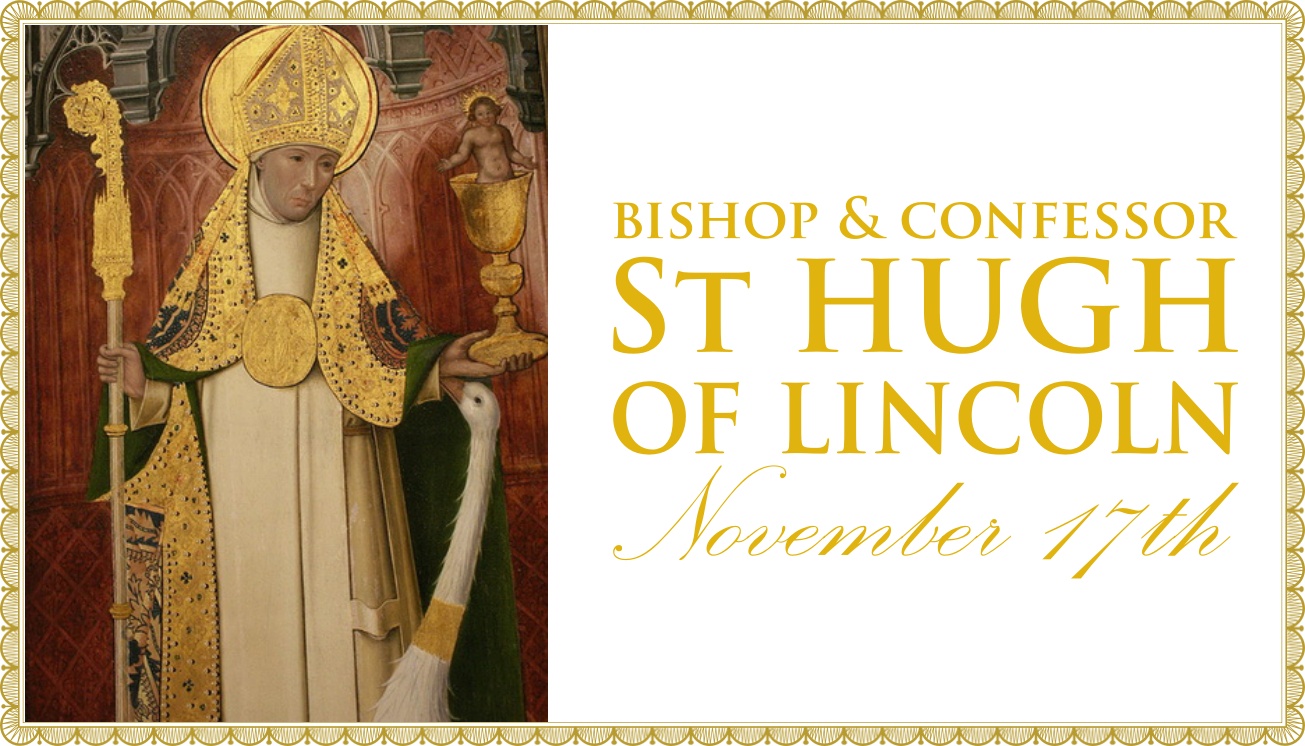
There is something rather wonderful about the fact that one of England’s most celebrated medieval bishops was a man who had never particularly wanted to become a bishop. St Hugh of Lincoln had chosen the Carthusian life, with its silence, solitude, prayer and penance. He had sought a life withdrawn from the affairs of the world, where he might attend principally to the salvation of his soul. Providence, however, had other ideas. The monk who desired the quiet of his cell found himself responsible for one of the largest dioceses in England, dealing with kings, clergy, quarrelsome officials and all the difficulties which accompany the government of souls.
It is worth considering that Hugh did not abandon his vocation to holiness when he accepted the episcopate. He was required to pursue it under different circumstances. The habits acquired in the monastery became the foundation of his pastoral ministry. His prayer sustained his activity, his discipline preserved his independence, and his detachment from worldly honours enabled him to confront men whose favour others were anxious to secure.
We often imagine that we should be better Christians if our circumstances were different. If we had more time, fewer responsibilities, less troublesome neighbours, or perhaps a more agreeable family, then surely we could give ourselves properly to God. Yet the circumstances in which Providence has placed us are ordinarily the very circumstances through which He intends our sanctification. Hugh discovered this when he exchanged the cloister for the episcopal household.
Today’s Epistle reminds us of the foundation of all priestly ministry. The priests of the Old Covenant succeeded one another because death prevented them from continuing. Christ, however, possesses an everlasting priesthood. He lives always to make intercession for us. His sacrifice is perfect, offered once upon Calvary, and made sacramentally present upon our altars.
Every Catholic priest exercises his ministry through participation in that one priesthood of Jesus Christ. Whatever his personal qualities, he has been entrusted with sacred duties which belong to Christ’s saving work. He must offer the Holy Sacrifice, administer the sacraments, teach the Faith and care for souls. His authority is therefore accompanied by a responsibility for which he must answer before God.
Hugh took that responsibility seriously. His diocese was extensive, and he travelled throughout it, visiting communities and attending to the needs of his people. He defended the rights of the Church against royal interference, yet his courage extended beyond ecclesiastical disputes. During the violence directed against Jewish communities in 1190, he intervened to protect those threatened. He recognised that injustice does not become permissible because its victims are unpopular.
His dealings with Henry II were equally instructive. Royal favour had assisted Hugh’s advancement, but it did not purchase his obedience in matters where conscience and ecclesiastical duty were concerned. He could disagree with a king without forgetting either courtesy or charity. There is a considerable difference between possessing courage and merely enjoying an argument, although the distinction is not always appreciated by those who make the most noise.
We commemorate today also St Hilda of Whitby, the great abbess of seventh-century Northumbria. The Venerable Bede tells us that five men formed within her religious community subsequently became bishops. Her monastery was a place of learning, prayer and disciplined Christian life, where those entrusted to her care were prepared for the service of God.
Hilda lived during a period when different ecclesiastical customs existed within the English Church. At the Synod of Whitby in 664, held at her monastery, the controversy concerning the calculation of Easter was resolved in favour of Roman usage. Hilda had supported the tradition received from the Irish missionaries. Yet the work of her community continued after the settlement. The episode reminds us that fidelity to the Church requires humility as well as conviction, and that questions of ecclesiastical discipline must be distinguished from the unchanging truths of divine revelation.
Bede records another beautiful incident concerning Hilda. A humble cowherd named Cædmon, previously unable to compose songs, received an extraordinary gift for sacred poetry. Hilda recognised that gift and encouraged its cultivation for the praise of God. She understood something which every parent, teacher and pastor ought to remember: those placed under our care are not simply to be governed. We must help them discover and use the gifts which God has given them.
Hugh and Hilda lived five centuries apart, yet both exercised authority as a responsibility towards others. Their example brings us directly to the Gospel, where Our Lord speaks of the faithful and wise servant appointed over his master’s household, to give its members their food in due season.
Notice what Our Lord praises. The servant is blessed because, when his master returns, he is found attending to the work entrusted to him. There is no mention of public recognition, exceptional achievements or the admiration of others. He has fulfilled his duty.
That should give us all something to consider. A father or mother has received the care of children whose souls are destined for eternity. Providing food, clothing and education is necessary, but Christian parenthood involves something more. Children must learn to pray, to distinguish right from wrong, to understand the commandments and to love Our Lord. They learn these things most effectively when they see the Faith practised faithfully at home.
Likewise, a priest cannot consider his duty discharged merely because the prescribed ceremonies have been performed. He must preach the truth, hear confessions, visit the sick and be attentive to those whose spiritual difficulties may never become publicly apparent. Sometimes charity requires consolation; sometimes it requires correction. The faithful steward must know how to give the household its food in due season.
There is a warning here against confusing religious activity with holiness. We may spend considerable time discussing the condition of the Church, the failings of ecclesiastical authorities or the errors of the modern world, while neglecting our own prayers, our duties towards our families, or the examination of conscience which would reveal faults rather closer to home.
The closing weeks of the ecclesiastical year bring us repeatedly to the judgement of God. Our Lord tells us to watch because we know neither the day nor the hour of His coming. St Hilda died in 680; St Hugh in 1200. Their earthly work came to an end, as ours certainly will. The question then will concern the fidelity with which we have answered the grace given to us.
We cannot answer that question confidently through our own strength. We need the grace of the sacraments, particularly confession and Holy Communion. We need the Holy Sacrifice of the Mass, where the eternal High Priest offers Himself to the Father. We need prayer, including those quiet moments when we cease telling God what ought to be done about everybody else and allow Him to show us what must be corrected in ourselves.
Let us ask St Hugh for courage in the performance of duty, and St Hilda for wisdom in the care of those entrusted to us. Above all, let us ask Our Lord for perseverance, that when He comes to call us from this world, He may find us faithfully attending to the work He has given us, and receive us into the joy of His everlasting kingdom.
In the Name of the Father, and of the Son, and of the Holy Ghost. Amen.




Leave a Reply