
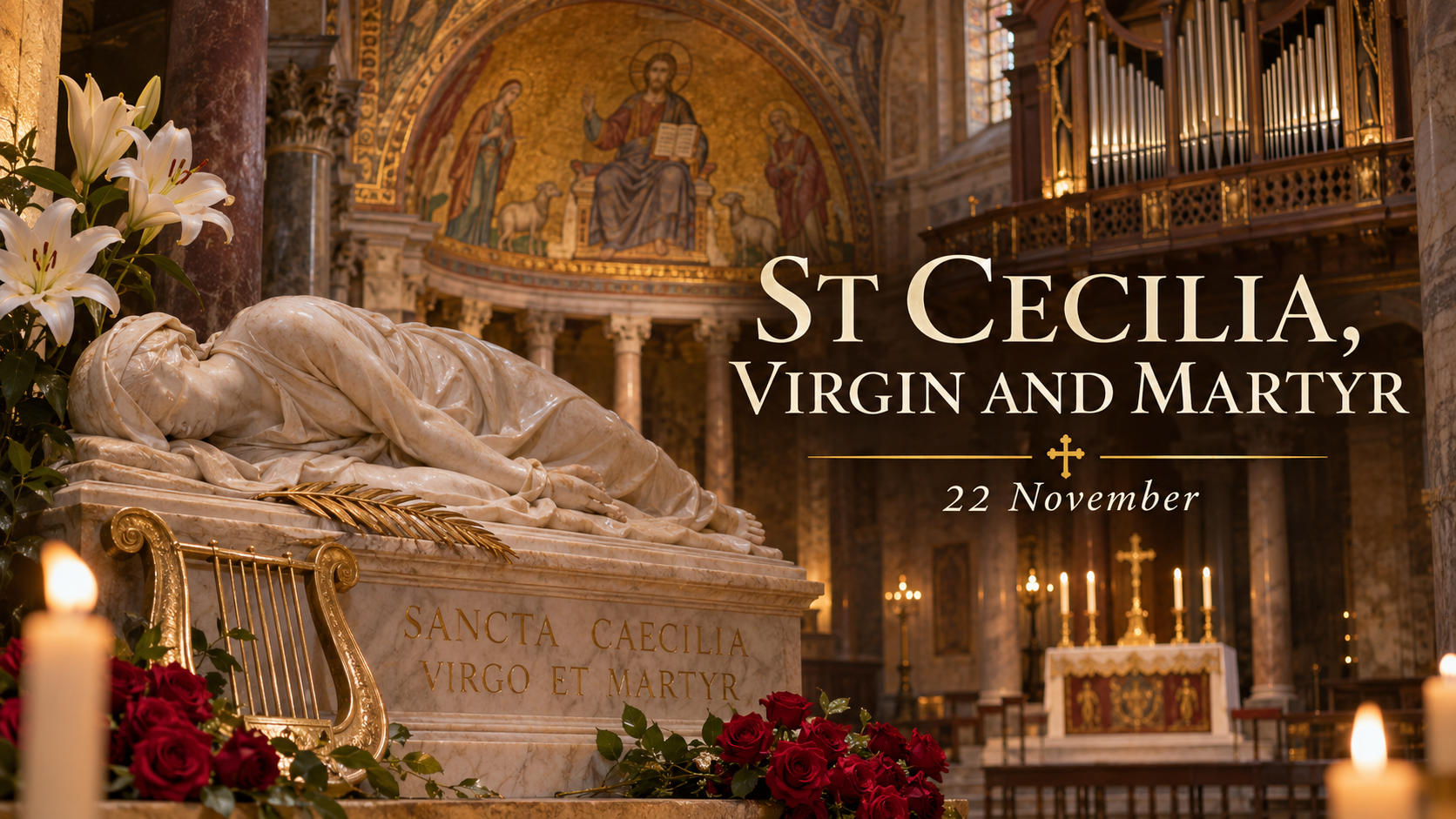
22 November | The Song of the Heart and the Crown of Martyrdom
The Roman Church has honoured St Cecilia for more than fifteen centuries, preserving her memory in the Canon of the Mass and among the ancient martyrs whose witness helped establish Christian Rome. Her familiar patronage of sacred music has sometimes obscured the more demanding character of her feast, which concerns consecrated virginity, fidelity under persecution and the readiness of the Christian soul to meet its divine Bridegroom.
THE MARTYR AND HER ROMAN HERITAGE
Every priest celebrating the traditional Roman Mass invokes St Cecilia during the Nobis quoque peccatoribus, that remarkable prayer in which the celebrant, acknowledging his own sinfulness, asks to be admitted into the company of the Apostles and Martyrs. Cecilia appears with Agnes, Agatha, Lucy, Anastasia and other saints whose names have been pronounced at Roman altars for centuries. Their commemoration belongs to the Church’s ancient liturgical inheritance, recalling the generations of Christians who endured persecution before Christianity emerged from the catacombs into the public life of the Empire.
Cecilia’s place among them is especially interesting because her liturgical commemoration has preserved more than the ordinary outline of a martyr’s cult. The Roman Church possesses an ancient titular church bearing her name, an established tradition concerning her burial, early Mass formularies composed in her honour, and a Passio whose narrative subsequently influenced Christian art, literature and sacred music throughout Europe. The historical evidence for her veneration is considerable, although the familiar account of her life cannot be reconstructed with anything approaching the same certainty.
The Passio Sanctae Caeciliae, generally assigned to the fifth or early sixth century, describes Cecilia as a young Roman woman of noble birth who had secretly consecrated her virginity to Christ. Her parents nevertheless arranged her marriage to Valerian, a pagan of patrician standing. During the wedding celebrations, while the musicians played and the guests rejoiced, Cecilia prayed within her heart that God would preserve her fidelity to the promise she had made.
On the evening of their marriage, according to the account, Cecilia disclosed her Christian faith to Valerian and explained that an angel protected her consecrated virginity. Valerian wished to see this heavenly guardian. She directed him to Urban, the Christian bishop who would instruct him in the faith and administer Baptism. After his conversion, Valerian returned to Cecilia and beheld an angel placing crowns of roses and lilies upon their heads, signs of their shared vocation and the heavenly grace bestowed upon them.
Valerian’s brother Tiburtius subsequently received the faith, and the two became involved in the burial of Christians who had suffered martyrdom. Their refusal to sacrifice to the pagan gods brought them before the Roman authorities. Both were condemned, while Maximus, an officer charged with their custody, was so affected by their witness that he too embraced Christianity and subsequently suffered martyrdom.
Cecilia’s own trial followed. The Passio recounts her interrogation by the prefect Almachius, whose threats of punishment are met with a confidence which the narrative attributes to her complete surrender to Christ. She is commanded to sacrifice to the gods and refuses. When reminded of the prefect’s authority over life and death, she observes that such power extends only to mortal things. Earthly magistrates may command the body, confiscate property and impose punishment. They possess no authority to alter divine revelation or compel the abandonment of Christian faith.
The narrative continues with an unsuccessful attempt to kill Cecilia by suffocation in a heated chamber. An executioner then strikes her neck three times without completing the beheading. The account explains that he was forbidden to attempt a fourth blow, and Cecilia remained alive for three days, during which she distributed her possessions among the poor and entrusted her house to the service of the Christian community. Having commended the faithful to Urban, she died from her wounds.
These details have been repeated in sermons, devotional books and the lessons of the Divine Office for many generations. They are drawn, however, from a literary account written centuries after the period in which Cecilia is traditionally supposed to have lived. The Passio contains recognisable features of late antique hagiography, including extended dialogues, elaborate conversions and dramatic interventions. Its author was concerned with presenting the martyr’s sanctity and the religious meaning of her death, rather than producing the kind of documentary account which a modern historian would expect from an eyewitness or contemporary court record.¹
Cecilia’s Roman cult is attested independently of these later embellishments. The Martyrologium Hieronymianum records a commemoration associated with her on 16 September, connected with the Via Appia and the cemetery of Callistus. By the fifth century, the Roman titulus Caeciliae was established in Trastevere, appearing among the churches represented at the Roman synod of 499. Beneath the present basilica remain substantial traces of an ancient Roman building complex, providing a material connection with the district in which her cult developed. The identification of these remains with every detail of the Passio is less secure than the existence of the ancient Christian sanctuary itself.
The collection of liturgical texts conventionally known as the Leonine Sacramentary contains five Mass formularies for Cecilia’s feast on 22 November. Blessed Ildefonso Schuster, in his Liber Sacramentorum, regarded their number and richness as evidence of the extraordinary honour accorded to her in early Christian Rome. He followed the traditional explanation that the September commemoration concerned her martyrdom, while 22 November marked an anniversary associated with the church in Trastevere. The precise origin of the November date remains open to historical discussion, but its antiquity as a Roman celebration is firmly established.²
An episode preserved in the Liber Pontificalis brings the feast into the troubled ecclesiastical politics of the sixth century. Pope Vigilius, whose pontificate was overshadowed by the controversy concerning the Three Chapters and the intervention of the Emperor Justinian, was seized by imperial agents at the church of St Cecilia on 22 November. The papal biography states that Vigilius was distributing gifts to the people when he was arrested and taken down to the Tiber, where a vessel awaited him. His removal formed part of the imperial intervention in the affairs of the Roman See.
Schuster, following the fuller liturgical tradition surrounding the incident, describes the faithful demanding that the pontiff be allowed to complete the blessing before his departure. The versions differ in their details, and the year assigned to the arrest has been disputed, with 538 and 545 appearing in historical treatments. The Liber Pontificalis establishes the association with Cecilia’s feast and her titular church, while the additional circumstances preserved by later authors require separate consideration.³
The importance of the episode lies also in the picture which it provides of Roman worship. The imperial authorities were concerned with the obedience of a pope who had become entangled in the theological and political ambitions of Constantinople. The Roman faithful were assembled for the anniversary of their martyr and expected the accustomed ceremonies to be completed. Even under the pressure of imperial intervention, the observance of Cecilia’s feast was recognised as belonging to the religious life of the city.
The history of her relics is equally instructive. The earliest Roman burial tradition associated Cecilia with the cemetery of Callistus on the Via Appia, near the crypt of the early Roman pontiffs. Pope Paschal I, undertaking the restoration of her basilica in Trastevere during the ninth century, sought the remains for translation to the church dedicated in her honour.
The account preserved in the Liber Pontificalis describes their discovery in the cemetery of Praetextatus, rather than in Callistus, where earlier tradition had placed her grave. Some historians have suggested that the relics had been moved between the cemeteries, possibly for their protection, although the circumstances cannot now be established with certainty. The translation to Trastevere is generally dated to 821–822, and Paschal’s reconstruction of the basilica belongs securely to his pontificate.⁴
The great apsidal mosaic still records his patronage. Cecilia appears in the company of Our Lord and the saints, while the pope himself is depicted presenting the restored sanctuary to Christ. The church has consequently preserved both the ancient cult of the martyr and the memory of a pontiff who devoted considerable resources to recovering and honouring the relics of Rome’s early Christians.
When Cardinal Paolo Emilio Sfondrati ordered further work in the basilica in 1599, the tomb was opened and an examination of the remains undertaken. Contemporary descriptions of their condition prompted considerable devotion, although later retellings sometimes go beyond what the surviving evidence can establish. Stefano Maderno’s celebrated marble sculpture, commissioned following the discovery, represents the saint lying upon her side, her face turned away and her body arranged in the posture traditionally associated with the opening of the tomb.
The sculptor’s work possesses an extraordinary restraint. Cecilia is represented neither as a triumphant classical heroine nor as a figure of exaggerated suffering. Her body rests in death beneath the altar where the Holy Sacrifice continues to be offered. The sculpture recalls the Christian conviction that the bodies of the saints, consecrated by Baptism and made temples of the Holy Ghost, await the resurrection promised by Christ.
Rome has preserved many monuments to the power of emperors and the ambitions of its great families. Cecilia’s church preserves the memory of a Christian woman whose precise earthly circumstances are imperfectly known, but whose name has survived in the daily prayer of the Roman Church. The continuity is all the more remarkable because the liturgy has perpetuated her memory without depending upon the historical authentication of every episode in her Passio.
THE MASS LOQUEBAR: SCRIPTURE AND THE WITNESS OF MARTYRDOM
The Introit of Cecilia’s Mass, Loquebar, is taken from Psalm 118:
Loquebar de testimoniis tuis in conspectu regum, et non confundebar: et meditabar in mandatis tuis, quae dilexi nimis.
I spoke of thy testimonies before kings, and I was not ashamed: and I meditated on thy commandments, which I loved exceedingly.
The Psalmist’s declaration of fidelity to the divine law becomes, in the Church’s liturgical application, the profession of a martyr standing before the authorities of the Roman Empire. Whatever words Cecilia may actually have spoken during her interrogation, the sacred text expresses the religious character of her witness. She belongs to that company of Christians who recognised an obligation towards Almighty God which no earthly ruler could legitimately set aside.
The first Christians were frequently accused of disloyalty because they refused the religious observances upon which Roman public life was understood to depend. Their willingness to obey legitimate civil authority did not extend to offering divine honours to the emperor or participating in sacrifices to pagan gods. The magistrates, accustomed to regarding public sacrifice as an elementary expression of civic obedience, encountered subjects who refused to comply even under sentence of death.
The martyr’s confession arose from the First Commandment. There could be no accommodation with idolatry, because the worship owed to God belonged to Him alone. Christian obedience to civil authority was therefore bounded by the prior obligation to obey the divine law.
The second half of the Introit places this public confession within the ordinary life of prayer. The Psalmist has meditated upon the commandments and loved them exceedingly. Fidelity during persecution cannot safely be separated from the formation of conscience which precedes it. The Christian who has learned to measure his conduct by God’s commandments, to examine his conscience and to seek grace through prayer and the sacraments, is being prepared for occasions when obedience may become difficult.
The Roman Office expresses this interior preparation in the antiphon describing Cecilia as continually carrying the Gospel of Christ in her heart and persevering in prayer. Public confession is sustained by habits cultivated when no hostile magistrate is present, and the duty to remain faithful has not yet exacted any visible sacrifice.
The Collect of the Mass asks:
Deus, qui nos annua beatae Caeciliae Virginis et Martyris tuae solemnitate laetificas: da, ut, quam veneramur officio, etiam piae conversationis sequamur exemplo.
O God, who dost gladden us by the annual solemnity of blessed Cecilia, thy Virgin and Martyr: grant that we may also follow in holy conduct the example of her whom we honour in our sacred observance.
The prayer expresses the customary purpose of the saints’ feasts in the Roman liturgy. Their victories are commemorated in thanksgiving to Almighty God, whose grace made their perseverance possible, while the faithful ask for the strength to imitate their virtues. The ceremonies of their feasts would be poorly understood if admiration for their heroism were allowed to become a substitute for the conversion of those who celebrate them.
The Epistle, Ecclesiasticus 51:13–17, introduces the language of deliverance:
Domine, Deus meus, exaltasti super terram habitationem meam, et pro morte defluente deprecata sum.
O Lord, my God, thou hast exalted my dwelling place upon the earth, and I prayed that death might pass away.
The passage describes a soul crying to God in tribulation and subsequently praising Him for deliverance. Its application to a martyr might initially appear perplexing. Cecilia’s earthly life was ended by violence. The persecutors accomplished the physical death which they intended.
Christian revelation has given death a meaning which cannot be understood solely through the immediate fate of the body. Our Lord’s Passion was followed by His glorious Resurrection, and the martyrs share in His victory through their faithful witness. They do not escape death as an event. They are delivered from its final dominion through the redemption accomplished by Christ.
Schuster applies the Epistle to Cecilia’s Roman sanctuary. The dwelling associated with her suffering is raised to the dignity of a place of divine worship. The body which her executioners sought to destroy becomes the object of reverent burial, while the faithful gather above her relics to offer the Holy Sacrifice. The development of her church in Trastevere furnished successive generations with a visible illustration of the Christian understanding of martyrdom. The apparent victory of the persecutor was temporary; the witness of the martyr endured.⁵
The Epistle’s thanksgiving also prevents the Christian doctrine of martyrdom from becoming an admiration of suffering for its own sake. The martyr does not desire the violence inflicted upon him. He desires fidelity to God, accepting the consequences rather than violating conscience. Death remains an evil in the natural order, yet the grace of Christ enables the faithful to endure it without surrendering the supernatural life bestowed upon them.
The corona martyrii, the crown of martyrdom, belongs to those who persevere in the charity of Christ, whose Passion and Resurrection have opened the way to eternal life. The martyr’s sacrifice derives its value from union with His, and the Church honours her martyrs as witnesses to the Redeemer whose grace sustained them.
The Gradual draws upon Psalm 44, the royal marriage psalm:
Audi, filia, et vide, et inclina aurem tuam: quia concupivit Rex speciem tuam.
Hearken, O daughter, and see, and incline thine ear: for the King hath greatly desired thy beauty.
The Psalm’s imagery of a royal bride was received by Christian tradition as speaking of Christ and His Church. It also supplied the language through which the Church expressed the consecrated virgin’s dedication to the divine Bridegroom. The soul is summoned to hear the voice of God and respond with an undivided heart.
St Ambrose developed this theology with particular richness in De Virginibus. For him, the consecration of virginity is intelligible through the mystery of the Incarnation and the Church’s relationship with Christ. Our Lady provides the supreme human example of virginity joined to perfect faith and obedience. The Christian virgin follows a particular vocation within the life of the Church, offering herself to Christ in anticipation of that heavenly condition in which men shall neither marry nor be given in marriage.⁶
Ambrose distinguished the evangelical counsel of virginity from pagan practices of ritual chastity. The mere observance of celibacy cannot explain the Christian vocation. Its meaning arises from the person to whom the consecration is directed, and from the charity which animates the offering.
Cecilia’s marriage to Valerian, as described in the Passio, belongs to this tradition. The narrative portrays a husband who, having received Baptism, willingly enters a common life of continence with his wife. It would be contrary to Catholic doctrine to infer that the obligations of marriage may be disregarded without mutual consent, or that the married state is inherently incompatible with Christian perfection.
St Thomas Aquinas addresses the matter with customary precision. Consecrated virginity possesses an objective excellence as a state ordered towards undivided dedication to God, while personal sanctity depends upon charity. A married Christian may therefore possess greater holiness and merit than one who has embraced virginity. The Church’s esteem for the evangelical counsels has never abolished her honour for Christian marriage or the sanctity attainable within it.⁷
THE WISE VIRGINS AND THE COMING OF THE BRIDEGROOM
The Gospel appointed for Cecilia’s feast, Matthew 25:1–13, recounts the parable of the ten virgins who go out to meet the bridegroom. Five bring sufficient oil for their lamps; the other five neglect this necessary preparation. While the bridegroom delays, all become weary and sleep. When the cry announces his arrival at midnight, the prudent virgins are ready to enter the marriage feast. The others discover that their lamps are failing, and by the time they return from seeking oil the door has been shut.
The parable is frequently associated with consecrated virginity because of its imagery, although Our Lord’s teaching concerns the readiness of all His disciples for the final coming of the Bridegroom. The virgins represent those who have been called to meet Him. Their possession of lamps indicates an outward preparation; the difference lies in the oil which some had prudently provided and others lacked.
St John Chrysostom’s exposition, preserved within the older tradition of the Roman Office for the feast, is particularly severe upon the assumption that virginity can compensate for a want of charity. He associates the lamps with the outward observance of virginity and the oil with the works of mercy. Those who have undertaken the considerable sacrifice of renouncing marriage may nevertheless find themselves spiritually unprepared if they have neglected their obligations towards the poor and suffering.⁸
Chrysostom had no desire to diminish the excellence of consecrated virginity. He was concerned with the danger of mistaking a particular ascetical achievement for the whole substance of Christian holiness. The Gospel presents five women who possess lamps and have gone out to meet the bridegroom, yet discover that something essential is lacking when the decisive moment arrives.
The traditional account of Cecilia’s life joins the obligations which Chrysostom insists must remain together. Her consecration is accompanied by concern for Valerian’s conversion, assistance to persecuted Christians and the distribution of her property among the poor. The virtue of chastity is represented within a life animated by charity.
Such teaching remains necessary wherever outward religious observance is taken as sufficient evidence of fidelity. A Christian may be exact in the performance of devotional exercises, knowledgeable concerning ceremonial and zealous for the preservation of Catholic practice, while neglecting duties of justice, charity and mercy which are no less binding upon the conscience. The Fathers repeatedly warned against the possibility of an impressive exterior religion concealing a heart insufficiently converted to God.
The wise virgins possess oil because they have attended to the demands of their calling before the bridegroom appears. The foolish have left their preparation until the moment when it can no longer be supplied. The final summons will expose the condition in which the soul has actually lived.
The Gospel acquires a particular character this year because Cecilia’s feast falls upon the Last Sunday after Pentecost. Under the earlier Roman calendar observed by the Old Roman Apostolate, the saint’s feast takes precedence, while the Sunday is commemorated. The Mass is Loquebar, with the Sunday Collect, Secret and Postcommunion added according to the rubrics, and the Sunday Gospel read as the proper Last Gospel.⁹
That Gospel, Matthew 24:15–35, records Our Lord’s prophecy concerning the tribulations associated with Jerusalem and the consummation of the age. The destruction of Jerusalem in AD 70 provides an essential historical context, while the Church has also understood the discourse in relation to the final judgement and the passing of the present world.
The parable of the wise virgins and the Gospel of the Last Sunday approach the same supernatural reality from different directions. The latter speaks of the judgement of God upon human history and the certainty of Christ’s divine word. The former concerns the readiness required of each soul when the Bridegroom comes.
The closing of the ecclesiastical year lends Cecilia’s commemoration a solemnity beyond the particular circumstances of her martyrdom. The Christian is reminded of the end towards which his earthly life is directed. His profession of faith, reception of the sacraments, duties towards his neighbour and perseverance in grace will all be brought before the judgement of Christ.
The Roman liturgy approaches Advent through these warnings because the expectation of the Redeemer’s coming cannot be separated from His promised return in glory. The first coming of Christ in humility and the final manifestation of His kingship belong to the same mystery of salvation. Cecilia’s Gospel urges the faithful to keep their lamps prepared while the appointed hour remains unknown.
CECILIA AND THE MUSIC OF DIVINE WORSHIP
Cecilia’s association with sacred music is so familiar that she is frequently represented holding an organ, seated among musicians or listening to the harmonies of heaven. Choirs and musical societies have invoked her patronage for centuries, and some of the finest works in the European sacred repertoire were composed in her honour.
The earliest substantial narrative of her life does not describe Cecilia as a professional musician or an organist. Her musical patronage developed through the reception of a passage describing the celebration of her wedding:
Cantantibus organis, illa in corde suo soli Domino decantabat.
While the instruments were sounding, she sang in her heart to the Lord alone.
The language is familiar from the liturgical tradition of her feast, although the wording of the Office antiphons underwent adaptation. In the original narrative, Cecilia’s response to the wedding music is interior prayer. She asks God to preserve her purity and fidelity amid the celebrations surrounding her marriage.
The development of her musical patronage can be followed through medieval liturgical texts, illuminated manuscripts and later Renaissance painting. By the fourteenth and fifteenth centuries, artists were increasingly representing her with instruments. During the Renaissance, the musical imagery became established throughout Europe, and Cecilia came to be invoked particularly by singers, composers and organists.
The Roman institution now known as the Accademia Nazionale di Santa Cecilia traces its antecedents to an association of musicians active in the 1570s. Its formal foundation occurred in May 1585, when Pope Sixtus V issued the bull Ratione congruit, establishing the Congregation of Musicians under the patronage of the Blessed Virgin Mary, St Gregory the Great and St Cecilia. The association united prominent Roman musicians, including composers connected with the tradition of Palestrina, and combined professional organisation with artistic and charitable purposes.¹⁰
The history of the Academy illustrates how firmly Cecilia’s musical patronage had become established by the late sixteenth century. The saint whose Passio described an act of silent prayer amid the sounds of a wedding celebration had become one of the recognised heavenly patrons of those engaged in the composition and performance of music.
The Church’s acceptance of her patronage is readily understood within the theology of sacred music, even though the familiar image of the saint playing an organ cannot be established as an event from her earthly life.
Music has formed part of Christian worship since apostolic times, drawing upon the Psalter and the inherited religious practices of Israel. The Roman Church developed her own traditions of liturgical chant, which received a more systematic organisation during the centuries associated with the Gregorian tradition. The liturgy’s musical expression was shaped by the sacred texts and the ceremonial action which those texts accompanied.
The words of the Psalms, the canticles of Scripture, the prayers of the Mass and the antiphons of the Office were not originally conceived as opportunities for independent musical display. They were prayers of the Church, directed towards Almighty God and ordered according to the character of the sacred rites.
St Augustine, whose reflections on sacred song remain among the most penetrating in Christian antiquity, insists that the praise of God must be expressed through the whole Christian life. His sermons concerning the canticum novum, the new song, join the worship of the lips to the conduct of the believer. A life formed by charity becomes itself an offering of praise. The voice may sing beautifully while the heart remains disordered; such a contradiction exposes a failure which musical accomplishment cannot repair.¹¹
Augustine’s own experience of sacred music was far from indifferent. In the ninth book of his Confessions, he remembers the tears which accompanied his hearing of the Church’s hymns during the period of his conversion. He also recognised, particularly in Book X, the possibility that pleasure in musical beauty could distract the worshipper from the sacred words and the realities which they expressed.
His treatment of the subject displays a theological seriousness sometimes absent from later arguments about liturgical music. Beauty moves the human soul, and music can assist prayer profoundly. The emotions which it awakens must nevertheless remain ordered towards the worship of God. A performance which excites admiration for the performers while leaving the sacred text subordinate to musical effect has departed from the proper purpose of the liturgy.
Pope St Pius X addressed these concerns in his motu proprio Tra le sollecitudini, promulgated on 22 November 1903, the feast of St Cecilia. The document sought to restore the dignity of sacred music and to correct practices which had allowed theatrical conventions and secular musical fashions to exercise excessive influence upon Catholic worship.
The pope identified holiness, excellence of form and universality among the essential qualities of sacred music. Gregorian chant occupied a privileged position as the chant proper to the Roman Church, while classical polyphony, particularly the tradition associated with Palestrina, was recognised for its capacity to serve the liturgical text with artistic excellence.¹²
Pius X understood sacred music as an integral part of solemn liturgical worship. Its dignity arose from its participation in the sacred action, and its proper character was therefore determined by the worship of God rather than by the prevailing tastes of composers or audiences.
The legislation was concerned with more than the selection of particular musical styles. It sought to preserve the distinction between the Church’s worship and forms of entertainment whose immediate purpose was the pleasure of those present. The liturgy possesses its own sacred order and purpose, within which music must find its place.
During the wedding festivities, the music sounds around Cecilia, yet the Passio describes her prayer as proceeding within the heart. The visible and audible ceremonies of worship are intended to express and assist an interior offering to God. Where that interior orientation has been lost, the excellence of the external performance cannot supply what is lacking.
The Church has encouraged the cultivation of sacred music precisely because the praise of Almighty God deserves the most fitting expression which human skill can provide. The great treasury of Gregorian chant and sacred polyphony is evidence of centuries of artistic labour placed at the service of the liturgy.
The same principle governs the architecture, vestments and ceremonial of traditional Catholic worship. Their dignity is derived from the mysteries which they serve. The Church has never regarded ugliness or disorder as desirable expressions of humility. She has likewise resisted the confusion of beauty with mere display.
Cecilia’s patronage recalls the disposition which must govern the whole endeavour. The voice, the instrument and the trained musician are placed at the service of a prayer whose ultimate object is God Himself.
THE MARTYR’S CROWN AND THE HOLY SACRIFICE
The Secret of Cecilia’s Mass expresses the relationship between the martyr’s sacrifice and the redemptive offering of Christ:
Haec hostia, Domine, placationis et laudis, quaesumus: ut, intercedente beata Caecilia Virgine et Martyre tua, nos propitiatione tua dignos semper efficiat.
May this sacrifice of propitiation and praise, we beseech thee, O Lord, through the intercession of blessed Cecilia, thy Virgin and Martyr, render us always worthy of thy merciful favour.
The Roman prayer speaks with characteristic precision. The Mass is a sacrifice of propitiation and praise, offered to Almighty God through the priestly ministry of Christ’s Church. Cecilia’s intercession is invoked within that offering, while the efficacy of redemption belongs to the Sacrifice of Calvary, made sacramentally present upon the altar.
St Thomas Aquinas, treating martyrdom in the Summa Theologiae, identifies its perfection with charity. The martyr suffers death in fidelity to divine truth, exercising the virtue of fortitude under the gravest natural trial. The outward endurance is made meritorious by the love of God which sustains it. The Christian martyr consequently bears witness to Christ, whose Passion and death constitute the supreme sacrifice of obedience and charity.¹³
The sufferings of Cecilia, understood through the Church’s traditional account, possess their proper theological significance through union with the Redeemer. Her death neither repeats nor supplements the work of redemption accomplished upon Calvary. The grace of Christ enabled her to persevere, and her witness manifests the power of that grace within a human life.
The Roman Church’s celebration of her feast has preserved this understanding from the ancient sacramentaries to the Tridentine Missal. Her intercession is invoked, her example commended, and her memory honoured within the worship offered to the Blessed Trinity.
Dom Prosper Guéranger, in The Liturgical Year, contemplated Cecilia as one of the great witnesses to the sovereignty of Christ over the pagan world. His treatment reflects the devotional and historical scholarship of his own century, including confidence in traditional accounts which subsequent historians have subjected to closer examination. Guéranger associated Cecilia with the Christian transformation of Roman society and the inheritance of the great patrician families, whose conversion contributed to the gradual establishment of Christian Rome. His proposed chronology of her martyrdom and several particulars concerning her relics are less secure than the ancient evidence for her veneration.
His spiritual interpretation remains rooted in the Church’s liturgical prayer. The martyrs demonstrate the power of divine grace through their fidelity to Christ, and their triumph belongs to His victory over sin and death. Guéranger’s account of Cecilia is concerned with the enduring fruitfulness of Christian witness and the duty of each generation to preserve the faith which earlier generations received at such cost.¹⁴
The Communion antiphon returns to Psalm 118 and the love of God’s commandments. The faithful who have heard the account of the martyr’s courage now approach the sacramental source of Christian perseverance. The same Lord who strengthened His servants during persecution gives Himself as food to those who must fulfil their own vocations amid the difficulties of the present world.
As the ecclesiastical year draws to its conclusion, Cecilia’s feast stands alongside the solemn warnings of the Last Sunday after Pentecost. The Christian has once more passed through the Church’s annual remembrance of the Incarnation, Passion, Resurrection and Ascension of Our Lord. The Gospel has been proclaimed, the sacraments offered, and the example of the saints set continually before the faithful.
The Gospel of the wise virgins demands the charity and perseverance without which external profession becomes spiritually empty. Cecilia’s traditional history places that fidelity within the ordinary obligations of prayer, chastity, conversion and service to others, carried to their final perfection through martyrdom.
The music of her wedding feast has long since passed into silence. The Roman Church continues to preserve the memory of the prayer which the Passio says she offered in her heart, and to commemorate the martyr whose earthly fidelity was completed in death. Her name remains within the Canon of the Mass, where each generation of Catholics joins its prayers to the communion of saints and asks to share, through the mercy of Christ, in their everlasting blessedness.
FOOTNOTES
¹ Johann Peter Kirsch, St Cecilia, Catholic Encyclopedia; The Reality of St Cecilia: An Historical Note, Christendom Media.
² Blessed Ildefonso Schuster, Liber Sacramentorum, Commentary on St Cecilia; Kirsch, St Cecilia.
³ Liber Pontificalis, Life of Vigilius, Oxford Cult of Saints in Late Antiquity Database; Schuster, Liber Sacramentorum, St Cecilia.
⁴ Material Memory: Rebuilding the Basilica of S. Cecilia in Trastevere, Rome, Early Medieval Europe, 15.1 (2007); The Reality of St Cecilia: An Historical Note, Christendom Media; Vatican News, St Cecilia, Virgin and Martyr.
⁵ Schuster, Liber Sacramentorum, Commentary on St Cecilia.
⁶ St Ambrose, De Virginibus, Book I.
⁷ St Thomas Aquinas, Summa Theologiae, II–II, q. 152, a. 4.
⁸ St John Chrysostom, Homilies on St Matthew, Homily LXXVIII.
⁹ Nuntiatoria, Traditional Roman Ordo, 15–22 November 2026; Missale Romanum, Mass of St Cecilia, 22 November.
¹⁰ Accademia Nazionale di Santa Cecilia, A Multi-Century History.
¹¹ St Augustine, Sermon 34, Let Us Sing to the Lord a Song of Love; Confessions, Book IX; Confessions, Book X.
¹² Pope St Pius X, Tra le sollecitudini, 22 November 1903.
¹³ St Thomas Aquinas, Summa Theologiae, II–II, q. 124, aa. 1–3.
¹⁴ Dom Prosper Guéranger, The Liturgical Year, St Cecilia, 22 November, Church Music Association of America.





Leave a Reply