
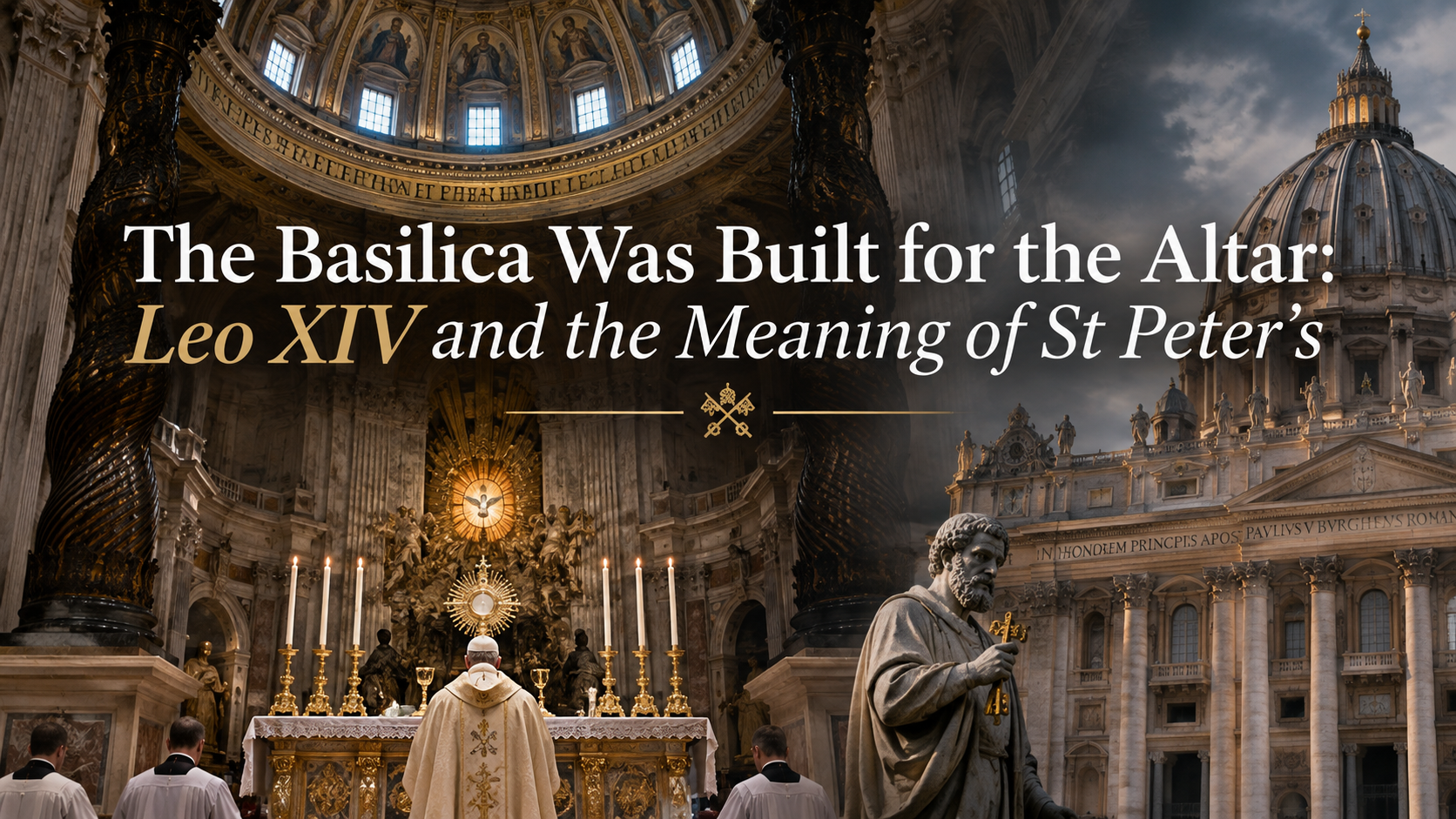
On the four-hundredth anniversary of the dedication of St Peter’s Basilica, Leo XIV has returned to the theological purpose of the world’s most recognisable Catholic sanctuary. His homily provides a useful answer to questions already raised by Nuntiatoria about the relationship between sacred worship, architectural inheritance and the increasingly elaborate management of the Vatican’s principal church.
Four centuries after Urban VIII dedicated the present Basilica of St Peter on 18 November 1626, Pope Leo XIV celebrated Mass beneath its great dome and recalled the reason why so much marble, labour and artistic genius had been expended upon a tomb belonging to a fisherman from Galilee. The answer, he insisted, was the confession made by Simon Peter at Caesarea Philippi: Jesus is the Christ, the Son of the living God.¹
The anniversary was always likely to invite reflections upon the building’s extraordinary history. Bramante, Michelangelo, Raphael and the succession of architects who transformed the Vatican Hill into one of the world’s most celebrated architectural ensembles would have furnished ample material. So too would the enormous demands of preserving a building visited by millions.
Leo acknowledged that inheritance and thanked those responsible for its conservation. Yet the substance of his homily concerned the purpose for which the basilica exists. Its significance arises from the apostolic witness it preserves and the Catholic Faith it proclaims.
The point is particularly relevant to questions recently raised about the administration of St Peter’s. In February, Nuntiatoria examined the Vatican’s anniversary programme and the proposals involving expanded visitor facilities, digital services and commercial provision. Our article, Above the Tomb or Above the Threshold?, asked whether the increasing emphasis upon access and visitor management risked obscuring the sanctuary’s essential religious character. A related investigation considered the theological ordering of the building itself, from the Apostle’s tomb beneath the papal altar to the dome rising above it.²
The argument was never that the Vatican Basilica should disregard the practical requirements of those who enter it. Its maintenance imposes extraordinary costs, and the safe reception of pilgrims requires professional administration. A Catholic sanctuary, however, cannot be understood adequately through the language of cultural tourism or heritage management. Those who maintain it must remain conscious of the purpose towards which their work is directed.
The anniversary homily supplied the theological principle by which the basilica’s history is to be understood. The basilica stands upon the burial place traditionally identified with St Peter. The first great church was raised there under Constantine. By the sixteenth century, the deterioration of the Constantinian structure had prompted the undertaking which eventually produced the present building. Its dedication in 1626 marked the completion of a long architectural history, although work upon its embellishment and maintenance continued.
The essential continuity was the site and the apostolic confession associated with it. The new structure was raised over the same sacred place, preserving the relationship between the martyrdom of Peter and the Eucharistic worship of the Church which honours his memory.
The physical arrangement expresses a theological truth. The altar stands above the Apostle’s tomb because the Church’s sacramental life is inseparable from the apostolic witness through which the Gospel was handed down. Yet Peter’s importance derives entirely from Christ, whose authority he received and whose death and Resurrection he proclaimed.
Petrine primacy belongs within that confession of Christ. Leo spoke explicitly of apostolic succession and the Church’s living Tradition, identifying Christ as their origin and rule. He recalled the declaration of St Leo the Great that what Christ established in Peter endures, and situated the Petrine office within the mission entrusted to the Church for the salvation of the world.¹
The language is theologically important. Apostolic succession concerns the continuing transmission of a real ecclesiastical office, not merely the preservation of an historical memory. Yet succession is inseparable from the apostolic Faith which gives that office its purpose.
The Bishop of Rome succeeds Peter in an office established by Christ. His authority serves the unity of the Church in the profession of the Catholic Faith and the communion of her sacraments. This is why the First Vatican Council, meeting within the basilica itself, defined the doctrine of papal primacy and the conditions under which the Roman Pontiff teaches infallibly. The authority described by Pastor Aeternus was received within the Church’s existing doctrinal constitution.³
Leo’s description of living Tradition must be understood in that setting. Tradition lives because the apostolic Faith continues to be professed, taught and celebrated in the Church. Its vitality is found in the transmission of what has been received, including the legitimate development of doctrine and ecclesiastical practice in fidelity to that inheritance.
The term should not be employed as though the living character of Tradition authorised an indefinite reconstruction of Catholic belief. Nor should fidelity to Tradition be confused with the proposition that every disciplinary arrangement must remain unchanged. These are distinct questions, and an account of apostolic continuity which fails to distinguish them can serve neither theology nor ecclesiastical government.
The Pope’s treatment of the Eucharist returned the anniversary homily to the purpose for which the basilica was dedicated. Leo identified the Eucharistic celebration as the central event which takes place within its walls. The great sanctuary exists so that Christ may be worshipped, His sacrifice sacramentally made present and His people nourished by His grace. He described the Eucharist as the greatest work to be contemplated, whether in St Peter’s or the smallest church.¹
This recalls a truth easily obscured by the grandeur of the Vatican Basilica. Its size, artistic treasures and historical associations are extraordinary, but the supernatural reality celebrated upon its altar is the same sacramental mystery offered in an obscure country chapel.
That theological distinction has practical consequences for the administration of sacred space. The dignity of a church does not arise simply from its architectural importance. Its dedication establishes it as a place set apart for divine worship, and its use ought to express that purpose. A building consecrated to God may accommodate pilgrims, preserve works of art and require substantial administrative provision. Such activities remain subordinate to its sacred character.
Leo’s anniversary homily provides a clear standard by which the questions raised in February may be examined. The great portals of the basilica are an invitation to the world, but the invitation is to enter a place where the Catholic Faith is proclaimed and the Eucharistic sacrifice celebrated.
The Pope’s emphasis upon welcome is therefore not adequately understood as a general endorsement of ever-expanding visitor facilities. His homily places hospitality within a particular religious purpose: those who enter should encounter the witness of Peter and the truth of Jesus Christ.
That distinction is particularly important when architectural developments are justified in terms of increased accessibility and improved visitor experience. Such improvements may be desirable. Their success cannot be judged solely by the number of people accommodated or the commercial resources generated.
A pilgrim entering St Peter’s should be able to recognise its sacred purpose amid the practical arrangements required by its extraordinary prominence. There is also a wider implication for contemporary ecclesiastical policy. The Pope spoke of a Church built upon the apostolic confession, sustained through succession and Tradition, whose mission is to proclaim Christ and administer the divine mysteries. This account of ecclesiastical identity supplies principles against which the Church’s decisions may be considered, including those affecting worship and sacred architecture.
The homily did not address Traditionis Custodes, nor would it be legitimate to treat its language concerning Tradition as an announcement of liturgical policy. The Pope’s statements about the sacramental purpose of the basilica nevertheless belong to the same theological understanding by which all Catholic worship must be judged.
A Church which recognises the Eucharist as the supreme event occurring within her sanctuaries ought to ensure that decisions concerning those sanctuaries are demonstrably ordered towards divine worship and the spiritual welfare of the faithful.
The four-hundredth anniversary has consequently provided more than an opportunity to celebrate the achievements of Renaissance architects. It has returned attention to the confession for which the building exists, the apostolic office exercised from Rome and the sacrifice offered upon its altar.
Those responsible for the Vatican Basilica must inevitably concern themselves with conservation, security and the reception of visitors. The programmes examined by Nuntiatoria earlier this year require continued scrutiny as they are implemented. The Pope’s homily supplies the appropriate theological measure.
St Peter’s remains one of the world’s most remarkable monuments, but its importance to the Catholic Church arises from the Faith for which Peter died and which his successors are bound to preserve. The administration of the basilica should make that purpose unmistakable.
FOOTNOTES
¹ Leo XIV, Homily for the Fourth Centenary of the Dedication of St Peter’s Basilica, 18 November 2026
² Nuntiatoria, Above the Tomb or Above the Threshold?, 21 February 2026
³ First Vatican Council, Pastor Aeternus, 18 July 1870
⁴ Holy See Press Office, Notice for the Fourth Centenary Celebration, 3 November 2026


Leave a Reply