
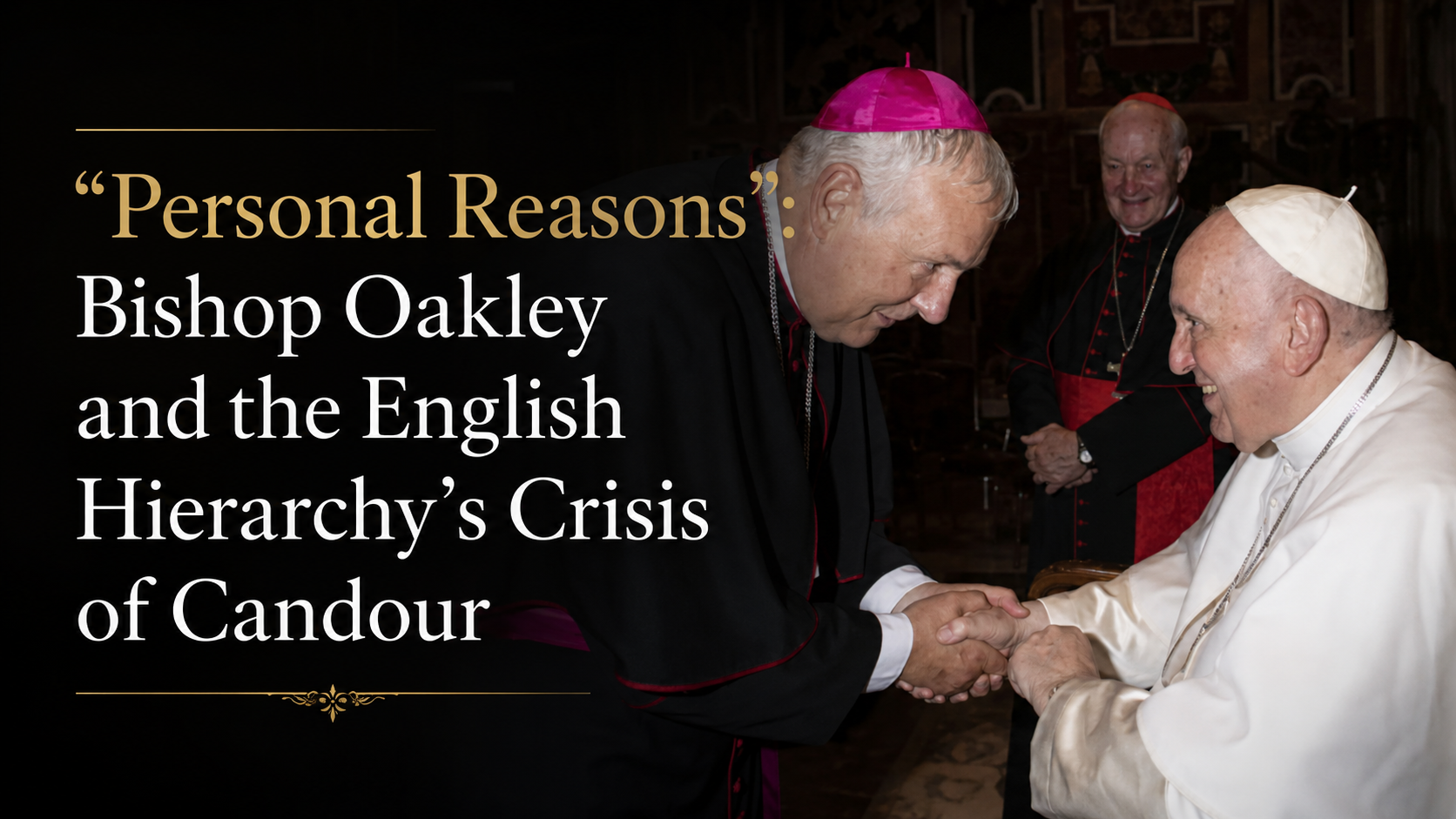
“Personal Reasons”: Bishop Oakley and the English Hierarchy’s Crisis of Candour
A bishop was arrested in September 2025. A month later Catholics were told that he had stepped aside for “personal reasons”. Whatever the criminal courts eventually decide, the handling of Bishop David Oakley’s disappearance from public ministry already raises questions the English hierarchy cannot answer with another safeguarding statement.

There are two stories here, and it is essential not to confuse them. The first belongs to the criminal courts. On 13 August Bishop David Oakley of Northampton appeared by video link before Westminster Magistrates’ Court charged with two counts of rape of a girl under sixteen, relating to alleged offences in Staffordshire between February 2000 and February 2001, when he was a priest of the Archdiocese of Birmingham. He entered no plea. Chief Magistrate Paul Goldspring sent the case to the Central Criminal Court, with a plea hearing scheduled for 10 September, and Oakley was released on bail subject to conditions including that he have no contact with the complainant or her family.¹ Oakley is entitled to the presumption of innocence. These proceedings are active, and Nuntiatoria will neither try the charges in print nor turn allegations, rumours or unrelated controversies into surrogate evidence of guilt. English contempt law exists precisely to prevent that sort of trial by publication.²
The second story, however, does not belong exclusively to a jury. It concerns the conduct of the Church. We already know that Oakley was arrested in September 2025 after an allegation was made to Staffordshire Police. We also know what Catholics were subsequently told. On 20 October The Tablet reported the Diocese of Northampton’s explanation that its bishop had taken leave “for personal reasons for the time being”. At that very moment Oakley was not an obscure auxiliary slipping quietly from the diary. He was being discussed as one of the leading candidates to succeed Cardinal Vincent Nichols as Archbishop of Westminster.³ The phrase “personal reasons” therefore did real work. It encouraged clergy and faithful to understand the absence as a private matter belonging to the bishop himself. What they were not initially told was that he had withdrawn from public ministry after an allegation had been made to police and after his arrest.
That does not mean Northampton was obliged to proclaim every detail of an uncharged allegation. It plainly was not. The presumption of innocence matters inside the Church as well as outside it. Police investigations may require confidentiality; complainants are entitled to protection; the reputation of an accused cleric is not something a bishop is free casually to destroy. There are circumstances in which silence is not merely prudent but just. Yet silence and misdirection are not the same thing. The Church eventually found perfectly adequate language for the situation: Oakley had temporarily withdrawn from public ministry following an allegation made to police, and that withdrawal did not imply guilt. The existence of such language exposes the problem with the original formula. “Personal reasons” was not simply discreet. It gave a materially different impression of why a diocesan bishop had vanished.
That distinction matters enormously after everything the Catholic Church in England and Wales has been through. The Independent Inquiry into Child Sexual Abuse did not spend years examining Catholic safeguarding so that, when the next grave allegation involving a senior churchman emerged, Catholics could once again be managed with a euphemism. Its 2020 investigation examined not merely historical offences but institutional responses, episcopal leadership, safeguarding culture and the effectiveness of the Church’s supposedly national “One Church” approach. It recommended, among other things, clearer leadership and oversight, publication of the framework for dealing with failures to comply with safeguarding procedures, and independent external scrutiny of safeguarding audit arrangements.⁴ The problem identified repeatedly in the abuse crisis was never only that wicked men committed wicked acts. No institution can promise that sin and crime will never enter it. The deeper scandal arose when institutions became skilled at managing appearances: preserving reputation, containing information, moving responsibility around and telling the faithful only what someone had decided they needed to know.
That is why the words “personal reasons” deserve much more scrutiny than their blandness suggests. Imagine the same sequence outside the Church. The chief executive of a large organisation is arrested in connection with an allegation sufficiently grave that he ceases exercising his office. Employees and stakeholders are then told only that he has stepped aside for “personal reasons”. They later discover that the organisation knew there was an active police matter when it issued that explanation. No sensible person would answer criticism by saying that “personal reasons” was technically capable of encompassing the situation. The question would be whether the communication was candid. Catholics should not demand less honesty from bishops than shareholders would demand from a company board.
Nor is this merely hindsight generated by the June charges. At the time Oakley stepped aside, his ecclesiastical significance made transparency more, not less, important. He had been Rector of St Mary’s College, Oscott, from 2013 until his appointment to Northampton in 2020. Pope Francis appointed him bishop in January of that year, and he received episcopal consecration in March.⁵ He therefore belonged to precisely that small circle of English prelates from whom further senior appointments might reasonably be expected. When The Tablet reported his leave in October 2025, it described him as a significant contender for Westminster.³ In such circumstances, the faithful were entitled to know at least the nature of the obstacle preventing him from exercising episcopal ministry. “The bishop has temporarily withdrawn from public ministry while a matter reported to the statutory authorities is investigated; no inference of guilt should be drawn” would have protected every legitimate interest. Instead they received “personal reasons”.
There is a further institutional history which cannot simply be forgotten, although it must be handled with particular care while the present criminal proceedings remain active. In 2018 Fr David Marsden, formerly involved in formation at Oscott, addressed an extraordinary open letter to the bishops of England, Wales and Scotland criticising seminary governance under Oakley and alleging serious failures in the application of Church discipline concerning priestly formation. Those claims were disputed. Oscott said that Marsden had presented a distorted and false picture of seminary life, while Archbishop Bernard Longley and the seminary trustees publicly declared their “full confidence” in Oakley and his staff.⁶ Nothing in Marsden’s letter proves, implies or corroborates the criminal charges now before the courts, and it would be irresponsible to pretend otherwise. Its relevance is narrower: Oakley’s governance had been placed publicly before the hierarchy years before his episcopal promotion, and the institutional response was an emphatic vote of confidence.
The Pillar has now reported, citing sources close to the present case, further claims concerning what ecclesiastical authorities may have known about Oakley many years before his appointment as bishop. Birmingham and a spokesman for Cardinal Nichols have declined to address those claims while criminal proceedings are under way.⁷ That is where responsible commentary must stop for the present. Allegations about earlier knowledge should not be converted into facts merely because they fit an attractive narrative, nor should material outside the evidence heard by a future jury be deployed to imply guilt. But neither should the institutional questions disappear. When the legal process permits them to be answered, they must be answered fully. What information existed? Who possessed it? What was recorded? What was communicated during the process that led to Oakley’s appointment to Northampton? What scrutiny was undertaken? Those are questions about ecclesiastical governance, not substitutes for a criminal verdict.
The eventual intervention of Rome itself illustrates the seriousness of the situation. After the charges were announced in June, Pope Leo XIV appointed Archbishop Richard Moth of Westminster Apostolic Administrator sede plena et ad nutum Sanctæ Sedis of Northampton. Oakley therefore remains canonically Bishop of Northampton, but the governance of the diocese has been entrusted to Moth for as long as the Holy See judges necessary. The Bishops’ Conference itself explained that this mechanism exists where it is not possible for the diocesan bishop to exercise his office.⁸ That is a proper canonical response. But canonical administration in June 2026 cannot retrospectively answer the communication failure of October 2025.
The bishops’ statement after Oakley was charged spoke, understandably, of distress, pastoral support, cooperation with the statutory authorities and the Church’s determination to continue its mission “safely and transparently”.⁹ The last word is the important one. Transparency is not demonstrated by publishing a safeguarding telephone number once the police issue charges. It is tested when disclosure is uncomfortable, when reputations are at stake, when the facts are incomplete, and when institutional instinct whispers that a softer phrase will cause fewer problems. Anyone can become transparent when there is nothing left to conceal. Christian candour is tested earlier.
There is a particular theological ugliness in ecclesiastical opacity. A diocese is not a corporation whose directors own its information and release it according to reputational advantage. A bishop does not possess his office as private property. He holds it for the Church. His relationship with his priests and people is not contractual but pastoral, sacramental and juridical. When something sufficiently grave occurs that he can no longer exercise that office publicly, those people are not troublesome spectators to be placated by communications professionals. They are the flock entrusted to him. They may not be entitled to every confidential detail, but they are entitled not to be deliberately left with a false impression.
This is precisely where the repeated language of “safeguarding” can become dangerously self-protective. Safeguarding is not a department. It is not a policy manual. It is not an annual training module, a flow chart, an external audit, a prominently displayed email address or a paragraph inserted at the bottom of a diocesan statement. Those things may all be necessary. They become useless, however, when the underlying culture still asks first how much must be admitted rather than what truthfully ought to be said. The Catholic abuse catastrophe was magnified by that culture. Bishops persuaded themselves that silence protected the Church. In reality it protected the institution’s immediate comfort while steadily destroying the credibility without which its proclamation of the Gospel becomes inaudible.
None of this pronounces David Oakley guilty. The distinction cannot be repeated too often. The Crown must prove its case; the defence must be heard; the court must determine what happened. If Oakley is acquitted, justice will require Catholics to respect that verdict just as surely as they must respect a conviction if one follows. But the hierarchy cannot make its own accountability dependent upon the outcome of the trial. Even an acquittal would not transform “personal reasons” into a satisfactory account of why a serving bishop withdrew after an arrest. The institutional question exists independently of the criminal one.
That question is painfully simple. Why were Catholics not told the truth that could safely have been told?
Not the evidence. Not the complainant’s identity. Not an assertion of guilt. Simply the truth: that the bishop had withdrawn from public ministry while an allegation reported to police was being investigated, and that no conclusion should be drawn from that fact.
The Church in England and Wales has issued apologies, commissioned reviews, restructured safeguarding bodies, accepted recommendations, spoken endlessly about listening and promised transparency. Fine words have not been lacking. The Oakley affair now provides something more useful than another opportunity for fine words. It provides a test.
The hierarchy should pass it by abandoning the instinct to manage the faithful through carefully engineered incompleteness. When criminal proceedings permit, the relevant ecclesiastical history must be examined without fear or favour. Records should be preserved. Decisions should be capable of reconstruction. Where information was known, the Church should say by whom and when. Where it was not passed onwards, it should explain why. Where procedures failed, responsibility should attach to persons rather than dissolve into the usual mist of “lessons learned”.
And before all that, someone should answer for two apparently harmless words.
“Personal reasons.”
They are harmless only if candour no longer matters.
¹ The Pillar, “English bishop has court appearance over rape charge,” 13 August 2026; The Times, “Bishop in court accused of ‘raping girl after Lourdes pilgrimage’,” 13 August 2026.
² Contempt of Court Act 1981, ss.1–2; Crown Prosecution Service, “Contempt of Court,” guidance on active proceedings, prejudicial publication and extraneous material.
³ The Tablet, “Bishop who is favourite for Westminster takes ‘leave of absence’ from diocese,” 20 October 2025.
⁴ Independent Inquiry into Child Sexual Abuse, The Roman Catholic Church Investigation Report, November 2020; IICSA final-report material recording recommendations on safeguarding leadership, compliance and independent audit.
⁵ Catholic Bishops’ Conference of England and Wales, biographical record for Bishop David Oakley; Diocese of East Anglia, announcement of Oakley’s appointment as Bishop of Northampton, 11 January 2020.
⁶ Fr David Marsden, “An open letter to the bishops of England, Wales and Scotland,” 2018; contemporary report of Oscott’s response and the statement of confidence issued by Archbishop Bernard Longley and the seminary trustees.
⁷ The Pillar, “English bishop has court appearance over rape charge,” 13 August 2026.
⁸ Holy See Press Office, “Resignations and Appointments,” 30 June 2026; Catholic Bishops’ Conference of England and Wales, “Pope Leo appoints Archbishop Richard Moth Apostolic Administrator of the Diocese of Northampton,” 30 June 2026.
⁹ Catholic Bishops’ Conference of England and Wales statement following the charges against Bishop Oakley, as reported in June 2026; Diocese of Northampton statement, 24 June 2026.
related articles


Latest articles
- Veritas non mutatur consensu ~ Truth is not altered by agreement: Spiritual Conference for Nuntiatoria CXXVThe text explores the theme of enduring truth amidst changing societal values, particularly within the Catholic faith. It emphasises that truth remains unchanged irrespective of popular opinion or individual feelings, urging believers to receive and embody divine teachings faithfully. The article concludes with a call to act upon this truth in daily life and relationships.
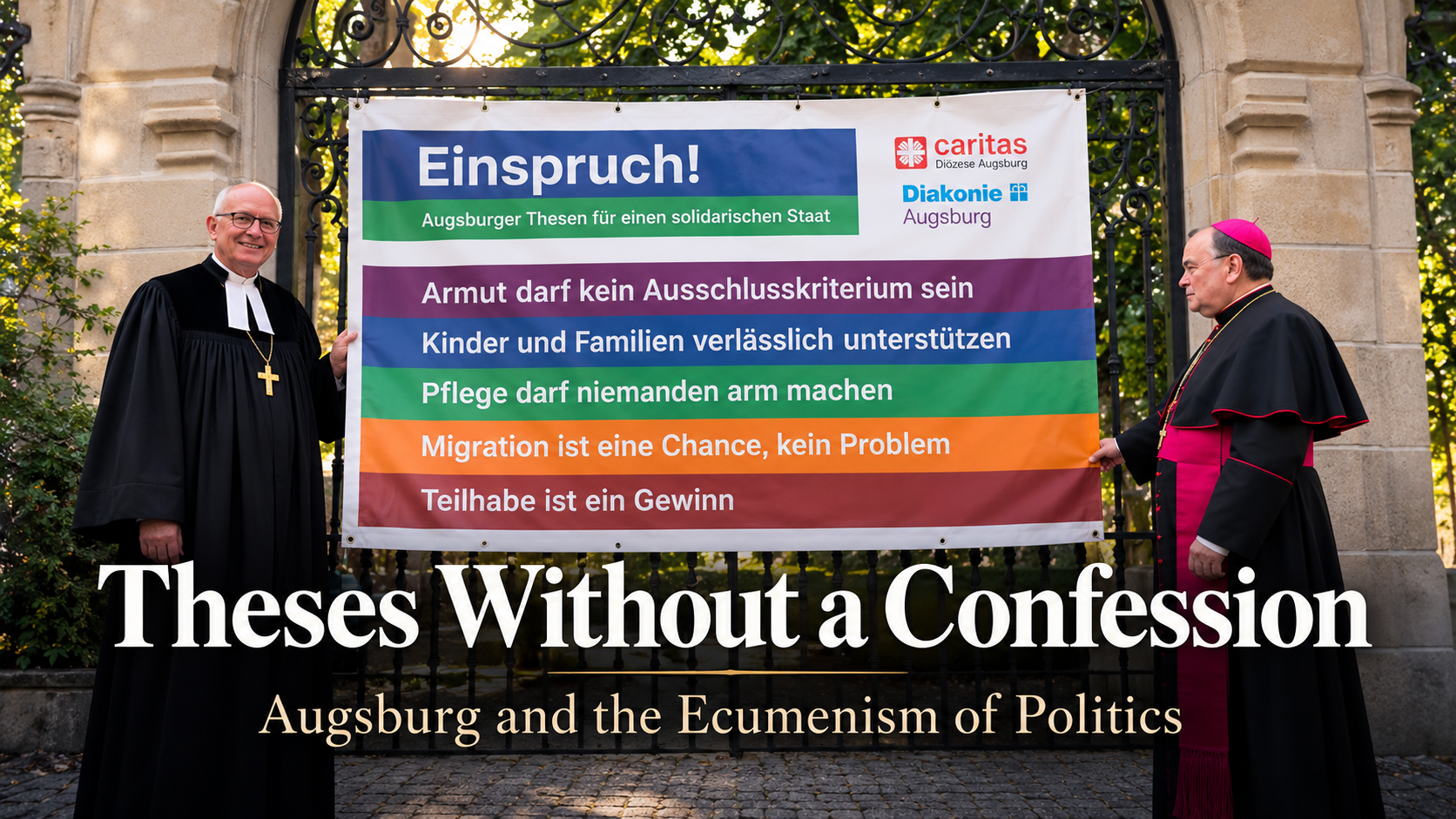
- Theses Without a Confession: Augsburg and the Ecumenism of PoliticsIn Augsburg, Catholic and Lutheran leaders have symbolically reposted theses on social issues like poverty and migration, reflecting Christian social teaching. This event highlights a growing divide where churches confidently address social policies while unresolved doctrinal differences remain. Cooperation on such issues is valuable but should not replace the pursuit of true Christian unity.
- Quis ut Deus? Michaelmas and the Order of HeavenThe Dedication of Saint Michael, celebrated on 29 September, highlights the Archangel’s role within divine order, illustrating humility and obedience before God. Rooted in ancient Roman traditions, the feast contrasts human pride with the recognition of God’s sovereignty. It underlines the importance of worship that connects earthly life to heavenly realities, centering around God’s presence.
- Today’s homily: The Dedication of S. Michael, ArchangelThe Apostles ask, “Who is greatest in the kingdom of heaven?” Saint Michael’s very name supplies the answer: Quis ut Deus? — “Who is like unto God?” From the angelic rebellion to Daniel’s vision of spiritual warfare, from Christ’s victory over Satan to the Guardian Angels and the worship surrounding the altar, the feast teaches that victory begins with humility, obedience and adoration. The Christian defeats the logic of Lucifer whenever he ceases to enthrone himself and kneels before God.
- Today’s Mass: September 29 Dedication of Saint Michael the ArchangelThe Feast of the Dedication of Saint Michael the Archangel highlights St. Michael’s role as the leader of heavenly armies and protector of the Church. He is revered for defeating evil spirits and is traditionally invoked for defence against sin. The liturgy honours his significant role alongside other angels in spiritual warfare and the protection of believers.




Leave a Reply