
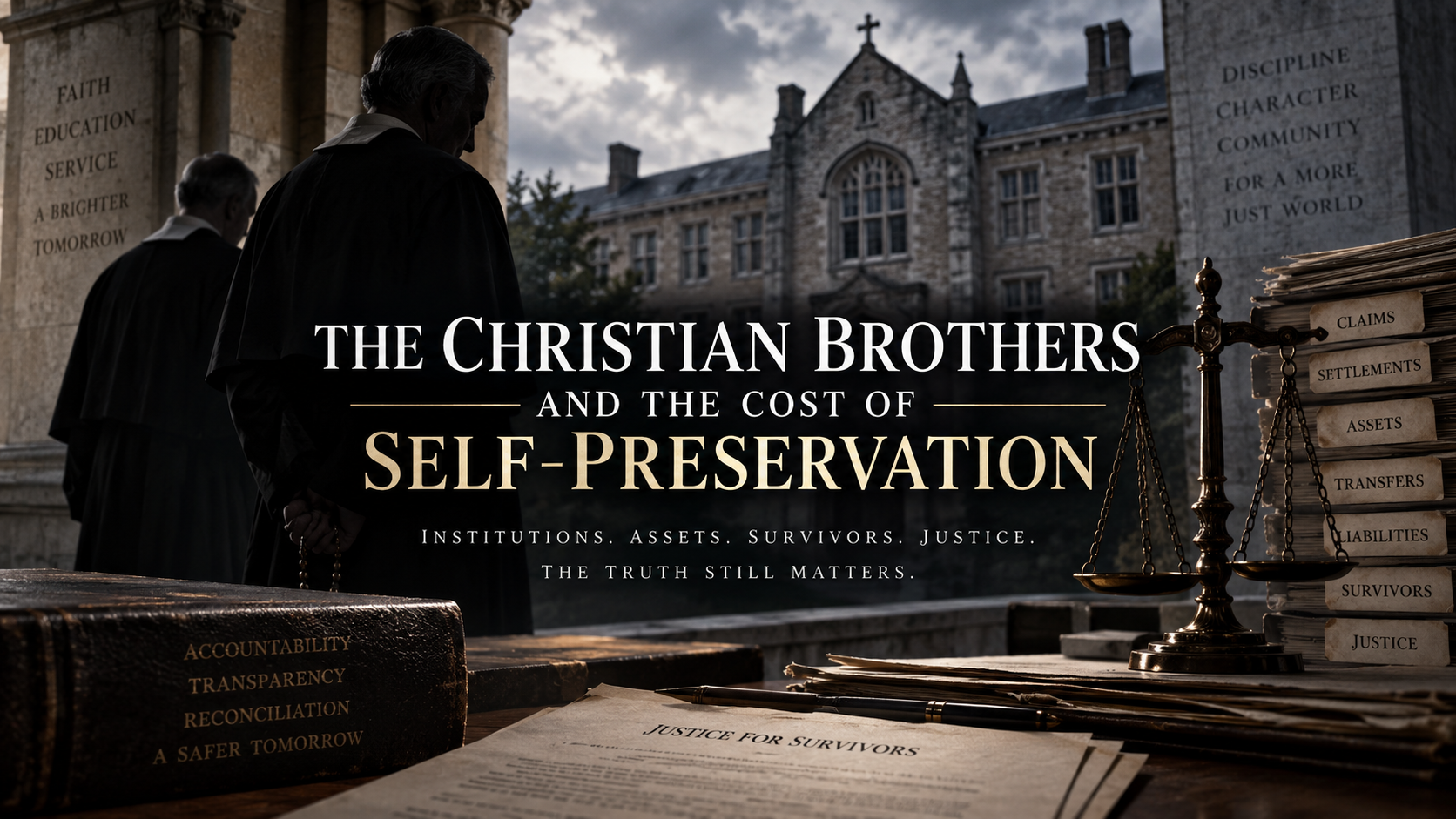
An Australian investigation has exposed a disturbing collision between the Christian Brothers’ abuse liabilities, hundreds of millions of dollars in transferred school property and an institutional instinct for legal self-preservation. Ireland supplies the uncomfortable parallel. This is not merely another abuse story. It is about what happens when a Catholic institution begins to treat justice as one interest among several.
On 22 June, lawyers acting for the Christian Brothers in Australia summoned solicitors representing survivors of child sexual abuse to an urgent online meeting. There would be no questions. The following day the order moved towards a court-supervised arrangement which brought compensation litigation against it to a halt. Some survivors had spent years pursuing their claims. Some negotiations were close to settlement. Twenty-one claimants, ABC subsequently reported, had agreed settlements but had not yet received the money. The Christian Brothers were facing imminent insolvency. An actuarial report commissioned by their lawyers had estimated current and future abuse liabilities at A$774 million.¹
Those figures are appalling enough. But they are not what makes the story so difficult for Catholics.
Beginning in 2013, the Christian Brothers transferred school properties to the Trustees of Edmund Rice Education Australia, the body established to govern their extensive educational network. According to EREA’s own valuation cited by ABC, those transferred properties were worth A$891 million. Many were transferred without payment or for the nominal consideration of one Australian dollar. The property concerned includes extremely valuable school sites in Sydney and Melbourne. ABC reports that the portfolio is now estimated to be worth nearer A$2 billion. That latter figure is an estimate, not an audited present valuation, and it would be reckless to turn the chronology alone into an accusation of fraudulent conveyance. But the chronology cannot simply be waved away either. Hundreds of millions of dollars of property passed out of the hands of the body now pleading inability to meet hundreds of millions of dollars of liabilities arising from the abuse of children.¹
There is a habit in modern institutional life of believing that once the lawyers have explained the legal distinction between two entities, the moral question has also been answered. It has not.
Edmund Rice Education Australia and the Christian Brothers are distinct civil entities. That fact matters in law. Yet they did not descend independently from the clouds. EREA exists because the Christian Brothers created it to continue the educational apostolate historically entrusted to the congregation. The schools, property, traditions and accumulated social capital did not originate with an unrelated corporation which happened accidentally to acquire them. They came out of the Christian Brothers’ mission. Legal separation may determine which defendant can be sued. It does not make institutional history disappear.
Nor is there, at present, evidence sufficient to declare that those property transfers were unlawful. That distinction matters. Nuntiatoria has no interest in improving an argument by claiming more than the evidence will carry. The scandal does not need embellishment. Its established facts are serious enough.
The Australian Royal Commission into Institutional Responses to Child Sexual Abuse examined Catholic Church authorities whose members ministered between 1950 and 2010. Using a weighted methodology which took duration of ministry into account, it calculated that 22 per cent of Christian Brothers in its survey were alleged perpetrators. That does not mean that 22 per cent were convicted, nor even that every allegation was substantiated. It means precisely what the Royal Commission said: the weighted proportion alleged to have perpetrated child sexual abuse was 22 per cent.² Even with that necessary qualification, the figure is staggering.
A religious congregation confronted by a history of that magnitude does not face an ordinary balance-sheet problem.
The distinction goes to the heart of Catholic moral theology. Restitution is not public relations. It is not philanthropy. It is not an optional act of institutional generosity performed when enough money remains after the important things have been protected. Saint Thomas places restitution under commutative justice because a wrong creates an obligation towards the person wronged. The Christian question is therefore not merely how much an institution can legally preserve. It is what justice requires it to surrender.
That distinction becomes particularly acute in the case of a religious congregation. Christian Brothers take vows in a tradition which professes evangelical poverty. Their property exists for mission. Catholic families sent their sons to these schools because they were Catholic schools. Benefactors gave money because they believed they were supporting Catholic education. Brothers gave their lives to the work. Generations built institutions which were never supposed to exist for their own perpetuation. If institutional preservation eventually competes with justice towards men abused as children within those institutions, the purpose of the property has been forgotten even if every document of title remains perfectly valid.
This is where the Australian investigation touches a theme to which Nuntiatoria has returned repeatedly in its treatment of safeguarding. Safeguarding is not fundamentally a bureaucratic system. Policies matter. Reporting mechanisms matter. Vetting, training, professional boundaries and information-sharing matter. But they are downstream from something more basic: a culture in which the vulnerable person matters more than the reputation, convenience or survival of the institution.
A safeguarding culture is tested precisely when doing the right thing hurts.
Institutions nearly always describe their failures backwards. Once the catastrophe has happened, policies are revised, committees established, apologies issued and lessons said to have been learned. Yet the decisive moral choices usually occurred much earlier, when somebody believed that avoiding scandal was prudent, that moving an offender was kinder than exposing him, that protecting the institution served the greater good, that lawyers should concede nothing unnecessarily, that property must be preserved for future mission, or that one more delay could do no harm. Very little institutional wickedness announces itself as wickedness. It usually arrives wearing the clothes of prudence.
The Christian Brothers have themselves apologised for abuse in their institutions and acknowledged the devastation inflicted upon victims. Their Oceania Province says that institutions serving children must act with “accountability, integrity and due care”.³ Those words are entirely right. They also establish the standard by which the subsequent conduct of the institution may fairly be judged.
The revised Australian proposal is therefore important and must be reported fairly. On 24 July the Christian Brothers and EREA announced a new arrangement intended to produce a better outcome than either liquidation or the earlier proposed scheme. Under its principles, claimants with established monetary settlements or judgments are intended to be paid in full; EREA is to accept nomination as the proper defendant for abuse claims once the scheme becomes effective; and it is to assume responsibility for current and future proceedings and National Redress Scheme claims. EREA described the decision as the right thing to do for survivors.⁴
But it has not yet happened merely because it has been announced. The revised scheme requires approval by creditors and by the court. The Christian Brothers’ own statement makes that clear. It would therefore be inaccurate to say simply that every claimant will now be paid in full. What exists is a proposed mechanism intended to achieve that result.¹ The distinction matters particularly to survivors who have heard promises before and are still waiting.
One should nevertheless recognise the change for what it is. If the revised arrangement succeeds and current and future legitimate claims are met properly, that will be infinitely preferable to an insolvency process leaving victims competing as ordinary creditors. EREA deserves credit for moving towards accepting responsibility. Nothing is gained by pretending that a better decision is worthless because it came after a worse one.
The difficulty is that it required a crisis to reach the morally obvious destination.
Why were men with agreed settlements left waiting when their abusers’ religious congregation approached insolvency? Why was a structure allowed to develop in which the historic educational assets had moved elsewhere while the historic abuse liabilities remained behind? Why did survivors have to confront the prospect of a creditors’ arrangement at all before another body carrying the Edmund Rice mission accepted that their claims must be met?
These are not accusations of criminality. They are questions of institutional conscience.
Ireland makes them harder to avoid.
The Christian Brothers there are an unincorporated association. Civil proceedings therefore present a technical problem: there is no single incorporated congregation which can simply be named as defendant. Other religious congregations generally nominate a member to represent the body in litigation. The Christian Brothers have declined to do so in a number of abuse cases. The consequence is that claimants must pursue the members and former members who constituted the congregation at the relevant time. In one case, the High Court permitted 341 former Christian Brothers to be served through a newspaper advertisement. Those men were not being accused of committing the abuse. Some had left religious life decades ago. Their names appeared because the congregation had not supplied a nominee.⁵
It is difficult to imagine a better illustration of institutional procedure consuming everyone around it. The victim encounters another obstacle. Innocent former Brothers find themselves publicly named as defendants in litigation concerning crimes they did not commit. Lawyers multiply. Costs rise. Years pass. The institution remains defended.
When sentencing convicted former Christian Brother Liam Coughlan, President of the Circuit Court Judge Keenan Johnson described the congregation’s civil litigation strategy as “morally bankrupt” and grossly unfair both to victims and to innocent Brothers. He said it appeared to protect congregational assets and wear claimants down through attrition.⁵ Those are not the words of an anti-Catholic polemicist constructing an argument from headlines. They are the judgment of a senior Irish judge confronted with the practical consequences of the strategy.
The Christian Brothers have defended their approach and argued that prolonged litigation consumes resources which might otherwise be available to claimants. There is an argument there which should not simply be caricatured. Litigation is expensive. Religious congregations have obligations to innocent members as well as claimants. False or exaggerated allegations cannot simply be paid without examination. Trustees have duties. Courts require procedure. Justice is not served by replacing one injustice with another.
But all of that still leaves the central question untouched. Why adopt a procedural position which makes the road to adjudication harder than it need be?
Catholic moral reasoning has never consisted in discovering the maximum that law permits and stopping there. The Christian is expected to ask what justice, charity, truth and scandal require. The corporate lawyer asks what exposure can be contained. The religious superior must ask something more.
This is why it would be a mistake for traditional Catholics to treat the Christian Brothers story merely as another exhibit in a dossier against the post-conciliar Church. Much of the abuse reached back into the supposedly disciplined Catholic culture before the Council; the Royal Commission’s study period began in 1950. The temptation to explain everything by liturgical rupture is understandable but inadequate. Orthodoxy, traditional worship, the religious habit, institutional discipline and strong Catholic identity are genuine goods. They do not make human beings incapable of cowardice, vice, tribal loyalty or institutional self-deception.
Indeed, one of the lessons is more uncomfortable. Catholic forms can survive after Catholic moral reflexes have weakened.
A community can have crucifixes on its walls, saints on its school buildings, founders in its iconography and Gospel language in its mission statements while learning to think institutionally in precisely the same fashion as the secular corporation next door. It can speak constantly of “mission” while quietly making survival the mission. It can regard scandal principally as reputational damage. It can hire specialists to manage risk until the person who was actually harmed has become one more risk to be managed.
That is managerialism in its most spiritually dangerous form. It does not necessarily deny Catholic doctrine. It makes doctrine operationally secondary.
The same danger exists wherever safeguarding becomes a compliance industry detached from moral courage. We see institutions produce elaborate policies after failures which occurred because people already knew enough to act and chose not to. Information existed, complaints existed, warning signs existed, but the preservation of structures, relationships and reputations intervened. More paperwork will not cure an institution which has learned to protect itself first.
The Australian and Irish cases therefore raise a much larger question than how the remaining assets of an ageing religious congregation should be distributed. What is a Catholic institution for?
If the answer is the salvation of souls and the service of Christ in those entrusted to it, then buildings, schools, endowments, canonical structures and corporate vehicles are means. None is the mission itself. There may come a point at which fidelity requires surrendering the means rather than betraying the end.
A religious institute can sell a school and remain Catholic. It can lose property and remain Catholic. It can see its numbers diminish to extinction and still have completed its work faithfully. No congregation possesses a divine promise of institutional survival.
What it cannot afford to lose is justice.
The Christian Brothers’ revised Australian scheme may yet provide a proper settlement for survivors. It should be encouraged to do so, and quickly. In Ireland the congregation should reconsider whether a legal strategy which a senior judge has condemned in such extraordinary terms can possibly be reconciled with the witness expected of a religious institute. Neither situation requires Catholics to indulge enemies of the Church or accept every accusation uncritically. It requires the opposite: enough confidence in Catholic truth to apply Catholic standards even when the institution under examination is our own.
The Church is not protected by concealing what Catholics have done badly. She is protected when Catholics do what the Church teaches.
For the Christian Brothers, the question now is painfully simple. When the price of protecting the institution is paid by those whom the institution failed, what exactly has been protected?

¹ ABC Four Corners, “Christian Brothers Inc.”, 7 September 2026; Louise Milligan, Elise Potaka and Lara Sonnenschein, ABC News, “Edmund Rice Catholic schools considering cutting ties with abuse-plagued Christian Brothers”, 7 September 2026.
² Royal Commission into Institutional Responses to Child Sexual Abuse, “Religious institutions”; Final Report, Volume 16, Religious Institutions, Book 1.
³ Christian Brothers Oceania Province, “Our Apology”.
⁴ Trustees of Edmund Rice Education Australia, “EREA supports revised scheme to compensate victims and survivors of historical Christian Brothers abuse”, 24 July 2026; Trustees of the Christian Brothers, Oceania Province, “Statement from the Trustees of the Christian Brothers”, 24 July 2026.
⁵ Colm Keena, The Irish Times, “More than 300 former Christian Brothers to be named in newspaper ad as part of abuse case”, 29 July 2026; Colm Keena and Vivienne Clarke, The Irish Times, “Names of 341 former Christian Brothers published following court order in sex abuse case”, 4 August 2026.




Leave a Reply