
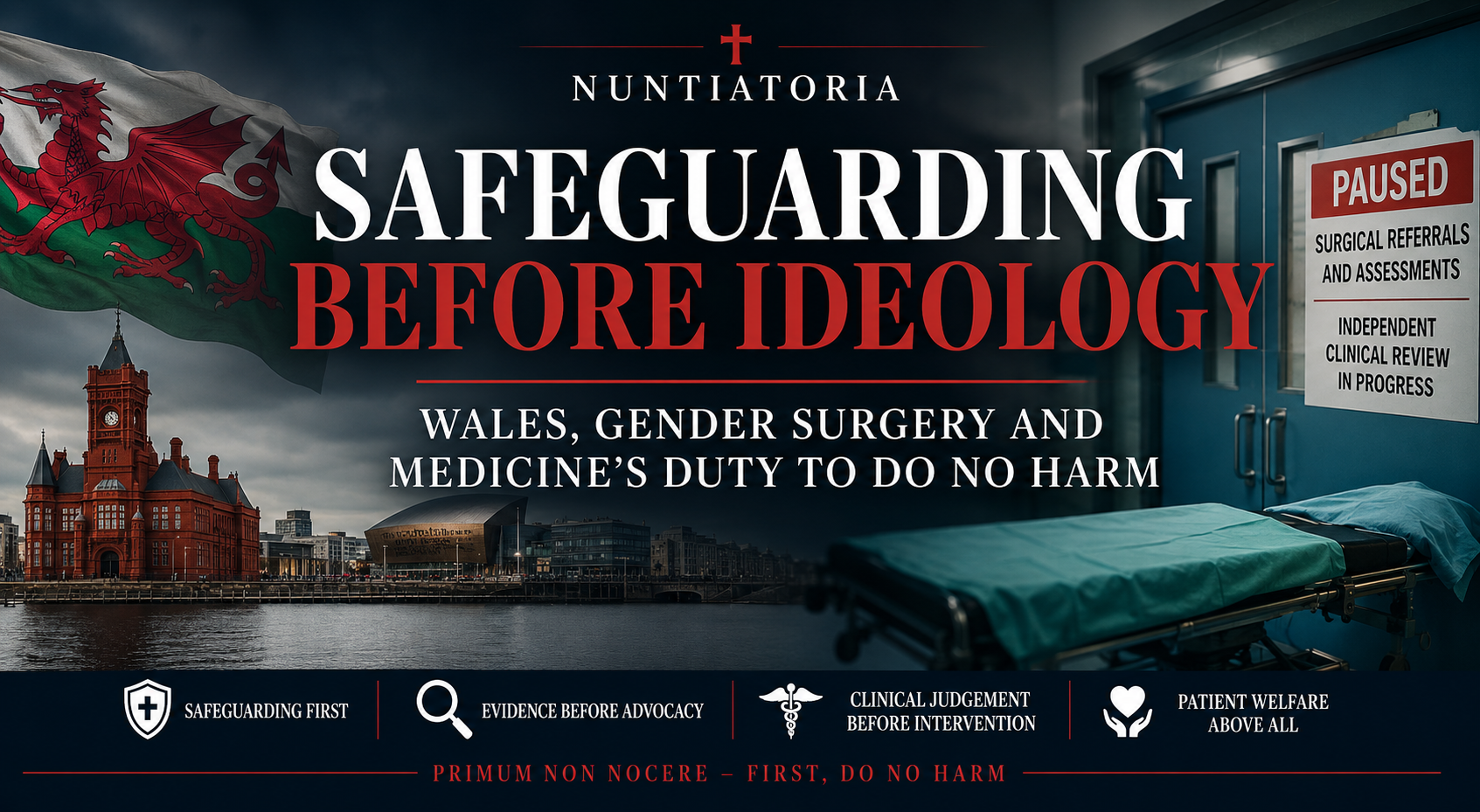
SAFEGUARDING BEFORE IDEOLOGY: Wales, Gender Surgery and Medicine’s Duty to Do No Harm

There are moments when an administrative decision reveals something much larger than the immediate controversy which produced it. The decision by NHS Wales to pause referrals for so-called “gender-affirming” surgery, surgical assessments and operations already scheduled through the Welsh Gender Service is one of them.
The immediate issue concerns a single adult NHS service in Wales. The principle at stake, however, is universal: “safeguarding first” must be the lens through which every medical intervention is judged.
On 28 August, Cardiff and Vale University Health Board confirmed that the NHS Wales Joint Commissioning Committee had ordered an immediate pause in new surgical referrals, surgical assessments and scheduled operations connected with the Welsh Gender Service pathway while an independent clinical review is undertaken. The decision followed a meeting of the Committee’s Quality, Safety and Outcomes Committee on 24 August, at which the Welsh Gender Service was escalated to Level 3 — a formal NHS improvement and assurance process signifying that concerns have been identified which require increased oversight, monitoring and improvement action.¹
The reasons given by NHS Wales are themselves striking. Referral data for 2025–26 indicated “significantly higher rates” of referral for gender-related surgery from the Welsh Gender Service compared with English gender services. Concerns had also been raised about aspects of the referral and assessment processes. The independent review has consequently been commissioned specifically to provide assurance regarding assessment, referral and governance arrangements.¹
Those words matter. NHS Wales has not concluded that every referral was inappropriate. It has not declared that named clinicians committed malpractice. Those questions belong properly to the independent review. But the significance of what has already happened should not be diminished. The commissioning authority responsible for ensuring that specialised NHS services in Wales are safe and effective has determined that the concerns are sufficiently serious that even operations already scheduled should not proceed until further clinical assurance has been obtained.
That is not routine administration. It is a safeguarding intervention.
Journalist Nick Wallis deserves considerable credit for exposing the statistical anomaly which helped bring these questions into public view. Using Freedom of Information data, Wallis reported that in 2025 the Welsh Gender Service referred 207 patients for masculinising chest surgery. Wales therefore accounted for approximately 16 per cent of the UK total for those referrals despite containing only about 4.6 per cent of the UK population. In 2024 the Welsh service made 234 such referrals — approximately 20 per cent of the UK total.²
The pattern was not confined to chest surgery. Wallis calculated that referrals for feminising genital surgery and masculinising genital surgery were also markedly disproportionate to the Welsh share of the UK population. Across the principal categories of gender surgery in 2024 and 2025, his analysis suggested that the Welsh Gender Service was referring patients for surgery at roughly three to four times the rate per head of population seen across the United Kingdom as a whole.²
Those statistics do not, of themselves, prove bad medicine. There may be demographic, organisational or clinical explanations for variation between services. But in any responsible healthcare system, variation of that magnitude involving irreversible surgical intervention must demand explanation.
It is precisely here that the distinction between advocacy and medicine becomes crucial. In advocacy, a high referral rate may be presented as evidence that a service is helping more people obtain something they desire. In medicine, that is not enough. Medicine must ask whether the intervention was clinically indicated, whether the diagnosis was sufficiently secure, whether co-existing conditions were properly evaluated, whether alternative treatments were considered, whether informed consent was meaningful, whether outcomes were followed and whether the balance of benefit and harm justified permanently altering the human body.
The question is not simply whether an adult may desire an irreversible intervention.
The question for medicine is whether a doctor ought to perform it.
Autonomy can authorise consent. It cannot manufacture clinical indication.
That distinction has become dangerously blurred in contemporary discussion. Adult patients unquestionably possess autonomy and, where competent, have the right to make decisions concerning their own medical care. But medicine has never understood autonomy to mean that a physician must provide whatever intervention a patient requests. The clinician remains under an independent professional obligation to determine whether the proposed treatment is appropriate, proportionate and justified.
A competent adult may request an unnecessary amputation, an inappropriate prescription or surgery from which the clinician reasonably expects more harm than benefit. Consent alone does not transform such an intervention into good medicine. The doctor is not merely a technician implementing autonomous preference. Clinical judgement remains indispensable precisely because medicine is concerned not simply with choice, but with health.
The more irreversible the proposed intervention, the greater that responsibility becomes.
Surgery cannot be recalled. Removed tissue cannot simply be restored because a diagnosis later changes, because psychological circumstances develop, because a patient comes to understand himself differently or because subsequent evidence reveals that the original treatment model was unsound. The threshold for evidence, assessment and informed consent must therefore rise in proportion to the permanence and gravity of the intervention.
This is where the old medical maxim remains indispensable: primum non nocere — first, do no harm.
The phrase is sometimes treated as a quaint relic of paternalistic medicine. In reality it expresses something much deeper: the recognition that medical power carries corresponding moral restraint. The fact that something can be done does not establish that it should be done. The possession of surgical technique does not itself supply a therapeutic indication.
Nor is the human body simply raw material upon which desire, ideology or theory may operate.
This is not an argument against compassion. It is an argument about what compassion requires. A patient experiencing profound gender distress deserves serious, humane and individually tailored care. Such a patient deserves clinicians capable of listening without contempt and investigating without prejudice. But he also deserves medicine rather than activism: accurate diagnosis, proper differential assessment, honest acknowledgment of uncertainty, consideration of psychological and psychiatric factors where relevant, realistic discussion of benefits and harms, proper examination of alternatives and sufficient time for reflection.
Compassion without clinical scrutiny can become negligence dressed in sympathetic language.
Nor are the Welsh concerns arising in isolation. NHS England commissioned an independent review of all nine commissioned adult Gender Dysphoria Clinics in England after concerns arising from the Cass Review demonstrated that questions about clinical practice could not safely be confined to paediatric services. NHS England specifically wanted to examine the appropriateness of service models, variation in practice, safety and effectiveness, and the quality of assessment for patients with complex presentations.³
The subsequent Levy Review, published in December 2025, exposed substantial weaknesses. It found that the changing patient population included increasing numbers of younger adults and patients presenting with additional neurodevelopmental, psychological and biopsychosocial complexities. Yet the review also found serious limitations in the data available to establish these patterns systematically. Across the adult services it examined, weaknesses in outcomes data, clinical audit and quality reporting impeded proper assessment of effectiveness and safety.⁴
This should trouble anyone concerned with evidence-based medicine, whatever their political or philosophical view of gender.
How can a healthcare system confidently defend irreversible interventions if it cannot adequately demonstrate long-term outcomes? How can clinicians know that a treatment model is functioning well if clinical audit is inadequate? How can commissioners identify poor practice if significant variation between services is not properly interrogated?
These are not ideological questions.
They are the most elementary questions of clinical governance.
Yet gender medicine has too often developed within an atmosphere in which such questions themselves can be portrayed as suspect. Caution is described as obstruction. Requests for evidence become attacks upon identity. Calls for psychological exploration are characterised as attempts to deny the authenticity of patients’ experiences. Those demanding more rigorous outcome data may find themselves accused of hostility rather than answered with data.
That is precisely how ideology compromises medicine: not necessarily by forcing an individual clinician consciously to act politically, but by creating an institutional culture in which certain assumptions become morally privileged and therefore increasingly difficult to challenge.
The cavalier attitudes of ideologues should have no place in medical practice.
Political enthusiasm, activist pressure, fashionable theory and institutional momentum must never determine what happens to a patient’s body. No therapeutic field should be permitted to become so morally charged that ordinary clinical scepticism is discouraged. Medicine advances by doubt, scrutiny, comparison and correction. It becomes dangerous when confidence becomes a substitute for evidence.
Indeed, the duty of the physician is especially important when a patient is distressed, vulnerable or desperate for relief. Such circumstances can make an intervention feel urgently necessary to the patient. They therefore increase rather than diminish the responsibility of the clinician to distinguish between what is desired and what is medically indicated.
The Welsh case concerns adults, and that distinction must remain explicit. It would be inaccurate to present the present suspension as NHS Wales stopping surgical procedures on children. But the safeguarding principle does not disappear upon a patient’s eighteenth birthday.
Adults can be vulnerable. Adults can suffer psychiatric illness. Adults can experience trauma. Adults can make decisions under intense psychological pressure. Adults can misunderstand risk. Adults can later regret irreversible medical choices. None of this abolishes autonomy; it simply demonstrates why informed consent must be more than an administrative formality.
Consent becomes meaningful only when the patient understands not merely the proposed benefits but the limitations of the evidence, the material risks, the permanence of the intervention, the possibility that circumstances or self-understanding may change and the existence of reasonable alternatives — including, where clinically appropriate, doing nothing irreversible at that time.
The General Medical Council’s standards reflect exactly this principle. Doctors are required to make the care of the patient their first concern, to provide treatment based upon the best available evidence and to ensure that patients receive the information necessary to make meaningful decisions about benefits, harms, uncertainties and reasonable alternatives.⁵
The clinician therefore has two responsibilities which must be held together: respect for the patient’s autonomy and fidelity to independent medical judgement.
When either collapses into the other, medicine becomes distorted. Pure paternalism disregards the competent patient. Pure consumerism disregards the responsibility of the physician.
Gender medicine must not be exempt from that balance.
The present Welsh decision is therefore important because NHS Wales has done what responsible medicine ought to do when serious questions arise about irreversible interventions: stop, examine the evidence, scrutinise the assessment process, investigate the referral threshold and establish whether governance is adequate before proceeding further.
That is not cruelty.
It is safeguarding.
The review must now be allowed to ask difficult questions without a predetermined conclusion. Why has the Welsh surgical-referral rate been so markedly different from comparable services elsewhere? Are there legitimate population differences capable of explaining the variation? Were patients consistently subjected to sufficiently comprehensive assessment before surgical referral? Were co-existing psychiatric, psychological or neurodevelopmental conditions properly identified and considered? Were alternative approaches adequately explored? Were patients given genuinely balanced information about risk, uncertainty and irreversibility? Were outcomes systematically recorded and audited? Was there sufficient institutional challenge within the service itself?
And one further question must be asked: why did it require investigative journalism and external scrutiny before the scale of the variation became a matter of urgent public concern?
Healthcare governance should identify anomalous patterns before journalists do.
Where hundreds of irreversible procedures are being recommended, unusual referral rates ought automatically to provoke comparative review. Outcome monitoring should not be an optional academic exercise. Long-term follow-up should not depend upon controversy. Independent audit should be routine.
Safeguarding begins before scandal.
This principle also reaches far beyond gender medicine. It applies whenever political enthusiasm, commercial interest, professional fashion or institutional orthodoxy threatens to outrun the evidence. The history of medicine contains enough examples of confident interventions later recognised as damaging to justify institutional humility.
The lesson is not that medicine should fear innovation.
The lesson is that medicine should earn confidence before demanding trust.
Patients place themselves literally into the hands of clinicians. That relationship carries an extraordinary moral responsibility. It cannot be reduced to consumer preference and it cannot be subordinated to ideology. The physician’s calling is neither to affirm every requested intervention nor to impose his own prejudices upon the patient. It is to seek the patient’s genuine good through reason, evidence, competence and care.
The human person must remain the subject of medicine, never the object of an experiment in social theory.
That is why the Welsh review matters. Its conclusions must not be prejudged. If the referral patterns are clinically justified, let the evidence demonstrate it. If assessment and governance have been sound, let independent scrutiny establish that. If weaknesses are found, let them be corrected openly. And if patients have been failed, institutional reputation must not be permitted to obscure the truth.
But whatever the review ultimately concludes, the principle which prompted the suspension should remain.
Safeguarding first.
Evidence before advocacy.
Clinical indication before irreversible intervention.
Patient welfare before institutional reputation.
Judgement before ideology.
And where what medicine proposes to do cannot be undone, the obligation to be certain before acting becomes not weaker, but stronger.
Primum non nocere.
First, do no harm.
¹ Cardiff and Vale University Health Board, “Welsh Gender Service update – 28 August 2026”, 28 August 2026.
² Nick Wallis, “Welsh Gender Service: Going Rogue?”, GenderBlog, 23 May 2026.
³ NHS England, “Review of NHS adult gender dysphoria clinics”, 10 April 2024.
⁴ NHS England, Operational and delivery review of NHS adult gender dysphoria clinics in England, 18 December 2025.
⁵ General Medical Council, Good medical practice; Decision making and consent.
related articles


Latest articles
- Today’s Mass: October 16 St Hedwig of SilesiaHedwig of Silesia, a member of the Bavarian comital House of Andechs, was Duchess of Silesia from 1201 and of Greater Poland from 1231 as well as High Duchess consort of Poland from 1232 until 1238. She was canonized by the Catholic Church in 1267 by Pope Clement IV.
- Today’s Mass: October 15 St Teresa of AvilaSaint Teresa of Avila, born in 1515, was the reformer of the Carmelite Order and founded the Discalced Carmelites. Renowned for her mystical writings, she faced opposition while establishing numerous convents. Teresa’s deep spiritual insights and experiences led to her canonisation in 1622, and her feast is celebrated on 15 October.
- Today’s Mass: October 14 St Callistus, Bishop of Rome & MartyrCallistus was born to a Christian slave who had a Christian master in second-century Rome. He was placed in charge of a Christian bank which went broke. He fled the city, but was caught and sentenced to the treadmill, then later to the tin mines. He was later ransomed and returned to Rome…
- Sermon for St. WilfridToday marks the feast of St. Wilfrid, who was pivotal in establishing the Roman Christian tradition in England over the Irish. Born in 634 in Northumbria, he travelled to France and Italy, eventually becoming bishop of York. Despite conflicts with kings and church leaders, he successfully evangelised Sussex and laid foundations for future missions, showcasing both determination and a contentious spirit. St. Wilfrid passed away in 709, leaving a complex legacy of leadership and zeal for evangelism.
- THE GENERATION THAT WAS TOLD TO MOVE ON Is Rediscovering What the Church Left BehindArchbishop Salvatore Cordileone’s interview highlights the challenge of reconciling Catholic Tradition with contemporary practices, warning that restrictions like Traditionis custodes may deepen existing divisions. He notes younger Catholics are rediscovering traditional worship, which contrasts with the Church’s modern adjustments and emphasizes the need for reflective continuity in liturgical development.





Leave a Reply