
Do Not Let It End with You
The Faith reached us because others guarded it through confusion, upheaval, persecution and loss. It rests now, for a little while, in our hands. We are trying to understand what happened, why it happened, and what we can do despite it: how we may preserve, defend, maintain and hand on the authentic Catholic Faith in a time of ecclesial crisis.
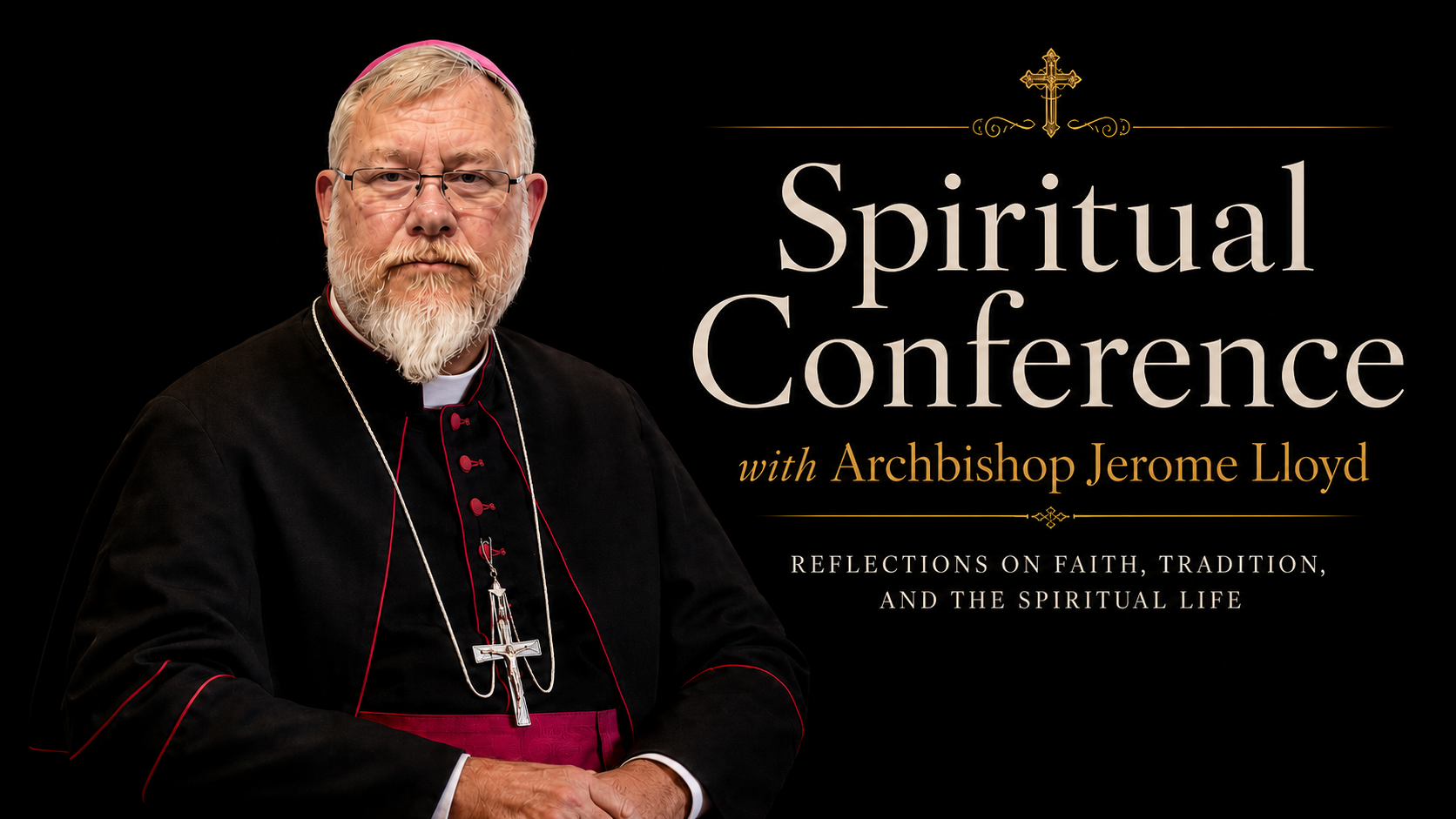
By HE ✠Jerome Lloyd
SPIRITUAL CONFERENCE
My dear friends, none of us chose the age into which we were born. We did not choose to inherit the Church at a moment when so much that once seemed settled has become disputed, when Catholics may hear different things said about the same doctrine according to which bishop, theologian, priest or document they happen to encounter, or when practices once universal in the Roman Church can be treated as though they belonged to some remote and slightly embarrassing past. Neither did we choose to live in a civilisation which has rejected so much of the Christian understanding of God, man, nature, family, authority and society. Providence placed us here, and therefore here is where our fidelity must be proved.
It is natural sometimes to imagine that faithfulness would have been easier in another age. We picture a Church in which doctrine was taught plainly, worship was recognisably continuous, Catholic institutions behaved as Catholic institutions, priests and religious were numerous, and the surrounding society, however imperfectly Christian, still acknowledged certain moral truths as part of the order of reality. There is some truth in that picture, although no age of the Church has ever been free from scandal, cowardice, ambition, confusion or sin. But such comparisons become spiritually dangerous if they merely leave us longing for circumstances God has not given us. We are not being judged upon how well we would have behaved in 1926, 1526 or 526. We shall answer for 2026, and that means the crisis through which we are living is not merely something happening around us. It is the field upon which our fidelity is being tested.
That is why our motto has acquired such force: Quod accepimus, custodimus et tradimus. What we have received, we guard and hand on. The words recall St Paul’s description of the apostolic pattern: “For I have received of the Lord that which also I delivered unto you.”¹ Reception creates responsibility. The words sound almost serene until one asks what custodimus really means. One does not guard what nobody threatens. Custody becomes a duty when something precious may be lost, altered, neglected or taken away. To say that we guard the Faith is therefore already to admit that fidelity sometimes requires resistance, discernment, patience, courage and action.
But we must be precise about what is being guarded. We are not defending inherited forms merely because they are old, nor Catholic customs simply because they are familiar. The ultimate object of our fidelity is the deposit of faith entrusted by Christ to His Church: revealed truth, the sacramental life, the moral law, the worship due to Almighty God, and the means by which souls are sanctified and saved. The Second Vatican Council itself taught that Sacred Tradition and Sacred Scripture constitute “one sacred deposit of the word of God, committed to the Church”, and that the Magisterium is not above that Word but serves it, “teaching only what has been handed on”.² We defend traditions, rites, disciplines, institutions and customs insofar as they embody, protect and transmit that deposit faithfully. Antiquarianism would preserve the shell after forgetting what it contained. Catholic Tradition guards the living inheritance because it carries truth and grace from one generation to the next.
St Paul gave St Timothy an instruction which might almost have been written for an age of confusion: “Keep the good thing committed to thy trust by the Holy Ghost, who dwelleth in us.”³ That language is important. Something has been committed to our trust. We are depositaries, not proprietors. The Faith is not raw material placed at the disposal of each generation so that it may decide what still appears useful. Its custodians receive an obligation with the gift itself.
For more than half a century Catholics have lived through extraordinary change. Doctrine has not ceased to be true, nor has the Church ceased to be the Church, but the practical experience of Catholic life has altered dramatically. Forms of worship which had nourished saints for centuries were rapidly displaced. Catechesis weakened. Religious discipline relaxed. Devotions disappeared from ordinary parish life. Confession declined. The language of sin, judgement, sacrifice, grace and the Four Last Things became much less prominent. Priestly and religious vocations collapsed in much of the West, while Catholic schools, universities, hospitals and charitable bodies often retained their names more securely than their Catholic purpose.
At the same time, the world outside the Church was undergoing its own revolution. Its most visible upheavals came in the 1960s, but their causes were older. War had battered confidence in authority. Industrialisation and mobility weakened settled communities. Prosperity opened possibilities unknown to earlier generations. Consumer culture taught people to interpret dissatisfaction as a reason for acquisition, change and reinvention. The language of duty increasingly yielded to the language of choice. None of these developments by itself destroyed Christian civilisation, but together they helped create a world in which inherited obligations could increasingly be portrayed as restrictions upon the sovereign individual.
The decisive change was deeper than changing fashions or changing laws. Western society gradually ceased to believe that moral truth existed independently of human desire. Earlier generations sinned, often grievously, but sin remained intelligible because there remained a standard against which conduct could be judged. A bad father did not disprove fatherhood. A corrupt priest did not make chastity false. An adulterer did not transform adultery into fidelity merely by committing it. The accusation of hypocrisy itself assumed that the professed standard remained true even when the person professing it failed.
Modern culture increasingly reversed that logic. The failures of Christians were used not merely to condemn those who failed, but to discredit the standards they had failed to keep. Authority had been abused, so authority itself became suspect. Marriages had been unhappy, so permanence became oppressive. Sexual morality had sometimes been preached without charity, so the morality itself was rejected. Christian institutions had concealed wrongdoing, so Christianity’s claim to moral authority was treated as fraudulent. Gradually the question ceased to be, “Is this true and good?” and became, “Did I choose it, and does it express who I believe myself to be?”
This matters because the Church did not meet that cultural revolution from a position of complete internal confidence. At precisely the moment when the surrounding world was proclaiming autonomy, novelty, emancipation from inherited forms and suspicion of authority, much Catholic life was itself being recast in the language of adaptation. The intention was often to make the Faith more accessible to modern man. Yet accessibility easily becomes accommodation when one begins from the assumption that modern man will not listen unless Christianity first apologises for being itself. Our recent examination of the archival evidence surrounding the post-conciliar transformation has also reminded us that much which later acquired the appearance of spontaneous or inevitable development was advanced through identifiable institutions, offices, formation programmes and ecclesiastical decisions.⁴
The liturgy cannot be excluded from this history. It would be foolish to claim that liturgical reform alone caused the collapse of Catholic practice or Western morality. The causes were far wider, and many Catholics had already absorbed materialism and moral compromise before the changes reached the sanctuary. But worship forms the imagination before it forms an argument. The ancient Roman liturgy had taught generations of Catholics through silence, sacred order, sacrifice, propitiation, hierarchy and the unrelenting orientation of the creature towards God. When rites Catholics had been taught to regard as venerable and sacred were altered with astonishing speed, something more than ceremonial custom was affected. Catholics learnt, however unintentionally, that even the sacred inheritance might be substantially reconstructed within a single generation.
That lesson became more powerful because it resembled what was already happening outside the Church. Society distrusted inherited forms; Catholic life seemed to discard many inherited forms. Society celebrated informality; sanctuaries became informal. Society distrusted hierarchy; the language of Catholic worship became increasingly horizontal. Society exalted choice; Catholic practice became filled with options. None of this establishes a crude chain of cause and effect, but it helps us understand why the Church became less able to offer a visibly contrary civilisation at precisely the moment the world most needed one. Benedict XVI would later insist that what earlier generations held as sacred “remains sacred and great for us too”, and that it could not suddenly be regarded as harmful.⁵ Whatever subsequent legislation has done to the juridical arrangements established under his pontificate, the underlying historical and theological question remains: what does it mean for one generation to receive as sacred what another generation is tempted to treat as disposable?
Something still deeper had weakened: supernatural confidence. Too many Catholics began to fear that if the Church spoke in her own language, modern people would simply walk away. Sin therefore became brokenness, conversion became accompaniment, judgement receded, Hell became almost unmentionable, missionary confidence weakened, and Catholic worship was often explained chiefly through community and participation rather than sacrifice and adoration. The Church did not formally cease believing her doctrine, but large areas of Catholic life began to behave as though the harder parts of that doctrine required continual mitigation before modern man could safely encounter them.
We now live with the consequences. France retains some of the most magnificent churches in Christendom while priests, parishes, baptisms and Catholic marriages have suffered enormous decline since 1980. Yet there are also signs of renewed interest among younger people and striking growth in adult baptisms, making the question of what they will actually receive all the more urgent.⁶ Ireland retains churches, shrines, schools, saints, memories and vocabulary while baptisms have fallen sharply and Catholic marriage has contracted still more severely, even as some recent evidence suggests a renewed religious interest among younger adults.⁷ These realities should not be spoken of merely as institutional contraction. A baptismal statistic represents a child. A vocations statistic represents a priest who will or will not exist. A parish statistic represents an altar at which Mass will or will not be offered. Behind the figures are souls.
This is why we have been trying, through these conferences and through Nuntiatoria, to understand what happened and why it happened. The recent sequence has deliberately returned to first principles: Res sunt quod sunt — things are what they are; Accipere, non fingere — receive, do not invent; Nomen manet, res deest — the name may remain after the reality has disappeared; Qui bene distinguit, bene docet — fidelity requires the ability to distinguish things which must not be confused; and now Quod accepimus, custodimus et tradimus — what we have received, we guard and hand on.⁸ These are not disconnected Latin ornaments. Together they amount to an argument about reality, reception, memory, discernment, custody and transmission.
We need to understand because confusion becomes more powerful when its origins disappear from memory. Once rupture has lasted long enough, people begin to mistake it for normality. Once an omission has persisted long enough, people forget that anything was omitted. Once a generation grows up without something, the next generation may not even know what question to ask. Yet analysis must eventually cease to govern us. One can know every stage of the crisis, every disputed document, every failed reform, every disastrous appointment and every depressing statistic, and gradually begin to live as though the crisis itself were the central mystery of Christianity. It is not. Christ is. The Catholic Faith is the revelation of God, the Incarnation of the Son, the Sacrifice of Calvary, the victory of the Resurrection, the life of grace, the forgiveness of sins and the promise of eternal life. We study the crisis in order to know where the breaches are, not in order to build our spiritual life around staring at them.
We therefore come to the question which matters most: what can we do despite it? We cannot wait for ideal conditions. We cannot postpone fidelity until every dispute is resolved, every liturgical restriction removed, every seminary renewed, every bishop courageous and every Catholic institution sound again. If our faithfulness depends upon favourable ecclesiastical weather, we shall spend our lives consulting the clouds.
The first necessity is steadiness. An ecclesial crisis produces a peculiar suffering because Catholics naturally expect the visible structures of the Church to confirm them in the Faith. When uncertainty appears instead to come through those structures, the shock can be profound. It is one thing to have Christian morality mocked by the world; it is another to wonder whether a priest, bishop or theologian will defend it clearly. It is one thing for secular authorities to misunderstand the traditional liturgy; it is another to find Catholics treating it as an embarrassment. The temptation is either to surrender one’s judgement completely or to lose trust in everything. Neither response is Catholic.
We have to relearn distinctions which easier circumstances allowed Catholics to take for granted. The Church is not identical with the prudence of every churchman. Authority is real, but authority is not magic. Obedience is a virtue, but servility is not. Development is possible, but contradiction does not become development merely by acquiring ecclesiastical vocabulary. The Church is indefectible, but indefectibility does not mean that every policy, reform, appointment, speech or disciplinary decision is prudent. These distinctions are among the means by which Catholics remain attached to the Church without being compelled to pretend that every human exercise of authority within her is beyond criticism.
That requires formation. We must know the Faith well enough not to be reconstructed by every controversy. A Catholic whose understanding extends no further than the most recent statement he has heard will live in permanent instability. We need Scripture, the Catechism, the Fathers, the great doctors, the perennial Magisterium and the history of Catholic worship, not as ammunition for endless disputes, but as roots. A tree survives the storm not because it argues with the wind but because its roots go deeper than the storm can reach.
Even roots are not enough if the soul becomes exhausted. There is a weariness peculiar to prolonged ecclesial confusion. One grows tired of having to explain why distinctions matter, tired of watching what was ordinary become exceptional, tired of hearing reverence described as rigidity, continuity as nostalgia, moral clarity as harshness, and resistance to obvious novelty as fear of the future. After enough years, one can become tempted simply to stop caring. Surrender begins to present itself not as cowardice but as relief. Perhaps, one thinks, it would be easier simply to accept whatever comes next.
That is precisely where we must understand that we are not called merely to outlast the crisis. We are called to fight for the Faith through it. St Jude urged Christians to “contend earnestly for the faith once delivered to the saints”.⁹ That fight begins in the soul, because a man defeated by discouragement will defend nothing for very long, but it cannot end there. Custodimus is an active word. To guard the Faith is to resist what would corrupt it, defend what is attacked, recover what has been unjustly discarded, repair what has been damaged and rebuild where institutions have failed.
There is a temptation to reduce traditional Catholic fidelity to personal survival: keep one’s own faith, find a sound Mass, protect one’s own family, avoid the worst errors and wait for better times. All of those things matter, but they are not enough. If Catholic doctrine is obscured, it must be taught clearly. If the traditional liturgy is unjustly restricted, its rightful place must be defended. If a Catholic school ceases to teach Catholic truth, those responsible for children have a duty to challenge it. If sanctuaries have been stripped, devotions forgotten, customs abandoned, doctrine diluted and institutions hollowed out, fidelity cannot consist merely in congratulating ourselves that our own small corner has survived.
The fight must be Catholic in both purpose and method. We do not fight the Church; we fight for what belongs to the Church. We do not oppose authority because it is authority; we resist the misuse of authority when it injures the inheritance which authority exists to protect. We do not seek quarrels, and there is no virtue in theatrical defiance, factionalism or permanent indignation. But neither can obedience, unity or pastoral sensitivity be invoked as though they required silence whenever doctrine, worship or the good of souls is placed at risk.
Sometimes defence will require public action. There are occasions when Catholics must write, speak, petition, appeal, organise, teach or use the remedies the Church’s own law provides. There are occasions when difficult questions must be asked precisely because easier questions will not reach the truth. A priest may have to preach something unpopular because souls need to hear it. A parent may have to challenge what a Catholic school is teaching. A teacher may be required in conscience to refuse language which falsifies reality. A benefactor has every right to ask whether what he supports remains genuinely Catholic. A layman may have to give his time, money and reputation to an apostolate which preserves what larger institutions have neglected. None of these actions is grand in itself, but together they are how an inheritance is defended in the places where people actually live.
This is not rebellion. There is a profound difference between rebellion against legitimate authority and resistance to its abuse. Genuine obedience is ordered towards God and truth. It does not require us to call destruction renewal, ambiguity clarity, or contradiction development merely because doing so would make life easier. The difficult position in a time of ecclesial crisis is neither to make an idol of authority nor to dispense with authority altogether, but to remain Catholic: recognising the Church’s divinely constituted order while refusing to pretend that prudential decisions, disciplinary acts and human judgements thereby acquire the character of revealed truth.
We should therefore expect the defence of the Faith to cost something. There will be occasions when fidelity attracts misunderstanding from the world, but perhaps more painful are those occasions when it attracts suspicion from fellow Catholics. One may be called rigid for insisting upon doctrine, divisive for raising a genuine difficulty, nostalgic for defending inherited worship, uncharitable for refusing moral equivocation, or disobedient simply for asking whether a policy or command is consistent with the Church’s own law and tradition. If the possibility of such labels is sufficient to silence us, then the surrender has already taken place internally.
Yet fortitude must never be confused with belligerence. A man can be loud and cowardly, while another can be quiet and immovable. Christian fortitude is strength governed by charity. It permits us to oppose what is wrong without becoming consumed by hatred for the people responsible; to contest a policy without turning personal hostility into a vocation; to speak firmly without cultivating contempt; and to continue praying for those whom we may sometimes be obliged to challenge.
The restoration of the High Altar at the Oxford Oratory gives us a vivid image of such active fidelity. What was dismantled in 1966 is now being put back. That is not merely endurance. It is recovery. Someone had to decide that loss need not be permanent, that what had been removed could be restored, that inherited form still embodied truth and that the future need not simply accept the damage of the past. Those responsible cannot know who will kneel there fifty years from now, but they have acted so that future Catholics may receive something which an earlier generation was prepared to discard.¹⁰
The principle extends much further than architecture. Where catechesis has failed, teach well. Where worship has been trivialised, restore reverence. Where vocations are scarce, create the conditions in which vocations may be heard and fostered. Where Catholic schools have lost their purpose, press them to recover it. Where an institution can be reformed, reform it; where it cannot, support or build something faithful in its place. Where children are being confused, parents must not outsource their responsibility. Where a sound priest is isolated, he should not be left isolated. Where the traditional liturgy survives only because a few refuse to let it disappear, those few should know that their perseverance serves far more than their own preferences.
This is what it means to ask what can be done despite the crisis. We are not powerless simply because we do not occupy the offices from which many decisions proceed. Catholic history was never made only by those who occupied the highest offices. Priests preserved the Faith in hidden chapels. Families preserved it around kitchen tables. Religious communities maintained disciplines abandoned elsewhere. Writers defended doctrine when fashionable theology despised it. Benefactors kept churches open. Laymen established schools and apostolates. Mothers taught prayers. Fathers protected households. Again and again, much that later generations inherited survived because ordinary Catholics refused to accept that decline was irreversible.
The same principle should free us from the tyranny of immediate results. Fighting for the Faith does not mean that every battle will be won in our lifetime. Appeals may fail. Institutions may continue to decline. Churches may close despite heroic efforts. Good priests may suffer unjustly. Worthy projects may remain small. But visible defeat does not release us from fidelity. The Christian acts within time while knowing that Providence sees a history larger than his own lifetime.
An altar restored today may form a priest not yet born. A child carefully catechised now may become the parent of a large Catholic family decades hence. A book preserved, a chapel maintained, a doctrine defended, a vocation encouraged or an institution challenged may produce fruit long after the person responsible has gone to his grave. Our obligation is not to command the harvest. It is to refuse to abandon the field.
St Matthew shows us this in another way. Our Lord passed the custom-house and said, “Follow me.” Matthew received no guarantee of success and no vision of everything his obedience would accomplish. He was not told beforehand that he would become an Apostle and Evangelist or that Christians thousands of years later would hear his Gospel proclaimed at Mass. He knew that Christ had spoken, and he rose. Fidelity acted; Providence supplied the fruit.¹¹
That must become our disposition. We do not need an encouraging forecast before we act. We do not need to know whether Catholic civilisation will recover within our lifetime, whether liturgical restrictions will be reversed, whether seminaries will reform or whether the West will rediscover natural law. We work for those things where we can, but we do not make obedience to present duty conditional upon being shown the eventual victory. Truth remains worth defending when victory is delayed. Sacred things remain worth restoring when restoration is difficult. Children retain the right to receive the Faith whole even when the surrounding culture has ceased to value it.
The fight must nevertheless remain for something greater than opposition. If all we know is what we are against, the crisis has already narrowed us. Catholic Tradition is not merely an objection to modernity. It is the worship of Almighty God, the Sacrifice of the Mass, the life of grace, the moral law, the communion of saints, the Christian ordering of human life, the salvation of souls and the promise of eternal life. We defend the traditional liturgy because it worships God magnificently and forms souls deeply, not merely because somebody wishes to restrict it. We defend Catholic morality because it tells the truth about the human person, not merely because the world contradicts it. We preserve doctrine because through it the mind is conformed to revealed truth, not simply because theologians occasionally obscure it.
Nor must fighting for the Faith become fighting against the Church. That distinction is indispensable. The Church remains the Mystical Body of Christ when churchmen fail. Her Sacraments remain instruments of grace. Her doctrine remains true. Her saints remain our family. Her visible hierarchy remains real even when particular exercises of authority are imprudent or unjust. The crisis does not release us from Catholicity. It requires a more mature Catholicity, capable of distinguishing fidelity to the Church from acquiescence in every decision made by those who govern her.
Our position is therefore harder than either submission to every novelty or rejection of authority itself. We remain within the Church and fight for what belongs to her. We recognise authority, pray for those who exercise it and obey where obedience is owed. At the same time, we use legitimate means of resistance where conscience, law and Tradition require it. We refuse the easy answer which says there is no crisis, and we refuse the equally easy answer which behaves as though the crisis had destroyed the Church.
That path requires judgement because much is lost gradually rather than dramatically. People do not always decide in one moment to abandon an inheritance. More often they accept one small concession because objecting seems tiresome, then another because the precedent has already been established, then another because resistance has become socially costly. Eventually something once unthinkable becomes normal, and the next generation scarcely knows that it was ever otherwise.
We should therefore know what deserves defence. Not every dispute warrants a campaign, and Catholics who quarrel about everything soon lose the ability to recognise what truly matters. But the integrity of doctrine matters. The Holy Sacrifice of the Mass matters. The innocence and formation of children matter. The natural family matters. Catholic education matters. The proper exercise of ecclesiastical authority matters. The memory of what the Church herself believed, taught, prayed and practised through centuries matters. If we refuse to defend such things because doing so is inconvenient, then custodimus has become a decorative word.
Yet even defence is not the end. The motto continues: et tradimus. We hand on. We do not fight merely so that we ourselves may possess the Faith in a hostile age. We fight so that somebody after us may receive it. That changes the whole character of the struggle because we are no longer defending private preferences. We are defending an inheritance which belongs also to those not yet born.
A child fifty years from now has an interest in whether we preserved the Mass. A seminarian not yet conceived has an interest in whether sound priestly formation survived. A future Catholic family has an interest in whether our schools remained recognisably Catholic. Souls whom we shall never meet have an interest in whether churches, chapels, books, devotions, music, customs and doctrine survived the period through which we are now passing. Seen in that light, the struggle is not an exercise in nostalgia. It is an act of charity towards the future.
Perhaps that is part of the vocation given to Catholics in this hour. We have received an inheritance at a moment when parts of it are contested, restricted, misunderstood or neglected. Our duty is therefore not merely to enjoy what remains but to secure it for those coming after us. We may have to recover what was lost, rebuild what was dismantled and defend what earlier generations scarcely imagined would ever need defending.
That is why we are trying to explain what happened, why it happened and what we can do despite it. The first question gives us memory. The second gives us understanding. The third demands courage. We study the crisis so that we know where the breaches are. We study its causes so that we are not deceived by the assumptions which created it. Then we undertake the work that lies within our competence: teaching clearly, worshipping faithfully, defending what is threatened, supporting what is sound, challenging what has ceased to be Catholic, and rebuilding wherever Providence gives us the means.
Throughout all of this we must pray, because the deepest struggle is supernatural. No amount of organisation will compensate for lack of grace. Error must be answered by truth, but discouragement must also be answered by hope, cowardice by fortitude, hatred by charity and confusion by faith. Otherwise the defence of Catholicism can itself become worldly, driven by anger, fear, pride or the appetite for conflict.
One day this crisis will belong to history. Catholics not yet born will look back upon our period and ask what people did when doctrine was obscured, ancient worship marginalised, Catholic institutions lost confidence, moral truth was overturned in public life and many within the Church seemed uncertain of the inheritance entrusted to them. They will find examples of accommodation, despair and drift. But, please God, they will also find men and women who remained within the Church and fought for what she had received: who taught the Faith, defended the Mass, raised families, supported priests, fostered vocations, restored sanctuaries, founded apostolates, appealed against injustice and refused to allow the inheritance quietly to disappear.
Most of their names may never be remembered, and that does not matter. We ourselves live from the fidelity of people whose names we do not know. Somebody paid for the church in which we first knelt. Somebody preserved the book from which we learnt. Somebody defended the doctrine before we were born. Somebody maintained a chapel when it would have been easier to close it. Somebody kept the Mass when abandoning it would have caused less trouble. Somebody fought before us, and because they did, the Faith reached us.
Quod accepimus, custodimus et tradimus. What we have received, we guard and hand on. We did not choose this crisis, but we can choose whether we meet it with resignation or courage. We can understand what happened without becoming imprisoned by the past, understand why it happened without imagining that decline is inevitable, and determine what can be done without waiting for perfect conditions.
The Faith has passed through many hands before reaching ours, and for a very little while it rests here. Our task is not simply to survive with it. Our task is to fight for it: to know it, love it, defend it, restore what has been damaged, maintain what remains, recover what has been lost where recovery is possible, and transmit the whole inheritance to those who come after us. We are not called merely to outlast the crisis. We are called to fight for the Faith through it. Do not let it end with you.
¹ Douay-Rheims Bible, 1 Corinthians 11:23, “For I have received of the Lord that which also I delivered unto you.” Douay-Rheims Bible
² Second Vatican Council, Dogmatic Constitution Dei Verbum, §10: Sacred Tradition and Sacred Scripture constitute one sacred deposit of the Word of God entrusted to the Church; the Magisterium “is not above the word of God, but serves it, teaching only what has been handed on”. Dei Verbum
³ Douay-Rheims Bible, 2 Timothy 1:14, “Keep the good thing committed to thy trust by the Holy Ghost, who dwelleth in us.” Douay-Rheims Bible
⁴ Nuntiatoria, “The Revolution Had an Office”, 18 September 2026; see also Nuntiatoria, “The Most Clerical Revolution in Modern Catholic History”, 21 August 2026.
⁵ Benedict XVI, Letter to the Bishops accompanying Summorum Pontificum, 7 July 2007; see also the Pontifical Commission Ecclesia Dei, Universae Ecclesiae, 30 April 2011, on the relationship between the lex orandi and lex credendi and the handing on of the Faith in its integrity.
⁶ Nuntiatoria, “France Before Leo XIV: The Numbers Rome Must Face”, 20 September 2026.
⁷ Nuntiatoria, “The Children Ireland No Longer Baptises”, 18 September 2026.
⁸ Nuntiatoria, “Quod accepimus, custodimus et tradimus”, 20 September 2026; “Accipere, non fingere — To Receive, Not to Invent”, 18 August 2026; “Nomen manet, res deest”, 6 September 2026; and “Qui bene distinguit, bene docet”, 17 September 2026. See also the preceding Nuntiatoria theme, Res sunt quod sunt, referenced in the subsequent sequence of conferences.
⁹ Douay-Rheims Bible, Jude 3, “I was under a necessity to write unto you: to beseech you to contend earnestly for the faith once delivered to the saints.” Douay-Rheims Bible
¹⁰ Nuntiatoria, “Putting It All Back”, 18 September 2026.
¹¹ Douay-Rheims Bible, St Matthew 9:9: “Follow me. And he rose up and followed him.” Douay-Rheims Bible


Leave a Reply