
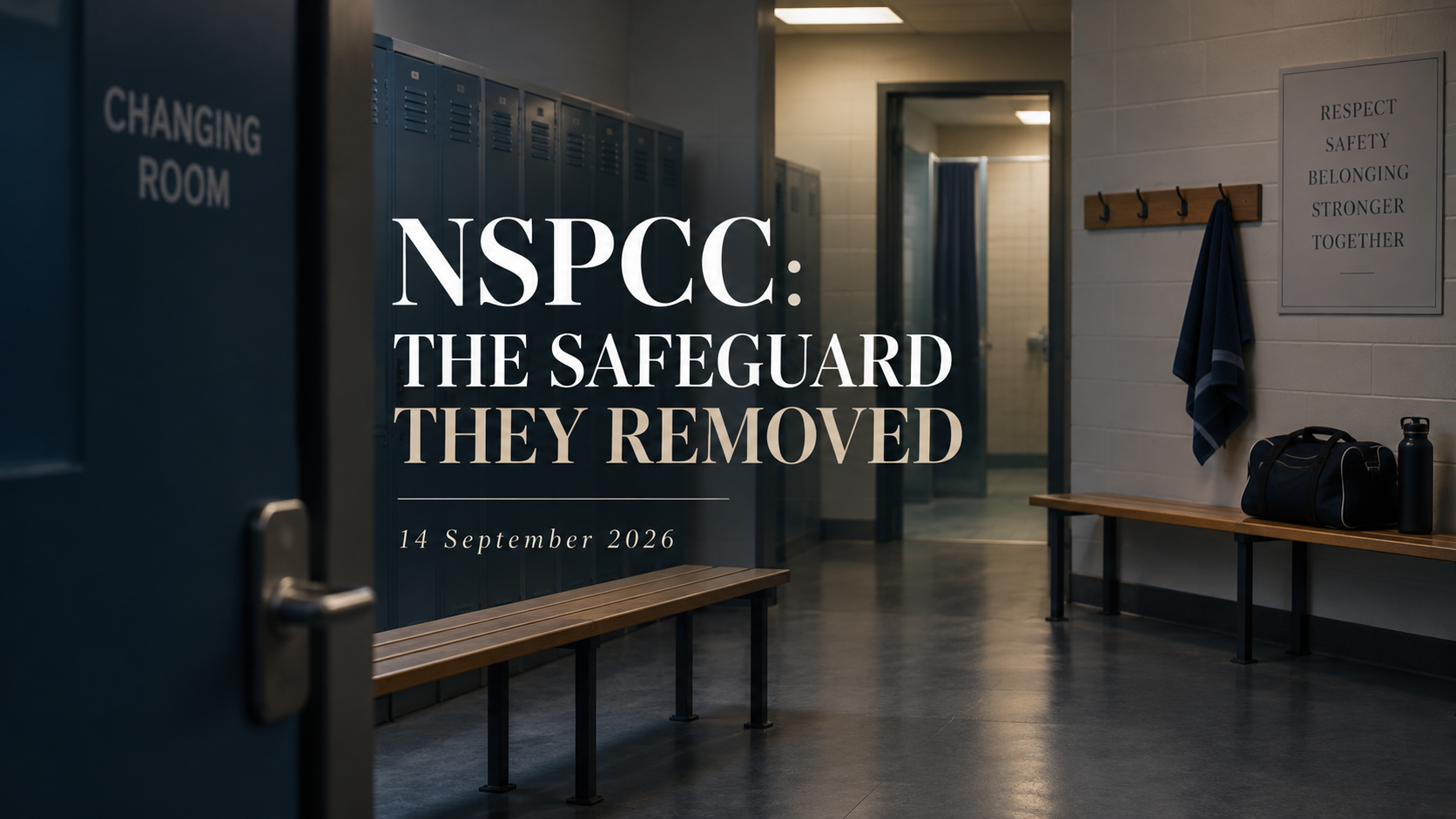
The NSPCC has quietly removed its former recommendation that children changing clothes should, where possible, be supervised by adults of the same sex. Yet in the very same month, NSPCC Sport retained precisely that safeguard. Why has an elementary protection of children’s privacy disappeared from the charity’s schools guidance?
There was nothing difficult to understand about the sentence. In its previous guidance on school changing rooms, the NSPCC advised: “Where possible, the adults who are supervising children getting changed should be of the same gender as them.” The terminology was imprecise. The relevant distinction is sex, and after the Supreme Court’s judgment in For Women Scotland there is even less excuse for confusing sex with gender identity. But the safeguarding principle itself was perfectly clear. Where children were undressing, supervision should, where practicable, be provided by an adult of the same sex. The words “where possible” already supplied the necessary flexibility.¹
The sentence has gone.
The NSPCC’s new schools briefing, published in August 2026, contains detailed advice about supervision. Adults ordinarily need not remain in the changing room. They should remain within earshot, announce themselves before entering, give pupils an opportunity to cover themselves, refrain from standing watching children change and never change or shower in the same space as them. Those are sensible precautions. But among what the NSPCC expressly calls its principles of best practice, there is now no recommendation whatever that the supervising adult should, where possible, be of the same sex as the children.²
That is the fact which matters. Some reporting has described the change as the NSPCC saying that male teachers may supervise girls while they change. Strictly speaking, that goes beyond what the document says. The NSPCC has not issued an instruction that men should supervise girls, nor has it positively recommended opposite-sex supervision. The change is both narrower and more revealing: a child-protection charity has deliberately removed a previous safeguarding presumption in favour of same-sex supervision and has put nothing in its place.
Why it did so becomes considerably harder to understand when one turns from NSPCC Learning to NSPCC Sport.
On 6 August 2026, NSPCC Sport updated its own guidance on changing facilities. That guidance still says that where mixed use of a changing facility by adults and children cannot be avoided, at least two members of staff “of the same sex as the children” should supervise the group.³ During the same month, therefore, the same organisation was telling sporting bodies that the sex of supervising adults matters while publishing schools guidance from which the corresponding safeguard had disappeared.
This is not a dispute between two charities with different philosophies. It is an internal contradiction inside the NSPCC.
Nor can the change readily be explained as following the direction of government safeguarding policy. Keeping Children Safe in Education 2026, which came into force on 1 September, moves explicitly in the opposite direction. Schools must not allow a child aged eleven or over at the start of the school year to undress in front of a child of the opposite biological sex. Changing accommodation and showers must be suitable having regard to pupils’ ages, numbers and sex. A school responding to a request for social transition must not allow a child to use changing rooms designated for the opposite sex. Where a gender-questioning child does not wish to use the facilities provided for his or her sex, an alternative should be considered without compromising the safety, comfort, privacy or dignity of that child or of other children.⁴
The Government has therefore recognised something elementary: sex matters especially where people are undressing.
The Supreme Court supplied the legal clarity which ought to have made revision of the old NSPCC wording remarkably simple. In For Women Scotland Ltd v The Scottish Ministers, the Court unanimously held that “man”, “woman” and “sex” in the Equality Act 2010 refer to biological sex. Its reasoning expressly recalled the longstanding legal recognition that where people undress together, live together or use sanitary facilities, considerations of privacy and decency can justify separate provision for men and women.⁵ The obvious correction to the NSPCC’s former sentence was consequently not deletion but amendment: replace “gender” with sex.
Instead, the safeguarding principle disappeared.
The anomaly becomes sharper when one considers another ordinary school procedure. Where a pupil is searched under the statutory powers governing prohibited items, the member of staff conducting the search must normally be of the same sex as the pupil, with another member of staff present as a witness. There is a tightly drawn exception where delay would create a risk of serious harm and a same-sex member of staff cannot reasonably be summoned. The pupil ordinarily cannot be required to remove more than outer clothing.⁶ Thus Government safeguarding guidance, reflecting statutory search powers, preserves a same-sex safeguard where a child remains substantially dressed, while the NSPCC has ceased even to recommend the same presumption where children may be removing virtually all their clothes.
That is not an argument that male teachers constitute a danger to girls, any more than the rules governing searches imply that teachers conducting them are presumptively predatory. Safeguarding rules exist precisely because prudent institutions do not make protection depend upon confident predictions about the virtue of particular individuals. Boundaries protect children; they also protect adults. A male teacher should not casually be placed in a situation in which adolescent girls are undressed in his presence, just as a female teacher should not unnecessarily be placed in the equivalent situation with boys. Avoiding such circumstances reduces embarrassment, protects privacy, removes unnecessary opportunity and diminishes the possibility of misunderstanding or allegation.
The old rule did all of that without being absolute. “Where possible” mattered. An emergency is an emergency. A disabled child may have established intimate-care arrangements. Staffing realities sometimes produce unavoidable situations. Nobody sensible requires a teacher to wait outside while a child is being injured because the available teacher happens to be of the opposite sex. Good safeguarding distinguishes exceptional necessity from ordinary practice. The deleted NSPCC sentence did precisely that.
The new briefing itself recognises the sensitivity of the setting. Getting changed, it says, can make children feel vulnerable and anxious. It warns that changing rooms can become locations for bullying and harmful sexual behaviour. It requires respect for privacy and dignity, recognises the needs of children from different religious and cultural backgrounds, and advises particular care when assistance involves underclothes or swimming costumes.² All of this makes the omission more conspicuous. The document understands that undressing creates vulnerability. It simply no longer regards the sex of the supervising adult as a best-practice consideration.
For many children that distinction is not theoretical. An adolescent girl may object to undressing before an unrelated man without possessing a pathology, political opinion or special safeguarding history. A boy may feel precisely the same embarrassment before a woman. Children who have suffered sexual abuse may experience the matter more intensely. Religious modesty may make it especially important. Puberty itself makes bodily exposure acutely sensitive. None of these children should have to construct a sophisticated case before adults acknowledge that privacy between the sexes is a reasonable human boundary.
Catholic moral thought has never regarded modesty as hatred or embarrassment concerning the body. Its purpose is almost the reverse. The body belongs to the person and therefore is not public property. Privacy is one expression of human dignity. A culture which treats reluctance to undress before the opposite sex as an inhibition to be overcome has not become more respectful of the body; it has forgotten why privacy matters.
The circumstances surrounding the change require explanation as well. According to the Daily Mail reporting subsequently discussed by the Daily Sceptic, the NSPCC initially said that it had changed its advice after a similar recommendation was removed from Department for Education guidance. The Department reportedly denied that it had removed such a recommendation. The NSPCC subsequently said that its decision had been informed by a “variety of sources” and denied that the revision resulted from external lobbying.⁷
That denial should be recorded. There is no evidential basis at present for asserting as fact that transgender campaigners forced the NSPCC to remove the sentence. An editorial which claims more than can be demonstrated merely makes it easier to evade the question which can be demonstrated.
The documentary question is formidable enough.
What evidence showed that the former recommendation was unsound? What safeguarding disadvantage arose from asking for same-sex supervision “where possible”? Why did NSPCC Sport retain the principle in August while NSPCC Learning removed it in August? If Department for Education policy was the reason, which provision required or justified the deletion? If it was not, what were the other “sources” upon which the NSPCC relied? And if the problem was merely the former document’s use of the word “gender”, why was the solution not to correct the word to “sex”?
A safeguarding organisation ought to be able to answer those questions without difficulty.
Nuntiatoria has returned repeatedly this year to a larger institutional problem of which this is a small but revealing example. In “When the Law Is Ignored: Schools, Safeguarding, and the Reassertion of Reality”, we argued that schools and public bodies had too often allowed policy fashion and administrative interpretation to obscure distinctions already present in law, particularly the distinction between biological sex and gender identity.⁸ More recently, in “Safeguarding Outside the Law”, we examined a different but related inversion: elaborate systems for safeguarding children can coexist with practices which fail the most elementary test of prudent protection.⁹
The lesson is not that complicated safeguarding architecture is unnecessary. Children’s protection sometimes demands specialist knowledge, multi-agency cooperation, information sharing, professional judgement and careful statutory procedure. But a system becomes strangely distorted when complexity begins to displace common prudence rather than support it.
Britain has learnt this at enormous cost. Its major child-protection scandals repeatedly involved information being available but discounted, boundaries being weakened, obvious concerns being rationalised and adults becoming more anxious about institutional consequences than about what was happening immediately before them. No serious comparison should be made between every questionable policy decision and the horror of organised sexual exploitation. The relevant lesson is narrower: safeguarding fails when ordinary protective instincts are treated as intellectually embarrassing obstacles to more fashionable priorities.
The sex distinction in changing rooms is not an obscure ideological doctrine. The Government recognises it between children. The Supreme Court recognises the legal reality upon which it rests. Statutory powers recognise it when pupils are searched. NSPCC Sport recognises it when children are changing. Schools around the country incorporated the NSPCC’s former recommendation into their own safeguarding policies precisely because it was intelligible, proportionate and easy to apply.¹⁰
Only the NSPCC’s new schools briefing has decided that the principle need no longer be said.
There is still an opportunity to correct this. The NSPCC says that it is awaiting updated technical guidance for schools from the Equality and Human Rights Commission.² When that process is complete, it should restore the safeguard in language which no longer confuses sex and gender: where supervision of children changing is required, it should, wherever reasonably practicable, be undertaken by an adult of the same sex as the children concerned, subject to genuine emergencies and properly assessed individual care requirements.
That would not stigmatise transgender pupils. It would not accuse male teachers of predatory intent. It would not prevent schools responding sensibly to emergencies. It would merely restore a presumption which reflects the law’s recognition of sex, children’s reasonable expectations of privacy and the NSPCC’s own continuing practice in sport.
Safeguarding organisations rightly ask schools to risk-assess almost everything. Staff are vetted. Procedures are written. Concerns are recorded. Incidents are escalated. Policies are reviewed. Training is refreshed. All of this rests upon the principle that risks should be reduced where they can reasonably be foreseen.
A child undressing in a changing room is not an abstract risk environment. She is a child without her clothes on.
Sometimes safeguarding really is that simple.
The NSPCC used to say so in one sentence.
It should explain why it removed it.
¹ NSPCC Learning, Safeguarding considerations for changing rooms — earlier schools briefing, archived copy.
² NSPCC Learning, Safeguarding considerations for changing rooms — Schools briefing, August 2026.
³ NSPCC Sport, Safe use of changing facilities, updated 6 August 2026.
⁴ Department for Education, Keeping Children Safe in Education 2026, in force from 1 September 2026.
⁵ UK Supreme Court, For Women Scotland Ltd v The Scottish Ministers [2025] UKSC 16, 16 April 2025.
⁶ Department for Education, Searching, Screening and Confiscation in Schools, July 2022.
⁷ Daily Sceptic, Fury as NSPCC Say Male Teachers Can Supervise Girls in Changing Rooms, 14 September 2026, reporting the Daily Mail account and NSPCC response.
⁸ Nuntiatoria, When the Law Is Ignored: Schools, Safeguarding, and the Reassertion of Reality, 5 June 2026.
⁹ Nuntiatoria, Safeguarding Outside the Law, 11 September 2026.
¹⁰ Eaton House Schools, Intimate Care and Toileting Policy, reproducing the earlier NSPCC same-gender recommendation.






Leave a Reply