
A PUB AND A PRINCIPLE: IDEOLOGY, EQUALITY LAW, AND THE RIGHT TO PUBLIC LIFE
A Cambridge student refused service over lawful beliefs
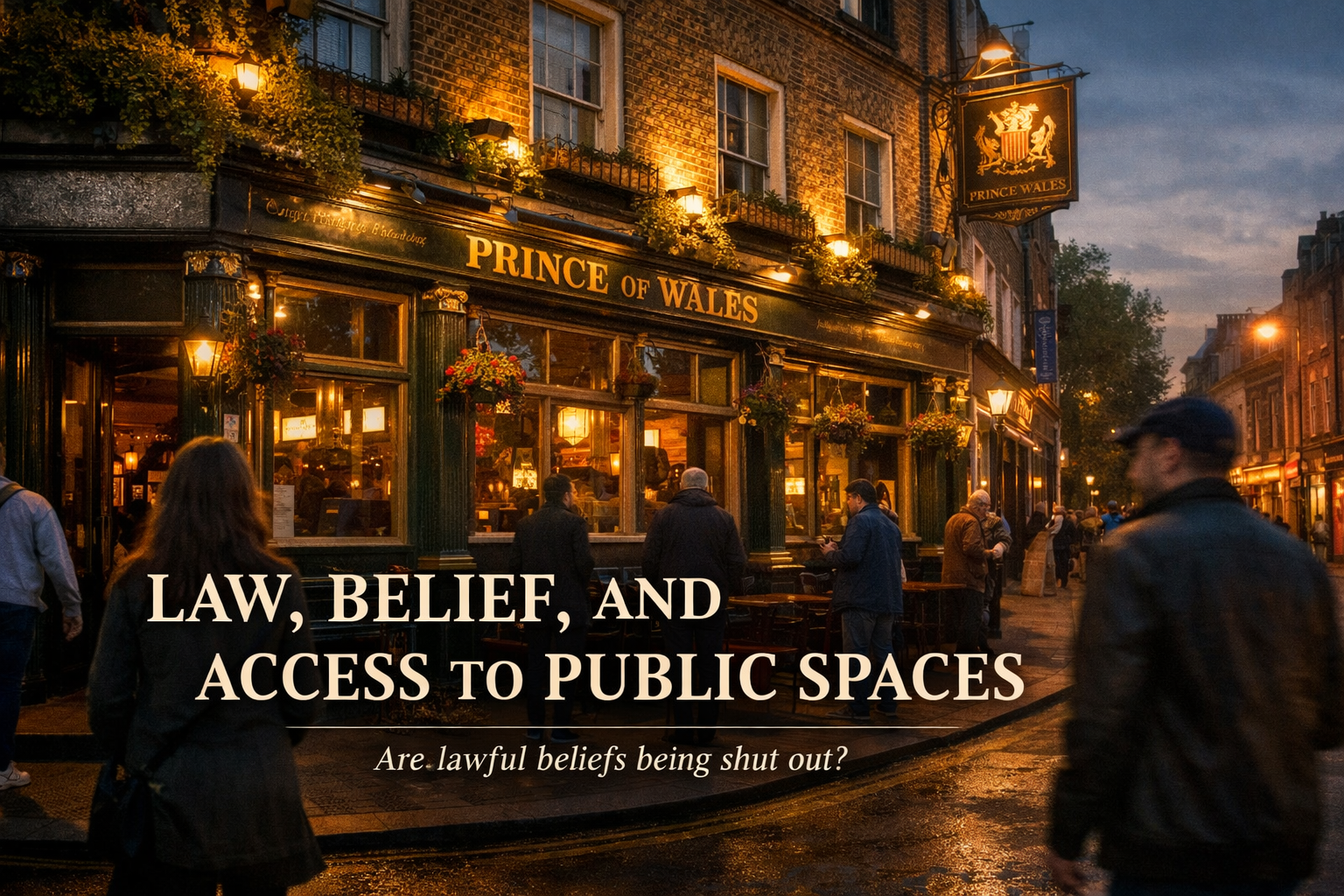
In January 2026, Thea Sewell, a philosophy student at the University of Cambridge and founder of the Cambridge Society of Women, alleged that she was refused service and told she was “not welcome” at her local pub, the Prince of Wales in Clapham, south London. According to Sewell, bar staff declined to serve her on the basis of her gender-critical beliefs, citing discomfort and concern for others present. When she returned later seeking clarification, she says the refusal was repeated.¹
Sewell has since issued a formal letter before claim, notifying the pub of her intention to pursue legal action unless an apology is issued and £2,500 in compensation is paid. The dispute has attracted wider attention because it engages settled questions of equality law rather than contested questions of social policy.
The legal framework: philosophical belief under the Equality Act 2010
The Equality Act 2010 prohibits discrimination in the provision of goods and services on the basis of protected characteristics, including religion or belief. The category of “belief” expressly includes philosophical belief, provided it satisfies the criteria established by the courts.²
These criteria, commonly known as the Grainger test, require that a belief be genuinely held; concern a substantial aspect of human life; attain a sufficient level of cogency, seriousness, and cohesion; and be worthy of respect in a democratic society. Crucially, the law does not require a belief to be popular, fashionable, or uncontroversial.
Gender-critical beliefs and binding legal precedent
The legal status of gender-critical beliefs was clarified authoritatively in the Employment Appeal Tribunal decision in Maya Forstater v Centre for Global Development Europe Ltd (2021). The Tribunal held that the belief that sex is biological and immutable is capable of protection under section 10 of the Equality Act.³
The judgment explicitly rejected the argument that such beliefs are inherently hateful or incompatible with human dignity. The Tribunal noted that the protection of belief in a pluralist democracy necessarily extends to views that others may find offensive. This ruling now functions as binding precedent in England and Wales.
Service provision and unlawful exclusion
If Sewell’s account is accurate, the alleged conduct of the Prince of Wales pub would fall squarely within what the Equality Act prohibits. A business open to the public may not refuse service or deny access because of a customer’s protected belief. Subjective discomfort, reputational anxiety, or ideological disagreement do not constitute lawful justification for exclusion.⁴
The law draws a clear distinction between belief and behaviour. While disruptive or abusive conduct may justify refusal of service, the mere holding or known expression of a protected belief does not.
Venue cancellations and the creeping normalisation of exclusion
The significance of the Sewell case extends beyond individual service refusal to a wider pattern increasingly evident across Britain: the cancellation of meetings, talks, and lawful events by venues citing “offence” at the views of invited speakers or organisers. Gender-critical groups in particular have seen rooms withdrawn, bookings cancelled, and contracts terminated after pressure campaigns alleging that their views render venues “unsafe” or “harmful.” Such justifications rest not on unlawful conduct, but on the mere existence of protected beliefs. This practice represents a quiet but consequential erosion of equality law, transforming public and quasi-public venues into ideological gatekeepers and reducing statutory protections to conditional privileges. If refusal of service or space can be justified by claimed offence alone, the right to participate in public life becomes contingent on conformity rather than law.⁵
Why this case matters beyond one pub
As Helen Joyce, director of advocacy at Sex Matters, has observed, cases such as Sewell’s expose a growing misunderstanding of equality law among service providers. There is an increasingly common — and legally erroneous — assumption that adherence to prevailing ideological norms may override statutory duties.⁶
The Sewell incident also reflects a broader cultural pattern. She has previously faced ostracism at Cambridge after fellow students discovered she possessed literature by gender-critical authors. What begins in universities as informal pressure now risks becoming informal exclusion from public life, enforced not by Parliament but by fear and misinformation.
The principle at stake
This dispute is not ultimately about pub management or campus politics. It is about whether equality law remains operative when beliefs are contested, or whether protection exists only for views deemed acceptable by dominant cultural currents.
Gender-critical beliefs are lawful. They are protected. Refusing service or access on that basis is not inclusion; it is discrimination. If the Equality Act is to retain credibility, it must apply most rigorously precisely where beliefs are unpopular.
A society in which one may be barred from ordinary public spaces for holding “perfectly ordinary, factual beliefs” is not advancing tolerance. It is quietly abandoning it.
¹ The Times, “Cambridge student banned from pub over transgender views,” January 2026.
² Equality Act 2010, c.15, s.10; Grainger plc v Nicholson [2010] ICR 360 (EAT).
³ Forstater v Centre for Global Development Europe Ltd [2021] UKEAT/0105/20.
⁴ Equality Act 2010, ss.29–31; Equality and Human Rights Commission, Services, Public Functions and Associations Statutory Code of Practice.
⁵ Equality Act 2010, s.29; EHRC guidance on indirect discrimination and provision of services; representative reporting on venue cancellations of gender-critical events in 2022–2025.
⁶ Helen Joyce, public statements reported in national press coverage of the Sewell case, January 2026.
RELATED ARTICLES


Latest ARTICLES
- Today’s homily: Christ the KingThe homily reflects on Christ’s kingship as seen in the Gospel narrative. It contrasts earthly authority with divine truth, emphasising that true allegiance to God requires genuine obedience and transformation. Believers are called to examine their personal commitments and respond to Christ’s demands in everyday life, ultimately recognising their identity as bearers of God’s image.
- Sermon for Christ the KingToday marks the celebration of Christ the King and the Twenty Second Sunday after Pentecost, a feast asserting Christ’s sovereignty against totalitarianism. St. Paul emphasised Christ’s supremacy over power and principalities, challenging early Gnostic beliefs. The early Church’s victory over evil is affirmed in Christ’s resurrection, offering hope and unity amidst contemporary struggles.
- Today’s Mass: October 25 SOVEREIGNTY OF OUR LORD JESUS CHRIST, SUPREME KINGThe Feast of the Sovereignty of Our Lord Jesus Christ celebrates Christ’s dual kingship by birth and conquest. Established by Pius XI, it aims to deepen faith and counter anti-clericalism. The liturgical observance underscores His authority as King, advocating for societal recognition of His reign to bring peace and harmony.
- TRADITION BEHIND THE FENCEThe Vatican’s prohibition of the traditional Ad Petri Sedem pilgrimage to St Peter’s Basilica has sparked controversy, especially among traditional Catholics. While some cite scheduling conflicts, the broader issue lies in the restrictive policies of Traditionis custodes, which may confine traditional liturgical practices to specific enclaves, risking the transmission and recognition of Catholic Tradition within the wider Church.
- Today’s Mass: October 24 St Raphael the ArchangelThe Feast of Saint Raphael the Archangel highlights his healing powers as depicted in the Book of Tobit, where he aids Tobit and his son, Tobiah. Venerated as a protector of travellers and the blind, Raphael is celebrated for his miraculous interventions. His legacy includes support for nurses, matchmakers, and Catholic studies.





Leave a Reply