
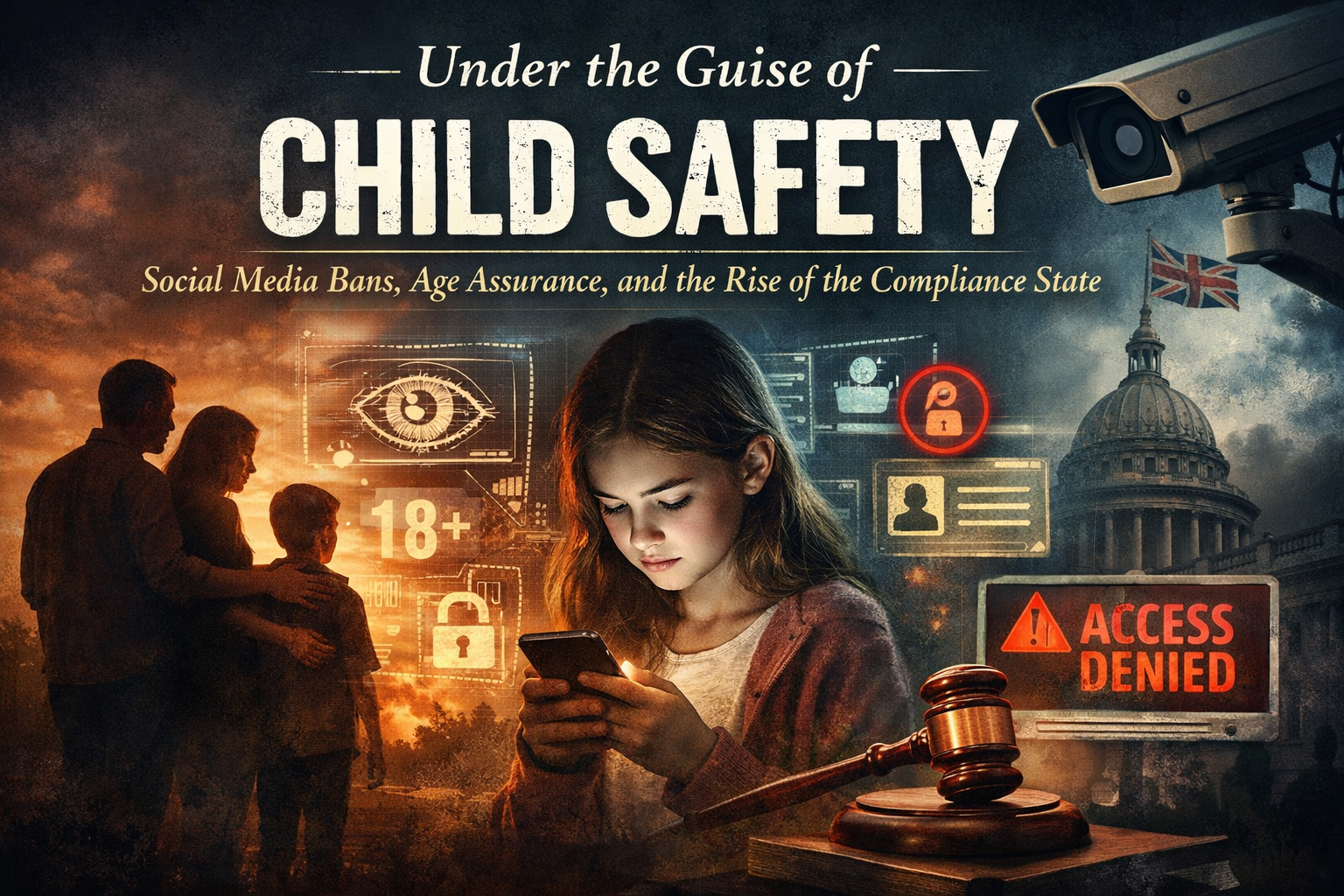
Under the Guise of Child Safety: Social Media Bans, Age Assurance, and the Rise of the Compliance State
The Government has launched a major new consultation on banning social media for under-16s.
In January 2026, the UK Government opened a three-month consultation examining children’s relationship with smartphones and social media, including the possibility of restricting or banning access to social media platforms for those under sixteen¹. The consultation builds on the framework of the Online Safety Act 2023, which already imposes far-reaching obligations on digital platforms to police content, behaviour, and access for minors².
The move follows increasing parliamentary pressure after the House of Lords voted in favour of amendments advocating a ban on social media use by under-16s, signalling growing cross-party unease about the effects of online environments on children³. Ministers have framed the consultation as a response to parental concern, high-profile tragedies, and mounting evidence of harm.
Child safety matters — and parents are right to be alarmed.
There is no denying the scale of the problem. Parents witness daily the anxiety, addiction, sleep disruption, and social withdrawal associated with compulsive social media use. Exposure to pornography, violent imagery, and algorithmically amplified content is no longer exceptional but routine. Campaigners such as Esther Ghey, following the murder of her daughter Brianna, have publicly called for urgent action to prevent further harm linked to online platforms⁴.
Nor is concern limited to overtly illegal material. Of particular alarm to many families is the rapid spread of gender ideology, where confused adolescents are exposed to content that normalises medicalisation and identity experimentation, often delivered via algorithmic feeds optimised for engagement rather than truth or wellbeing⁵.
Yet it is precisely here that the discussion becomes more complex — and more dangerous.
A ban requires enforcement, and enforcement requires surveillance.
Any meaningful social media ban for under-16s would require enforcement mechanisms. In practice, this means identity verification, age-assurance technologies, and content-classification systems capable of determining who may access what, and on what terms.
Under the Online Safety Act, platforms are already required to deploy “highly effective age assurance” measures to prevent children from accessing harmful content⁶. Ofcom has confirmed that such systems may include document verification, biometric estimation, or third-party identity services — all of which expand the infrastructure of digital monitoring.
This marks a significant shift. Under the guise of child protection, the State is constructing a framework that risks transferring authority from parents to regulators and compliance systems. Where families once exercised discretion within the home, digital access is increasingly adjudicated by bureaucratic and technological mechanisms beyond parental control.
The first warning sign: penalties without limits.
When pressed on how a ban would be enforced, senior ministers have conspicuously avoided ruling out penalties for non-compliance. Then-Technology Secretary Peter Kyle declined to give assurances that families would not face sanctions, stating that “everything is on the table”⁷.
This ambiguity matters. It opens the door to what may function, in effect, as a Parent Tax: while technology companies profit from addictive design and ideological capture, responsibility — and potential punishment — risks being displaced onto families who fail to police access perfectly.
The second threat: who defines ‘harm’?
The justification for these powers rests on the concept of protecting children from “harm”. Yet in 2026, harm is no longer a neutral or self-evident category.
Under current regulatory guidance, harm extends well beyond criminal content to include psychological impact, emotional offence, and exposure to views deemed inappropriate for age⁸. Such categories are inherently subjective and increasingly shaped by prevailing ideological norms.
To the modern progressive bureaucrat, harm can include dissent from identity politics or traditional moral teaching. If regulators are empowered to filter harmful speech, it is not difficult to imagine a future in which pro-marriage or pro-family views are restricted, while LGBT-affirming content is protected as “inclusive”.
This is not a hypothetical risk.
In Cardiff, teaching assistant Ben Dybowski was removed from his post after expressing orthodox Christian beliefs — including the view that marriage is between a man and a woman — in a private, staff-only forum. The school subsequently informed parents that his removal was linked to “possible safeguarding issues”⁹.
The episode is revealing. When traditional beliefs are framed as safeguarding threats within educational institutions, the incentives are already in place for digital regulators to follow the same logic. Once belief itself is treated as risk, censorship becomes a moral duty.
Why the State is stepping in: the collapse of marriage and authority.
The deeper cause of this moment is not technological but social. The State is attempting to fill a vacuum created by decades of policy that have systematically undermined marriage and paternal authority.
Marriage is the institution that makes parental authority durable: two adults, bound, united, accountable — providing stability, moral formation, and protection for children. As fathers have been rendered optional and family structures weakened, authority in the home has eroded¹⁰.
Into that void steps the State, proposing itself as the Digital Father — impersonal, bureaucratic, and increasingly hostile to traditional moral frameworks.
Conclusion: child safety cannot be severed from moral anthropology.
The Government’s consultation raises legitimate questions about children and technology. But safeguarding children cannot be reduced to technical controls and regulatory enforcement.
Without a robust defence of parental authority, a clear and objective definition of harm, and firm limits on state power, we risk exchanging one set of harms for another. Addiction may be curbed — only to be replaced by a compliance regime that surveils families, penalises belief, and reshapes childhood according to ideological norms.
True child protection begins not with bans, but with the restoration of marriage, the reinforcement of parental responsibility, and the recognition that the State is not — and must never become — the moral custodian of the home.
¹ UK Government, Government to drive action to improve children’s relationship with mobile phones and social media, January 2026.
² Online Safety Act 2023, c.50 (UK).
³ House of Lords, debates and votes on social media age restrictions, January 2026.
⁴ The Guardian, “UK must ‘move now’ to ban social media for under-16s, says Brianna Ghey’s mother,” 28 January 2026.
⁵ Cass Review, Independent Review of Gender Identity Services for Children and Young People, interim findings and evidence summaries.
⁶ Ofcom, Protecting children: age assurance and children’s access to online services, regulatory statement.
⁷ Parliamentary statements reported during scrutiny of Online Safety Act enforcement, January 2026.
⁸ Ofcom, Online Safety Risk Assessment Guidance, sections on psychological and developmental harm.
⁹ Reported UK employment and education safeguarding case, Cardiff, 2024–2025.
¹⁰ Office for National Statistics, Families and households in the UK; Institute for Fiscal Studies, analyses on family stability and child outcomes.
RELATED ARTICLES


Latest ARTICLES
- Today’s Mass: October 24 St Raphael the ArchangelThe Feast of Saint Raphael the Archangel highlights his healing powers as depicted in the Book of Tobit, where he aids Tobit and his son, Tobiah. Venerated as a protector of travellers and the blind, Raphael is celebrated for his miraculous interventions. His legacy includes support for nurses, matchmakers, and Catholic studies.
- 25.10.26 Nuntiatoria CXXIX: CHRISTUS REXThe text discusses the relationship between Christ’s kingship and authority within the Church amidst contemporary challenges. It contrasts ecclesiastical power with genuine faith, emphasising that authority must protect divine truth rather than alter it. The witness of imprisoned priests illustrates the enduring significance of fidelity to Christ over institutional conformity.
- THE DOMESTIC CHURCH: 25 October – 2 November 2026 A Home with Room for Heaven: Preparing for All Saints and All SoulsThe content outlines a week’s plan for traditional Catholic families to prepare for the feasts of All Saints and All Souls. Emphasising daily prayers, remembrance of the deceased, and engagement with children’s activities, it aims to integrate Catholic customs into family life, enriching spiritual practices and fostering a shared faith experience.
- ORDO w/c 25.10.26The text outlines the liturgical calendar for the last week of October and the beginning of November, highlighting key celebrations. Notable events include the Feast of Christ the King, St Evaristus, the Vigil of Saints Simon and Jude, and the Feast of All Saints, emphasising themes of holiness, unity in faith, and the Church’s teachings.
- Christ the King: The Sovereignty of the Crucified RedeemerThe Mass of Christ the King articulates core Catholic beliefs about Jesus’ divine authority, redemptive sacrifice, and the essence of His Kingdom. It emphasises Christ as Prophet, Priest, and King, whose sovereignty is inseparable from His mission of reconciliation, calling the faithful to acknowledge His authority and embrace moral duties rooted in divine truth.



Leave a Reply