
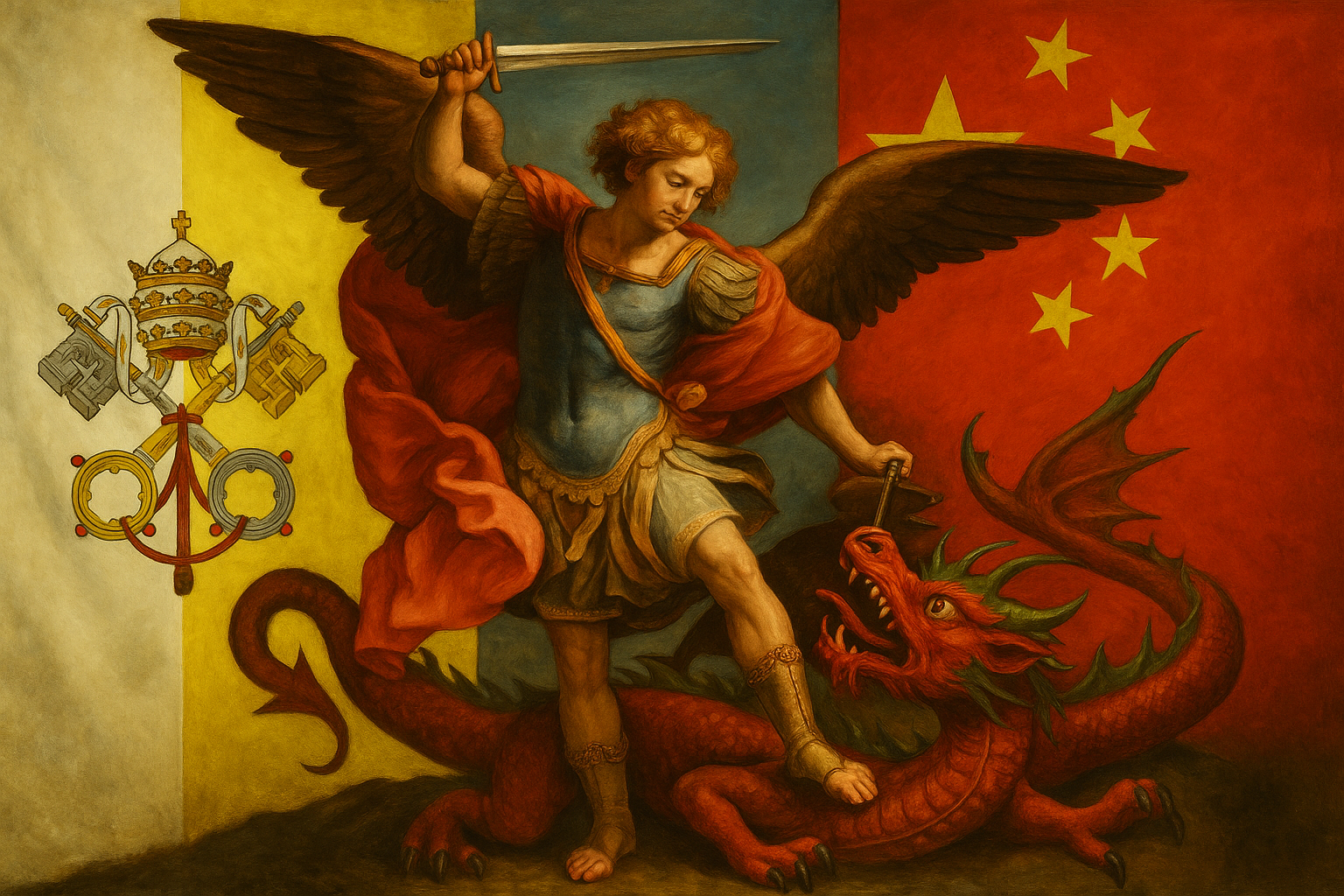
Bishop Julius Jia Zhiguo: The Underground Shepherd of Zhengding
Bishop Julius Jia Zhiguo, one of the most steadfast defenders of China’s persecuted underground Church, passed into eternal rest on October 29, 2025, aged 91. His funeral will be held on October 31 in his native Jinzhou, where his life of extraordinary fidelity began.
Born in Wuqiu Village, Jinzhou, Bishop Jia’s journey was one of hidden sanctity and heroic endurance. Arrested for the first time in 1963, he spent nearly fifteen years in prison for refusing to renounce his communion with the Roman Pontiff. When released, he resumed his priestly ministry undaunted, and in 1980 was ordained a priest. A year later, Bishop Joseph Fan Xueyan of Baoding — himself a confessor of the faith — secretly consecrated him Bishop of Zhengding, thus ensuring apostolic succession within the underground Church that remained faithful to Rome.

For more than four decades, Bishop Jia bore the weight of persecution with courage and serenity. He consistently refused to join the state-controlled Chinese Patriotic Catholic Association (CPCA), viewing it as incompatible with fidelity to the See of Peter. His defiance came at a cost: over ten arrests, prolonged surveillance, and recurring harassment. Reports from those close to him tell of his suffering in prison, where authorities at one point flooded his cell with water, causing lasting injuries that afflicted him throughout his life.
International attention to his plight first arose in 2004, when his sudden disappearance in Hebei Province provoked widespread concern. The Cardinal Kung Foundation in Connecticut successfully campaigned for his release, but detentions continued in 2008, 2009, and again in 2020, just before the Feast of the Assumption. Even in advanced age, he remained under scrutiny for his steadfast refusal to compromise with the regime.
Yet his life was not only marked by resistance, but by love. Deeply moved by the plight of abandoned children, Bishop Jia founded an orphanage in Hebei, caring personally for those whom society had cast aside. The authorities later demolished the home in 2020, citing lack of state approval — a symbolic act against a man whose entire ministry defied state control.
The Diocese of Zhengding, in northern China’s Hebei province, remains one of the largest Catholic communities in the nation, with an estimated 1.5 million faithful — most belonging to the underground Church that has not accepted government registration, even after the 2018 Sino-Vatican provisional agreement on episcopal appointments. Bishop Jia’s life embodied that fidelity. To the end, he stood as a living witness to the truth that “we must obey God rather than men” (Acts 5:29).
The Church in China: Between Two Altars
The history of the Catholic Church in China is a chronicle of both remarkable growth and relentless persecution. Catholicism first took root in China through the Jesuit missions of the sixteenth and seventeenth centuries, notably through figures such as St. Francis Xavier and Matteo Ricci. However, under the communist regime established in 1949, the Church faced a new and systematic campaign of control.
In 1957, the Chinese Communist Party created the Chinese Patriotic Catholic Association (CPCA) to sever the Church from the Vatican’s authority, enforcing what it termed the “independent, self-governing Church.” Bishops were appointed without papal mandate, and clergy were pressured to pledge loyalty to the Party above the Pope. Those who refused — such as Bishop Jia and many others — formed the so-called “underground Church,” remaining loyal to Rome at immense personal risk.
The Cultural Revolution (1966–1976) brought further devastation. Churches were desecrated, clergy imprisoned, and religious practice virtually outlawed. Yet the underground Church survived in secret, its faith transmitted through families and clandestine gatherings. By the 1980s, as China cautiously reopened, the Church began to reemerge — but divided between the “official” CPCA-approved hierarchy and the underground communities that continued to recognize papal authority.
The 2018 provisional agreement between the Holy See and Beijing on the appointment of bishops was presented as a diplomatic bridge, aiming to unify these two communities. However, its terms remain undisclosed, and reports from China indicate that persecution has not ceased. Indeed, in provinces such as Hebei, Fujian, and Shanxi, underground clergy have faced intensified pressure to register with state authorities under the “Sinicization” policy — an ideological campaign seeking to align all religions with socialist values and the leadership of the Communist Party.
In 2023, the Vatican’s Secretariat of State acknowledged “unilateral” actions by the Chinese government in appointing bishops without papal consultation, violating the spirit of the agreement. Despite this, Rome has maintained the pact, citing hopes for dialogue and gradual normalization. Critics, however, both within and outside China, argue that it has instead weakened the underground Church by removing the moral protection of Vatican protest.
For faithful Catholics like Bishop Jia, this conflict between conscience and compliance defined an entire lifetime. His defiance was not political but theological: a conviction that Christ’s Church cannot be remade by any earthly power. He personified the Church’s cruciform vocation in China — enduring persecution without hatred, practicing charity amid oppression, and offering silent witness to the invincible sovereignty of God.
As the underground Church continues its quiet endurance, Bishop Jia’s passing marks the close of a generation of confessors — those who bridged the era of open persecution with the present struggle for fidelity under compromise. His example remains a living catechism in perseverance, courage, and the unyielding primacy of divine truth over human coercion.
- Cardinal Kung Foundation, press releases and reports (2004–2020).
- AsiaNews, “Mgr Julius Jia Zhiguo, the underground bishop who suffered persecution and imprisonment,” 30 Oct 2025.
- Union of Catholic Asian News (UCAN), reports on Bishop Jia’s detentions, 2004–2020.
- Provisional Agreement between the Holy See and the People’s Republic of China on the Appointment of Bishops, 22 September 2018.
- Vatican Secretariat of State Statement, 24 November 2023.




Leave a Reply