
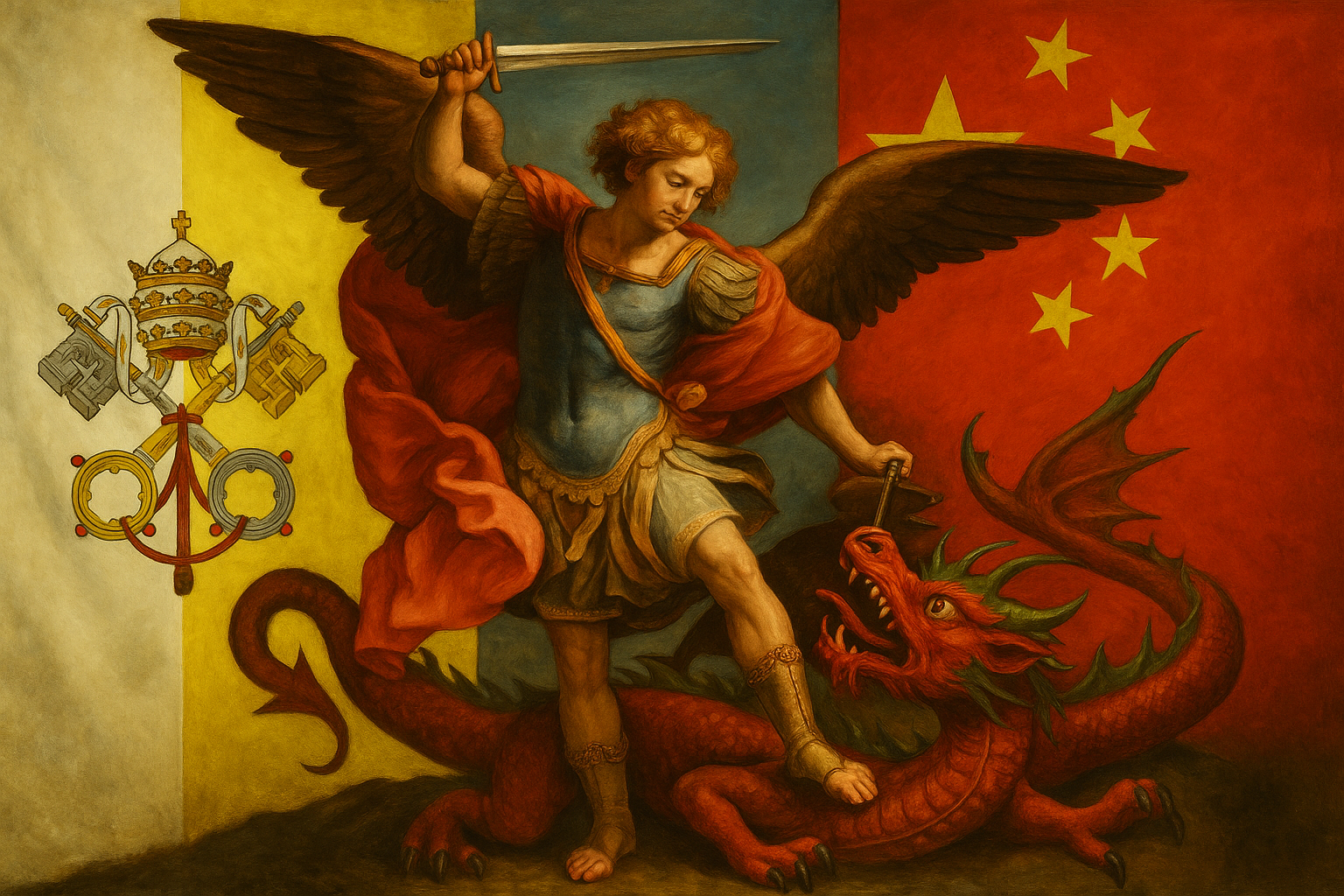
China’s Crackdown on Faith: The War Against Online Worship
China is waging a new war on religion — one fought not only in churches and cathedrals but in cyberspace. Over recent months, the Communist regime has launched its largest campaign in four decades against Christian leaders, arresting pastors, priests, and lay catechists under a novel pretext: “illegal use of information networks.”
The timing of this repression is not accidental. It follows months of growing unease within the Chinese Communist Party (CCP) over what it perceives as the “foreign infiltration” of culture through online platforms. Religion, long seen by the regime as an unpredictable and transnational force, is being treated as the most subversive of all such infiltrations. The Party’s ideological agencies have begun to speak of “digital contagion” — the spread of belief, hope, and community beyond state channels. The new laws seek to disinfect the internet of precisely that vitality.
Between 9 and 11 October 2025, police across Beijing, Shanghai, Zhejiang, Guangdong, Guangxi, Sichuan, and Henan carried out coordinated raids against the country’s most prominent unregistered Protestant network, Zion Church, and its affiliates.¹ Reuters, Human Rights Watch, and ChinaAid each confirm that the church’s founder, Pastor Jin Mingri — known internationally as Ezra Jin — was detained in Beihai, Guangxi, together with more than thirty colleagues.² The move, described by The Economist as “the most expansive crackdown on a single church for some forty years,” signals a new frontier of control: online faith.³
The detentions followed weeks of surveillance and intimidation. Witnesses in several provinces reported unmarked vehicles parked outside church members’ homes, while social-media accounts connected to Zion Church suddenly went dark. One by one, group administrators disappeared from WeChat and Telegram channels. When officers finally arrived, they confiscated laptops and mobile phones before taking pastors into custody. For many believers, the night of 9 October will be remembered as the moment China’s hidden Church entered its digital Gethsemane.
From the pulpit to the network
Since 2021, Beijing has tightened regulation of online religious activity through a series of measures culminating in the Online Code of Conduct for Religious Professionals (September 2025).⁴ Livestreamed homilies, prayer groups, or Bible studies now require prior approval from the State Administration for Religious Affairs; unregistered activity constitutes an “illegal transmission of religious information.”
These laws have effectively outlawed spontaneity in worship. Every pastor’s message must first pass through the sieve of ideological loyalty; every prayer offered publicly must echo the Party’s moral tone. The irony, as several observers have noted, is that even as China presents itself as the world’s technological vanguard, it is attempting to recreate a medieval censorship over the soul.
Zion Church’s vast digital footprint made it a natural target. Founded in 2007 and officially banned in 2018 for refusing state surveillance cameras, it survived by migrating online during the pandemic. Tens of thousands joined its livestreams and chat groups, forming a national fellowship that existed beyond Party oversight. “They could shut our building, but not our communion,” one member told The Independent before the October raids.⁵
For the state, this was intolerable. Christianity’s ability to generate communities of trust without permission, to create invisible networks of solidarity, threatened the social control on which the Party’s legitimacy depends. By invoking “information-network” laws rather than “illegal assembly,” authorities signalled that Christianity’s digital networks themselves are now viewed as subversive — faith as encryption.
The Catholic underground
The crackdown does not end with Protestant communities. The underground Catholic Church, which refuses allegiance to the government-run Chinese Patriotic Catholic Association (CPCA) and remains loyal to the Holy See, faces equal or greater repression.
This struggle has deep roots. Ever since the Communist victory in 1949, the Church in China has been divided between the official “Patriotic” church — whose bishops are chosen under Party supervision — and the underground faithful who recognise papal authority. The 2018 Vatican-China provisional agreement on episcopal appointments was meant to reconcile these hierarchies, yet persecution of loyal bishops has intensified. Human Rights Watch has documented that priests and nuns who reject CPCA registration continue to suffer detention, surveillance, and forced “re-education.”⁶
A 2024 Hudson Institute dossier lists ten bishops imprisoned or missing, including Augustine Cui Tai (Xuanhua, Hebei), Julius Jia Zhiguo (Zhengding, Hebei), and Joseph Zhang Weizhu (Xinxiang, Henan).⁷ National Catholic Reporter verified that Bishop Zhang and seven priests were arrested in May 2021 for conducting seminary formation without CPCA approval.⁸ In Wenzhou, Bishop Peter Shao Zhumin has been repeatedly detained since 2018 for refusing to celebrate state-approved liturgies; local sources told Catholic News Agency he remains under tight surveillance.⁹
The underground clergy endure the same tactics of attrition that broke so many dissidents during the Cultural Revolution: endless “study sessions,” isolation from their flocks, confiscation of property, and demands for public recantation. Priests in Mindong, Tianjin, and Guangdong report constant pressure to “sinicise” their parishes: crosses removed, Marian images replaced, children’s catechesis banned. In some regions even online rosary groups have been disbanded as “unlicensed religious broadcasts.”¹⁰
For China’s Catholics, fidelity now means living between two excommunications — one threatened by the state, the other feared from Rome’s diplomatic caution. Yet, as the old missionary chronicles remind us, persecution often unites what politics divides.
Why Beijing fears online faith
Authoritarian regimes can close church doors; the digital age opens new ones. The internet allows Christians to gather, teach, and pray across provinces — a decentralised communion that defies the Party’s monopoly on association. Livestreamed worship, encrypted messaging, and digital catechism create what ChinaAid calls “the invisible Church,” a network that survives every demolition order.¹¹
In earlier decades, the authorities had only to bulldoze a church or intimidate a bishop. Today, they must hunt data flows, algorithms, and private group chats. The new catechism is coded, the new homily streamed. It is a form of spiritual underground railway, linking believers from Wuhan to Guangzhou, from university students to old villagers, all under the cover of digital night.
The charge of “illegal use of information networks” transforms evangelisation into cybercrime. To preach online is to challenge the state’s claim to define truth. The Party’s fear is therefore not technological but theological: that faith, freely shared, forms a moral order higher than ideology.
As one underground priest in Hebei told AsiaNews, “They can silence our voices, but not the signal between our hearts.” His words echo the early Christian cry, non possumus — we cannot comply when Caesar demands worship. The same defiance now travels through fibre-optic cables instead of catacombs.
The digital battlefield of belief
The battle for the soul of China now extends into servers and firewalls. The regime employs artificial-intelligence monitoring, facial-recognition cameras in churchyards, and keyword scanning to trace “unauthorised” religious content. Yet faith persists. From secret Masses in candle-lit rooms to encrypted Bible-study groups, Chinese Christians continue to proclaim the Gospel in digital catacombs as once they did in Roman ones.
Behind every confiscated laptop lies a testimony; behind every deleted file, an act of witness. What the authorities fail to understand is that suppression itself becomes proclamation. Each arrest tells the world that there is something in Christianity powerful enough to frighten an empire.
Lessons for the global Church
For Catholics and other Christians abroad, the lesson is both sobering and prophetic. The persecution of China’s faithful demonstrates how swiftly religious freedom can vanish when the state presumes to regulate belief. The Vatican’s silence may buy diplomatic time, but the bloodless martyrs of China remind the world that the Church’s authority is moral, not political.
China’s example also poses a warning to Western societies increasingly tempted to police thought under the banner of “safety” and “inclusion.” Once governments learn to define what may be said in the name of compassion, they soon decide what may be believed in the name of order.
In every era the Church has survived precisely where she seemed weakest. The faithful of China, deprived of sanctuaries and servers alike, bear witness that no algorithm can silence the Word of God. Their courage calls believers everywhere to remember that truth is not fragile, and that communion — whether by candlelight or by code — is indestructible.
Footnotes
¹ Reuters, “China detains dozens of underground church pastors in crackdown,” 13 Oct 2025.
² Human Rights Watch, “China: Nationwide Crackdown on Major Underground Church,” 14 Oct 2025; ChinaAid, “Update: China launches another sweeping crackdown on house churches,” Oct 2025.
³ The Economist, “China is rounding up Christian leaders,” 16 Oct 2025.
⁴ State Administration for Religious Affairs, Online Code of Conduct for Religious Professionals, Sept 2025.
⁵ The Independent, “After 30 arrested in raid on an underground church,” 17 Oct 2025.
⁶ Human Rights Watch, “Holy See: Review Vatican-China Agreement,” 12 May 2025.
⁷ Hudson Institute, Ten Persecuted Catholic Bishops in China, Oct 2024.
⁸ National Catholic Reporter, “Authorities in northern China arrest underground bishop, priests,” 25 May 2021.
⁹ Catholic News Agency, “Persecution of Ten Catholic Bishops Intensifies after Vatican-China Deal,” Oct 2024.
¹⁰ AsiaNews, “Guangdong Officials Seize Catholic Property and Disband Online Prayer Groups,” 2024.
¹¹ ChinaAid, Special Report on the 10.9 Church Persecution, Oct 2025.





Leave a Reply