
5.4 Billion People at Risk of Losing Freedom of Religion:
A Global Crisis of Faith and Conscience
The 2025 edition of Religious Freedom in the World, published by Aid to the Church in Need (ACN), presents one of the most sobering assessments of liberty in modern times: almost two-thirds of humanity—an estimated 5.4 billion people—now live under governments or social systems that deny or severely restrict their right to worship. The report, which covers the period 2023 – 2024 and analyses 196 countries, concludes that 62 nations commit “grave violations” of religious freedom, including 24 where persecution has reached a systemic or violent extreme¹.
Freedom under siege
The report identifies authoritarian regimes as the most formidable threat to faith in the twenty-first century. In at least 52 countries, religious communities are monitored, restricted, or criminalised through an expanding apparatus of surveillance and digital control². China remains the archetype of this new totalitarianism, its government deploying facial-recognition software to monitor church attendance and imprison pastors who refuse to register under state supervision. Nicaragua’s government has expelled religious orders, seized church property, and jailed bishops. In Eritrea and Iran, Catholics, Orthodox, and Protestants are imprisoned indefinitely for worshipping without state approval.
Beyond state repression, religious liberty is undermined by militant ideologies. Across sub-Saharan Africa, Islamist terror groups continue to massacre Christian villagers and destroy churches. In India and Myanmar, ethno-religious nationalism has become a pretext for mob violence and discriminatory laws. In Western nations, religious freedom faces subtler corrosion—cultural derision, bureaucratic harassment, and the gradual exclusion of faith from the public square. France recorded over a thousand anti-Christian incidents last year; Greece reported more than six hundred attacks on churches³.
The new tools of persecution
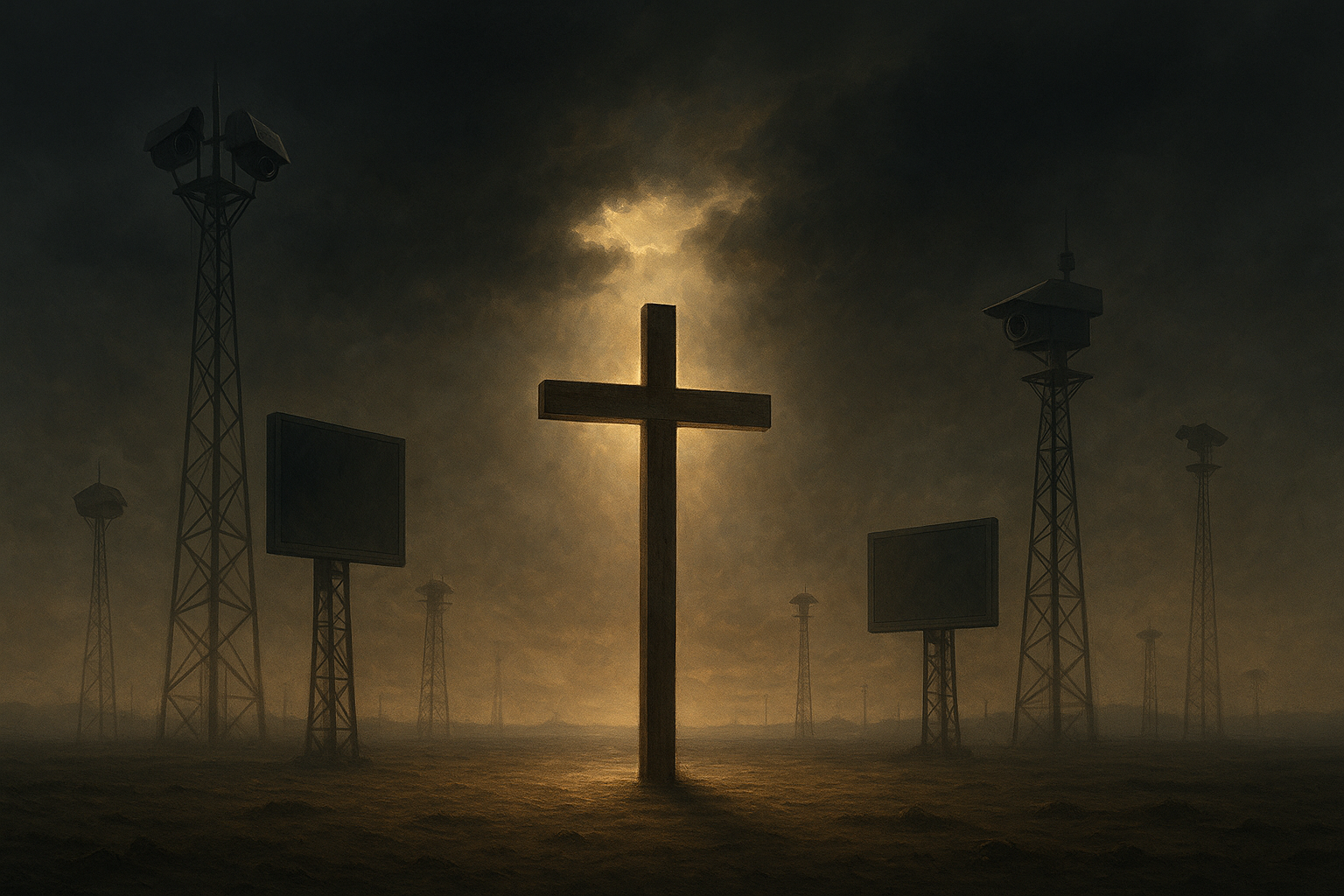
A particularly alarming trend is the fusion of political power and technology. Governments increasingly weaponise artificial intelligence, data harvesting, and digital identification systems to suppress dissent and regulate belief. The ACN report warns of “algorithmic persecution,” in which surveillance systems identify religious practice as a threat to social order⁴. In totalitarian contexts, the smartphone and camera tower have replaced the inquisitor’s cell.
Yet the same technological capacity that enables surveillance also mirrors a deeper theological crisis. The modern world seeks to measure and manipulate everything, yet cannot tolerate mystery. When faith in God is replaced by faith in systems, conscience becomes an inconvenience—and the soul, a dataset.
Faith in the shadow of empire
The Church has confronted such powers before. From Diocletian’s edicts to Stalin’s purges, the pattern remains constant: regimes that deny transcendence inevitably persecute those who profess it. The contemporary world, though armed with satellites rather than swords, wages the same war against the freedom of the soul.
The Old Roman Apostolate sees in this not despair but providence: the return of an ancient testing ground where fidelity is refined into sanctity. The Church must now recover the courage of her martyrs and confessors, proclaiming the Kingship of Christ over every ideology that claims dominion over man. For when Caesar demands the conscience, it is the Cross that answers.
The theology of freedom
True religious liberty, as the Church teaches, is not a moral relativism that licenses every belief, but the right of every person to seek and serve truth without coercion. It is the condition for authentic worship and moral order. Denied this freedom, society withers into tyranny, for it loses the principle by which law itself is judged.
Pope Pius XI warned in Quas Primas that when men “thrust Jesus Christ and His holy law out of their lives,” they find peace replaced by discord and nations “torn asunder by hatred and envy.” The ACN report proves that prophecy fulfilled. The crisis of religious freedom is not isolated; it is the symptom of a civilisation that has forgotten God.
Witness amid the ruins
For the faithful, statistics alone cannot suffice. The response must be prayer, penance, and solidarity. The Church’s witness begins wherever a believer refuses to deny Christ, even silently. Whether in an African village besieged by militants or a European city where faith is mocked, each act of fidelity becomes a spark in the encroaching dark.
Religious freedom is the outer garment of a deeper reality: the inviolable dignity of the human person made in God’s image. To defend that freedom is to defend humanity itself. In a world of control towers and empty screens, the light that falls upon the Cross still calls mankind to conscience, courage, and hope.
¹ Aid to the Church in Need, Religious Freedom in the World 2025 (London: ACN, 2025).
² The Tablet, “ACN Report Warns of Authoritarian Threat to Religious Freedom,” 21 October 2025.
³ The Catholic Herald, “5.4 Billion People at Risk of Living Without Freedom of Religion,” 22 October 2025.
⁴ Malay Mail, “Religious Freedom Under Siege as AI, Authoritarianism, and Hate Crimes Rise Globally,” 22 October 2025.





Leave a Reply