

Nuntiatoria begins a regular republication of two early twentieth-century Catholic guides to the formation of young men and women, edited for English-speaking readers by Fr Francis Xavier Lasance.
In 1906 Benziger Brothers published The Catholic Girl’s Guide, a substantial volume of instruction and devotion prepared by Fr Francis Xavier Lasance of Cincinnati. Four years later came its companion, The Young Man’s Guide. Their publishers did not imagine that a young Catholic’s religious education was completed by learning the answers to a catechism. A boy or girl entering adult life would encounter questions of friendship, employment, courtship, marriage, religious vocation, prayer, temptation and responsibility. The books were intended to accompany them through these decisions.
There is a useful point of authorship to establish at the outset. Both books drew heavily upon the work of Fr Coelestin Muff, O.S.B., a Benedictine of Einsiedeln. The conferences for girls had first appeared in German as Mit ins Leben; the companion for young men was based upon his Hinaus ins Leben. Lasance revised and adapted the English texts for American Catholic life and assembled the extensive material for prayer and devotion. These were works of pastoral collaboration across countries and languages, produced before Catholic formation came to be spoken of as though it required perpetual reinvention.
Their pages belong to a recognisable religious civilisation. The Mass, frequent confession, Holy Communion, devotion to Our Lady, respect for parents, diligence in work, and the discernment of one’s state of life are treated as practical obligations. More strikingly, the authors assume that religion ought to govern the whole of life, including those decisions which the modern reader might be disposed to regard as exclusively private. The authors are sometimes severe, sometimes affectionate, and occasionally more convinced of the force of an anecdote than a historian would be. Their immediate audience lived amid circumstances considerably different from ours. These are reasons for reading with intelligence; they are no justification for silently rewriting the books.
Nuntiatoria will therefore reproduce the original chapters in order, retaining their language and structure. Each instalment will identify its original source and page numbers. Where clarification is needed concerning historical claims, social circumstances, ecclesiastical legislation or indulgences, an editorial note will be plainly marked. The author’s words will remain the author’s. In particular, material concerning the Church’s discipline in 1906 or 1910 will not be presented without distinction as though every provision remains in force today.
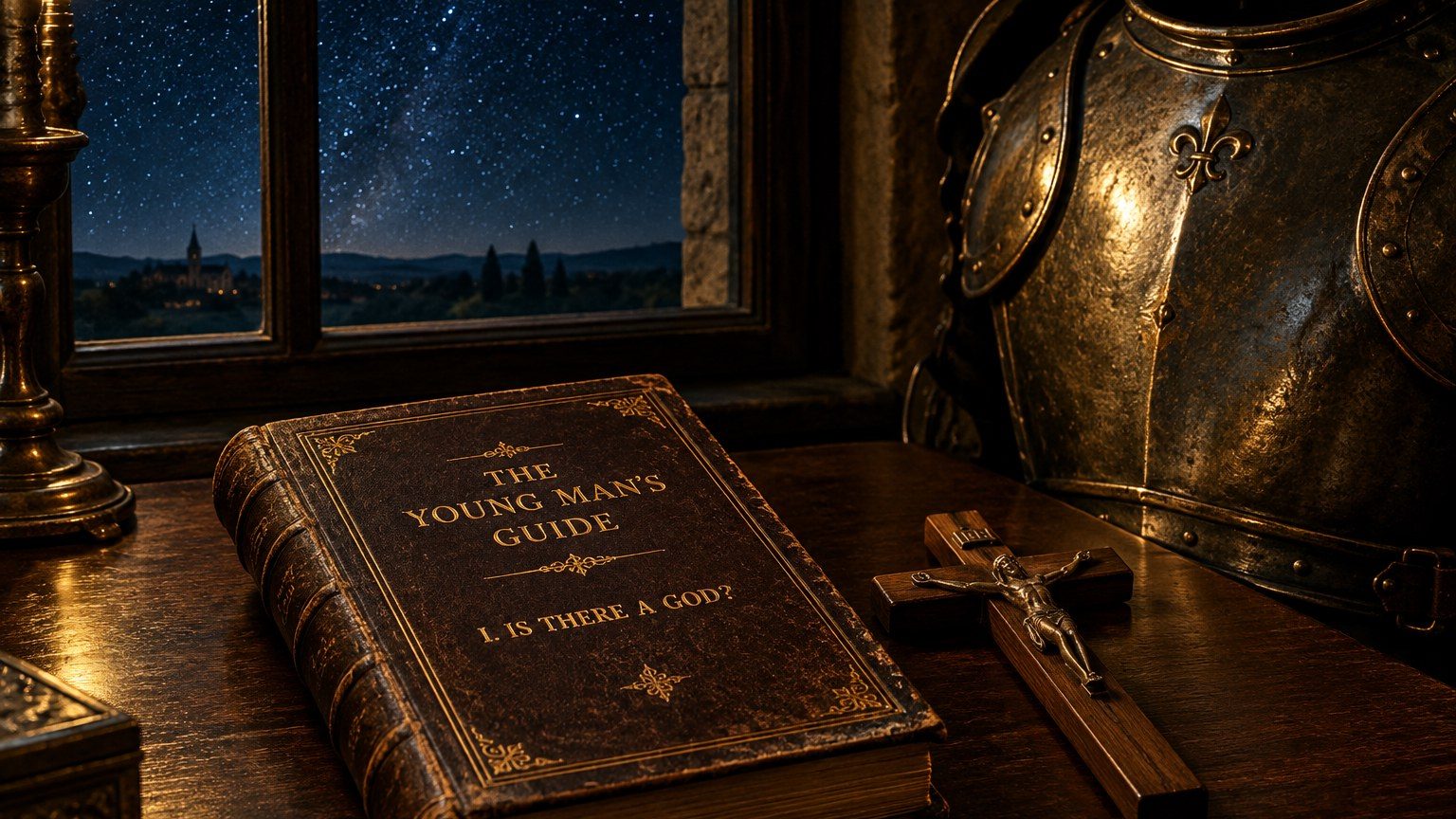
The two series will appear together in the weekly edition, with independent numbering and archives. We shall begin with the first chapters on faith: Is There a God? from The Young Man’s Guide and How Great a Blessing Is the True Faith from The Catholic Girl’s Guide. Their devotional sections will follow in due course; they are integral to the original purpose of the books. Formation which teaches the reader how to defend the Faith but never how to pray has already lost something essential.
The intention is modest enough: to make available, in a form that can be read a little at a time, instruction that earlier generations judged worth giving to the young before they were sent out into the world.
1. F. X. Lasance (ed.), The Catholic Girl’s Guide (Benziger Brothers, 1906), Editor’s Foreword and Preface.
2. F. X. Lasance (ed.), The Young Man’s Guide (Benziger Brothers, 1910), Preface.




Leave a Reply