
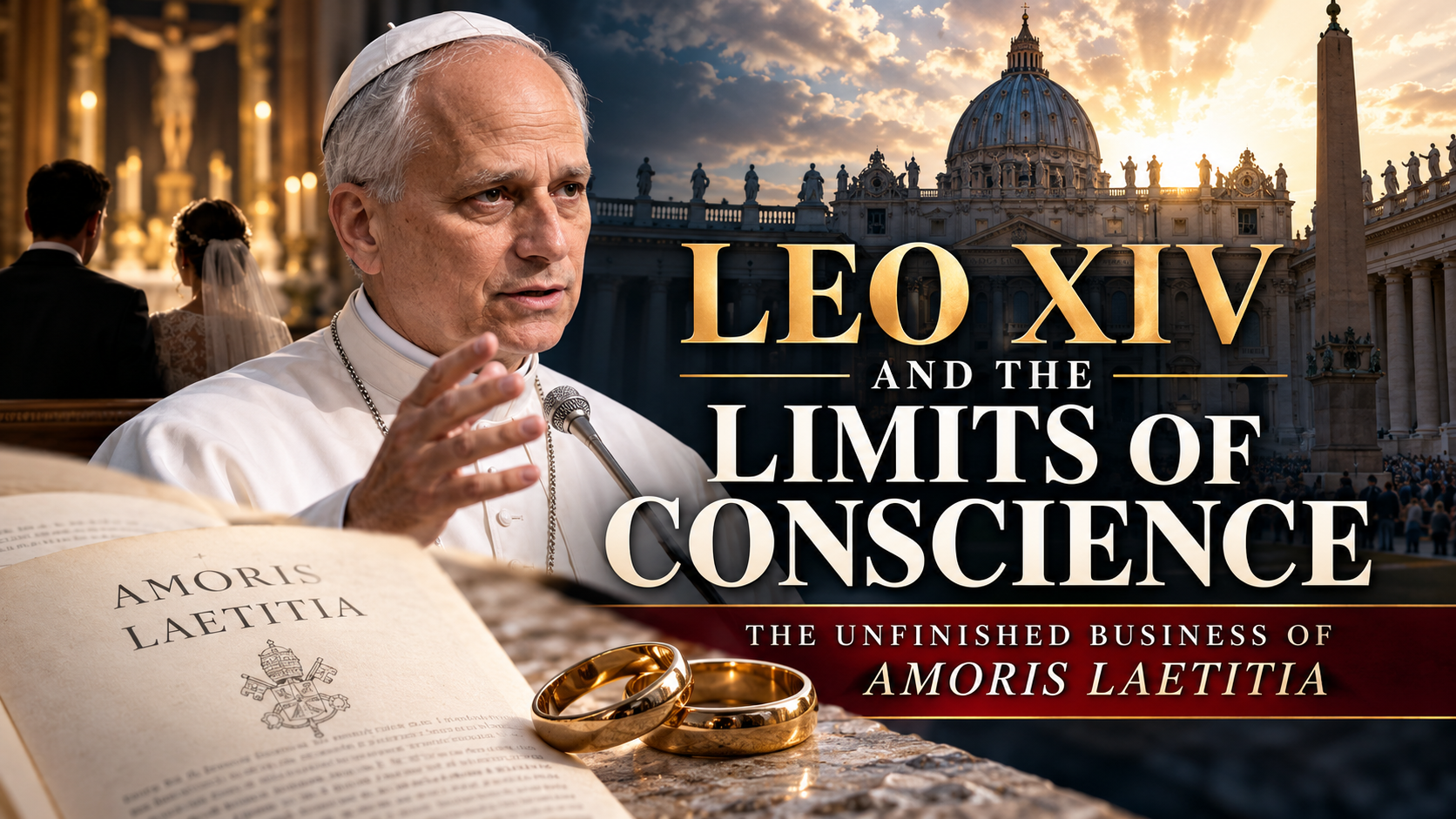
Pope Leo XIV has reaffirmed that conscience must conform to divine law as interpreted by the Church’s Magisterium. Coming immediately after the Vatican’s tenth-anniversary discussions on Amoris laetitia, his words expose the central difficulty of the Francis pontificate’s disputed pastoral legacy. The doctrine is clear. What remains uncertain is whether Rome will now require its pastoral practice to obey it.
There is something distinctly revealing about the timing of Pope Leo XIV’s General Audience of 21 October. Barely a week after the conclusion of the Vatican’s discussions marking the tenth anniversary of Amoris laetitia, the Holy Father returned to the foundations of Catholic teaching on marriage, reaffirming its indissolubility, the obligation of conjugal fidelity, the supreme gift of children and, most significantly, the subordination of conscience to divine law. None of these propositions is new. That is precisely why they matter. For ten years the controversy surrounding Amoris laetitia has concerned not principally whether the Church’s moral doctrine remains formally intact, but whether its practical application has been altered in ways that render the doctrine increasingly inconsequential. Leo has now restated the principle against which that controversy must ultimately be judged.¹
Drawing explicitly upon Gaudium et Spes, the Pope described the matrimonial covenant as the mutual self-giving of man and woman, whose union demands what the Council calls “total fidelity” and “unbreakable oneness”. Marriage is not merely a relationship of affection, still less an arrangement whose obligations endure only while its participants find them personally fulfilling. It is a covenant establishing an enduring moral reality, reflecting the union of Christ and His Church. The language of mutual self-giving and tenderness is therefore inseparable from the obligations of permanence, exclusivity and fidelity. Love does not dissolve those obligations; rightly understood, love fulfils them.
But the most consequential passage concerned conscience. Speaking of the responsibility of spouses to make judgements concerning the transmission and upbringing of children, Leo explained that such decisions must ultimately be made before God. He immediately added, however, that conscience must conform to divine law as interpreted by the Church’s Magisterium. The qualification is decisive. Personal responsibility does not confer personal sovereignty over the moral law. That a judgement belongs to the individual does not mean that its moral content is determined by the individual. Conscience is the faculty by which man recognises his obligation before God, not an authority by which he exempts himself from it.²
Strictly speaking, Leo was addressing responsible parenthood rather than the admission of divorced and civilly remarried Catholics to Holy Communion. His audience was also part of an established series of catecheses on the Second Vatican Council. It would therefore be unwarranted to describe the address as an explicit correction of Amoris laetitia, or to claim that its timing proves a deliberate intervention against particular interpretations. Nevertheless, the principle he reaffirmed is universal in its moral significance. If conscience must conform to divine law when spouses judge questions of procreation, it cannot acquire independence from that law when judging the obligations of fidelity, chastity and sacramental repentance.
The traditional Catholic understanding of conscience has never been a doctrine of moral self-determination. St Thomas Aquinas recognised that conscience binds the person who acts, even where his judgement is erroneous, while distinguishing that obligation from the objective goodness of the action and the responsibility of the person for his ignorance. The Church has always acknowledged that fear, ignorance, habit, coercion and diminished freedom can affect culpability. But the objective character of an action and the subjective responsibility of its agent are different questions. To confuse them is to undermine the very possibility of moral judgement. A person may be less culpable for committing a wrongful act without that act becoming permissible.
This distinction received particularly authoritative treatment in St John Paul II’s Veritatis Splendor, which rejected moral theories allowing intentions or circumstances to justify actions intrinsically contrary to the moral law. The encyclical did not deny the complexity of human experience. It denied that complexity could overturn the commandments. Nor was this an innovation of John Paul II. Pius XI’s Casti Connubii and Paul VI’s Humanae Vitae had already insisted that the obligations inherent in marriage and the transmission of life are established by God rather than by individual preference or prevailing social expectations. The doctrinal trajectory is consistent: conscience must be formed according to truth, and authentic pastoral care must assist that formation.³
This is where Amoris laetitia introduced a difficulty that cannot be resolved simply by repeating that the Church continues to uphold the indissolubility of marriage. Chapter VIII acknowledged the possibility of diminished culpability in objectively irregular matrimonial situations and proposed pastoral discernment concerning the assistance which the Church might offer. In itself, recognition of diminished culpability presents no doctrinal novelty. The difficulty arises when that recognition is employed to justify sacramental admission without resolving the continuing objective circumstances which previously governed the Church’s discipline.
Nor can responsibility for the resulting controversy be attributed exclusively to overenthusiastic interpreters. Francis explicitly approved the Buenos Aires bishops’ interpretation of Chapter VIII, and the accompanying documents were subsequently published with a rescript recognising their authentic magisterial status. The Dicastery for the Doctrine of the Faith’s 2023 response to Cardinal Dominik Duka further confirmed the possibility, in certain cases, of sacramental reconciliation where the proposal to live in continence had not been successfully maintained. These developments made the controversy institutional rather than merely speculative. The disputed practice was no longer simply something that individual bishops had inferred from ambiguous language; it had received substantial Roman endorsement.⁴
It is necessary here to distinguish three matters which have too often been collapsed into one: the objective morality of conduct, the subjective culpability of the person, and the conditions governing admission to the sacraments. Diminished culpability may affect the second without changing the first. It does not, by itself, settle the third. Sacramental discipline concerns repentance, amendment of life, ecclesial communion and, in appropriate circumstances, the public significance of a person’s condition. Canon 915, governing those obstinately persevering in manifest grave sin, is not simply a mechanism for assessing the internal culpability of individual souls. Nor does the absence of full subjective culpability automatically establish that every requirement for sacramental admission has been satisfied. The distinction between the internal and external forums exists for good reason. To invoke the former as though it necessarily superseded the latter is to misunderstand both.⁵
St John Paul II addressed this difficulty directly in Familiaris Consortio, §84. While distinguishing the circumstances of divorced persons and insisting upon their continuing pastoral care, he reaffirmed the Church’s practice of not admitting divorced persons who had entered a new union to Eucharistic Communion, unless the relevant conditions for reconciliation were fulfilled. Benedict XVI subsequently reaffirmed the same discipline in Sacramentum Caritatis, §29. These were not arbitrary administrative restrictions. They expressed a theological judgement concerning the relationship between the indissoluble matrimonial covenant, the Eucharist and the visible life of the Church. If subsequent pastoral provisions are said to preserve that teaching while permitting what the earlier discipline excluded, the precise grounds of reconciliation must be demonstrated. Merely invoking pastoral development does not supply the missing explanation.⁶
This is the unfinished business now confronting Leo XIV. His reaffirmation of the authority of divine law is welcome, but the Church possessed that principle throughout the preceding controversy. The disputed question has never been resolved by establishing that adultery remains objectively wrong while leaving uncertain what follows when a person continues in a relationship incompatible with an existing valid matrimonial bond. The issue is not whether every such person is equally culpable, nor whether every complicated matrimonial situation can be judged without investigation. Neither proposition belongs to traditional Catholic moral theology. The issue is whether a pastoral judgement concerning culpability can legitimately become the basis for sacramental permission where the objective conditions governing reception remain unresolved.
The October gathering makes this question especially pressing. The Vatican’s own presentation of the meeting placed considerable emphasis upon listening to families, examining local pastoral experiences and identifying what had been learned during ten years of implementing Amoris laetitia. Fr Giacomo Costa’s explanation of the methodology was particularly revealing: the exercise was concerned not simply with revisiting the exhortation’s meaning, but with considering what the Church had learned by attempting to live it. There is nothing objectionable about learning from pastoral experience. The difficulty begins when experience is permitted to determine what doctrine may reasonably require, rather than doctrine determining how experience must be understood.⁷
Nuntiatoria has repeatedly identified this danger in its examination of synodality, the tenth-anniversary discussions and the contemporary tendency to treat personal testimony as a privileged source of ecclesiastical judgement. The suffering of abandoned spouses, the struggles of those in irregular unions, the difficulties faced by young families and the circumstances of those seeking reconciliation deserve serious pastoral attention. But so does the witness of those who remain faithful to an abandoned marriage, who embrace continence despite personal hardship, or who refrain from Holy Communion because they recognise that their present circumstances require repentance or resolution. Their lived experience is no less real, and their sacrifices no less worthy of ecclesiastical recognition. A pastoral programme that celebrates accommodation while neglecting costly obedience presents a profoundly incomplete account of Christian discipleship.
The recent reflections associated with Bishop Erik Varden and Archbishop Jerome Lloyd’s The Sacraments Are Gifts, Not Achievements offer an important corrective to this tendency. The sacraments are not rewards for moral perfection, but neither are they tokens of institutional acceptance distributed without regard to their divinely established meaning. Holy Communion is not an entitlement arising from participation in ecclesiastical life. It is the reception of Christ Himself, requiring the dispositions appropriate to so great a mystery. St Paul’s warning against unworthy reception remains part of divine revelation, irrespective of the prevailing pastoral vocabulary. To assist a person in recognising why he should refrain from Communion may be an act of genuine mercy, especially when accompanied by patient spiritual direction and practical support. Charity cannot consist in concealing from a soul what charity requires him to confront.⁸
There is also an ecclesiastical question which deserves attention. Much of the enthusiasm surrounding the pastoral initiatives of Francis was expressed by senior churchmen who presented themselves as especially committed to the programme of the reigning pontiff. Cardinals such as Mario Grech, and officials closely associated with the synodal process, have exercised considerable influence over the language and methods through which that programme has been promoted. Should Leo now insist upon a more explicitly doctrinal framework, it will be instructive to observe whether those same ecclesiastical figures embrace the clarification with equal enthusiasm. Institutional loyalty to the Pope is not necessarily evidence of doctrinal conviction, just as disagreement with a particular pastoral initiative is not necessarily disloyalty to the Roman Pontiff. The question is whether fidelity is being rendered to the enduring teaching of the Church or merely to the administrative and theological preferences associated with whichever pontificate happens to be governing.
It would be unwarranted to assert that such cardinals privately disbelieved what they advocated under Francis, or that they will automatically abandon it under Leo. Their motives are not accessible to public judgement. Yet ecclesiastical history provides ample reason to distinguish principled adherence to doctrine from the culture of deference which can develop around papal personalities. The Roman Pontiff is not the author of revelation. His authority exists to preserve, expound and defend the deposit of faith. Neither a cardinal’s enthusiasm for a Pope nor a bishop’s appeal to pastoral necessity can dispense with that obligation.
Leo’s reliance upon Gaudium et Spes introduces a further consideration. Traditional Catholics have substantial reasons to question aspects of the postconciliar theological and pastoral settlement, and those concerns cannot be dismissed by invoking the supposed inevitability of development. Nevertheless, criticism of the Council’s consequences must not obscure the actual content of the passages under consideration. The Council’s personalist account of marriage, whatever difficulties may arise from particular formulations or subsequent interpretations, expressly retains the authority of divine law over conscience. Its language concerning mutual self-giving cannot legitimately be employed to establish a moral autonomy which the same document rejects. The proper measure of continuity is not whether a proposition can be described in conciliar terminology, but whether its doctrinal content remains faithful to what the Church has always taught.
This is also why the language of a hermeneutic of continuity must be subjected to examination rather than employed as a substitute for it. Continuity is not established by asserting that two positions are compatible while declining to explain their apparent contradiction. Where earlier papal teaching identifies an objective sacramental impediment and later pastoral guidance permits exceptions under circumstances which appear not to remove that impediment, an authoritative account is required. The faithful are entitled to understand whether the difference concerns the application of an unchanged principle, a revised judgement about relevant facts, or a substantive alteration of discipline. If the discipline is inseparable from doctrine, that distinction becomes especially important.
Leo XIV has therefore reached a moment at which doctrinal clarity must acquire practical consequences. He has not repudiated Amoris laetitia. Indeed, his concluding reference to the synodal assemblies convened by Francis and the recent Vatican discussions indicates that he continues to regard that pastoral history as part of the Church’s present work. Nor has he issued a new disciplinary norm governing the admission of divorced and civilly remarried Catholics to Holy Communion. His General Audience should not be made to say what it did not say. Nevertheless, he has publicly reaffirmed a principle that places necessary limits upon every legitimate exercise of pastoral discernment. The responsibility now rests with the Holy See to demonstrate how those limits govern the practices it has authorised.
A Pope need not repudiate his predecessor in order to correct a disputed interpretation or discipline. Nor does genuine continuity require preserving every administrative decision, pastoral experiment or theological emphasis of an earlier pontificate. The authority of the Petrine office is exercised most faithfully when it confirms the brethren in the faith received from the Apostles, including where that responsibility demands clarification of decisions made under previous occupants of the See of Peter. The Church’s unity cannot depend upon leaving unresolved contradictions unexamined for fear of disturbing an inherited ecclesiastical consensus.
There is a particular irony in the present situation. For a decade, Catholics who insisted upon the objective demands of the moral law were frequently portrayed as insufficiently attentive to pastoral complexity. Yet Leo has now reaffirmed precisely the principle upon which their objections depended. That does not prove every criticism of Amoris laetitia correct, nor does it establish that every pastoral application associated with Francis necessarily violates Catholic doctrine. It does establish that no interpretation can be defended merely because it appears compassionate, accommodates difficult circumstances or enjoys the support of influential ecclesiastical figures. It must also be demonstrably consistent with divine law.
The Holy Father has spoken clearly about conscience. He has spoken clearly about the indissolubility of marriage. He has situated both within the Church’s received understanding of the matrimonial covenant. What remains is the question which has persisted since 2016: whether the Church’s sacramental practice will express those truths with equal clarity.
The decisive test of Leo XIV’s teaching is not whether conscience must conform to divine law. He has affirmed that it must. The test is whether Rome will now require pastoral discernment, sacramental discipline and the policies inherited from Francis to conform to the same law.
For ten years, the Church has been told that doctrine has not changed. It is time for her pastoral practice to make that assurance unmistakable.
¹ Pope Leo XIV, General Audience: Commitment to the Family in Today’s Society, 21 October 2026.
² Second Vatican Council, Gaudium et Spes, §§48–51, 7 December 1965.
³ Pius XI, Casti Connubii, 31 December 1930; Paul VI, Humanae Vitae, §§10–14, 25 July 1968; John Paul II, Veritatis Splendor, §§54–64, 79–83, 6 August 1993.
⁴ Francis, Amoris Laetitia, §§300–305, 19 March 2016; Dicastery for the Doctrine of the Faith, Response to Cardinal Dominik Duka, 25 September 2023.
⁵ Code of Canon Law (1983), Canons 912–923, especially canons 915–916.
⁶ John Paul II, Familiaris Consortio, §84, 22 November 1981; Benedict XVI, Sacramentum Caritatis, §29, 22 February 2007.
⁷ Holy See Press Office, Press Conference to Present the Meeting “Ten Years After Amoris Laetitia: Proclaiming the Gospel with Families Today”, 2 October 2026.
⁸ Archbishop Jerome Lloyd, The Sacraments Are Gifts, Not Achievements, Selsey.org, 16 October 2026; 1 Corinthians 11:27–29 (Douay-Rheims).



Leave a Reply