
Synodality at the Graveside: When Accompaniment Yields to Optics
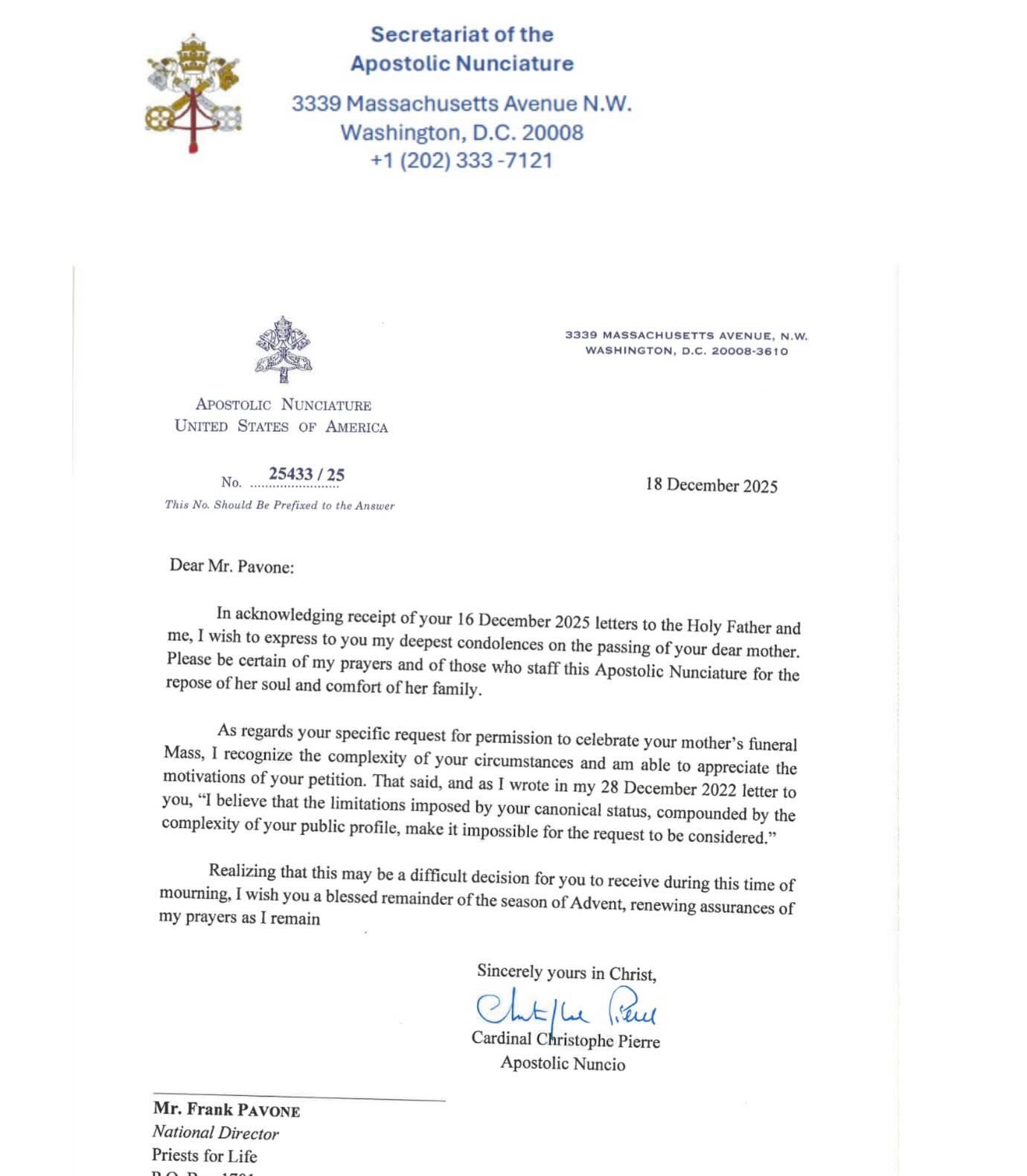
On 18 December 2025, Cardinal Christophe Pierre, Apostolic Nuncio to the United States, wrote formally to Fr Frank Pavone to deny permission for him to celebrate the Funeral Mass of his own mother. The letter is courteous, restrained, and carefully composed. It expresses condolences. It assures prayers. It acknowledges grief. And then, with administrative finality, it refuses one of the Church’s most basic works of mercy—on grounds not of sacramental theology, but of canonical status and public profile.
The document is revealing precisely because of what it does not say.

At no point does the Nuncio suggest that Fr Pavone is incapable of offering the Holy Sacrifice of the Mass. There is no claim of invalidity, sacramental abuse, or doctrinal defect. Nor is there any assertion that the Eucharist would be profaned by the act. The refusal rests entirely on governance: the “limitations imposed by your canonical status,” compounded by the “complexity” of a public profile. The request is therefore deemed impossible to consider.
This distinction is not incidental. It is decisive.
The Church has always understood the Mass for the Dead as among the most ancient and solemn expressions of Christian charity. To offer the Sacrifice for one’s own parent is not a discretionary privilege bestowed by administrators; it is a profoundly human and priestly act, rooted in the Church’s maternal care for the departed and her proclamation of the Resurrection. To deny such an act without reference to doctrine is to concede—implicitly but unmistakably—that the refusal is not theological but managerial.
The invocation of complexity functions here as a bureaucratic solvent. It dissolves responsibility without resolving the question. Nothing is weighed. Nothing is adjudicated. No reasoning is offered beyond an appeal to circumstance. The request is simply placed beyond consideration. This is not discernment in any classical sense; it is procedural closure.
The pastoral dissonance is acute. A funeral Mass concerns the dead, the grieving, and the Church’s public witness to hope beyond death. Yet the letter subordinates this reality to reputational risk management. Sympathy is expressed, but sacramental proximity is withheld. Prayers are promised, but the altar is barred. The Church accompanies—at a distance.
Background: Fr Frank Pavone and the Question of Canonical Status
Fr Frank Pavone has been one of the most prominent Catholic pro-life figures of the past three decades, serving for many years as National Director of Priests for Life, an organisation founded in 1991 with ecclesiastical approval and dedicated to opposing abortion through pastoral outreach, education, and public advocacy. His ministry combined priestly functions with sustained public engagement, including extensive media presence and political commentary.
Tensions with ecclesiastical authorities did not principally concern formal doctrinal dissent. Rather, they centred on questions of obedience, governance, and the prudential limits of clerical participation in highly polarised public discourse. Over time, these tensions culminated in disciplinary action.
In December 2022, the Holy See announced that Fr Pavone had been dismissed from the clerical state. The communication, issued through the Dicastery for the Clergy, cited “blasphemous communications on social media” and “persistent disobedience of lawful instructions of his diocesan bishop.” No detailed penal decree or public acta were released, and the absence of a fully articulated public rationale has prompted sustained commentary among canonists regarding procedural clarity, proportionality, and transparency in the application of penal law.
Fr Pavone has consistently contested both the characterisation of the allegations and the adequacy of the process, maintaining that he neither denied Catholic doctrine nor rejected ecclesiastical authority as such, and that the measures taken against him lacked the procedural safeguards ordinarily associated with penalties of such gravity. These claims remain disputed and unresolved in the public forum.
It is against this background that the Nunciature’s letter invokes Fr Pavone’s “canonical status” and the “complexity” of his public profile. The phrasing is significant. It avoids sacramental or theological claims and situates the refusal squarely within the sphere of administrative governance. The decision therefore does not hinge on the nature of the Mass, the state of the deceased, or the ontological reality of priesthood, but on the Church’s determination to withhold authorisation in light of an ongoing and unresolved canonical controversy.
Canonical Explainer: Laicisation and Sacramental Character
Dismissal from the clerical state, commonly referred to as laicisation, is a juridical act affecting a cleric’s rights, obligations, and faculties within the Church’s legal order. It does not erase the sacramental character of Holy Orders.
Catholic doctrine has consistently taught that ordination confers an indelible ontological character. The Council of Trent affirmed that Holy Orders imprints a permanent spiritual mark that cannot be removed, even by the gravest canonical penalties. Canon law reflects this distinction: while a laicised priest is ordinarily forbidden to exercise sacred ministry publicly, he remains a priest in sacramental reality.
Accordingly, laicisation concerns licitness and authorisation, not validity. A laicised priest may be prohibited from celebrating Mass, but if he does so, the Mass is not invalid by reason of laicisation alone. The refusal of permission in such cases is therefore disciplinary and administrative, not theological. This distinction is essential for understanding decisions that invoke “canonical status” while avoiding any claim of sacramental incapacity.
Synodality Tested
This episode thus becomes an unintentional test case for the rhetoric of synodality. For several years, the faithful have been told that the Church is entering a new phase marked by listening, accompaniment, and attentiveness to concrete human situations. Yet when a concrete situation presents itself—grief, burial, filial duty—accompaniment proves conditional. When it collides with institutional caution, accompaniment yields.
The asymmetry is striking. A Church that can accommodate doctrinal ambiguity, moral experimentation, and public scandal in the name of dialogue finds itself unable to accommodate a Funeral Mass in the name of prudence. This is not a question of personalities or polemics. It is a question of governance culture.
Nuntiatoria has previously observed a recurring pattern in which disciplinary authority is exercised administratively rather than judicially, often without public reasoning proportionate to the gravity of the penalties imposed.¹ Managerial language—“complexity,” “discernment,” “non-consideration”—replaces explicit juridical judgment. The present case exemplifies that pattern with unusual clarity.
Likewise, earlier editorials have noted that synodality often operates selectively: expansive when addressing doctrinal uncertainty, restrictive when confronted with dissent framed as disobedience or reputational risk.² Mercy is invoked rhetorically, but withheld concretely when it becomes inconvenient.
Conclusion: Governance and Credibility
If this letter becomes widely known, the danger for the hierarchy will not be public outrage. Outrage is transient. The deeper risk is credibility erosion.
A Church that speaks incessantly of accompaniment while denying a son the ability to bury his mother at the altar reveals a widening gap between language and action. When pastoral ideals are subordinated to institutional risk management, compassion becomes symbolic, and mercy procedural. Over time, such practices hollow out the Church’s moral authority, not because they provoke anger, but because they expose incoherence.
The letter closes with Advent well-wishes and renewed assurances of prayer. Advent, of course, is the season in which the Church proclaims that God does not remain distant from human sorrow, but enters it. That contrast—between proclamation and practice—is the lasting significance of this episode. It is not merely a personal tragedy. It is a documentary moment, dated and signed, in which governance culture quietly eclipses the very credibility synodality claims to restore.
¹ Nuntiatoria, “The Orphaned Altar: On the Crisis of Episcopal Fatherhood,” 17 October 2025.
² Nuntiatoria, “Synodality and Selective Listening,” 4 November 2025.
³ Council of Trent, Session XXIII, Doctrine on the Sacrament of Order.
⁴ Code of Canon Law (1983), can. 1176 §1–2.
⁵ Catechism of the Catholic Church, §§1680–1690.
⁶ Congregation for Divine Worship, Directory on Popular Piety and the Liturgy (2001), §§261–262.
related articles


Latest articles
- Today’s homily: Christ the KingThe homily reflects on Christ’s kingship as seen in the Gospel narrative. It contrasts earthly authority with divine truth, emphasising that true allegiance to God requires genuine obedience and transformation. Believers are called to examine their personal commitments and respond to Christ’s demands in everyday life, ultimately recognising their identity as bearers of God’s image.
- Sermon for Christ the KingToday marks the celebration of Christ the King and the Twenty Second Sunday after Pentecost, a feast asserting Christ’s sovereignty against totalitarianism. St. Paul emphasised Christ’s supremacy over power and principalities, challenging early Gnostic beliefs. The early Church’s victory over evil is affirmed in Christ’s resurrection, offering hope and unity amidst contemporary struggles.
- Today’s Mass: October 25 SOVEREIGNTY OF OUR LORD JESUS CHRIST, SUPREME KINGThe Feast of the Sovereignty of Our Lord Jesus Christ celebrates Christ’s dual kingship by birth and conquest. Established by Pius XI, it aims to deepen faith and counter anti-clericalism. The liturgical observance underscores His authority as King, advocating for societal recognition of His reign to bring peace and harmony.
- TRADITION BEHIND THE FENCEThe Vatican’s prohibition of the traditional Ad Petri Sedem pilgrimage to St Peter’s Basilica has sparked controversy, especially among traditional Catholics. While some cite scheduling conflicts, the broader issue lies in the restrictive policies of Traditionis custodes, which may confine traditional liturgical practices to specific enclaves, risking the transmission and recognition of Catholic Tradition within the wider Church.
- Today’s Mass: October 24 St Raphael the ArchangelThe Feast of Saint Raphael the Archangel highlights his healing powers as depicted in the Book of Tobit, where he aids Tobit and his son, Tobiah. Venerated as a protector of travellers and the blind, Raphael is celebrated for his miraculous interventions. His legacy includes support for nurses, matchmakers, and Catholic studies.





Leave a Reply