
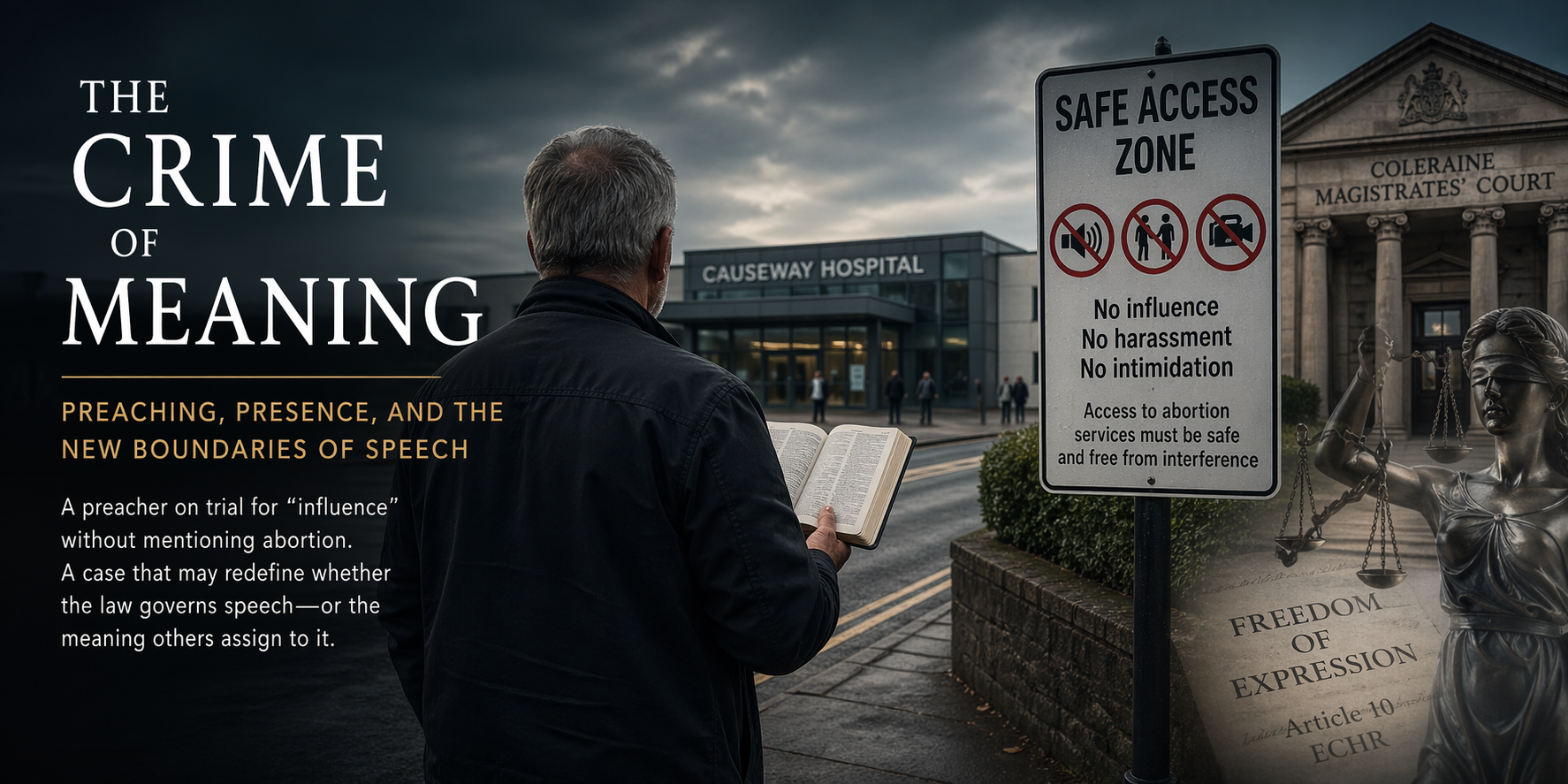
The Crime of Meaning: Preaching, Presence, and the New Boundaries of Speech

On 22 April 2026, at Coleraine Magistrates’ Court in Northern Ireland, the trial of Clive Johnston entered its second day. Johnston, a retired pastor, is charged under “safe access zone” provisions—derived in structure from the Public Order Act 2023 and reflected in regional legislation—with “influencing” persons within a designated buffer zone surrounding Causeway Hospital.¹ The alleged incident, dated 7 July 2024, consisted of open-air preaching: the reading of John 3:16, hymn singing, and personal testimony. There is no allegation that abortion was mentioned. There is no claim of obstruction, harassment, or direct engagement with patients. A secondary charge concerns failure to comply with a police direction to leave the area.²
The issue before the court is therefore sharply defined. It is not whether Johnston protested abortion. It is whether the law now permits conviction for what speech is taken to mean, rather than for what is actually said.
From Speech to Context
The statutory scheme governing buffer zones is built upon the concept of “influence.” In operative form, the offence is committed where a person engages in conduct “with the intent of, or reckless as to whether it has the effect of, influencing a person’s decision” in relation to abortion services.³ The breadth of this formulation is immediately apparent. It does not require explicit reference. It does not require direct communication. It does not even require that influence be successful—only that it be capable of being inferred.
This is the pivot. The prosecution need not show that Johnston spoke about abortion; it need only persuade the court that his presence and words, in that place, could reasonably be understood to bear upon it. Meaning is thus detached from expression and relocated in context. Words acquire legal significance not from their content, but from their proximity to a protected activity.
Such a shift alters the character of public order law. Traditionally, liability attaches to observable conduct: obstruction, harassment, intimidation. These are acts that can be identified and proved. Here, by contrast, the court is invited to adjudicate upon interpretation—to determine what speech signifies when placed within a particular environment. The object of regulation is no longer the act, but the meaning attributed to the act.
A Pattern of Expansion
This development is not isolated. In Birmingham, Isabel Vaughan-Spruce was detained for standing silently within a buffer zone, with officers asserting that she “may be praying” about abortion. Proceedings were discontinued, and compensation followed.⁴ In Bournemouth, Livia Tossici-Bolt was prosecuted for holding a sign stating, “Here to talk if you want”—a message devoid of explicit content, yet treated as a form of influence.⁵
The trajectory is clear. Enforcement has moved from overt protest to passive presence, from explicit message to inferred intention. Johnston’s case appears to extend the principle further still: to general religious proclamation, unconnected in content to abortion, yet deemed capable of falling within prohibition by virtue of location alone.
At each stage, the boundary of the law becomes less a matter of what is done, and more a matter of what is presumed.
The Secondary Charge and Circular Enforcement
The additional allegation—that Johnston failed to comply with a police direction to leave—introduces a procedural mechanism that may prove determinative. Yet its legitimacy is derivative. A direction to disperse is lawful only if grounded in a correct understanding of the underlying offence. If the premise of “influence” is itself uncertain or overextended, the command risks resting on the very ambiguity the court is asked to resolve.
This produces a form of circular enforcement: the refusal becomes culpable only if the original interpretation is valid, while the validity of that interpretation is established, in part, by the refusal. The law, in such circumstances, risks validating its own assumptions.
Rights, Proportionality, and the Problem of Vagueness
The tension with the European Convention on Human Rights is immediate. Article 10 protects freedom of expression; Article 9 protects freedom of religion. Both rights may be limited, but only where the limitation is prescribed by law, pursues a legitimate aim, and is necessary in a democratic society.⁶
The requirement that a restriction be “prescribed by law” entails more than formal enactment. It requires that the rule be sufficiently precise to enable the citizen to foresee, to a reasonable degree, the consequences of his actions.⁷ Where liability depends upon what others might infer—rather than what the speaker says—that foreseeability is weakened. The individual cannot regulate his conduct by reference to clear boundaries, but must instead anticipate the interpretations of others.
As Jonathan Sumption has observed in a related context, free speech protections are tested not by agreeable expression, but by speech that others find unwelcome: *“Freedom of speech includes not only the inoffensive but the irritating, the contentious, the eccentric, the heretical, the unwelcome and the provocative.”*⁸ The present difficulty is not that Johnston’s speech was provocative, but that its provocation is inferred rather than expressed.
A New Legal Threshold
The court is thus confronted with a question of principle. Can “influence” be established in the absence of identifiable content? Can the law attribute meaning where none is articulated, and impose sanction on that basis?
If the answer is affirmative, a new threshold is crossed. Speech becomes contingent upon location in a manner that extends beyond traditional public order concerns. Liability is determined not by what is said, nor even by what is intended, but by what is imputed. Presence, coupled with a recognisable moral framework, may suffice.
If the answer is negative, a limit is restored. The law remains anchored in demonstrable acts, and the distinction between lawful and unlawful conduct is preserved.
Conclusion: The Governance of Meaning
The case of Clive Johnston reveals a deeper transformation within contemporary legal culture. The movement is subtle but significant: from the regulation of conduct to the regulation of meaning. It is a shift that increases the discretion of enforcement, while diminishing the certainty of the citizen.
For when the law governs meaning, it ceases to operate upon fixed acts and begins to operate upon variable interpretations. The individual is no longer guided by what he may or may not do, but by what his actions may be taken to signify. Compliance becomes an exercise not in obedience, but in anticipation.
A law that must be anticipated cannot be clearly known. And a law that cannot be clearly known cannot be freely obeyed.
- Court listings and contemporaneous reporting of proceedings at Coleraine Magistrates’ Court, 21–22 April 2026, concerning Clive Johnston.
- Summary of charges as reported in Reason (21 April 2026) and The Christian Post (22 April 2026), including allegation of failure to comply with police direction.
- Public Order Act 2023, provisions relating to “safe access zones,” defining offences of influencing persons accessing abortion services; cf. analogous wording in Abortion Services (Safe Access Zones) (Northern Ireland) Act 2023.
- West Midlands Police statements and discontinuance of proceedings involving Isabel Vaughan-Spruce (2023), including compensation following wrongful arrest.
- Bournemouth, Christchurch and Poole Council enforcement proceedings involving Livia Tossici-Bolt under Public Spaces Protection Orders (2023–2024).
- European Convention on Human Rights, Articles 9–10.
- Sunday Times v United Kingdom (No. 1) (1979) 2 EHRR 245, on the requirement that a law be formulated with sufficient precision to enable foreseeability.
- Jonathan Sumption, Trials of the State: Law and the Decline of Politics (Profile Books, 2019), lecture and published remarks on free speech principles.
RELATED ARTICLES


LATEST ARTICLES
- Today’s Mass: September 25 Feria of Sunday XVII Post PentecostThe Feria of Sunday XVII Post Pentecost focuses on the commandment of charity towards God and neighbour, emphasising unity in faith. It recalls the story of Saints Placidus and Maurus, disciples of St. Benedict. The Gospel highlights Jesus’ teaching on loving God and neighbour as foundational to the Law.
- Today’s homily: Our Lady of WalsinghamThe Mass reflects on the significance of Walsingham, Loreto, and the Christian soul as “Holy Houses” that embody the connection between heaven and earth. It highlights Mary’s central role in the Incarnation and emphasises the importance of inner conversion by inviting believers to reflect on their own hearts as dwelling places for God.
- Today’s Mass: September 24 Our Lady of WalsinghamThe Feast of Our Lady of Walsingham commemorates the vision of Mary that inspired Richeldis de Faverches to build a replica of her house in Nazareth in 1061. This shrine became a significant pilgrimage site, attracting royal visits until its destruction in 1538. The revival of pilgrimage in the 20th century reaffirmed its spiritual importance.
- Sermon for Blessed Virgin Mary of RansomToday, we commemorate the feast of the Blessed Virgin Mary of Ransom, which honours the Mercedarians, a religious order founded in 1218 to free Christian captives from the Moors in Spain. Their mission persists today, highlighting the ongoing relevance of ransoming captives amidst contemporary persecution, combining spiritual redemption with social responsibility.
- OUR LADY OF RANSOM: THE MOTHER OF THE REDEEMER AND THE BREAKING OF CHAINSThe Feast of Our Lady of Ransom, celebrated on 24 September, commemorates the Mercedarian Order’s mission to redeem Christian captives, embodying the concept of liberation from sin through Christ’s sacrifice. This day’s significance links historical devotion with England’s Catholic restoration, connecting the feast to both the Incarnation and personal spiritual freedom.





Leave a Reply