
Christmas in the Domestic Church: How Catholic Families Keep the Feast Around the World
Adoremus in Aeternum — The Incarnation Lived at Home
For the Catholic Church, Christmas is not a moment but a movement — not a single day extracted from the year, but a mystery that enters time and reshapes it. The Nativity of the Lord does not interrupt ordinary life; it judges it, reorders it, and redeems it. This is why, wherever Catholic faith has been deeply rooted, Christmas has never belonged solely to the public square or the commercial calendar. It has been guarded, enacted, and transmitted above all within the household — the domestic church — where doctrine becomes habit and belief takes flesh.
A global view of Catholic Christmas customs reveals something striking. Beneath immense cultural variety lies a remarkably stable theological pattern. Catholic families have instinctively understood that the Incarnation demands preparation, restraint, reverence, and consequence. Joy is not improvised; it is received. Celebration is not detached from worship; it flows from it. Time itself is stretched and sanctified so that the Word made flesh may be contemplated rather than consumed.
Southern Europe: Waiting for the Gift Rather Than Claiming It
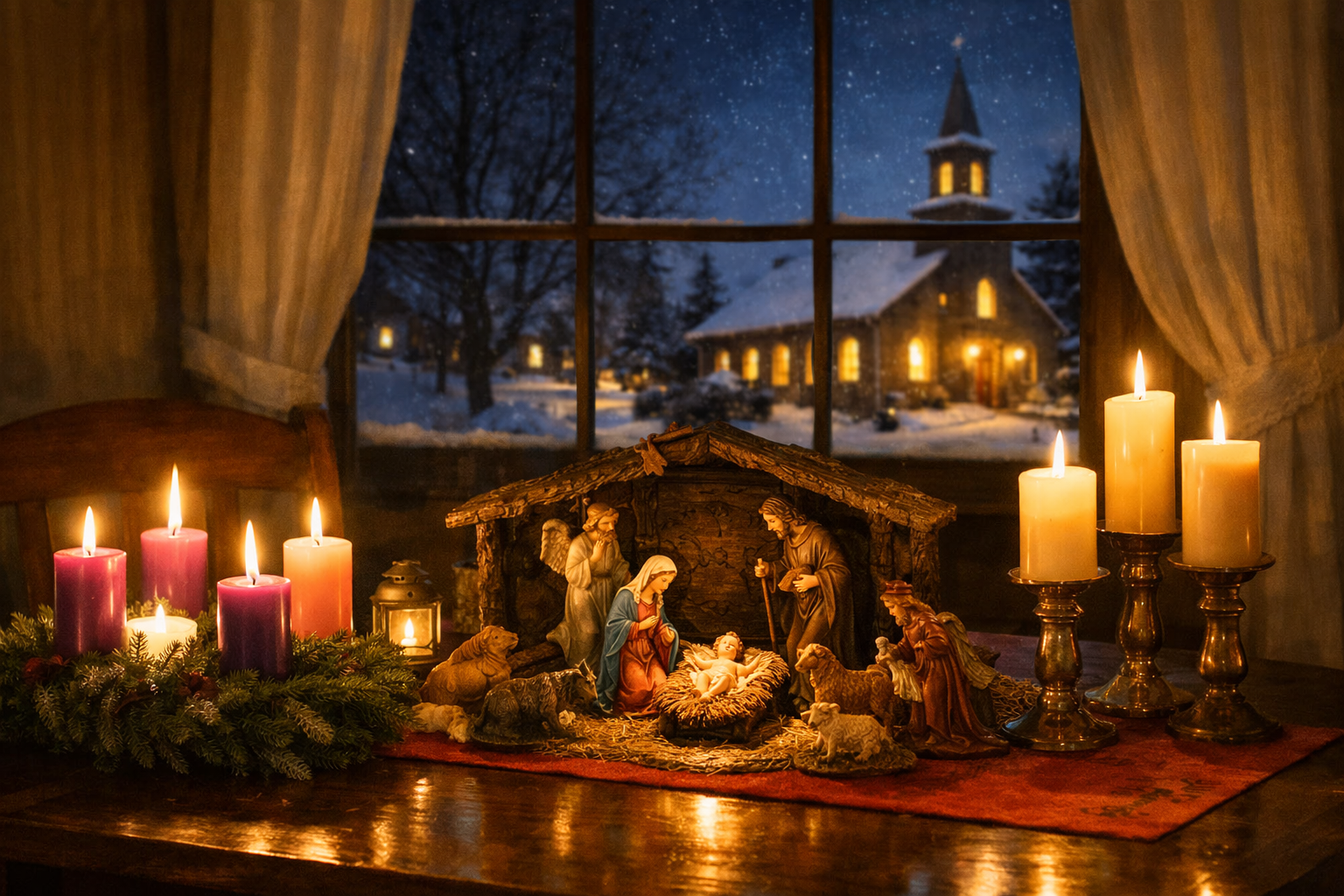
In Italy, the central domestic symbol of Christmas is not the tree but the presepe. Unlike modern decorative displays, the traditional Nativity scene is a theological object. Figures are introduced gradually during Advent, and the manger often remains empty until Christmas Night. Only after the proclamation of the Nativity at Midnight Mass is the Christ Child placed in the crib. This is not theatrical flourish, but catechesis enacted: Christ is not summoned by human effort. He comes when and how He wills.
Older Italian custom preserved Christmas Eve as a vigil rather than a feast. The abstinence from meat was not a culinary quirk but a theological instinct, marking the boundary between waiting and fulfilment. In many regions, silence, candlelight, and restrained anticipation characterised the hours before Mass. The feast belonged properly to Christmas Day, because the feast belonged properly to Christ.¹
Spain, while culturally exuberant, preserved a similarly disciplined structure. Nochebuena is a vigil — long, familial, prayerful — ordered toward the Church’s worship rather than replacing it. The traditional postponement of gift-giving until Epiphany is particularly instructive. In deferring gifts to the feast of the Magi, Spanish Catholic culture refused to sever Christmas from revelation and worship. Gifts are offered because Christ has been manifested, not merely because sentiment demands exchange.²
Central and Eastern Europe: The Moral Demands of the Incarnation
In Poland, the domestic celebration of Christmas reaches an almost liturgical density, shaped by centuries of Catholic faith woven deeply into family life. Wigilia—the Christmas Eve supper—is not simply a meal but a ritualised vigil that consciously mirrors the Church’s own preparation for the Nativity. The supper does not begin at a convenient hour, but only when the first star appears in the night sky, recalling the Star of Bethlehem that announced Christ’s birth to the world. This deliberate waiting is an act of obedience to sacred time rather than personal appetite, teaching that Christmas joy is received, not seized.
Central to Wigilia is the sharing of the opłatek, a thin, unleavened wafer blessed by the priest and distributed to families before Christmas. Although not the Eucharist, it bears a deliberate visual and symbolic resemblance, reinforcing its moral and spiritual seriousness. Each person approaches the others in turn, breaks a piece of the wafer, and exchanges spoken words of forgiveness and blessing. No one eats until this reconciliation has taken place. In this moment, the home becomes a place of judgment and mercy, where estrangement is confronted and peace is restored face to face. The ritual teaches, with striking clarity, that the Child born in Bethlehem cannot be welcomed where resentment is harboured, and that the celebration of Christ’s birth demands a prior ordering of the heart.
This annual reckoning is not optional sentimentality. It reflects a deeply Catholic conviction: the Child born in Bethlehem is also the Judge of hearts. To celebrate His birth without reconciliation would be a contradiction enacted at the table. The empty place set for the absent or the stranger reinforces this lesson in silence, reminding the family that charity is not complete until it extends beyond blood and convenience. Midnight Mass (Pasterka) follows as the natural culmination of this moral and spiritual preparation.³
In Catholic regions of Germany and Austria, Advent retains a sobriety that modern culture increasingly resists. The Advent wreath structures time visually and prayerfully, teaching patience in an age of acceleration. Each candle marks not progress toward indulgence, but proximity to mystery. Hymns and Scripture are not decorative, but formative, shaping children to understand that joy grows rather than erupts.
The figure of the Christkind — now often displaced — once preserved a crucial Christological focus. Gifts were not detached from worship, nor was Christmas Eve overwhelmed by excess. Silence, candlelight, and prayer prepared the household to receive what the Church proclaimed.⁴
The Americas: Learning the Incarnation by Walking It
In Mexico, Catholic families enact the Nativity through Las Posadas, a nine-day drama of rejection and welcome. Each evening’s procession is both prayer and pedagogy. Children do not merely hear that there was “no room at the inn”; they experience closed doors, repeated refusals, and the final opening that transforms exclusion into celebration.
This embodied catechesis teaches something essential: the Incarnation is not sentimental. Christ arrives as a stranger, and the household must decide whether to make room. The joy that follows is inseparable from this moral choice. Midnight Mass crowns the processions, uniting domestic enactment with sacramental reality.⁵
In the Philippines, Simbang Gabi imposes a quiet but demanding discipline. Rising before dawn for nine consecutive days reorders family life around worship rather than convenience. It teaches children — and reminds adults — that the Incarnation costs something. Light breaks into darkness not at a comfortable hour, but when the world is still asleep.
The parol, glowing in windows and streets, proclaims this theology visually. Christmas light is not decoration; it is confession. And crucially, Filipino Catholic culture resists the secular truncation of Christmas. The feast extends through Epiphany and often to Candlemas, preserving an older instinct that sacred joy requires time to unfold.⁶
Africa: The Incarnation as Corporate Reality
In much of Catholic Africa, Christmas is experienced less as a private domestic retreat and more as a communal ecclesial event. The Mass is central, extended, and richly participatory. Processions, chant, and collective response affirm that the Incarnation creates a people, not merely a mood.
Domestic celebration follows worship rather than competing with it. Visiting elders, widows, and the poor is not framed as optional charity but as fulfilment of the feast itself. Christmas joy is measured by restored relationships and shared abundance. In this context, the Incarnation is understood instinctively as social and moral transformation, not interior sentiment alone.⁷
The Middle East: Christmas Without Illusion
For Eastern Catholic families in Lebanon and neighbouring regions, Christmas is marked by fasting, vigil, and theological seriousness. The Nativity is celebrated not against a backdrop of cultural dominance, but often amid fragility and pressure. As a result, Christmas is experienced less as nostalgia and more as confession.
Domestic prayer, parish liturgy, and communal identity are inseparable. The birth of Christ is proclaimed as truth, not merely tradition. Here, the domestic church does not shelter from the world; it stands within it as witness. The manger is not romanticised, but recognised as the place where God enters a world that still resists Him.⁸
The English-Speaking World: Survival, Suppression, and Recovery
In the English-speaking world, Catholic Christmas customs developed under conditions markedly different from those of Catholic Europe. In England, Ireland, Scotland, and later in North America and Australia, the domestic celebration of Christmas was shaped not only by theology, but by persecution, legal suppression, Protestant polemic, and eventual cultural absorption. As a result, Catholic families often preserved the substance of Christmas quietly, defensively, and at times imperfectly — yet with remarkable tenacity.
In England, following the Reformation, the public celebration of Christmas became suspect or outright illegal in many periods. Under Puritan influence, Christmas was condemned as “popish,” and even after legal toleration returned, Catholic households learned to keep the feast discreetly. Midnight Mass, where possible, was attended in secrecy or at great personal risk. Domestic prayer before the Nativity crib — often small, hidden, or improvised — replaced the public splendour lost to confiscation and penal law.
This history left a lasting imprint. English Catholic families developed a restrained, interiorised form of Christmas observance, emphasising quiet prayer, family unity, and fidelity to Mass over spectacle. Even into the nineteenth century, Christmas for Catholics in England remained more ecclesial than cultural, more sacramental than festive — a posture that sharply distinguished them from the surrounding Protestant milieu.⁹
Ireland presents a contrasting but related picture. Here, Catholic Christmas survived not in minority silence, but in national resistance. Under the Penal Laws, the Mass — including Midnight Mass — was often celebrated outdoors or in secret, yet widely attended. Christmas customs such as fasting before Christmas Day, attending Mass at night or dawn, and extended celebration through Epiphany were retained with unusual strength.
Irish Catholic families traditionally treated Christmas Eve as a night of prayer and preparation rather than indulgence. Candles were placed in windows to welcome the Holy Family, and hospitality to the poor and the stranger was regarded as a concrete obligation of the feast. The home functioned explicitly as a domestic church precisely because the institutional Church was frequently under threat.¹⁰
In the United States, Catholic Christmas customs arrived through immigrant communities — Irish, Italian, Polish, German, and later Hispanic and Filipino — each bringing their own liturgical instincts. Early American Catholicism preserved strong ties between home and parish, with Midnight Mass widely attended even in rural areas. Nativity scenes, Advent wreaths, and extended Christmas seasons were once common features of Catholic households.
However, the rapid Protestantisation and later secularisation of American culture exerted immense pressure. Christmas increasingly became detached from the Church’s calendar and absorbed into a civic festival. Catholic families often retained outward forms — trees, gifts, family meals — while losing the disciplines that once governed them: Advent restraint, Epiphany gift-giving, and the prioritisation of Mass.
Nevertheless, in many traditionally Catholic families, particularly those conscious of their immigrant roots, the older grammar endured. Midnight Mass remained a marker of identity. Nativity scenes retained pride of place. In recent decades, a modest recovery of explicitly Catholic domestic customs — Advent devotions, home blessing, restoration of Epiphany — has emerged among families seeking to reclaim what was lost to assimilation.¹¹
Australia and other Commonwealth nations reflect similar patterns. Catholic Christmas life was initially shaped by Irish devotional culture, marked by strong parish loyalty and domestic prayer. Over time, however, Christmas became heavily secularised and seasonal rather than liturgical. Yet even here, Catholic families who consciously resist this drift tend to recover the same instincts seen elsewhere: Mass before meal, restraint before joy, and the Nativity as centre rather than ornament.¹²

Sacralising Christmas in a Secularised Culture: Recovering the Domestic Liturgy
In a culture where Christmas has been reduced to atmosphere, consumption, and vague benevolence, the task facing Catholic families is not to compete with secular Christmas, but to re-establish hierarchy: God before gift, worship before celebration, mystery before mood. This begins not with grand gestures, but with the deliberate sacralisation of domestic space and time.
One of the most effective recoveries is the restoration of Advent as a season distinct from Christmas. Placing an Advent wreath in a visible, central location — not as decoration but as a ritual object — immediately resists the cultural collapse of anticipation into indulgence. Lighting the candles progressively, ideally accompanied by a short prayer or Scripture verse before the evening meal, teaches patience and sacred time almost without explanation. Children learn, instinctively, that not all light arrives at once.
Likewise, the Nativity crib should not function as background ornament. Whether large or small, elaborate or simple, it ought to occupy a place of honour within the home. Many families find it salutary to leave the manger empty throughout Advent, introducing the Christ Child only after attendance at Midnight Mass or the first Mass of Christmas Day. This single gesture silently catechises against sentimental anticipation and restores the logic of reception: Christ is given, not staged.
In households where space is limited, even a small image of the Infant Christ placed reverently at the centre of the dining table on Christmas Eve or Christmas Day can re-orient the feast. The table becomes an extension of the altar — not sacramentally, but symbolically — reminding the family that the meal is ordered around a Presence, not merely shared appetite.
The recovery of grace before meals, particularly when prayed slowly, audibly, and without embarrassment before guests, is another act of quiet resistance. In a secularised culture, saying grace is no longer assumed; precisely for that reason, it has regained its evangelical force. It asserts dependence, gratitude, and hierarchy in a world that insists on self-sufficiency. Where possible, extending grace into a brief prayer after the meal further reinforces the sacrificial character of celebration.
Catholic families may also recover the older instinct of Christmas Eve as vigil rather than indulgence. This need not be rigid or joyless. A simpler meal, reduced excess, or a conscious decision to defer celebration until Christmas Day teaches that joy deepens when it follows restraint. Even modest acts of self-denial regain meaning when clearly ordered toward worship.
Attending Midnight Mass, where possible, remains one of the most decisive ways to sacralise Christmas. It anchors domestic celebration in the Church’s public worship and prevents the feast from collapsing inward into private sentiment. Where Midnight Mass is impossible, prioritising the earliest Mass of Christmas Day and ordering the household schedule around it achieves much the same effect.
For families with young children, a simple but powerful custom is to sing “Happy Birthday” to Jesus at the moment of placing the Christ Child into the crib, completing the Nativity in a modest domestic rite. Gathering the children around the manger, lighting a candle, and singing deliberately and reverently allows the mystery of the Incarnation to be grasped without abstraction. Christ is not an idea, a seasonal mood, or a symbol of kindness; He is a Person who was born at a particular moment in history. What might appear childlike is, in fact, deeply theological. The union of gesture, song, and sight teaches more effectively than explanation alone. What is sung in childhood becomes instinct in adulthood, fixing in memory the truth that today a Saviour is born to us, and allowing children to rejoice in Him as the Child He truly was.
Finally, families should resist the modern impulse to end Christmas abruptly. Keeping the Nativity scene in place through the Twelve Days, observing Epiphany with prayer or blessing of the home, and speaking consciously of Christmas as a season rather than a date helps restore a Catholic sense of time. Sacred joy, like sacred truth, requires duration.
The Catholic Shape of Christmas
Across continents, languages, and histories, Catholic families have preserved a coherent vision of Christmas. Advent restraint gives way to genuine festal joy. Worship governs celebration rather than yielding to it. The Nativity instructs the conscience as well as the heart. Time is expanded, not compressed. Charity follows inevitably from doctrine.
Where these instincts survive, Christmas remains recognisably Catholic. It is not a seasonal aesthetic, but a sacramental rhythm. The Child laid in the manger is not a comforting symbol of winter, but the eternal Word who enters history to judge, redeem, and reign. And it is in the faithful ordering of domestic life — table, time, prayer, and charity — that this mystery is received anew, year after year, by the domestic church.
A Word to Parents and Grandparents
In an age where faith is no longer assumed, the preservation of Christmas as a Christian feast rests largely with parents and grandparents. Children will not absorb the meaning of the Incarnation from slogans or seasonal ambience; they will learn it from what is done, repeated, and reverenced in the home. Small, faithful acts — lighting a candle, praying aloud, insisting on Mass, placing Christ at the centre — transmit more theology than explanation ever could. What is lived annually becomes memory; what becomes memory shapes belief. To guard Christmas, therefore, is not nostalgia. It is an act of responsibility toward those who will inherit the faith.
¹ Josef A. Jungmann, The Mass of the Roman Rite, vol. I (New York: Benziger, 1951), pp. 206–210.
² Louis Duchesne, Christian Worship: Its Origin and Evolution (London: SPCK, 1904), pp. 271–273.
³ Ronald Knox, The Belief of Catholics (London: Burns & Oates, 1927), pp. 147–149.
⁴ Josef Pieper, In Tune with the World (South Bend: St Augustine’s Press, 1999), pp. 35–38.
⁵ Virgil Elizondo, Mexican American Catholicism (Maryknoll: Orbis, 1997), pp. 112–115.
⁶ Pedro de Achútegui, The Filipino Catholic (Manila: UST Press, 1981), pp. 89–92.
⁷ Aylward Shorter, African Christian Theology (London: Geoffrey Chapman, 1975), pp. 201–204.
⁸ Robert Taft SJ, The Liturgy of the Hours in East and West (Collegeville: Liturgical Press, 1986), pp. 287–289.
⁹ Eamon Duffy, The Stripping of the Altars (New Haven: Yale University Press, 1992), pp. 568–575.
¹⁰ Patrick J. Corish, The Irish Catholic Experience (Dublin: Gill & Macmillan, 1985), pp. 102–106.
¹¹ Jay P. Dolan, The American Catholic Experience (Garden City: Doubleday, 1985), pp. 187–191.
¹² John Hirst, Freedom on the Fatal Shore (Melbourne: Black Inc., 2008), pp. 233–235.
related articles


Latest articles
- Today’s Mass: October 24 St Raphael the ArchangelThe Feast of Saint Raphael the Archangel highlights his healing powers as depicted in the Book of Tobit, where he aids Tobit and his son, Tobiah. Venerated as a protector of travellers and the blind, Raphael is celebrated for his miraculous interventions. His legacy includes support for nurses, matchmakers, and Catholic studies.
- 25.10.26 Nuntiatoria CXXIX: CHRISTUS REXThe text discusses the relationship between Christ’s kingship and authority within the Church amidst contemporary challenges. It contrasts ecclesiastical power with genuine faith, emphasising that authority must protect divine truth rather than alter it. The witness of imprisoned priests illustrates the enduring significance of fidelity to Christ over institutional conformity.
- THE DOMESTIC CHURCH: 25 October – 2 November 2026 A Home with Room for Heaven: Preparing for All Saints and All SoulsThe content outlines a week’s plan for traditional Catholic families to prepare for the feasts of All Saints and All Souls. Emphasising daily prayers, remembrance of the deceased, and engagement with children’s activities, it aims to integrate Catholic customs into family life, enriching spiritual practices and fostering a shared faith experience.
- ORDO w/c 25.10.26The text outlines the liturgical calendar for the last week of October and the beginning of November, highlighting key celebrations. Notable events include the Feast of Christ the King, St Evaristus, the Vigil of Saints Simon and Jude, and the Feast of All Saints, emphasising themes of holiness, unity in faith, and the Church’s teachings.
- Christ the King: The Sovereignty of the Crucified RedeemerThe Mass of Christ the King articulates core Catholic beliefs about Jesus’ divine authority, redemptive sacrifice, and the essence of His Kingdom. It emphasises Christ as Prophet, Priest, and King, whose sovereignty is inseparable from His mission of reconciliation, calling the faithful to acknowledge His authority and embrace moral duties rooted in divine truth.




Leave a Reply